Synchronization: why? A running computer has multiple processes and - - PDF document

synchronization why
SMART_READER_LITE
LIVE PREVIEW

Synchronization: why? A running computer has multiple processes and - - PDF document

2/4/13 Operating Systems ECE344 Ding Yuan Synchronization: why? A running computer has multiple processes and each process may have multiple threads Threads User space Process Kernel space Need proper sequencing Analogy: two


slide-1
SLIDE 1

2/4/13 1

Operating Systems ECE344

Ding Yuan

Jan 31, 2013 Ding Yuan, ECE344 Operating System 2

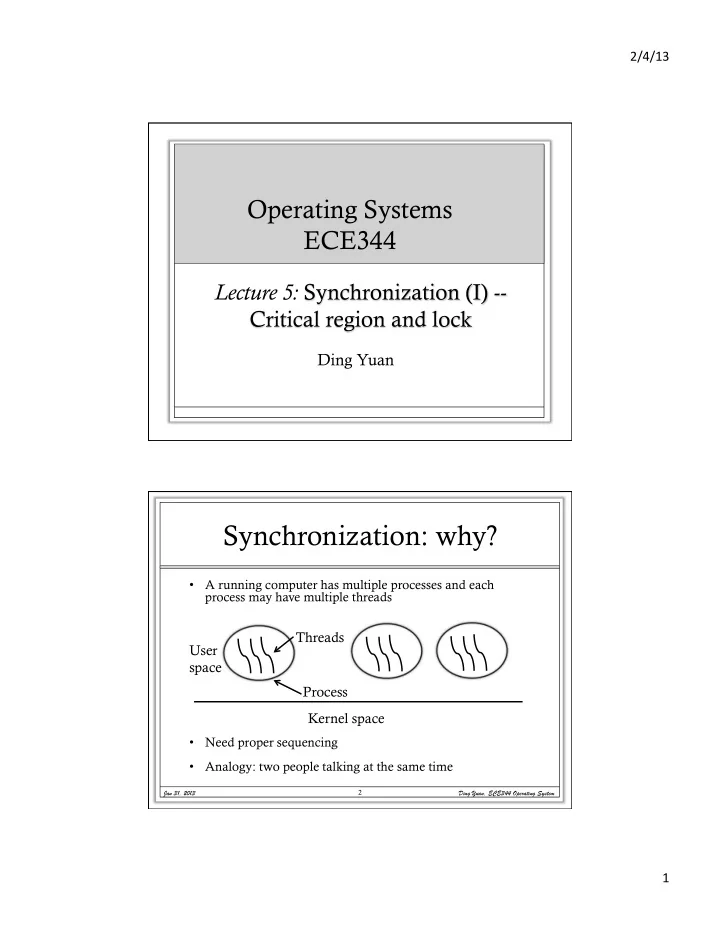
Synchronization: why?

  • A running computer has multiple processes and each

process may have multiple threads

  • Need proper sequencing
  • Analogy: two people talking at the same time

Threads Process User space Kernel space

slide-2
SLIDE 2

2/4/13 2

A simple game

  • Two volunteers to play two threads
  • Producer: produce 1 cookie bar per iteration
  • Step1: increment the counter on the board
  • Step2: put one cookie on the table
  • Consumer:
  • Step1: read the counter LOUD
  • Step2a: if the counter is zero, go back to step1
  • Step2b: if the counter is nonzero, take a cookie from the table
  • Step 3: decrement counter on the board
  • Rule: only one should “operate” at any time
  • You are the OS
  • You decide who should operate, who should freeze
  • Can you get them into “trouble” before the cookies run out?

Jan 31, 2013 Ding Yuan, ECE344 Operating System 3

A simple game (cont.)

  • Producer: produce 1 cookie per iteration
  • Step1: increment the counter on the board
  • Step2: put one cookie bar on the table
  • Consumer:
  • Step1: read the counter LOUD
  • Step2a: if the counter is zero, go back to step1
  • Step2b: if the counter is nonzero, take a cookie from the table
  • Step 3: decrement counter on the board

Jan 31, 2013 Ding Yuan, ECE344 Operating System 4

Switch to consumer, what will happen? Switch to producer, what will happen?

slide-3
SLIDE 3

2/4/13 3

Data races

  • Why are we having this problem?
  • Reason:
  • concurrency
  • data sharing
  • What are shared in this game?
  • Share the counter
  • Share the cookie

Jan 31, 2013 Ding Yuan, ECE344 Operating System 5

Shared Resources

  • The problem is that two concurrent threads (or

processes) accessed a shared resource without any synchronization

  • Known as a race condition (memorize this buzzword)
  • We need mechanisms to control access to these shared

resources in the face of concurrency

  • So we can reason about how the program will operate
  • Shared data structure
  • Buffers, queues, lists, hash tables, etc.

Jan 31, 2013 Ding Yuan, ECE344 Operating System 6

slide-4
SLIDE 4

2/4/13 4

Can you give me some real world examples

  • What are shared in real world and require some

synchronization?

Jan 31, 2013 Ding Yuan, ECE344 Operating System 7

When are resources shared?

Jan 31, 2013 Ding Yuan, ECE344 Operating System 8

  • Local variables are not shared (private)
  • Stored on the stack
  • Each thread has its own stack
  • Never pass/share/store a pointer to a local variable on the

stack for thread T1 to another thread T2

  • Global variables and static objects are shared
  • Stored in the static data segment, accessible by any thread
  • Dynamic objects and other heap objects are shared
  • Allocated from heap with malloc/free or new/delete
  • Accesses to shared data need to be synchronized
slide-5
SLIDE 5

2/4/13 5

Why synchronize?

  • Interleaving by an access from another thread to the same

shared data between two subsequent accesses can result in errors

Jan 31, 2013 Ding Yuan, ECE344 Operating System 9

Analogy

  • Synchronization is like traffic signals
  • Each thread is like a car----it can make progress

independently with its own speed

  • Road or intersection is the shared resource
  • http://www.youtube.com/watch?v=nocS1Z4gcDU

Jan 31, 2013 Ding Yuan, ECE344 Operating System 10

slide-6
SLIDE 6

2/4/13 6

Jan 31, 2013 Ding Yuan, ECE344 Operating System 11

Classic Example

  • Suppose we have to implement a function to handle

withdrawals from a bank account:

withdraw (account, amount) { balance = get_balance(account); balance = balance – amount; put_balance(account, balance); return balance; }

  • Now suppose that you and your significant other share a

bank account with a balance of $1000.

  • Then you each go to separate ATM machines and

simultaneously withdraw $100 from the account.

Jan 31, 2013 Ding Yuan, ECE344 Operating System 12

Example Continued

  • We’ll represent the situation by creating a separate thread for

each person to do the withdrawals

  • These threads run on the same bank machine:
  • What’s the problem with this implementation?
  • Think about potential schedules of these two threads

withdraw (account, amount) { balance = get_balance(account); balance = balance – amount; put_balance(account, balance); return balance; } withdraw (account, amount) { balance = get_balance(account); balance = balance – amount; put_balance(account, balance); return balance; }

slide-7
SLIDE 7

2/4/13 7

Jan 31, 2013 Ding Yuan, ECE344 Operating System 13

Interleaved Schedules

  • The problem is that the execution of the two threads can be

interleaved:

  • What is the balance of the account now?
  • Is the bank happy with our implementation?
  • What if this is not withdraw, but deposit?

balance = get_balance(account); balance = balance – amount; balance = get_balance(account); balance = balance – amount; put_balance(account, balance); put_balance(account, balance); Execution sequence seen by CPU Context switch

Jan 31, 2013 Ding Yuan, ECE344 Operating System 14

How Interleaved Can It Get?

............... get_balance(account); put_balance(account, balance); put_balance(account, balance); balance = balance – amount; balance = balance – amount; balance = get_balance(account); balance = ...................................

How contorted can the interleavings be?

  • We'll assume that the only atomic operations are reads

and writes of words

  • Some architectures don't even give you that!
  • We'll assume that a context

switch can occur at any time

  • We'll assume that you can

delay a thread as long as you like as long as it's not delayed forever

slide-8
SLIDE 8

2/4/13 8

Jan 31, 2013 Ding Yuan, ECE344 Operating System 15

Mutual Exclusion

  • We want to use mutual exclusion to synchronize access

to shared resources

  • This allows us to have larger atomic blocks
  • Code that uses mutual exclusion to synchronize its

execution is called a critical region (or critical section)

  • Only one thread at a time can execute in the critical region
  • All other threads are forced to wait on entry
  • When a thread leaves a critical region, another can enter
  • Example: sharing your bathroom with housemates

Critical Region (Critical Section)

Jan 31, 2013 Ding Yuan, ECE344 Operating System 16

  • What requirements would you place on a critical section?
slide-9
SLIDE 9

2/4/13 9

Jan 31, 2013 Ding Yuan, ECE344 Operating System 17

Critical Region Requirements (apply to both thread and process)

1) Mutual exclusion (mutex)

  • No other thread must execute within the critical region while a thread is

in it 2) Progress

  • A thread in the critical region will eventually leave the critical region
  • If some thread T is not in the critical region, then T cannot prevent some other

thread S from entering the critical region

3) Bounded waiting (no starvation)

  • If some thread T is waiting on the critical region, then T should only have wait

for a bounded number of other threads to enter and leave the critical region

4) No assumption

  • No assumption may be made about the speed or number of CPUs

Critical Region Illustrated

Jan 31, 2013 Ding Yuan, ECE344 Operating System 18

slide-10
SLIDE 10

2/4/13 10

Jan 31, 2013 Ding Yuan, ECE344 Operating System 19

Mechanisms For Building Critical Sections

  • Atomic read/write
  • Can it be done?
  • Locks
  • Primitive, minimal semantics, used to build others
  • Semaphores
  • Basic, easy to get the hang of, but hard to program with
  • Monitors
  • High-level, requires language support, operations implicit
  • Messages
  • Simple model of communication and synchronization based on atomic

transfer of data across a channel

  • Direct application to distributed systems
  • Messages for synchronization are straightforward (once we see how the others

work)

Jan 31, 2013 Ding Yuan, ECE344 Operating System 20

Mutual Exclusion with Atomic Read/Writes: First Try

while (true) { while (turn != 1) ; critical region turn = 2;

  • utside of critical region

} while (true) { while (turn != 2) ; critical region turn = 1;

  • utside of critical region

} int turn = 1; This is called alternation It satisfies mutex:

  • If blue is in the critical region, then turn == 1 and if yellow is in the critical

region then turn == 2 (why?)

  • (turn == 1) ≡ (turn != 2)

It violates progress: the thread could go into an infinite loop outside of the critical section, which will prevent the yellow one from entering. Easy to use? (what if more than 2 threads? what if we don’t know how many threads?)

slide-11
SLIDE 11

2/4/13 11

Jan 31, 2013 Ding Yuan, ECE344 Operating System 21

Locks

  • A lock is an object in memory providing two operations
  • acquire(): before entering the critical region
  • release(): after leaving a critical region
  • Threads pair calls to acquire() and release()
  • Between acquire()/release(), the thread holds the lock
  • acquire() does not return until any previous holder releases
  • What can happen if the calls are not paired?
  • Locks can spin (a spinlock) or block (a mutex)

Jan 31, 2013 Ding Yuan, ECE344 Operating System 22

Using Locks

  • What happens when blue tries to acquire the lock?
  • Why is the “return” outside the critical region? Is this OK?
  • What happens when a third thread calls acquire?

withdraw (account, amount) { acquire(lock); balance = get_balance(account); balance = balance – amount; put_balance(account, balance); release(lock); return balance; } acquire(lock); balance = get_balance(account); balance = balance – amount; balance = get_balance(account); balance = balance – amount; put_balance(account, balance); release(lock); acquire(lock); put_balance(account, balance); release(lock); Critical Region

slide-12
SLIDE 12

2/4/13 12

Jan 31, 2013 Ding Yuan, ECE344 Operating System 23

  • How do we implement locks? Here is one attempt:
  • This is called a spinlock because a thread spins waiting for the lock

to be released

  • Does this work?

Implementing Locks (1)

struct lock { int held = 0; } void acquire (lock) { while (lock->held); lock->held = 1; } void release (lock) { lock->held = 0; } busy-wait (spin-wait) for lock to be released

Jan 31, 2013 Ding Yuan, ECE344 Operating System 24

Implementing Locks (2)

  • No. Two independent threads may both notice that

a lock has been released and thereby acquire it.

struct lock { int held = 0; } void acquire (lock) { while (lock->held); lock->held = 1; } void release (lock) { lock->held = 0; } A context switch can occur here, causing a race condition

slide-13
SLIDE 13

2/4/13 13

Jan 31, 2013 Ding Yuan, ECE344 Operating System 25

Implementing Locks (3)

  • The problem is that the implementation of locks has critical

sections, too

  • How do we stop the recursion?
  • The implementation of acquire/release must be atomic
  • An atomic operation is one which executes as though it could not

be interrupted

  • Code that executes “all or nothing”
  • How do we make them atomic?
  • Need help from hardware
  • Atomic instructions (e.g., test-and-set)
  • Disable/enable interrupts (prevents context switches)

Jan 31, 2013 Ding Yuan, ECE344 Operating System 26

Atomic Instructions: Test-And-Set

  • The semantics of test-and-set are:
  • Record the old value
  • Set the value to TRUE
  • Return the old value
  • Hardware executes it atomically!
  • When executing test-and-set on “flag”
  • What is value of flag afterwards if it was initially False? True?
  • What is the return result if flag was initially False? True?

bool test_and_set (bool *flag) { bool old = *flag; *flag = True; return old; }

slide-14
SLIDE 14

2/4/13 14

Jan 31, 2013 Ding Yuan, ECE344 Operating System 27

Using Test-And-Set

  • Here is our lock implementation with test-and-set:
  • When will the while return? What is the value of held?
  • Does it work? What about multiprocessors?

struct lock { int held = 0; } void acquire (lock) { while (test-and-set(&lock->held)); } void release (lock) { lock->held = 0; }

Jan 31, 2013 Ding Yuan, ECE344 Operating System 28

Problems with Spinlocks

  • The problem with spinlocks is that they are wasteful
  • If a thread is spinning on a lock, then the thread holding the

lock cannot make progress

  • Solution 1:
  • If cannot get the lock, call thread_yield to give up the CPU
  • Solution 2: sleep and wakeup
  • When blocked, go to sleep
  • Wakeup when it is OK to retry entering the critical region
slide-15
SLIDE 15

2/4/13 15

Jan 31, 2013 Ding Yuan, ECE344 Operating System 29

Disabling Interrupts

  • Another implementation of acquire/release is to disable

interrupts:

  • Note that there is no state associated with the lock
  • Can two threads disable interrupts simultaneously?

struct lock { } void acquire (lock) { disable interrupts; } void release (lock) { enable interrupts; }

Jan 31, 2013 Ding Yuan, ECE344 Operating System 30

On Disabling Interrupts

  • Disabling interrupts blocks notification of external events

that could trigger a context switch (e.g., timer)

  • This is what OS161 uses as its primitive
  • In a “real” system, this is only available to the kernel
  • Why?
  • Disabling interrupts is insufficient on a multiprocessor
  • Back to atomic instructions
slide-16
SLIDE 16

2/4/13 16

Critical regions without hardware support?

  • So far, we have seen how to implement critical regions

(lock) with hardware support

  • Atomic instruction
  • Disabling interrupt
  • Can we implement lock without HW support?
  • Software only solution?
  • Yes, but…
  • Complicated (easy to make mistake)
  • Poor performance
  • Production OSes use hardware support

Jan 31, 2013 Ding Yuan, ECE344 Operating System 31 Jan 31, 2013 Ding Yuan, ECE344 Operating System 32

Mutex without hardware support: Peterson's Algorithm

while (true) { try1 = true; turn = 2; while (try2 && turn != 1) ; critical section try1 = false;

  • utside of critical section

} while (true) { try2 = true; turn = 1; while (try1 && turn != 2) ; critical section try2 = false;

  • utside of critical section

} int turn = 1; bool try1 = false, try2 = false;

  • Does it work?
  • Yes!
  • Try all possible interleavings

Has thread 2 executed “try2=true?”. If not, I am safe. If yes, let’s see… Did I execute “turn=2” before thread 2 executed “turn=1”?

slide-17
SLIDE 17

2/4/13 17

Jan 31, 2013 Ding Yuan, ECE344 Operating System 33

Summarize Where We Are

  • Goal: Use mutual exclusion to protect critical sections of

code that access shared resources

  • Method: Use locks (spinlocks or disable interrupts)
  • Problem: Critical sections can be long

acquire(lock) … Critical section … release(lock) Disabling Interrupts:

 Should not disable interrupts

for long periods of time

 Can miss or delay important

events (e.g., timer, I/O) Spinlocks:

 Threads waiting to acquire

lock spin in test-and-set loop

 Wastes CPU cycles  Longer the CS, the longer

the spin

 Greater the chance for lock

holder to be interrupted

If you only remember one thing from this lecture…

  • When you have concurrency & shared resources,

protect your critical region with synchronization primitives (e.g., locks, semaphore (next

lecture), etc.)

  • You don’t want to go to that crazy intersection in Russia.

Jan 31, 2013 Ding Yuan, ECE344 Operating System 34