Synchronization: Recap Why? Example The Critical Section Problem - - PDF document

synchronization recap
SMART_READER_LITE
LIVE PREVIEW

Synchronization: Recap Why? Example The Critical Section Problem - - PDF document

CPSC-410/611 Operating Systems Process Synchronization: Recap Synchronization: Recap Why? Example The Critical Section Problem (recap!) Hardware Support for Synchronization Lock-free operations Semaphores Monitors


slide-1
SLIDE 1

CPSC-410/611 Operating Systems Process Synchronization: Recap 1

Synchronization: Recap

  • Why?

– Example

  • The Critical Section Problem (recap!)
  • Hardware Support for Synchronization
  • Lock-free operations
  • Semaphores
  • Monitors
  • Reading: Doeppner, Ch. 2.2.3

prev prev prev prev prev prev prev prev prev prev prev prev prev prev prev

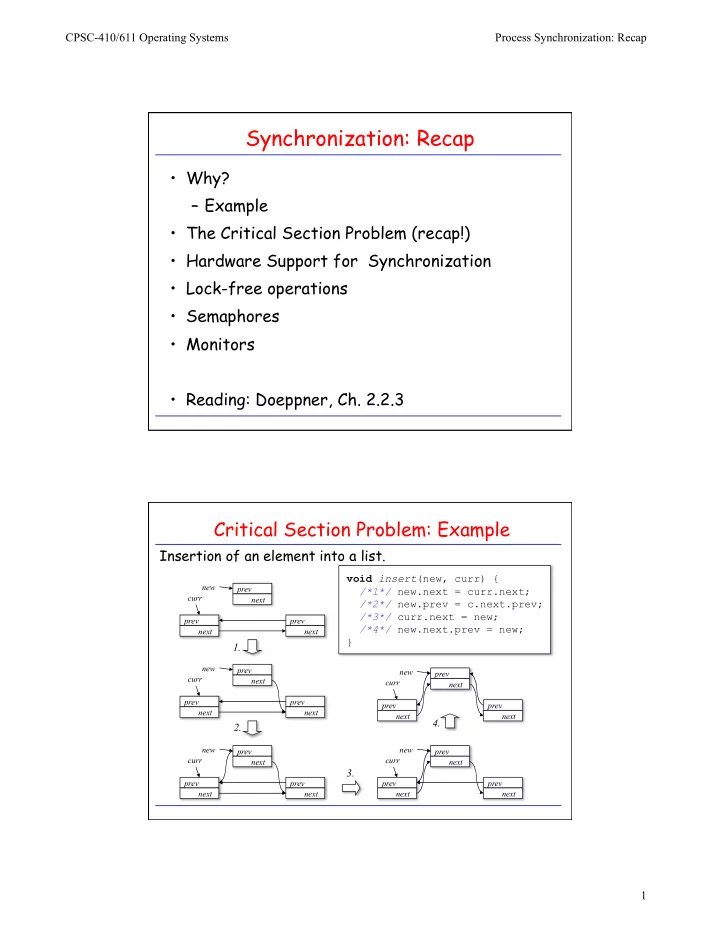
Critical Section Problem: Example

Insertion of an element into a list.

void insert(new, curr) { /*1*/ new.next = curr.next; /*2*/ new.prev = c.next.prev; /*3*/ curr.next = new; /*4*/ new.next.prev = new; }

next next next new curr next next next new curr next next next new curr next next next new curr next next next new curr

1. 2. 3. 4.

slide-2
SLIDE 2

CPSC-410/611 Operating Systems Process Synchronization: Recap 2

Interleaved Execution causes Errors!

new1.next = curr.next; new1.prev = c.next.prev; … … … … curr.next = new1; new1.next.prev = new1; Process 1 … … new2.next = curr.next; new2.prev = c.next.prev; curr.next = new2; new2.next.prev = new2; … … Process 2

prev prev prev next next next new1 curr prev next new2

  • Must guarantee mutually exclusive access to list data structure!

The Critical Section Problem

  • Execution of critical section by processes must be mutually

exclusive.

  • Typically due to manipulation of shared variables.
  • Need protocol to enforce mutual exclusion.

while (TRUE) { enter section; critical section; exit section; remainder section; }

slide-3
SLIDE 3

CPSC-410/611 Operating Systems Process Synchronization: Recap 3

Criteria for a Solution of the C.S. Problem

  • 1. Only one process at a time can enter the critical section.
  • 2. A process that halts in non-critical section cannot prevent other

processes from entering the critical section.

  • 3. A process requesting to enter a critical section should not be

delayed indefinitely.

  • 4. When no process is in a critical section, any process that

requests to enter the critical section should be permitted to enter without delay.

  • 5. Make no assumptions about the relative speed of processors (or

their number).

  • 6. A process remains within a critical section for a finite time only.

A (Wrong) Solution to the C.S. Problem

  • Two processes P0 and P1
  • int turn; /* turn == i : Pi is allowed to enter c.s. */

Pi: while (TRUE) { while (turn != i) no_op; critical section; turn = j; remainder section; }

slide-4
SLIDE 4

CPSC-410/611 Operating Systems Process Synchronization: Recap 4

Another Wrong Solution

bool flag[2]; /* initialize to FALSE */ /* flag[i] == TRUE : Pi intends to enter c.s.*/

Pi: while (TRUE) {

while (flag[j]) no_op; flag[i] = TRUE; critical section; flag[i] = FALSE; remainder section; }

Yet Another Wrong Solution

bool flag[2]; /* initialize to FALSE */ /* flag[i] == TRUE : Pi intends to enter c.s.*/ while (TRUE) { flag[i] = TRUE; while (flag[j]) no_op; critical section; flag[i] = FALSE; remainder section; }

slide-5
SLIDE 5

CPSC-410/611 Operating Systems Process Synchronization: Recap 5

A Combined Solution (Petersen)

int turn; bool flag[2]; /* initialize to FALSE */

while (TRUE) { flag[i] = TRUE; turn = j; while (flag[j]) && (turn == j) no_op; critical section; flag[i] = FALSE; remainder section; }

Hardware Support For Synchronization

  • Disallow interrupts

– simplicity – widely used – problem: interrupt service latency – problem: what about multiprocessors?

  • Atomic operations:

– Operations that check and modify memory areas in a single step (i.e. operation can not be interrupted) – Test-And-Set – Fetch-And-Add – Exchange, Swap, Compare-And-Swap – Load-Link/Store Conditional

slide-6
SLIDE 6

CPSC-410/611 Operating Systems Process Synchronization: Recap 6

Hardware Support: Test-And-Set

bool TestAndSet(bool & var) { bool temp; temp = var; var = TRUE; return temp; } bool lock; /* init to FALSE */ while (TRUE) { while (TestAndSet(lock)) no_op; critical section; lock = FALSE; remainder section; }

atomic! Mutual Exclusion with Test-And-Set

Hardware Support: Exchange (Swap)

void Exchange(bool & a, bool & b){ bool temp; temp = a; a = b; b = temp; }

bool lock; /*init to FALSE */ while (TRUE) { dummy = TRUE; do Exchange(lock, dummy); while(dummy); critical section; lock = FALSE; remainder section; }

atomic! Mutual Exclusion with

Exchange

slide-7
SLIDE 7

CPSC-410/611 Operating Systems Process Synchronization: Recap 7

Hardware Support: Fetch & Add

function FetchAndAdd(&location) { int value = location; location = value + 1; return value; } record locktype { int ticketnumber; int turn; } procedure LockInit( locktype * lock ) { lock.ticketnumber = 0; lock.turn = 0; } procedure Lock( locktype * lock ) { int myturn = FetchAndAdd( &lock.ticketnumber ); while (lock.turn != myturn) skip; // spin until lock is acquired } procedure UnLock( locktype* lock { FetchAndAdd( &lock.turn ) }

Hardware Support: Compare-And-Swap

bool Compare&Swap(Type * x, Type old, Type new) { if *x == old { *x = new; return TRUE; } else { return FALSE } }

atomic!

bool lock; /*init to FALSE */ while (TRUE) { while(!C&S(&lock, false, true)); critical section; lock = FALSE; remainder section; }

slide-8
SLIDE 8

CPSC-410/611 Operating Systems Process Synchronization: Recap 8

Compare-and-Swap: Example Lock-Free Concurrent Data Structures

Example: Shared Stack PUSH element C onto stack:

A! B! head! 1. Create C! 2. C.next = head! 3. head = C! C!

Compare-and-Swap: Example Lock-Free Concurrent Data Structures

Example: Shared Stack PUSH element C onto stack: What can go wrong?!

A! B! head! 1. Create C! 2. C.next = head! 3. head = C! C! 1. Create C’! 2. C’.next = head! 3. head = C’!

context switch!! context switch back!!

C’! Solution: compare-and-swap(head, C.next, C),! i.e. compare and swap head, new value C, and expected value C.next.! If fails, go back to step 2.!

slide-9
SLIDE 9

CPSC-410/611 Operating Systems Process Synchronization: Recap 9

Compare-and-Swap: Example Lock-Free Concurrent Data Structures

Example: Shared Stack Push Operation: void push(sometype t) {

Node* node = new Node(t); do { node->next = head; } while (!C&S(&head, node->next, node)); }

Compare-and-Swap: Example Lock-Free Concurrent Data Structures

Example: Shared Stack Pop Operation: bool pop(sometype & t) {

Node* current = head; while(current) { if(C&S(&head, current, current->next)) { t = current->data; return true; } current = head; } return false; }

slide-10
SLIDE 10

CPSC-410/611 Operating Systems Process Synchronization: Recap 10

Compare-And-Swap is “weak”: LL/SC

  • CSW does not detect updates if old value has been restored! (so-

called ABA problem)

  • Solution: “strong” pair of instructions:

– load-link (LL): returns current value of memory location – subsequent store-conditional (SC) stores a new value

  • only if no updates of memory location since LL
  • otherwise SC fails
  • Supported on MIPS, PowerPC, Alpha, ARM
  • Implementation of LL/SC are often not perfect, e.g.:

– any exception between LL/SC may cause SC to fail – any updates over memory bus may cause SC to fail

Semaphores

  • Problems with solutions above:

– Although requirements simple (mutual exclusion), addition to programs complex. – Based on busy waiting.

  • A Semaphore variable has two operations:

– V(Semaphore * s); /* Increment value of s by 1 in a single indivisible action. If value is not positive, then a process blocked by a P is unblocked*/ – P(Semaphore * s); /* Decrement value of s by 1. If the value becomes negative, the process invoking the P operation is blocked. */

  • Binary semaphore: The value of s can be either 1 or 0 (TRUE or

FALSE).

  • General semaphore: The value of s can be any integer.
slide-11
SLIDE 11

CPSC-410/611 Operating Systems Process Synchronization: Recap 11

Effect of Semaphores

  • Mutual exclusion with

semaphores:

V(s) P(s) V(s) P(s) s.value = 0

BinSemaphore * s; /* init to TRUE*/ while (TRUE) { P(s); critical section; V(s); remainder section; }

  • Gen

eneral Synchronization using semaphores:!

Implementation (with busy waiting)

  • Binary Semaphores:

P(BinSemaphore * s) { key = FALSE; do exchange(s.value, key); while (key == FALSE); } V(BinSemaphore * s) { s.value = TRUE; }

  • General Semaphores:!

BinSemaphore * mutex /*TRUE*/ BinSemaphore * delay /*FALSE*/ P(Semaphore * s) { P(mutex); s.value = s.value - 1; if (s.value < 0) { V(mutex); P(delay); } else V(mutex); } V(Semaphore * s) { P(mutex); s.value = s.value + 1; if (s.value <= 0) V(delay); V(mutex); }

slide-12
SLIDE 12

CPSC-410/611 Operating Systems Process Synchronization: Recap 12

Implementation (“without” busy waiting)

P(Semaphore * s) { while (TestAndSet(lock)) no_op; s.value = s.value - 1; if (s.value < 0) { append(this_process, s.L); lock = FALSE; sleep(); } lock = FALSE; } Semaphore

bool lock; /* init to FALSE */ int value; PCBList * L;

blocked processes

V(Semaphore * s) { while (TestAndSet(lock)) no_op; s.value = s.value + 1; if (s.value <= 0) { PCB * p = remove(s.L); wakeup(p); } lock = FALSE; }

Classical Problems: Producer-Consumer

Producer:

while (TRUE) { produce item; P(mutex); deposit item; V(mutex); V(n); }

Consumer:

while (TRUE) { P(n); P(mutex); remove item; V(mutex); consume item; } Semaphore * n; /* initialized to 0 */ BinSemaphore * mutex; /* initialized to TRUE */

slide-13
SLIDE 13

CPSC-410/611 Operating Systems Process Synchronization: Recap 13

Classical Problems:

Producer-Consumer with Bounded Buffer

Producer:

while (TRUE) { produce item; P(empty); P(mutex); deposit item; V(mutex); V(full); }

Consumer:

while (TRUE) { P(full); P(mutex); remove item; V(mutex); V(empty); consume item; } Semaphore * full; /* initialized to 0 */ Semaphore * empty; /* initialized to n */ BinSemaphore * mutex; /* initialized to TRUE */

Classical Problems: Readers/Writers

Reader:

P(mutex); nreaders = nreaders + 1; if (nreaders == 1) P(wrt); V(mutex); do the reading .... P(mutex); nreaders = nreaders - 1; if (nreaders = 0) V(wrt); V(mutex); Semaphore * mutex, * wrt; /* initialized to 1 */ int nreaders; /* initialized to 0 */

Writer:

P(wrt); do the writing ... V(wrt);

  • Multiple readers can access data element concurrently.
  • Writers access data element exclusively.
slide-14
SLIDE 14

CPSC-410/611 Operating Systems Process Synchronization: Recap 14

Monitors (Hoare / Brinch Hansen, 1973)

  • Safe and effective sharing of abstract data types among several

processes.

  • Monitors can be modules, or objects.

– local variable accessible only through monitor’s procedures – process can entrer monitor only by invoking monitor procedure

  • Only one process can be active in monitor.
  • Additional synchronization through conditions (similar to

semaphores) Condition c; c.cwait() : suspend execution of calling process and enqueue it

  • n condition c. The monitor now is available for other

processes. c.csignal() : resume a process enqueued on c. If none is enqueued, do nothing. – cwait/csignal different from P/V: cwait always waits, csignal does nothing if nobody waits.

Structure of Monitor

initialization code local (shared) data procedure 1 procedure 2 procedure k ...

  • perations

blocked processes c1 cm

...

urgent queue

slide-15
SLIDE 15

CPSC-410/611 Operating Systems Process Synchronization: Recap 15

Example: Binary Semaphore

monitor BinSemaphore { bool locked; /* Initialize to FALSE */ condition idle; entry void P() { if (locked) idle.cwait(); locked = TRUE; } entry void V() { locked = FALSE; idle.csignal(); } }

Example: Bounded Buffer Producer/Consumer

void deposit(Item x) { if (count == N) notfull.cwait(); buffer[nextin] = x; nextin = nextin + 1 mod N; count = count + 1; notempty.csignal(); }

void remove(Item & x) { if (count == 0) notempty.cwait(); x = buffer[nextout]; nextout = nextout + 1 mod N; count = count - 1; notfull.csignal(); } monitor boundedbuffer { Item buffer[N]; /* buffer has N items */ int nextin; /* init to 0 */ int nextout; /* init to 0 */ int count; /* init to 0 */ condition notfull; /* for synchronization */ condition notempty;

slide-16
SLIDE 16

CPSC-410/611 Operating Systems Process Synchronization: Recap 16

Incorrect Implementation of Readers/Writers

monitor ReaderWriter{ int numberOfReaders = 0; int numberOfWriters = 0; boolean busy = FALSE; /* READERS */ procedure startRead() { while (numberOfWriters != 0); numberOfReaders = numberOfReaders + 1; } procedure finishRead() { numberOfReaders = numberOfReaders - 1; } /* WRITERS */ procedure startWrite() { numberOfWriters = numberOfWriters + 1; while (busy || (numberOfReaders > 0)); busy = TRUE; }; procedure finishWrite() { numberOfWriters = numberOfWriters - 1; busy = FALSE; }; };

A Correct Implementation

monitor ReaderWriter{ int numberOfReaders = 0; int numberOfWriters = 0; boolean busy = FALSE; condition okToRead, okToWrite; /* READERS */ procedure startRead() { if (busy || (okToWrite.lqueue)) okToRead.wait; numberOfReaders = numberOfReaders + 1;

  • kToRead.signal;

} procedure finishRead() { numberOfReaders = numberOfReaders - 1; if (numberOfReaders = 0) okToWrite.signal; } /* WRITERS */ procedure startWrite() { if (busy || (numberOfReaders > 0)) okToWrite.wait; busy = TRUE; }; procedure finishWrite() { busy = FALSE; if (okToWrite.lqueue) okToWrite.signal; else okToRead.signal; }; };

slide-17
SLIDE 17

CPSC-410/611 Operating Systems Process Synchronization: Recap 17

Synchronization in JAVA

  • Critical sections:

– synchronized statement

  • Synchronized methods:

– Only one thread can be in any synchronized method of an

  • bject at any given time.

– Realized by having a single lock (also called monitor) per

  • bject.
  • Synchronized static methods:

– One lock per class.

  • Synchronized blocks:

– Finer granularity possible using synchronized blocks – Can use lock of any object to define critical section.

  • Additional synchronization:

– wait(), notify(), notifyAll() – Realized as methods for all objects

public class BoundedBuffer { Object[] buffer; int nextin, nextout; Object notfull, notempty; int size; int count; synchronized public deposit(Object x){ if (count == size) notfull.wait(); buffer[nextin] = x; nextin = (nextin+1) mod size; count = count + 1; notempty.notify(); }

Java Synchronized Methods: vanilla Bounded Buffer Producer/Consumer

synchronized public Object remove() { Object x; if (count == 0) notempty.wait(); x = buffer[nextout]; nextout = (nextout+1) mod size; count = count - 1; notfull.notify(); return x; } public BoundedBuffer(int n) { size = n; buffer = new Object[size]; nextin = 0; nextout = 0; count = 0; }

slide-18
SLIDE 18

CPSC-410/611 Operating Systems Process Synchronization: Recap 18

Example: Synchronized Block

(D. Flanagan, JAVA in a Nutshell) public static void SortIntArray(int[] a) { // Sort array a. This is synchronized so that // some other thread cannot change elements of // the array or traverse the array while we are // sorting it. // At least no other thread that protect their // accesses to the array with synchronized. // do some non-critical stuff here... synchronized (a) { // do the array sort here. } // do some other non-critical stuff here... }