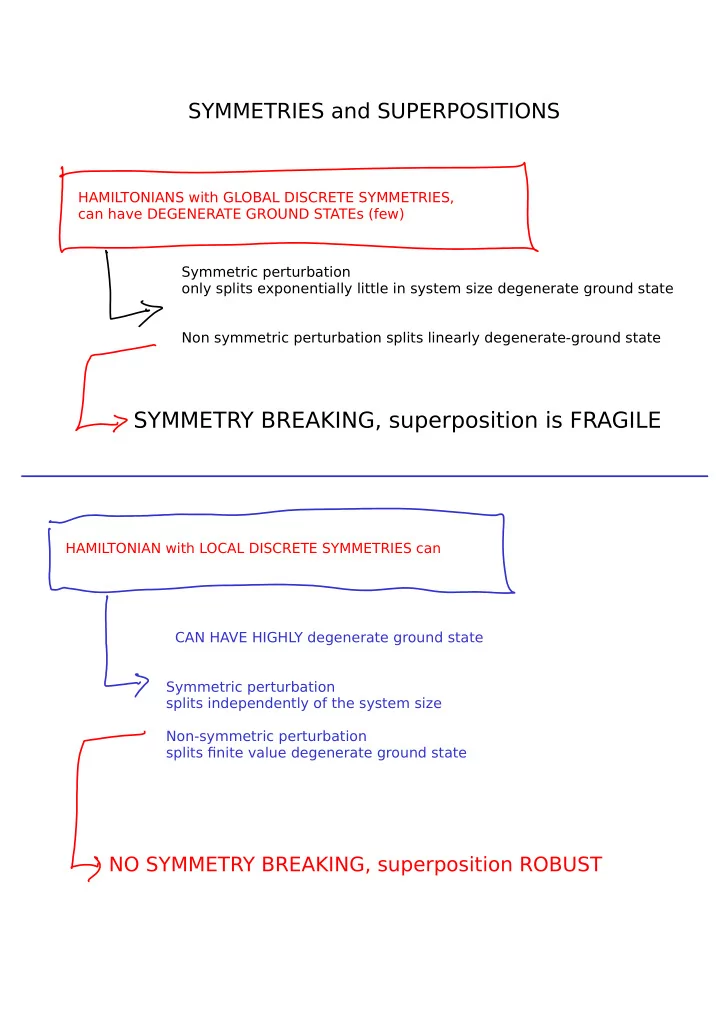
SLIDE 1 SYMMETRIES and SUPERPOSITIONS
HAMILTONIANS with GLOBAL DISCRETE SYMMETRIES, can have DEGENERATE GROUND STATEs (few) Symmetric perturbation
- nly splits exponentially little in system size degenerate ground state
Non symmetric perturbation splits linearly degenerate-ground state CAN HAVE HIGHLY degenerate ground state Symmetric perturbation splits independently of the system size Non-symmetric perturbation splits nite value degenerate ground state
NO SYMMETRY BREAKING, superposition ROBUST
HAMILTONIAN with LOCAL DISCRETE SYMMETRIES can
SYMMETRY BREAKING, superposition is FRAGILE
SLIDE 2
ON SPONTANEOUS SYMMETRY BREAKING Has two eigenvectors The same eigenvectors are selected by using Producing the same eect 1) 2)
SLIDE 3
HOW STABLE is the SUPERPOSTION WITH respect to a small perturbation? Notice that If we work at nite the gap is We dene the magnetization as what state do we use? Unique ground state
SLIDE 4
But we are interested in the thermodynamic limit, Even if for small L the gap is closing exponentially and we need for large enough L to use again the degenerate Perturbation theory Now the degeneracy get lifted as We compute M on the appropriate ground state We have a FINITE MAGNETIZATION
SPONTANEOUS SYMMETRY BREAKING
GAUGE THEORY, LOCAL SYMMETRY
SLIDE 5
Now we see that H has a huge degeneracy There are several operators (LOCAL) that commute with H We can add these operators to the Hamiltonian The ground state becomes the uniform superpostion of the degenerate ground states
SLIDE 6
Rather than putting the symmetry operators we could have added a transverse edl T The ground state is the same than above IMPORTANT OBSERVATION LOCAL SYMMETRY GLOBAL SYMMETRY Now dierently from the globally symmetric case the splitting does not depend on the size
SLIDE 7
In order to address the stability of the superposition and Since the ground state is symmetric
NO SYMMETRY BREAKING