Syllabus Summary provided Appendiceal GCC and LAMN Complete - - PowerPoint PPT Presentation

syllabus
SMART_READER_LITE
LIVE PREVIEW

Syllabus Summary provided Appendiceal GCC and LAMN Complete - - PowerPoint PPT Presentation

2016 Current Issues in Surgical Pathology Syllabus Summary provided Appendiceal GCC and LAMN Complete presentation Navigating the Alphabet Soup in the Appendix sanjay.kakar@ucsf.edu Sanjay Kakar, MD University of California, San


slide-1
SLIDE 1

1

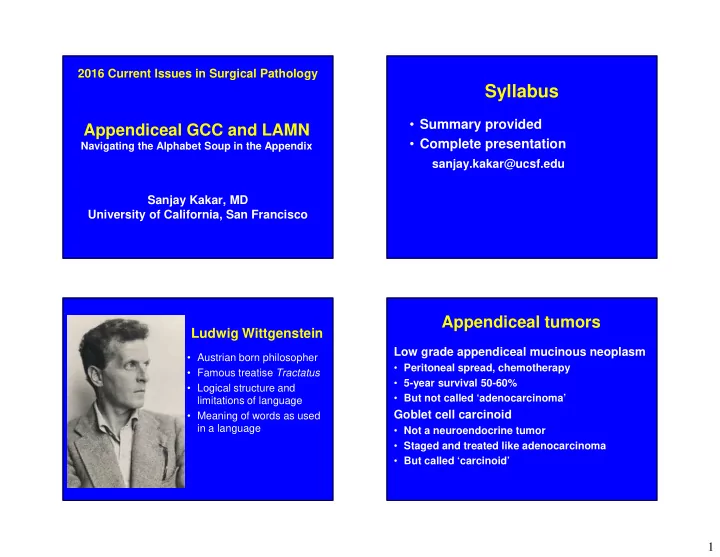
Appendiceal GCC and LAMN

Navigating the Alphabet Soup in the Appendix

Sanjay Kakar, MD University of California, San Francisco 2016 Current Issues in Surgical Pathology

Syllabus

  • Summary provided
  • Complete presentation

sanjay.kakar@ucsf.edu

Ludwig Wittgenstein

  • Austrian born philosopher
  • Famous treatise Tractatus
  • Logical structure and

limitations of language

  • Meaning of words as used

in a language

Appendiceal tumors

Low grade appendiceal mucinous neoplasm

  • Peritoneal spread, chemotherapy
  • 5-year survival 50-60%
  • But not called ‘adenocarcinoma’

Goblet cell carcinoid

  • Not a neuroendocrine tumor
  • Staged and treated like adenocarcinoma
  • But called ‘carcinoid’
slide-2
SLIDE 2

2

Outline

  • Appendiceal LAMN
  • Peritoneal involvement by mucinous

neoplasms

  • Goblet cell carcinoid
  • Terminology
  • Grading and staging
  • Important elements for reporting

LAMN

WHO 2010: Low grade carcinoma

  • Low grade
  • ‘Pushing invasion’

LAMN vs. adenoma

LAMN Appendiceal adenoma

Low grade cytologic atypia Low grade cytologic atypia At minimum, muscularis mucosa is obliterated Muscularis mucosa is intact Can extend through the wall Confined to lumen

Appendiceal adenoma: intact muscularis mucosa

slide-3
SLIDE 3

3

LAMN: Pushing invasion, obliteration of m mucosa

LAMN vs. adenoma

  • Intactness of muscularis mucosa
  • No mucin (cellular or acellular) in

the appendiceal wall

  • In borderline cases, go with

LAMN

LAMN vs adenocarcinoma

LAMN Mucinous adenocarcinoma Low grade High grade Pushing invasion

  • No desmoplasia or

destructive invasion Destructive invasion

  • Complex growth pattern
  • Angulated infiltrative glands
  • r single cells
  • Desmoplasia
  • Tumor cells floating in mucin

WHO 2010 Davison, Mod Pathol 2014 Carr, AJSP 2016

Complex growth pattern

slide-4
SLIDE 4

4 Complex growth pattern

Angulated infiltrative glands, desmoplasia

Tumor cells in extracellular mucin Few floating cells common in LAMN

slide-5
SLIDE 5

5 Few floating cells common in LAMN

Implications of diagnosis

LAMN Mucinous adenocarcinoma

LN metastasis Rare Common Hematogenous spread Rare Can occur Peritoneal metastasis Common Common Treatment Follow-up imaging

  • Rt hemicolectomy
  • Systemic chemo if

needed

Grade

  • By definition, LAMN is low grade
  • Focal or diffuse high grade changes

in tumors which architecturally resemble LAMN

  • No destructive invasion or desmoplasia

High grade appendiceal mucinous neoplasm (HAMN)

  • HAMN is not part of WHO 2010

classification

  • Included: AJCC 8th edition

CAP protocol (2017 version)

Carr, AJSP 2016: Peritoneal Surface Oncology Group International (PSOGI)

slide-6
SLIDE 6

6

HAMN: rare tumor

  • Architecture like LAMN, no destructive

invasion or desmoplasia

  • Focal or diffuse high grade cytologic

atypia

High grade features: cribriform growth pattern HAMN: high grade features, no destructive invasion

LAMN: staging

  • WHO 2010: Low grade carcinoma
  • AJCC and CAP:

LAMN should be staged

slide-7
SLIDE 7

7

LAMN: staging challenges

  • Erroneous interpretation as mucinous

adenocarcinoma

  • T category is difficult to apply

Depth of cellular or acellular mucin Correlation of depth with outcome

LAMN: depth of invasion and recurrence

Study Confined to MP Acellular mucin beyond MP Cellular LAMN beyond MP

Umetsu/Kakar 2016 0/21 0/5 4/7 Higa 1973 0/7 4/7 Misdraji 2003 0/27 * 20/31 Pai 2009 0/16 1/14 21/27 Yantiss 2009

  • 1/44**

2/10

Total 0/64 2/70 (3%) 51/82 (62%)

LAMN staging: AJCC 8th edition

Category Change/update

Tis (LAMN) LAMN extending into muscularis propria, but not beyond it T1, T2 Not applicable to LAMN T3 Cellular LAMN into subserosa ?Acellular mucin into subserosa T4a Involvement of serosal surface Cellular LAMN or acellular mucin

LAMN: Acellular mucin on serosal surface

slide-8
SLIDE 8

8

LAMN: Acellular mucin as T4a

  • Based on limited data
  • Entire appendix was not submitted
  • Risk of overtreatment
  • Pathology report:

“Acellular mucin on serosal surface has a low

risk of recurrence, and categorization of this finding as T4a is based on limited data. Treatment

  • ptions should be evaluated in light of this

information.”

LAMN

Elements in pathology reporting

  • Submit the entire appendix
  • Extent of disease: both cellular and

acellular mucin (T category)

  • Margin assessment
  • Absence of high risk features:

No high grade cytology or complex growth No destructive invasion or desmoplasia

LAMN

Do not use obsolete terms

  • Mucocele
  • Mucinous cystadenoma

HAMN

Elements in pathology reporting

  • Extent of high grade changes
  • Use mucinous adenocarcinoma staging

scheme

  • Outcome may be similar to mucinous AC

AJCC, 8th Edition Misdraji, AJSP 2003

slide-9
SLIDE 9

9

Peritoneal involvement

  • Terminology
  • Grading
  • Treatment

Pseudomyxoma peritonei

  • Mucinous ascites
  • Omental cake
  • Mucin accumulation in peritoneum

due to involvement by mucinous neoplasm

Peritoneal involvement

Pseudomyxoma peritonei Low grade High grade

LAMN with peritoneal involvement, or Mucinous adenocarcinoma, low grade with peritoneal involvement Mucinous adenocarcinoma, high grade with peritoneal involvement Mucinous carcinoma peritonei, low grade Mucinous carcinoma peritonei, high grade Disseminated peritoneal adenomucinosis (DPAM) Peritoneal mucinous adenocarcinoma (PMAC)

Peritoneal involvement

Low grade

LAMN with peritoneal involvement Mucinous adenocarcinoma, low grade with peritoneal involvement Mucinous carcinoma peritonei, low grade Disseminated peritoneal adenomucinosis (DPAM)

Appendix shows LAMN

  • LAMN with peritoneal

involvement

  • Include synonyms in a

comment

Appendix: no LAMN or not known

  • Mucinous carcinoma

peritonei, low grade

  • Mucinous adenocarcinoma,

low grade

slide-10
SLIDE 10

10

Peritoneal involvement

High grade

Mucinous adenocarcinoma, high grade with peritoneal involvement Mucinous carcinoma peritonei, high grade Peritoneal mucinous adenocarcinoma (PMAC)

Primary sites

  • Appendix
  • Colorectum
  • Ovary
  • Pancreas

Grading of peritoneal disease

WHO 2010

2-tier scheme

  • Low grade
  • High grade

Criteria

  • Cytologic atypia
  • Architecture

High grade

  • Complex growth
  • Stratification
  • Loss of polarity
  • Prominent nucleoli
  • Frequent mitoses
  • Signet ring cells

Grading of peritoneal disease

WHO 2010 AJCC 7th edition/CAP

2-tier scheme

  • Low grade
  • High grade

3-tier scheme

  • Well-differentiated (G1)
  • Moderately differentiated (G2)
  • Poorly differentiated (G3)

Criteria

  • Cytologic atypia
  • Architecture

No defined criteria

  • Extent of gland formation not

applicable to mucinous tumors

slide-11
SLIDE 11

11

Study # of cases Grading scheme 5-year survival Ronnett (2001) 109 DPAM PMCA-I/D PMCA 75% 50% 14% Smeenk (2007) 103 DPAM PMCA-I PMCA 75% 42% 0% Guo (2012) 92 DPAM PMCA-I/D PMCA 80% 67% 50% Shetty (2013) 211 PMP1 PMP2 PMP3 86% 63% 32% Davison (2014) 151 G1 G2 G3 91% 61% 23% NCDB database 3105 Well differentiated Moderately differentiated Poorly differentiated 57% 32% 11%

Gestalt grading scheme

  • Looks good: G1
  • Looks bad: G3
  • All others: G2

AJCC 8th edition/CAP

(modified Davison scheme)

G1

  • Low grade cytologic atypia (similar to LAMN)
  • Includes acellular mucin
  • Cellularity <20%
  • No destructive invasion of implants

G2

  • Mix of low and high grade cytologic atypia, or

diffuse high grade cytologic atypia

  • Architectural complexity
  • Destructive invasion of implants
  • Cellularity >20%

G3

  • Signet ring cells infiltrating the stroma
  • Poorly differentiated adenocarcinoma component

Davison, Mod Pathol 2014

Challenges in grading

  • Invasive implants
  • Small or borderline G2

component

  • Discrepant grading in appendix

and peritoneum

  • Signet ring cells
slide-12
SLIDE 12

12

Challenges in grading

Invasive implants

  • Mucinous tumors on visceral organs

like liver, colon etc. not sufficient

  • Destructive invasion and

desmoplasia LAMN: Noninvasive ovarian implant LAMN: Noninvasive ovarian implant

Challenges in grading

Small or borderline G2 component

  • Significance unclear
  • Descriptive report stating that there

is a minor G2 component

slide-13
SLIDE 13

13

Challenges in grading

Discrepant grade in appendix and peritoneum

  • Uncommon
  • Higher grade peritoneal disease

generally drives prognosis

LAMN, T4a

Peritoneum: signet ring cell carcinoma Pseudo-signet ring cells

slide-14
SLIDE 14

14

Challenges in grading

Signet ring cell component

  • >10% cutoff has been suggested for G3

designation (not specified in AJCC)

  • Disregard cells in mucin resembling

signet ring cells

  • Consider only if infiltrating signet ring

cells in stroma

Sirintrapun, Hum Pathol 2014 Davison, Mod Pathol 2014

AJCC 8th: M categories

Category Definition

M1a Acellular mucin with disseminated peritoneal involvement M1b Peritoneal mucinous depositis containing tumor cells M1c Metastasis to sites other than peritoneum

Stage Definition

IVa Any T or N, M1a (acellular mucin) Any T or N, M1b (G1) IVb Any T or N, M1b (G2, G3) IVc Any T or N, M1c (Any G)

Grade: impact on treatment

Stage IVa M1a: acellular mucin M1b : G1 tumors Stage IVb M1b: G2, G3 tumors

Combined peritoneal surgery (tumor debulking) with HIPEC (hyperthermic intraperitoneal chemotherapy) Role of surgery and HIPEC controversial Systemic chemotherapy not useful Systemic chemotherapy

HIPEC: Hot chemotherapy leads to hot debate

Debate at ASCO meeting

  • ‘Heating drugs makes them more

effective’

  • ‘Precious little data that heated

chemotherapy does anything’

slide-15
SLIDE 15

15

LAMN Tis with peritoneal disease

  • LAMN confined to muscularis propria

(Tis) but with peritoneal disease

  • TisN0M1: does not make sense
  • Explanations:

Not entirely submitted Defect has ‘sealed’

  • Suggestion: pTxN0M1

Peritoneal involvement: summary

  • Use appropriate terminology
  • Include synonymous terms in report
  • Use 3-tier grading scheme (AJCC 8th edition)
  • Uncommon situations

Grade discrepancy: appendix and peritoneum Minor component of higher grade

Goblet cell carcinoid

  • Terminology
  • Grading and staging
  • Important elements for reporting

Diagnosis of GCC

  • Pure GCC
  • GCC with adenocarcinoma
  • GCC with well-differentiated

neuroendocrine tumor

slide-16
SLIDE 16

16

Goblet cell carcinoid

  • Primarily in appendix
  • Rare reports: colon, ampulla

Unique features

  • Recapitulates the crypts (crypt cell

adenocarcinoma)

  • Dual features

Exocrine: goblet cells, mucin Endocrine: NET-like areas, IHC, EM

Pure goblet cell carcinoid

Pure goblet cell carcinoid

  • Crypt-like clusters of

‘goblet cells’

  • No large irregular

clusters or sheets

  • Cytologic atypia mild
  • Mitoses rare
  • No desmoplasia or

destructive invasion Ki67, typically <20%, not necessary for diagnosis

slide-17
SLIDE 17

17

GCC: single filing in muscularis propria GCC: perineural and vascular invasion GCC: extracellular mucin pools GCC: small tubules with minimal atypia

slide-18
SLIDE 18

18

GCC with adenocarcinoma

Adenocarcinoma component

  • GCC-like but with higher cytologic and

architectural atypia

  • Adenocarcinoma

Well-differentiated Moderately-differentiated Poorly differentiated

GCC with adenocarcinoma

  • Cytologically atypical cells
  • Loss of cohesive clusters
  • Large irregular clusters
  • Single cell infiltration
  • Frank SRC: sheets of signet ring cells

GCC with AC: irregular clusters GCC with AC: irregular clusters

slide-19
SLIDE 19

19 GCC with AC: cytologic atypia GCC with well-diff AC GCC with poorly-diff adenocarcinoma

Terminology

  • Goblet cell carcinoid
  • Mixed GCC-adenocarcinoma
  • Proportion of adenocarcinoma

Taggart: <25%, 25-50%, >50%

  • Subtype and differentiation

Taggart, Arch Path Lab Med 2013 Wen/Kakar, Hum Pathol (in press)

slide-20
SLIDE 20

20

Other terminology

Tang, AJSP 2008 Adenocarcinoma ex GCC, signet ring cell type (Type B) Adenocarcinoma ex GCC, poorly differentiated (Type C)

  • Irregular large clusters, but lack
  • f confluent sheets of cells
  • Discohesive single file or single

cell infiltrating pattern

  • Significant cytologic atypia
  • Desmoplasia
  • Stage IV: 5-yr survival 38%
  • Confluent sheets of signet ring

cells

  • Poorly differentiated

adenocarcinoma

  • Undifferentiated carcinoma
  • Stage IV: 5-yr survival 0%
  • Irregular clusters vs sheets is difficult
  • No provision for well/mod diff adenocarcinoma
  • Few single cells: not clear

GCC with a few single goblet/signet ring cells

GCC with adenocarcinoma

Variety of terms

  • Adenocarcinoma ex GCC (Tang scheme)
  • Mixed GCC-adenocarcinoma
  • Crypt cell adenocarcinoma

My approach

Mixed GCC-adenocarcinoma

  • Approximate proportion of each
  • Equivalent term from Tang scheme in

the comment if possible

  • Ki-67 not necessary, may provide

prognostic information

  • Clarify that this is not a neuroendocrine

tumor; treat like adenocarcinoma

slide-21
SLIDE 21

21

Clinical impact

Pure GCC vs. mixed GCC-AC

  • GCC-adenocarcinoma have worse
  • utcome, treatment largely similar
  • Rt. hemicolectomy

?GCC limited to submucosa

  • Adjuvant chemotherapy especially if

LN+ or peritoneal spread

  • Possible prophylactic oophrectomy

Challenges in GCC

  • Goblet cell ‘carcinoid’
  • GCC or GCC-AC is not a

neuroendocrine carcinoma

Goblet cell ‘carcinoid’

  • Can be misinterpreted as

neuroendocrine tumor

  • GCC is not grade like NET: Ki-67

index is not required

  • GCC is staged and treated like

adenocarcinoma, not like NET

Mixed GCC-adenocarcinoma

  • WHO 2010 recommended term ‘mixed

adenoneuroendocrine carcinoma’ should not be used

  • Can be misinterpreted as

neuroendocrine carcinoma (NEC)

  • Platinum-based chemotherapy used in

NEC, but not in GCC

slide-22
SLIDE 22

22

Goblet cell carcinoid

  • GCC: pattern of spread like an

adenocarcinoma

  • Genetic changes

No KRAS mutation p53, APC mutation rare Mutations in chromatin remodeling genes

Wen/Kakar, USCAP 2017

Common errors

Incorrect interpretation Number

NET staging scheme should be used for GCC 41% Ki-67 necessary for grading 43% Oncologists interpreted mixed GCC-AC as poorly differentiated NEC 2 cases Wen/Kakar, Hum Pathol (in press)

GCC: summary

  • Use appropriate terminology
  • Comment
  • State that this is not a neuroendocrine tumor
  • r neuroendocrine carcinoma
  • Include commonly used synonyms
  • Do not grade based on Ki-67 index
  • Avoid using the term adeno-neuroendocrine

carcinoma

  • Use staging scheme for adenocarcinoma, not

NET

slide-23
SLIDE 23

23

Tumor Board list

.

Ludwig Wittgenstein

  • PhD oral exam
  • His book Tractatus used

as dissertation

  • Told the examiners:

You’ll never understand it

GCC: summary

  • Use appropriate terminology
  • Comment
  • State that this is not a neuroendocrine tumor
  • r neuroendocrine carcinoma
  • Include commonly used synonyms
  • Do not grade based on Ki-67 index
  • Avoid using the term adeno-neuroendocrine

carcinoma

  • Use staging scheme for adenocarcinoma, not

NET

slide-24
SLIDE 24

24

GCC: summary

  • Use appropriate terminology
  • Comment
  • State that this is not a neuroendocrine tumor
  • r neuroendocrine carcinoma
  • Include commonly used synonyms
  • Do not grade based on Ki-67 index
  • Avoid using the term adeno-neuroendocrine

carcinoma

  • Use staging scheme for adenocarcinoma, not

NET

slide-25
SLIDE 25

25

The impact of stage, grade, and mucinous histology on the efficacy of systemic chemotherapy in adenocarcinomas of the appendix: Analysis of the National Cancer Data Base

Cancer Volume 122, Issue 2, pages 213-221, 27 OCT 2015 DOI: 10.1002/cncr.29744 http://onlinelibrary.wiley.com/doi/10.1002/cncr.29744/full#cncr29744-fig-0002

The impact of stage, grade, and mucinous histology on the efficacy of systemic chemotherapy in adenocarcinomas of the appendix: Analysis of the National Cancer Data Base

slide-26
SLIDE 26

26

WHO 2010

.

Appendiceal adenoma: intact muscularis mucosa. LAMN: Low grade carcinoma, rests on fibrous stroma, obliteration of MM

slide-27
SLIDE 27

27

  • Ludwig Wittgenstein
  • An aim of the Tractatus is to reveal the relationship

between language and the world: what can be said about it, and what can only be shown. Wittgenstein argues that language has an underlying logical structure, a structure that provides the limits of what can be said meaningfully.

  • Witt-chen-shtein