Switching networks Switches and bulbs are 2-state components of - - PDF document

switching networks
SMART_READER_LITE
LIVE PREVIEW

Switching networks Switches and bulbs are 2-state components of - - PDF document


slide-1
SLIDE 1

1

  • 03 Logic networks

03.02 Switching networks and combinational circuits

  • Switching networks
  • Logic gates
  • Boolean networks and logic families
  • Transistors
  • CMOS gates
  • Combinational circuits
  • Examples
  • Switching networks
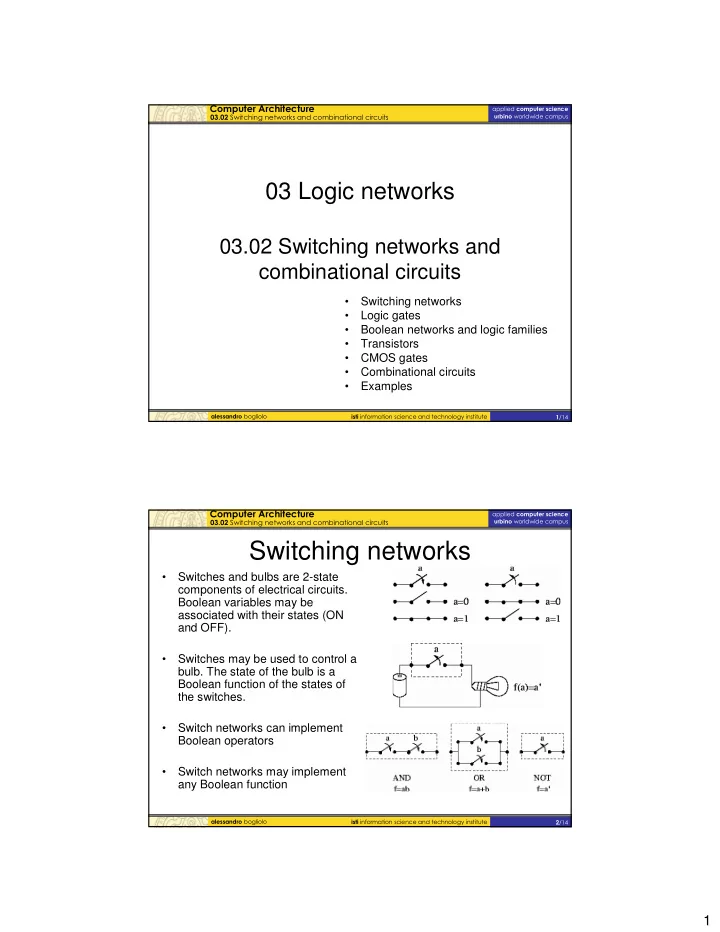
  • Switches and bulbs are 2-state

components of electrical circuits. Boolean variables may be associated with their states (ON and OFF).

  • Switches may be used to control a
  • bulb. The state of the bulb is a

Boolean function of the states of the switches.

  • Switch networks can implement

Boolean operators

  • Switch networks may implement

any Boolean function

slide-2
SLIDE 2

2

  • Logic gates
  • Logic gates are elementary building blocks of digital

circuits

  • A logic gate is a component that takes in input one or

more logic signals and provides one output signal whose logic value is a function of the configuration of the input signals

  • Logic gates are implemented as switch networks
  • Logic gates
  • Logic gates implement elementary Boolean operations:

' ' )' ( ' ' )' ( )' ( ' b a ab b a f b a ab b a f b a f ab f b a f ab f a a f + = ⊕ = + = ⊕ = + = = + = = = =

slide-3
SLIDE 3

3

  • Boolean networks
  • Logic gates can be composed to form a Boolean

network as the corresponding operations can be composed in a Boolean expression

  • There is a 1-1 correspondence between Boolean

networks and Boolean expressions

  • The output of gate g1 is connected to the input of gate

g2 if and only if the result of operation o1 is an operand

  • f operation o2.

bc b a f + = '

  • Logic families
  • Logic library: set of logic gates to be used as building

blocks for implementing Boolean networks

  • Functional completeness: capability of a logic library to

implement any Boolean function

  • Examples:

– {AND, OR, NOT} Functional completeness demonstrated by SoP canonical forms – {NAND} Functional completeness demonstrated by showing that and,

  • r and not can be expressed in terms of NANDs

a’ = (aa)’, ab = ((ab)’(ab)’)’, a+b = ((aa)’(bb)’)’ – {NOR}

slide-4
SLIDE 4

4

  • Transistors
  • A transistor is a 3-terminal component realizing an

electronic switch that uses terminal G (gate) to control the connection between terminal S (source) and D (drain)

  • Logic values are associated with voltage levels

(0=low, 1=high)

  • nMOS and pMOS transistors

form complementary switches

  • CMOS gates
  • Complementary MOS gates
  • Use complementary networks of nMOS and pMOS

transistors to connect the output node either to the “0” or to the “1” voltage source

  • Switch networks connecting to 0 and 1 are called

pull-down and pull-up, respectively

slide-5
SLIDE 5

5

  • CMOS gates (2)
  • Elementary CMOS gates form inverting functions
  • A n-input CMOS gate is made of 2n transistors
  • Thanks to De Morgan’s law, pull-up and pull-down

networks are never simultaneously active

  • Combinational circuits
  • A combinational circuit is a circuit that

implements a Boolean function

  • The logic value assigned to the output

signals is a Boolean function of the current configuration of input signals

  • A combinational circuit that implements a

Boolean function is called an implementation of that Boolean function

  • There are infinite possible implementations
  • f the same Boolean function
slide-6
SLIDE 6

6

  • Implementation

1. Starting from a functional specification 2. Find a formal representation of the target Boolean function (e.g., truth table) 3. Find a Boolean expression that represents the Boolean function 4. Possibly optimize the Boolean expression by means of Boolean manipulation, according to given optimization criteria (e.g., minimum number of literals) 5. Realize the Boolean network associated with the optimal Boolean expression

  • Example: MUX
  • Functional specification: take the output value f from

either input a or b, depending on the value of control signal c c=0 f=a, c=1 f=b

a c b f

1

c b a f 1 1 1 1 1 1 1 1 1 1 1 1 1 1 1 1

f = ab’c’ + abc’ + a’bc + abc = ac’(b’+b) + bc(a’+a) = ac’ + bc f = ((ac’)’)’+((bc)’)’ = ((ac’)’(bc)’)’ NAND implementation

slide-7
SLIDE 7

7

  • Example: Parity bit
  • Functional specification: extra bit to added to a word in
  • rder to obtain an even number of 1’s

f = x1’x0+x1x0’ = ((x1’x0)’(x1x0’)’)’ = x1⊕ x0 NAND implementation

xn-1 x2 x1 x0 p

Parity bit

x 1 x 0 p 1 1 1 1 1 1

EXOR

x0 x1 x1 x0 p p

  • Example: Parity bit (2)

f = x2’x1’x0+x2’x1x0’+x2x1’x0’+x2x1x0 = = x2’(x1’x0+x1x0’) + x2 (x1’x0’+x1x0) = = x2’(x1⊕ x0)+x2(x1⊕ x0)’= x2⊕ (x1⊕ x0)

x 2 x 1 x 0 p 1 1 1 1 1 1 1 1 1 1 1 1 1 1 1 1

x0 x1 x2 p