SLIDE 1
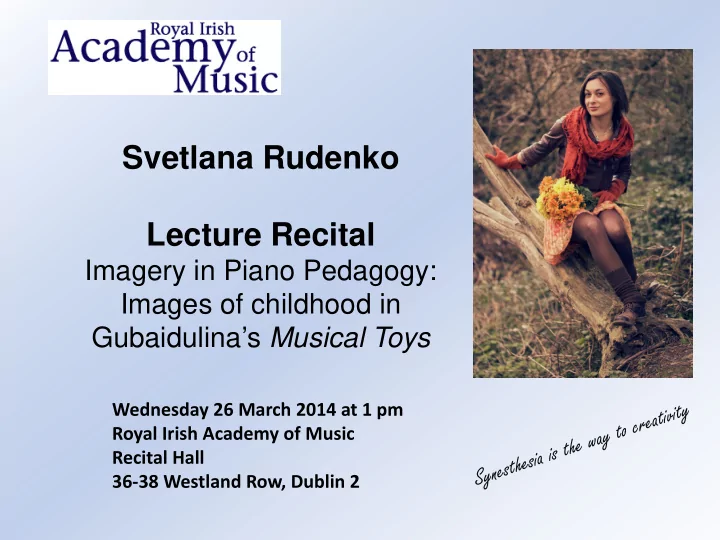
Svetlana Rudenko Lecture Recital
Imagery in Piano Pedagogy: Images of childhood in Gubaidulina’s Musical Toys
Wednesday 26 March 2014 at 1 pm Royal Irish Academy of Music Recital Hall 36-38 Westland Row, Dublin 2
SLIDE 2 Overview
- Music Perception: cross modal processing
- Gubaidulina
- Cultivating a Synesthetical approach in the
learning process, communication through Images.
SLIDE 3
- Synesthesia (ancient Greek [syn], ‘together’, and [aisthesis],
‘sensation’) is a neurological phenomenon in which stimulation of
- ne sensory or cognitive pathway leads to automatic, involuntary
experiences in a second sensory or cognitive pathway.
- People Who Feel, Taste and Hear Color…
- Are we all born as synesthetes…? Infants synesthesia.
Synesthetical Mind
Primary recognition (sound) Secondary sensory (shapes, colours)
SLIDE 4
Sofia Gubaidulina
(24 Oct. 1931/ Chistopol, Tatar ASSR) Soviet Avant-Garde Composer Together with Schnittke, Denisov and Silvestrov she is now regarded worldwide as one of the leading representatives of New Music.
SLIDE 5
“In the first instance, perhaps on a walk, I hear a huge, shapeless, multi-faceted sound, absolutely fascinating, with everything piled up together in a way you could never notate - something which exists outside time. It’s like a present, and I consider it a duty to transform it from vertical to horizontal” Sofia Gubaidulina
SLIDE 6
Fish’s Night Song
SLIDE 7 “I often thought of my childhood and of the lack, in those days, of piano pieces that were able to take one back into the highly imaginative world of
- toys. At that time I also looked upon toys as material from which I could
elicit sounds; they were part of the world of my musical sensations. With this collection, I have paid a late tribute to my childhood” S.G.
Musical Toys (1969)
SLIDE 8
- Children’s cycle Musical Toys - synesthetical
perception.
- The texture of Gubaidulina’s pieces stimulates
visual/auditory/tactile images in the imaginations
SLIDE 9 Images:
- 1. mf Mechanical Accordion
- 2. mp Voice / whistle
- 1. Mechanical Accordion
SLIDE 10 Images:
- 1. mp Magic Roundabout
- 2. f Spell
- 2. Magic Roundabout
SLIDE 11
- 3. The Trumpet In The Forest
Images: 1. f Trumpet 2. p “Shadows” of the Forest
SLIDE 12 Images: 1. f Hammering of the Blacksmith
- 2. p Magic Spell
- 3. ff White Magic
- 4. The Magic Smith
SLIDE 13 Images: Two-part Invention
- 1. Subject
- 2. Counterpoint
- 5. April Day
SLIDE 14 Images: 1. Song of the Fisherman
- 2. Water Reflections / ripples
(perfect fifths)
SLIDE 15 Images:
- 1. A Bear Playing the Double Bass
- 2. Black Woman Humming
- 3. Piano Chords
- 8. A Bear Playing The
Double Bass And The Black Woman
SLIDE 16 Images: 1. ‘Darkness’ of the Forest
- 2. Woodpecker
- 3. Small Bird
- 9. The Woodpecker
SLIDE 17 Images:
- 1. Little Bells
- 2. “Road” / Sleigh
- 3. Song of the Bells
- 11. Sleigh With Little Bells
SLIDE 18
- It could enhance musical imagination (and therefore
learning) of a child if we find ways to stimulate the voluntary synesthetical senses as they will boost the involuntary senses.
- “Synesthesia causes excess communication amongst
brain maps…. Depending on where and how widely in the brain the trait was expressed, it could lead to both synaesthesia and to a propensity toward linking seemingly unrelated concepts and ideas - in short, creativity.” (Ramachandran and Hubbard, Journal of Consciousness Studies, 2001)
- We can all refresh our synesthetical potential
Conclusions
SLIDE 19
- 13. The Drummer
- 14. Forest Musician