
SLIDE 1
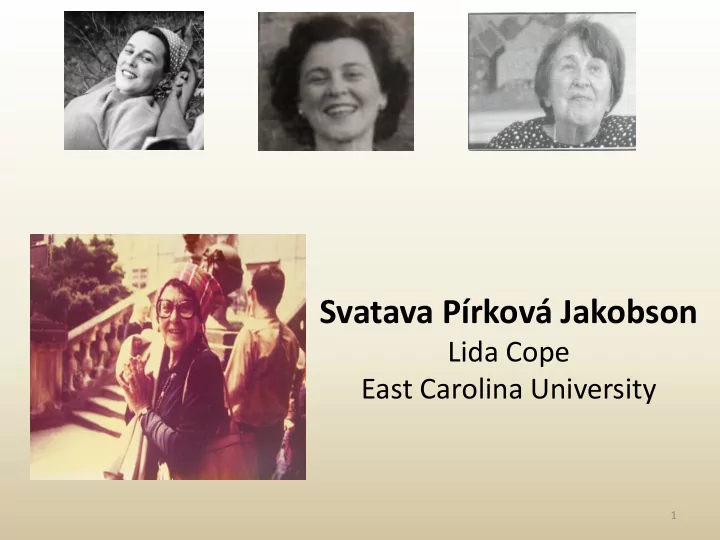
Svatava Pírková Jakobson
Lida Cope East Carolina University
1
Svatava Prkov Jakobson Lida Cope East Carolina University 1 The - - PowerPoint PPT Presentation
Svatava Prkov Jakobson Lida Cope East Carolina University 1 The Svatava Jakobson Archive: Major Components The earliest sound collection of Texas Czech recordings : 189 hour- long (now digitized) analog tapes; cc. 800 reel-to-reel
1
long (now digitized) analog tapes; cc. 800 reel-to-reel recordings, and stacks of LPs; an extensive collection of today famous Texas Czech bands
songbooks (hand-written, the earliest found so far from 1917), photographs, and manuscripts concerning ethnocultural and intellectual traditions of Czechs and Slovaks in the U.S.; a script for a documentary entitled Argument for the Film AND the unprocessed film itself: Czech Language in Texas; notes, personal letters, student fieldwork reports; fieldnotes and other documents prepared for the Smithsonian Bicentennial’s Festival of American Folk Life in 1976.
2
3
4
Challenge: Digitizing of the film canisters currently stored at the Briscoe Center in Austin
5
6
7
8
9
10
11
12
A life of uncertainty inside and out; before us always a thought and hope for return. Temporary apartments, clothes in the suitcases, books in the boxes, boxes in storage, losses as we moved from one country to another, searching for places to stay, for visa, for seats on the ships and on the trains, switching from one language to another, from one environment to the next, and people, people of many countries, of different traits, expertise, fates; meetings and farewells, lifting the anchor and as soon as lowered again, fleeing Norway on foot with Germans right behind us, our friends there arrested and killed, tension in Sweden, another full year of visiting consulates and legal offices, acrobatic attempts to leave, drowned ships, occupied docks, our ship stopped and searched by Germans in the open Atlantic, and finally that incredible feeling of freedom and peace still with mines within a hand’s reach, and then America, full of surprises in all respects.
14
.
I have continued with my sociologic-musical work here among our countrymen, thousands of whom live in the Czech quarter of New York and on the farms in its vicinity, teach Czech at 2 universities to white and black Americans, Slavic people, American Czechs and other nationalities, [and] it makes me very happy to hear them speak and read it […]. Sometimes I dream that I’m walking through a crowd of people speaking
about the state of the Czech folksong and music in emigration, the other a monograph about an old woman originally from Skalica [in Slovakia], and various articles for academic journals.
15
16
17
18
19
20
21
22
23