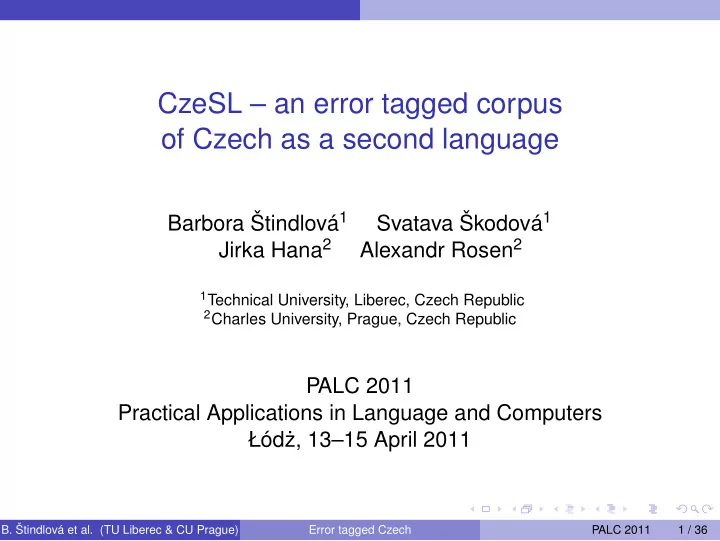
CzeSL an error tagged corpus of Czech as a second language Barbora - - PowerPoint PPT Presentation

czesl an error tagged corpus of czech as a second language
SMART_READER_LITE
LIVE PREVIEW

CzeSL an error tagged corpus of Czech as a second language Barbora - - PowerPoint PPT Presentation

CzeSL an error tagged corpus of Czech as a second language Barbora tindlov 1 Svatava kodov 1 Jirka Hana 2 Alexandr Rosen 2 1 Technical University, Liberec, Czech Republic 2 Charles University, Prague, Czech Republic PALC 2011


slide-1
SLIDE 1

CzeSL – an error tagged corpus

  • f Czech as a second language

Barbora Štindlová1 Svatava Škodová1 Jirka Hana2 Alexandr Rosen2

1Technical University, Liberec, Czech Republic 2Charles University, Prague, Czech Republic

PALC 2011 Practical Applications in Language and Computers Łód˙ z, 13–15 April 2011

  • B. Štindlová et al. (TU Liberec & CU Prague)

Error tagged Czech PALC 2011 1 / 36

slide-2
SLIDE 2

Outline of the talk

1

Introduction

2

Measuring inter-annotator agreement

3

Application of automatic methods on learner texts

4

Conclusion

  • B. Štindlová et al. (TU Liberec & CU Prague)

Error tagged Czech PALC 2011 2 / 36

slide-3
SLIDE 3

Introduction

Outline of the talk

1

Introduction

2

Measuring inter-annotator agreement

3

Application of automatic methods on learner texts

4

Conclusion

  • B. Štindlová et al. (TU Liberec & CU Prague)

Error tagged Czech PALC 2011 3 / 36

slide-4
SLIDE 4

Introduction

Learner Corpus (LC)

A computerized textual database of language as produced by second/foreign language learners (Leech 1998) Differs from national corpora:

◮ not a representative repository of contemporary language ◮ but a repository of interlanguage, which is dynamic, varied

  • B. Štindlová et al. (TU Liberec & CU Prague)

Error tagged Czech PALC 2011 4 / 36

slide-5
SLIDE 5

Introduction

Research value of LC

Language data for the research of interlanguage:

◮ regularities ◮ factors ◮ development

  • B. Štindlová et al. (TU Liberec & CU Prague)

Error tagged Czech PALC 2011 5 / 36

slide-6
SLIDE 6

Introduction

CzeSL – a learner corpus of Czech

First learner corpus of Czech For other Slavic languages – Slovene: PiKUST, ... ? Part of an acquisition corpus project – AKCES Other parts: native speakers’ classroom language:

  • ral (SCHOLA), written (SKRIPT)
  • B. Štindlová et al. (TU Liberec & CU Prague)

Error tagged Czech PALC 2011 6 / 36

slide-7
SLIDE 7

Introduction

Planned extent in 2012

2 million words 4 subcorpora according to the learners’ L1:

◮ Related Slavic language: Russian, Polish ◮ Non-Slavic Indo-European language: German, English, French ◮ Non-related language: Vietnamese, Arabic ◮ L1/2: Romani

  • B. Štindlová et al. (TU Liberec & CU Prague)

Error tagged Czech PALC 2011 7 / 36

slide-8
SLIDE 8

Introduction

Features of CzeSL

Written and spoken texts Original texts – handwritten All proficiency levels according to CEFRL Various genres and topics Metadata on the learner and the task (18 items)

  • B. Štindlová et al. (TU Liberec & CU Prague)

Error tagged Czech PALC 2011 8 / 36

slide-9
SLIDE 9

Introduction

Error annotation

About 46% of existing LC are annotated Partial error annotation:

◮ Pronunciation (LeaP) ◮ Orthography (TLEC) ◮ Syntax (AleSKO)

Complex error annotation: ICLE, FRIDA. FALCO, NICT JLE, CzeSL

  • B. Štindlová et al. (TU Liberec & CU Prague)

Error tagged Czech PALC 2011 9 / 36

slide-10
SLIDE 10

Introduction

Error annotation in CzeSL

Issues in Czech: rich inflection, derivation, complex agreement rules and information-structure-driven constituent order The answer: multi-level annotation scheme

◮ Combination of manual and automatic annotation

Automatic annotation

Automatic assignment of error tags wherever possible, based on comparing faulty and corrected forms Standard morphosyntactic tagging and lemmatization

  • B. Štindlová et al. (TU Liberec & CU Prague)

Error tagged Czech PALC 2011 10 / 36

slide-11
SLIDE 11

Introduction

Annotation scheme

Multi-level design – two-stage annotation, three levels, allows for:

◮ Successive emendation ◮ Annotating errors in both single forms and discontinuous strings

  • B. Štindlová et al. (TU Liberec & CU Prague)

Error tagged Czech PALC 2011 11 / 36

slide-12
SLIDE 12

Introduction

Levels of annotation

LEVEL 0

Transcribed input

LEVEL 1

Orthographical and morphological emendation of isolated forms Result:

◮ String of existing Czech forms ◮ Sentence as a whole can still be incorrect

LEVEL 2

All other types of errors Syntactic, lexical, word order, usage, style, reference, negation,

  • veruse/underuse of syntactic items

Result: grammatically correct sentence

  • B. Štindlová et al. (TU Liberec & CU Prague)

Error tagged Czech PALC 2011 12 / 36

slide-13
SLIDE 13
slide-14
SLIDE 14

Introduction

Taxonomy of errors

2 stages of error emendation Minimal intervention in the original 22 manually added tags + 10 automatic error tags

  • B. Štindlová et al. (TU Liberec & CU Prague)

Error tagged Czech PALC 2011 14 / 36

slide-15
SLIDE 15

Measuring inter-annotator agreement

Outline of the talk

1

Introduction

2

Measuring inter-annotator agreement

3

Application of automatic methods on learner texts

4

Conclusion

  • B. Štindlová et al. (TU Liberec & CU Prague)

Error tagged Czech PALC 2011 15 / 36

slide-16
SLIDE 16

Measuring inter-annotator agreement

Sample

67 texts, about 150 words each 9373 tokens 7995 words (excluding punctuation) CEFRL level A2–B1 Various L1s 14 annotators, each text by two

  • B. Štindlová et al. (TU Liberec & CU Prague)

Error tagged Czech PALC 2011 16 / 36

slide-17
SLIDE 17

Measuring inter-annotator agreement

A measure of IAA: Kappa

A naive measure: identical choices / number of choices Kappa penalizes cases with fewer choices (agreement by chance is higher) Kappa = 1 – perfect agreement Kappa = 0 – random agreement Kappa > 0.4 – reasonable

  • B. Štindlová et al. (TU Liberec & CU Prague)

Error tagged Czech PALC 2011 17 / 36

slide-18
SLIDE 18

Measuring inter-annotator agreement

IAA results

  • n 9848 tokens

Tag A1 only A2 only Both A1 and A2 Kappa incor 168 130 894 0.84 incorStem 167 165 559 0.75 incorInfl 173 130 250 0.61 wbd 14 21 45 0.72 fw 25 17 18 0.46 agr 82 99 110 0.54 dep 99 118 87 0.43 neg 11 9 9 0.47 styl 19 14 10 0.38 lex 107 131 74 0.37 use 60 74 19 0.21 sec 45 18 4 0.11

  • B. Štindlová et al. (TU Liberec & CU Prague)

Error tagged Czech PALC 2011 18 / 36

slide-19
SLIDE 19

Measuring inter-annotator agreement

Examples of high IAA

Agreement error

kappa = 0.54 (1) Vidˇ el malého Petra (2) Vidˇ el *malou Petra Why not still higher?

Different emendations

L0: Vˇ eci budou *težki A1 – L1: tˇ ežký, L2: tˇ ežké + AGR A2 – L1: tˇ ežké, L2: tˇ ežké

  • B. Štindlová et al. (TU Liberec & CU Prague)

Error tagged Czech PALC 2011 19 / 36

slide-20
SLIDE 20

Measuring inter-annotator agreement

Wrong choice of a tag

due to misunderstanding of a grammar concept by the annotator: agreement vs. valency (3) kv˚ uli jeho *životním/životnímu stylu ‘for his lifestyle’ (4) každý *muset/musí ˇ rešit ten problém ‘everyone has to solve the problem’

  • B. Štindlová et al. (TU Liberec & CU Prague)

Error tagged Czech PALC 2011 20 / 36

slide-21
SLIDE 21

Measuring inter-annotator agreement

Examples of low IAA

Lexical error

kappa = 0.37 Due to semantic proximity of lexemes annotators disagree about the need for correction: (5) když se dívám na *?druhý/jiný kultury ‘when I look at other cultures’ On the other hand, some lexemes are distant enough and annotators agree about the need for for correction: (6) *housenky/housky kupuju v pekaˇ rství ‘I buy caterpillars in the baker’s shop’

  • B. Štindlová et al. (TU Liberec & CU Prague)

Error tagged Czech PALC 2011 21 / 36

slide-22
SLIDE 22

Measuring inter-annotator agreement

Some reasons for low IAA

Errors of type lex involve a high degree of subjective judgement, thus cannot aim at high IAA. Errors of type sec – highly formal specific, due to primary errors.

  • B. Štindlová et al. (TU Liberec & CU Prague)

Error tagged Czech PALC 2011 22 / 36

slide-23
SLIDE 23

Application of automatic methods on learner texts

Outline of the talk

1

Introduction

2

Measuring inter-annotator agreement

3

Application of automatic methods on learner texts

4

Conclusion

  • B. Štindlová et al. (TU Liberec & CU Prague)

Error tagged Czech PALC 2011 23 / 36

slide-24
SLIDE 24

Application of automatic methods on learner texts

Questions

How far can we get without manual annotation? Does it make sense to use morphosyntactic taggers, parsers, spell-checkers on both emended and ill-formed input? So far, we tried two taggers and a spell-checker.

  • B. Štindlová et al. (TU Liberec & CU Prague)

Error tagged Czech PALC 2011 24 / 36

slide-25
SLIDE 25

Application of automatic methods on learner texts

Taggers

Taggers use different default strategies to handle faulty forms. Morˇ ce: includes morphological analyzer, lexically-driven TnT: more sensitive to syntactic context Both include a method to handle unknown words. Do they have something interesting to say about incorrect forms?

  • B. Štindlová et al. (TU Liberec & CU Prague)

Error tagged Czech PALC 2011 25 / 36

slide-26
SLIDE 26

Application of automatic methods on learner texts

(7) Tady je vecne dobra programa navstevy. here is always? good programme of the visit ‘This place is always worth visiting.’ — emendable as: (8) Tady je vždy dobrý program návštˇ evy.

What the taggers say about programa:

Morˇ ce: genitive masculine singular, lemma programus – morphology-based interpretation TnT: nominative neuter singular – syntax-based interpretation – unfortunately, not enough nice results like this in our data

  • B. Štindlová et al. (TU Liberec & CU Prague)

Error tagged Czech PALC 2011 26 / 36

slide-27
SLIDE 27

Application of automatic methods on learner texts

Comparison of taggers (Morˇ ce vs. TnT)

The sample:

  • no. of texts: 93
  • no. of tokens: 12681
  • no. of words (excluding punctuation): 10727

Comparison of tagger results on ill-formed words: ill-formed tokens (= unidentified and guessed by Morˇ ce): 1323 (8.9%) ill-formed tokens where taggers agree: 405 (28.8%) ill-formed tokens where taggers disagree: 918 (71.2%) Evaluation of tagger results on L0 vs. L1: (next slide)

  • B. Štindlová et al. (TU Liberec & CU Prague)

Error tagged Czech PALC 2011 27 / 36

slide-28
SLIDE 28

Application of automatic methods on learner texts

Tags on L0 and L1 – percentages of agreement

L0m x L0t L0m x L1 L0t x L1 L0m x L1 L0t x L1 # tokens 918 2589 2589 314 314 Tag 84.1 79.0 19.1 26.1 POS 39.2 89.6 88.7 43.9 52.5 SubPOS 37.1 89.2 87.9 42.0 49.7 Gender 23.9 88.8 88.2 36.0 46.5 Number 36.9 91.1 91.2 49.0 63.1 Case 31.2 89.0 86.5 43.0 51.3 PossGen 98.6 99.8 99.9 98.4 99.7 PossNr 99.5 99.8 99.7 99.0 99.7 Person 68.1 96.3 94.2 81.8 76.1 Tense 70.6 96.7 95.3 83.1 77.4 Grade 78.3 96.4 96.9 75.2 81.5 Negation 74.4 95.3 93.8 73.9 74.2 Voice 70.6 96.7 95.5 83.1 78.7

  • B. Štindlová et al. (TU Liberec & CU Prague)

Error tagged Czech PALC 2011 28 / 36

slide-29
SLIDE 29

Application of automatic methods on learner texts

Numbers of tags assigned to ill-formed words

POS Morˇ ce Tnt adjective 158 94 adverb 118 21 gradable adverb 31 11 noun 499 441 preposition 10

  • particle

8

  • finite verb

32 129 infinitive 7 41 l-participle 10 119 passive participle 1 29

  • B. Štindlová et al. (TU Liberec & CU Prague)

Error tagged Czech PALC 2011 29 / 36

slide-30
SLIDE 30

Application of automatic methods on learner texts

Morˇ ce vs. TnT Morphological / syntactic interpretation of faulty forms: unconfirmed, more experiments needed TnT loses ground in a context with many errors Morˇ ce strongly disprefers verbs TnT better on faulty forms, Morˇ ce better in general

  • B. Štindlová et al. (TU Liberec & CU Prague)

Error tagged Czech PALC 2011 30 / 36

slide-31
SLIDE 31

Application of automatic methods on learner texts

Spell-checker I

michalisekSpell, by Michal Richter (2010) combines morphology with context Modes: spell-checker, proof-reader, diacritics assigner The sample

◮ no. of texts: 67 ◮ no. of tokens: 9373 ◮ no. of words (excluding punctuation): 7995

Evaluated on:

◮ identical emendations on L1: 9069 tokens (96.8%) ◮ identical emendations on L2: 8549 tokens (91.2%)

Ill-formed tokens:

◮ ill-formed total (= unidentified and guessed by morce): 918 ◮ ill-formed with identical emendations on L1: 786

Results for ill-formed tokens with identical emendations on L1:

  • B. Štindlová et al. (TU Liberec & CU Prague)

Error tagged Czech PALC 2011 31 / 36

slide-32
SLIDE 32

Application of automatic methods on learner texts

Spell-checker II

◮ where diacritics assigner agrees with L1: 552 (70.2%) ◮ where proof-reader agrees with L1: 639 (80.5%) ◮ where diacritics assigner followed by proof reader agrees with L1:

644 (81.9%)

  • B. Štindlová et al. (TU Liberec & CU Prague)

Error tagged Czech PALC 2011 32 / 36

slide-33
SLIDE 33

Conclusion

Outline of the talk

1

Introduction

2

Measuring inter-annotator agreement

3

Application of automatic methods on learner texts

4

Conclusion

  • B. Štindlová et al. (TU Liberec & CU Prague)

Error tagged Czech PALC 2011 33 / 36

slide-34
SLIDE 34

Conclusion

  • B. Štindlová et al. (TU Liberec & CU Prague)

Error tagged Czech PALC 2011 34 / 36

slide-35
SLIDE 35

Conclusion

Conclusion

Morphosyntactic errors are easy to formalize and lead to a high Kappa – incor, agr, dep Semantic errors depend on subjective judgement, should standard measures be applied? Projecting morphosyntactic annotation of L1 and L2 onto L0 straightforward and useful Extracting useful information from multiple taggers applied to L0 not proved viable so far Proof-reader has a relatively high degree of success, could be a part of a fully automatic chain, with a tagger as the next step

  • B. Štindlová et al. (TU Liberec & CU Prague)

Error tagged Czech PALC 2011 34 / 36

slide-36
SLIDE 36

Conclusion

Acknowledgments

Thanks to

  • ther members of the project team, namely Karel Šebesta, Milena

Hnátková, Tomáš Jelínek, Vladimír Petkeviˇ c, and Hana Skoumalová

  • B. Štindlová et al. (TU Liberec & CU Prague)

Error tagged Czech PALC 2011 35 / 36

slide-37
SLIDE 37

Conclusion

  • B. Štindlová et al. (TU Liberec & CU Prague)

Error tagged Czech PALC 2011 36 / 36