
SLIDE 1
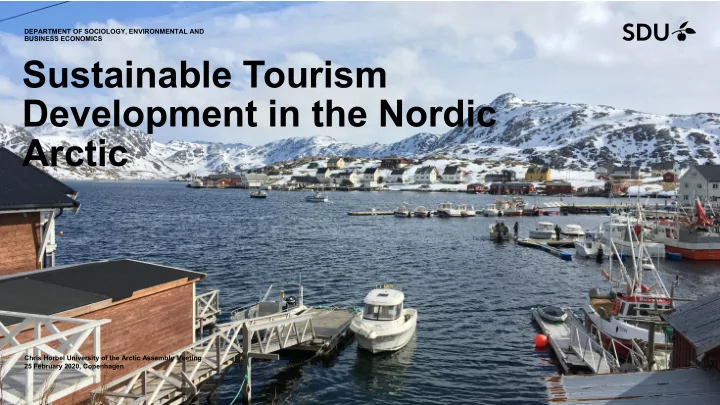
Sustainable Tourism Development in the Nordic Arctic
Chris Horbel University of the Arctic Assembly Meeting 25 February 2020, Copenhagen DEPARTMENT OF SOCIOLOGY, ENVIRONMENTAL AND BUSINESS ECONOMICS
Sustainable Tourism Development in the Nordic Arctic Chris Horbel - - PowerPoint PPT Presentation
DEPARTMENT OF SOCIOLOGY, ENVIRONMENTAL AND BUSINESS ECONOMICS Sustainable Tourism Development in the Nordic Arctic Chris Horbel University of the Arctic Assembly Meeting 25 February 2020, Copenhagen Significance of the tourism industry:
Chris Horbel University of the Arctic Assembly Meeting 25 February 2020, Copenhagen DEPARTMENT OF SOCIOLOGY, ENVIRONMENTAL AND BUSINESS ECONOMICS
DEPARTMENT OF SOCIOLOGY, ENVIRONMENTAL AND BUSINESS ECONOMICS
2
Source: Statistics Norway
Finnmark Troms
DEPARTMENT OF SOCIOLOGY, ENVIRONMENTAL AND BUSINESS ECONOMICS
3
Source: Statistics Iceland
WHAT? How to utilize existing human capital, natural resources and infrastructure capacity to develop innovative sustainable tourism that can diversify and make Arctic economic development more resilient? HOW? Series of interrelated workshops in the Arctic regions of the Nordic countries to identify community challenges and opportunities pertaining to Sustainable Arctic tourism
29 April 2018DEPARTMENT OF SOCIOLOGY, ENVIRONMENTAL AND BUSINESS ECONOMICS 4
Social/cultural Environmental Economic
DEPARTMENT OF SOCIOLOGY, ENVIRONMENTAL AND BUSINESS ECONOMICS
5
DEPARTMENT OF SOCIOLOGY, ENVIRONMENTAL AND BUSINESS ECONOMICS
6
DEPARTMENT OF SOCIOLOGY, ENVIRONMENTAL AND BUSINESS ECONOMICS
Project duration: 1 August 2017 – 31 July 2019 Workshop 1: Northern Norway, 26-30 April 2018 Workshop 2: Northern Iceland, 18-22 March 2019
and nature-based tourism in Northern Norway and Iceland
a range of scenarios
(socio-cultural, economic and environmental)
29 April 20187
DEPARTMENT OF SOCIOLOGY, ENVIRONMENTAL AND BUSINESS ECONOMICS
Academic partners: Industry and public partners: Funders:
DEPARTMENT OF SOCIOLOGY, ENVIRONMENTAL AND BUSINESS ECONOMICS 9
DEPARTMENT OF SOCIOLOGY, ENVIRONMENTAL AND BUSINESS ECONOMICS
10
DEPARTMENT OF SOCIOLOGY, ENVIRONMENTAL AND BUSINESS ECONOMICS
Port Population Date Anchorage, Alaska 300,950 Aug 16th Kodiak, Alaska 6,423 Aug 17th Dutch Harbor, Alaska 4,319 Aug 19th Nome, Alaska 3,797 Aug 21st Ulukhaktok, NWT, CA 402 Aug 27th Cambridge Bay, Nunavut, CA 1,477 Aug 29th Pond Inlet, Nunavut, CA 1,549 Sept 4th Ilulissat, Greenland 4,541 Sept 7th Sisimiut, Greenland 5,572 Sept 8th Nuuk, Greenland 16,583 Sept 9th Bar Harbor, ME 5,235 Sept 13th Boston, MA 645,966 Sept 14th
29 April 2018 DEPARTMENT OF SOCIOLOGY, ENVIRONMENTAL AND BUSINESS ECONOMICS11
Crystal Serenity 2016
DEPARTMENT OF SOCIOLOGY, ENVIRONMENTAL AND BUSINESS ECONOMICS
12
Annual visitors to Nordkapp 2017: 260,481 Honningsvåg population: 2,465
DEPARTMENT OF SOCIOLOGY, ENVIRONMENTAL AND BUSINESS ECONOMICS
and space
environments, societies, and economies
well as oversight of use by both local and national entities
13
DEPARTMENT OF SOCIOLOGY, ENVIRONMENTAL AND BUSINESS ECONOMICS
communities
inform, guide, and accommodate sustainable tourism
environment/society/economy (e.g., fisheries management systems)
integrated, and applied knowledge gathering
Arctic nations to establish broad-scale resilience
29 April 201814
DEPARTMENT OF SOCIOLOGY, ENVIRONMENTAL AND BUSINESS ECONOMICS
private
15
DEPARTMENT OF SOCIOLOGY, ENVIRONMENTAL AND BUSINESS ECONOMICS
and workshops
Ocean Monitoring Knowledge Systems and Communities. Frontiers in Marine Science, 6, [309]. https://doi.org/10.3389/fmars.2019.00309
Fernandez, & J. Nymand Larsen (Eds.), Arctic Marine Resource and Governance Development (pp. 185-217). Springer. Springer Polar Sciences
Development in the Nordic Arctic: Proceedings and Analysis, London.
29 April 2018 DEPARTMENT OF SOCIOLOGY, ENVIRONMENTAL AND BUSINESS ECONOMICS
stakeholder collaboration in Nordic Arctic Blue Economy communities
29 April 201817
DEPARTMENT OF SOCIOLOGY, ENVIRONMENTAL AND BUSINESS ECONOMICS
18
For further information please contact:
Video capture of workshop 2: http://bit.ly/iceland_workshop_2019
DEPARTMENT OF SOCIOLOGY, ENVIRONMENTAL AND BUSINESS ECONOMICS
19
DEPARTMENT OF SOCIOLOGY, ENVIRONMENTAL AND BUSINESS ECONOMICS
Academic Partners
University of Southern Denmark, Esbjerg Brooks Kaiser Chris Horbel Cape Breton University/Nipissing University, Canada Pat Maher NIBIO – the Norwegian Institute of Bioeconomy Paul Eric Aspholm Hallvard Jensen Tor Arne Bjørn Eva Narten Høberg Bjørn Frantzen University of Tromsø, Norway Yajie Liu Göteborg University, Centre for Tourism Lena Mossberg University of Iceland Gunnar Þór Jóhannesson NTNU Norwegian University of Science and Technology Jon Olaf Olaussen Wageningen University & Research, Netherlands; University of Akureyri, Iceland Edward Huijbens University of Akureyri, Iceland Nathan Reigner UCL, London, UK Ilan Kelman Holar University College, Iceland Jessica Aquino
Industry Partners
Polar Research and Policy Initiative Dwayne Ryan Menezes Thomas Bishop Visit Faroe Islands Annleyg Lamhauge Abercrombie & Kent Philanthropy, USA Keith Sproule NLA International Ltd., UK Jonathan Turner Iceland Unwrapped by helgastina Helga Kristin Fridjonsdottir Susan Seubert Photography, USA Susan Seubert Superfolk Films, UK Tom Huntingford
Governmental Partners
The Scottish Government, UK Iain Morrison UK Department of International Trade Alex Wright Faroe Islands, Ministry of Fisheries Hans Ellefsen
29 April 2018 DEPARTMENT OF SOCIOLOGY, ENVIRONMENTAL AND BUSINESS ECONOMICS