
SLIDE 1
Strengthening Agricultural and Nutrition Extension (SANE) Stacia Nordin, RD
University of Illinois Nutrition Education Specialist Nordin@illinois.edu
Sustainable Nutrition: Malawi is Rich
with Potential
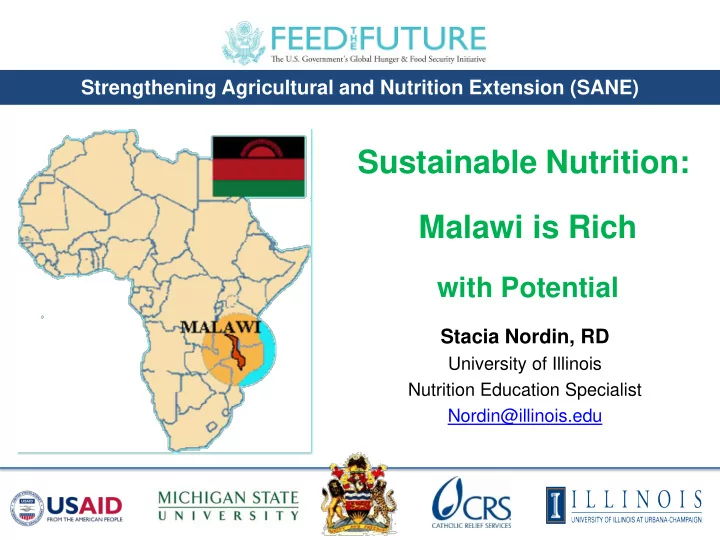
Sustainable Nutrition: Malawi is Rich with Potential Stacia - - PowerPoint PPT Presentation
Strengthening Agricultural and Nutrition Extension (SANE) Sustainable Nutrition: Malawi is Rich with Potential Stacia Nordin, RD University of Illinois Nutrition Education Specialist Nordin@illinois.edu Strengthening Agricultural and
Strengthening Agricultural and Nutrition Extension (SANE) Stacia Nordin, RD
University of Illinois Nutrition Education Specialist Nordin@illinois.edu
with Potential
Strengthening Agricultural and Nutrition Extension (SANE)
to improve agriculture nutrition programs and policies in Malawi
Staples Legumes & Nuts Vegetables
Staples Animal Foods
Fats & Oils
Legumes & Nuts Vegetables Fruits
Current Imbalance
4
Malawians eat more maize per capita than any other country on earth!
Over ½ of calories are from just 1 food.
85 % of land is used to grow maize 75 % of calories consumed is from maize
Maize was brought to Southern Africa from Central America about 300 years ago
Staple food security is NOT food security Yet, this is the focus for most programmes in Agriculture, Food security & Food Aid.
Same Amount – Balanced Groups with More Variety
75% of Agriculture & Diets are Maize 47% of Malawi’s children are nutritionally “stunted”
5
Unbalanced production
All Seasons (rains vs. dry)
Balanced Production
All Seasons (rains vs. dry)
Too Much Maize Soil & Water Loss Diverse Production Care for the Earth Permaculture
Designed with Nature Care for Earth, Care for People, Fair Share
Bare Soil & Water Loss
“Agro-ecology and the Right to Rood”
March 2011: Agroecology, if sufficiently supported, can double food production in entire regions within 10 years while mitigating climate change and alleviating rural poverty.
Permaculture: Designing Sustainable Human Systems
Any Size – Any Place
Top: www.Kusamala.org Bottom, my home: www.NeverEndingFood.org
Malnourished
= Drought Floods Low Yield Nourished = Resilient Sustainable Productive
(1) Before Wife sweeping 1 hour+ each day (2) Month 1 Reduced sweeping and beds (3) Month 7 Area flourishing with foods
(1) 2005 July: Before (2) 2005 Aug: 1 month (2) 2006 Jan: 7 months
Good
Nutrition
Health
Body & living conditions:
care, water, sanitation, hygiene
Food & Water Security
All food groups & water: available, accessible, utilized, all the time
Human Systems
For food, water, health, education, policies, etc.
Natural Resources & Systems
Soil, water, air, vegetation, animals (including insects & humans)
1st 4th 3rd 2nd
Environment + Agriculture = the foundation of Nutrition, the source of our nutrients Nutrition Security =
Nutrient needs met for growth, health & energy
Medication
Soil, Food, Water & People
can be avoided
with a healthy foundation
Agriculture – the Foundation of Nutrition
9
High levels of
Poor Nutrition Food & Water Insecurity
Calories, but lacking nutrients Water becoming serious threat
Systems are currently out of balance
Requires higher inputs Higher Medications
for People Food & Water Plants, Animals, Soil
Malawi: Heights & Weights of Children under 5 years
Slight improvements from 1992 to 2016 (~24 years)
Stunted
Too short for age Chronic nutrition/health issue
Underweight
Too thin for age Chronic or Acute
Wasted
Too thin for height Current nutritional status
47.1 24.4 13.8 55.8 4.1 6.6
24%
Global
8%
37%
2015/6 MDHS Preliminary
12% 3%
9.8 11.2 13.1 2.0 2.4 4.0
2000 MDHS 2004 MDHS 2010 MDHS
%
Overweight Obesity
have an increased risk of overweight & obesity
High blood pressure, Diabetes, Heart diseases
Global
12% 38%
1. The total annual costs associated with child undernutrition are estimated at 10.3% GDP:
2. 66% of the adult population engaged in manual activities were stunted as children, an annual loss of:
Scaling Up Nutrition (SUN) 13 key interventions
Based on Lancet Series
Healthy Eating & Living:
THESE 10 WILL DIMINISH AS WE IMPROVE: Treatments / supplements:
4. Vitamin A supplementation 5. Zinc supplementation for diarrhoea 6. Deworming 7. Iron & folate supplements 8. Salt iodisation 9. Prevent & treat Undernutrition 10. Treat Severe Acute Malnutrition 11. Multiple micronutrient powders 12. Iodised oil capsules 13. Iron fortification of staples
1 day 1 year 1 Adult Calories % Calories 1 adult (Kg) 16 Million Adults (kg)
½ Grains
838 38% 90 1,460,000
½ Tubers
240 11% 90 1,460,000
150 7% 108 1,752,000
96 4% 108 1,752,000
588 26% 54 584,000
58 3% 36 584,000
235 11% 18 116,800 TOTAL food needed: 2,205 100% 504 7,708,800 Agriculture = maize Agriculture = 300 kg maize
Disconnect between Agriculture & Nutrition
Production Processing Marketing Buying Preparing Eating
Global FOOD Supply 7,000 plant foods available 3 crops = 50 % plant energy 30 crops = 95 % calories & protein
FAO 1997
Policies against Hunger XII. Sowing the seeds for nutrition: What food systems do we need? Berlin, 22-24 June 2016 Slide 16
Do we have the foods we need in Malawi? YES! Malawi has at least 600 different foods.
Plus species for soil fertility, medicines, energy, building, fibres, finances, etc.
Slide 18
Home Environment
Natural Resource Environment
Food Market Environment
Nutrition / health knowledge and norms
Food allocation Food expenditure Non-food expenditure
Diet
Family
nutrition
HOUSEHOLD ASSETS farm inputs Livelihoods
& skills
Health status Mother’s
nutrition
Health care
Women’s
time and empowerment
National nutrition profile
Agricultural income
Individual & Parent’s
Caring capacity & practices
Female energy
expenditure
National economic growth
AGRICULTURE PRODUCTION
Non- agricultural income
PROCESSING Post-harvest Handling
What role for agriculture in nutrition?
Slightly Adapted By Stacia Nordin@illinois.edu
20
no NE participant NE participant (2012/13)
Height for Age Z-score (HAZ)
Control area
no participation
(n=382)
Intervention area
NE no FS
(n=29)
Intervention Area
FS but no NE
(n=74)
Intervention area
NE and FS
(n=20) NE = Nutrition Education FS = Food Security (inputs / training) Stunting = HAZ -2
Winner!
Continue as is? Production for Food Security (FS)? Nutrition Education (NE)?
Action Research, Mzimba & Kasungu 2011 - 2015
Local Food Cards Meal Photos
Measuring Cup Recipe Book
Wrap
Counselling Cards
Integrated Homestead Farming Manual
Food Guide Poster Food Availability Calendar Nutrition Education Bag
Biodiverse Food Cards & Food Availability Calendar
Ufa Nsomba Masaamba Mafuta Madzi Mchere
IYCF Recipe Books: with flexible, diverse ingredients
Pictures & Recipes - healthy diverse family meals
Other Materials:
Nutrition Handbook July 2015
Other Materials
February 2015
Staples Fats Fruits Vegetables Legumes & Nuts Animal Foods
28