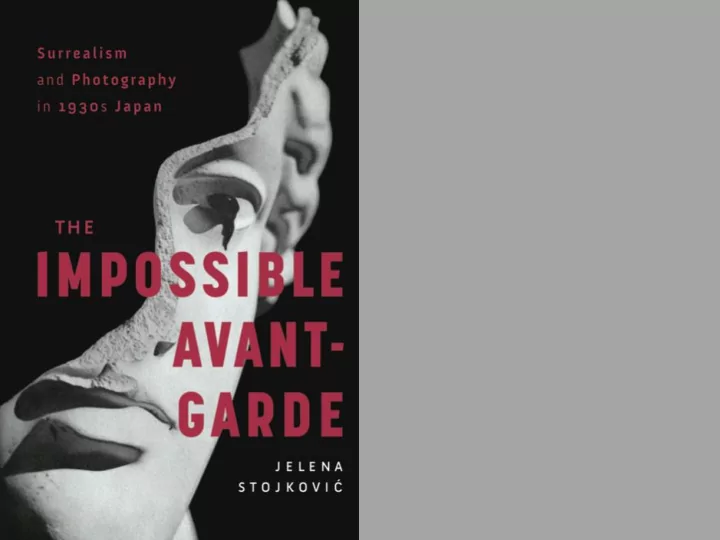
SLIDE 1
Surrealist photography in 1930s Japan, only emerging at the beginning of the decade, is fundamentally defined by impossibility, or, as it were, several impossibilities. First of al, there was no singular Surrealist group to foster it and any public proclamation of a support for an alliance with Surrealism could lead to surveillance or prosecution. To an extent, this situation mirrors a wider problem of authenticating historical avant-gardes in Japan, which were questioned
- n many occasions such like Surrealism was. As the notion of avant-garde is mostly understood from a Europocentric point of
view, its very existence in Japan could be considered as another impossibility to account for. However, Japan occupies a specific place within the process of cultural diversification of this discourse, acutely pertaining to avant-garde practice during the 1930s. As Eiji Oguma notes, situating Japan within the framework of Orientalism – in which the representation of the East is created by the West – is problematic as Japan was subjected to the Orientalizing gaze of the West while concurrently occupying and colonizing various countries in Asia. This situation forces every discussion of Surrealism in 1930s Japan to take into consideration the complex dynamics of the time while acknowledging the fact that it enabled a crucial link between the prewar (senzen) and postwar (sengo) avant-
- gardes. For Surrealist photography, this link is also important considering that women photographers only started to adopt