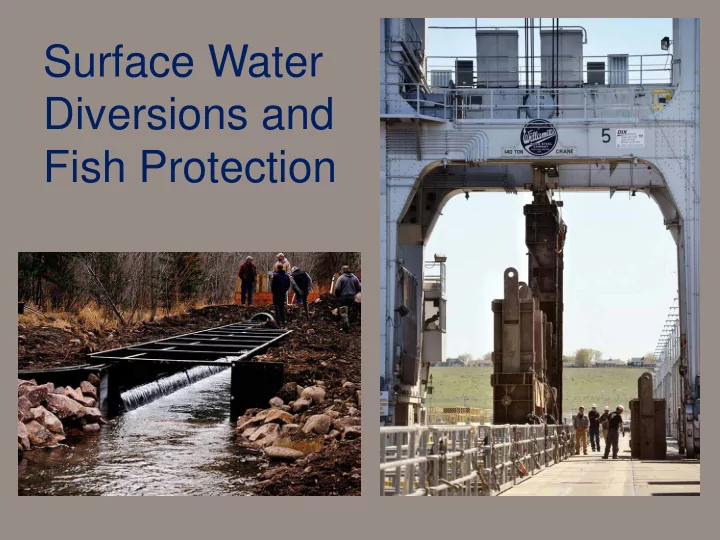
SLIDE 1
Surface Water Diversions and Fish Protection
SLIDE 2 The Need
Taking Water Out of Its Natural Location
SLIDE 3
The Impact
SLIDE 4 Annika W. Walters, Damon M. Holzer, James R. Faulkner, Charles D. Warren, Patrick D. Murphy & Michelle M. McClure (2012): Quantifying Cumulative Entrainment Effects for Chinook Salmon in a Heavily Irrigated Watershed, Transactions of the American Fisheries Society, 141:5, 1180-1190 The cumulative effect of water diversion on smolt out-migration was substantial, the installation of fish screens would reduce entrainment by 50- 90%.
SLIDE 5 The History
1946 - WDFW began providing screening services Endangered Species Act
SLIDE 6
The Challenge
SLIDE 7 Screening Solutions
Design Criteria
– Swimming abilities – Size
criteria and generally states follow
- Physical Barriers are the standard over
behavioral devices (lights, sound, electrical fields)
SLIDE 8 Screen Material
Welded Screen (wedge wire) Profile Bar Screen
SLIDE 9
Screen Type
Off Channel Upstream Control In or On Channel Downstream Control No Bypass
SLIDE 10
Diversion Type Off Channel Screen
SLIDE 11
Diversion Type On Channel
SLIDE 12 Screen Types
– Rotating Drum (conventional style) – Horizontal Fixed Plate – Eicher Screen (inclined inside pipe screen)
– End-Of-Pipe Screens (cone, cylinder, etc..) – Tee-screen (fixed or rotating) – Floating Surface Collectors
– Fixed Vertical and Non-Vertical Plate – Vertical or Horizontal Traveling – belt and panel – Coanda (weir screen)
SLIDE 13
Rotary Drums
SLIDE 14 Rotary Drums
- Susceptible to direct hits from large debris
- Seals require much maintenance.
- Susceptible to abrasions
- Passing debris downstream may require debris
screens if using sprinklers or hydro turbines
- Requires careful attention to water depth
– 65% to 85% submergence – May require checkboards downstream
SLIDE 15
Horizontal / Farmers Screen
SLIDE 16 Horizontal Plate Screen
- More headloss than other screen, requires
higher gradient system (~2% stream slope min)
- Requires more bypass flow
- Large civil footprint
- Works well for:
– High sediment systems – High organic debris systems – Remote sites with no power available
SLIDE 17
Vertical Traveling Screens
SLIDE 18 Vertical Traveling Screens
channel
- Compact civil works
- Jet sprays provide
additional cleaning.
conveyor behind screen to keep debris out of canal
complex
problem
down belting
stretching has been an issue.
PROS CONS
SLIDE 19 End of Pipe
- Passive or Active
- Often Wedge Wire
- Air burst, bushed, back
spray
SLIDE 20
End of Pipe – Cylinder
SLIDE 21
End of Pipe - Cones
SLIDE 22 End of Pipe - Advantages
- Good option for deep intakes
- Air burst cleaning system can be made to be
effective
- Some have effective brush cleaners
- Some off-the-shelf models with water backwash
systems meet NMFS criteria for active screens.
- Some can be easily removed for off-season
SLIDE 23 End of Pipe - Disadvantages
- Out of sight, out of mind (difficult maintenance)
- Need current to transport debris from screen site.
- Air burst systems on large installations don’t
always clean entire screen - especially the bottom.
- Long, stringy vegetation is a problem on small
pump screens.
- Requires sufficient depth to meet clearance
criteria
– ½ Screen diameter all around screen – Therefore min water depth must be 2x screen diameter
SLIDE 24
Vertical Panel
SLIDE 25
Cleaning Systems
SLIDE 26 Vertical Fixed Plate Screens
- Mechanically simple and easy to seal
- Can be installed on channel
- Large bypass flows required if installed in canal
- Brush arms can be damaged by large debris
- Sediment accumulation can cause brush
problems
- Very tall screens can have difficulty holding brush
tight to screen
- Brush cleaners can be mechanically complex
SLIDE 27 Other Screens
– Barrier – Not NMFS approved
SLIDE 28
Diversion Design
Screen and Intakes work Together
SLIDE 29 Intake Design
– place or precast concrete, metal, wooden.
transport can often be mitigated by intake design
– Orientation to stream – What is the morphology of the stream
SLIDE 30 Intake Design
- Entrance hydraulics
- Headloss
- Water Surface profile
especially for gravity systems behind a headgate
SLIDE 31 Design Considerations - Trashracks
- Trashracks have to be cleaned too!
– Sweeping flow
- In some cases, on channel T-screens or Cone
screens should be equipped with trash racks deflectors.
SLIDE 32 Design Considerations - Sediment
- Bedload vs suspended
- Sediment sinks
SLIDE 33 Entrance Conditions and Screen Orientation
hotspots
– Deflectors – Screen orientation to flow
SLIDE 34 Design Considerations - Bypass
used, a formal bypass is required.
backwater and not injuring fish
SLIDE 35
Design Considerations - Flooding
SLIDE 36 Maintenance
– Is screen shielded from debris? – Is sediment management accounted for? – Is there a maintenance plan in place for the system?
maintenance?
SLIDE 37 Summary
- Often complex projects with
multiple stakeholders with conflicting interests
– Fish Passage and protection – Operations – Cost
solutions
- Can be a catalyst for more
installation of more efficient infrastructure
maintenance
guide
SLIDE 38
Questions
Shane Sheldon shane@vientoeng.com
SLIDE 39 From Screens to Irrigation Modernization
- Allowed District to pipe and
pressurize 11 kilometers of
- pen canal
- Allowed installation of 1
Megawatt of hydropower capacity
- Allowed individual users to
install center pivots and micros
- District diverts 40% less water
to irrigate the same number of acres
their system
SLIDE 40 Modern Irrigation
- Farmers ID, OR
- Constructed 2003
- 80 CFS maximum
- 1 of 7 screens
- 4.8 Megawatts of
hydropower production
SLIDE 41 Screen Project Benefits
year in operational costs
production by 23%
pressurization of 64 kilometers of open ditches
1,400 pumps
improvements