Surface Defects, Symmetries and Dualities Christoph Schweigert - - PowerPoint PPT Presentation

surface defects symmetries and dualities
SMART_READER_LITE
LIVE PREVIEW

Surface Defects, Symmetries and Dualities Christoph Schweigert - - PowerPoint PPT Presentation

Surface Defects, Symmetries and Dualities Christoph Schweigert Hamburg University, Department of Mathematics and Center for Mathematical Physics joint with Jrgen Fuchs, Jan Priel and Alessandro Valentino Plan: 1. Topological defects in


slide-1
SLIDE 1

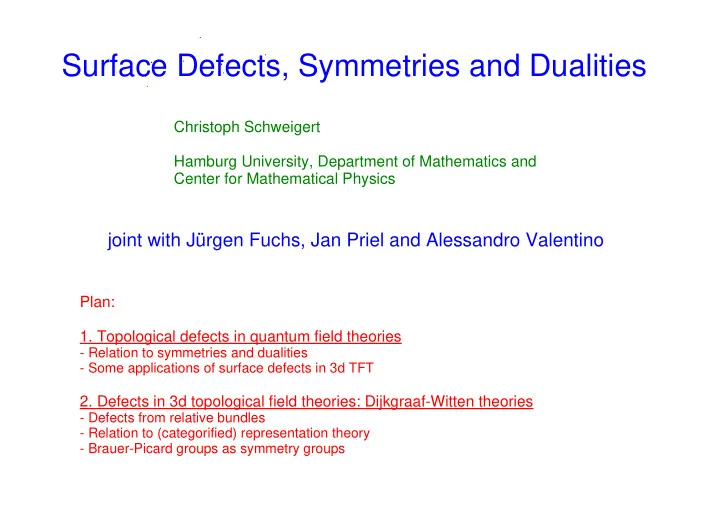
Surface Defects, Symmetries and Dualities

Christoph Schweigert Hamburg University, Department of Mathematics and Center for Mathematical Physics

joint with Jürgen Fuchs, Jan Priel and Alessandro Valentino

Plan:

  • 1. Topological defects in quantum field theories
  • Relation to symmetries and dualities
  • Some applications of surface defects in 3d TFT
  • 2. Defects in 3d topological field theories: Dijkgraaf-Witten theories
  • Defects from relative bundles
  • Relation to (categorified) representation theory
  • Brauer-Picard groups as symmetry groups
slide-2
SLIDE 2
  • 1. Topological defects in quantum field theories

Central insight: Defects and boundaries are important parts of the structure of a quantum field theory Particularly important subclass of defects: topological defects

1.1 Symmetries from invertible topological defects (2d RCFT [FFRS '04])

Invertible Defects

topological = correlators do not change under small deformations of the defect

slide-3
SLIDE 3
  • 1. Topological defects in quantum field theories

Central insight: Defects and boundaries are important parts of the structure of a quantum field theory Particularly important subclass of defects: topological defects

1.1 Symmetries from invertible topological defects (2d RCFT [FFRS '04])

Invertible Defects

equality of correlators topological = correlators do not change under small deformations of the defect

slide-4
SLIDE 4
  • 1. Topological defects in quantum field theories

Central insight: Defects and boundaries are important parts of the structure of a quantum field theory Particularly important subclass of defects: topological defects

1.1 Symmetries from invertible topological defects (2d RCFT [FFRS '04])

Invertible Defects

equality of correlators topological = correlators do not change under small deformations of the defect

slide-5
SLIDE 5

defect boundary composite boundary

is invertible defect

Action on boundaries: Example: critical Ising model Ex: critical Ising model 3-state Potts model Important for this talk: Similar statements apply to codimension-one topological defects in higher dimensional field theories. Insight: In two-dimensional theories: Group of invertible topological line defects acts as a symmetry group symmetry:

free fixed

slide-6
SLIDE 6

1.2 T-dualities and Kramers-Wannier dualities from topological defects

General situation:

Defect creates a disorder field can be undone by if Action on correlators: Order / disorder duality For critical Ising model: remnant of Kramers-Wannier duality at critical point Defects for T-dualities

  • f free boson can be

constructed from twist fields

invertible defect

slide-7
SLIDE 7

1.3 Defects in 3d TFTS

Motivation:

  • A local two-dimensional rational conformal field theory can be described

as a theory on a topological surface defect in a 3d TFT of Reshetikhin-Turaev type [FRS, Kapustin-Saulina]. Example: construction of (rationally) compactified free boson using abelian Chern-Simons theory

  • Topological phases

Topological codimension one defects also occur in other dimensions. This talk: Topological surface defects in 3d TFT of Reshetikhin-Turaev type. (Examples: abelian Chern-Simons, non-abelian Chern-Simons with compact gauge group, theories of Turaev-Viro type toric code)

slide-8
SLIDE 8

1.3 Defects in 3d TFTS

Motivation:

  • A local two-dimensional rational conformal field theory can be described

as a theory on a topological surface defect in a 3d TFT of Reshetikhin-Turaev type [FRS, Kapustin-Saulina]. Example: construction of (rationally) compactified free boson using abelian Chern-Simons theory

  • Topological phases

Topological codimension one defects also occur in other dimensions. This talk: Topological surface defects in 3d TFT of Reshetikhin-Turaev type. (Examples: abelian Chern-Simons, non-abelian Chern-Simons with compact gauge group, theories of Turaev-Viro type toric code) A general theory for such defects involving "categorified algebra" (e.g. fusion categories, (bi-)module categories) emerges. This talk: rather a case study in the class of Dijkgraaf-Witten theories (example: ground states of toric code), including the relation between defects and symmetries

slide-9
SLIDE 9
  • 2. Defects and boundaries in topological field theories

M closed oriented 3-manifold

G finite group

2.1 Construction of Dijkgraaf-Witten theories from G-bundles

slide-10
SLIDE 10
  • 2. Defects and boundaries in topological field theories

M closed oriented 3-manifold

groupoid cardinality G finite group

2.1 Construction of Dijkgraaf-Witten theories from G-bundles

Groupoid cardinality. Trivially, is a 3-mfd invariant. It is even a local invariant.

slide-11
SLIDE 11
  • 2. Defects and boundaries in topological field theories

M closed oriented 3-manifold closed oriented 2-manifold

groupoid cardinality G finite group This is a (gauge invariant) function on

2.1 Construction of Dijkgraaf-Witten theories from G-bundles

Groupoid cardinality. Trivially, is a 3-mfd invariant. It is even a local invariant. Consider for function defined by * A 3d TFT assigns vector spaces to 2-mfds * In DW theories, vector spaces are obtained by linearization from gauge equivalence classes of bundles

slide-12
SLIDE 12

2.2 DW Theory as an extended TFT

Idea: implement even more locality by cutting surfaces along circles

  • riented 1-mfg.

For any

``Pair of pants decomposition''

slide-13
SLIDE 13

2.2 DW Theory as an extended TFT

Idea: implement even more locality by cutting surfaces along circles

This is a vector bundle over the space of field configurations on . To a 1-mfd associate thus the collection of vector bundles over the space of G-bundles on . Bundles come with gauge transformations. Keep them! Two-layered structure. Two-layered structure: is category. TFT associates to S the category

  • riented 1-mfg.

Interpretation: category of Wilson lines: pointlike insertions types of Wilson lines For any

``Pair of pants decomposition''

slide-14
SLIDE 14

Exercise: compute this category! 4 simple Wilson lines Example: toric code: linear map vector space Linearize Element in Drinfeld center equivariant vector bundle on bundle described by holonomy gauge transformation

slide-15
SLIDE 15

2.3. Defects and boundaries in Dijkgraaf-Witten theories

Idea: relative bundles

Given relative manifold and group homomorphism Idea: keep the same 2-step procedure, but allow for more general field configurations

linearize

Allow for a different gauge group on the defect or boundary

(e.g. a subgroup)

slide-16
SLIDE 16

2.3. Defects and boundaries in Dijkgraaf-Witten theories Idea: relative bundles

Given relative manifold and group homomorphism Idea: keep the same 2-step procedure, but allow for more general field configurations

linearize

Transgress to

twisted linearization

Additional datum in DW theories: twisted linearization from topolog. Lagrangian

Allow for a different gauge group on the defect or boundary

(e.g. a subgroup)

slide-17
SLIDE 17

2.4 Categories from 1-manifolds Example: Interval

slide-18
SLIDE 18

2.4 Categories from 1-manifolds Example: Interval Data:

bulk Lagrangian bdry Lagrangian

such that such that

slide-19
SLIDE 19

2.4 Categories from 1-manifolds Example: Interval Data:

bulk Lagrangian bdry Lagrangian

Transgress to 2-cocycle on

Twisted linearization gives -linear category for generalized boundary Wilson lines. Here:

such that such that

slide-20
SLIDE 20

2.5 A glimpse of the general theory

Warmup: Open / closed 2d TFT [Lauda-Pfeiffer, Moore-Segal] Frobenius algebra : module Idea: associate vector spaces not only to circles, but also to intervals

boundary conditions

and is an

(not necessarily commutative; assume semisimple)

with to be determined

slide-21
SLIDE 21

Algebra is Morita-equivalent to algebra Boundary conditions correspond to modules; moreover

for all is the center of (intertwiners)

slide-22
SLIDE 22

Algebra is Morita-equivalent to algebra Boundary conditions correspond to modules; moreover

for all is the center of Dictionary 2d TFT

  • ne bc (semisimple) algebra
  • ther bc -modules

defects bimodules bulk center (intertwiners)

slide-23
SLIDE 23

Algebra is Morita-equivalent to algebra Boundary conditions correspond to modules; moreover

for all is the center of Dictionary 2d TFT 3d TFT of Turaev Viro type

  • ne bc (semisimple) algebra fusion category (bdry Wilson lines)

for DW theories:

  • ther bc -modules module categories

defects bimodules bimodule categories bulk center Drinfeld center (intertwiners)

slide-24
SLIDE 24

Module category

  • ver

Twisted linearization of relative bundles exactly reproduces representation theoretic results.

2.6 An example from Dijkgraaf-Witten theories

Fusion category is Known: indecomposable module categories The two ways to compute boundary Wilson lines agree:

(computed from twisted bundles) (computed from module categories over fusion categories)

such that , with finite group,

slide-25
SLIDE 25

2.7 Symmetries from defects

Recall: Symmetries invertible topological defects For 3d TFT of Turaev-Viro type (e.g. Dijkgraaf-Witten theories) based on fusion category these are invertible -bimodule categories (e.g. for DW-theories invertible -bimodule categories)

Bicategory ("categorical 2-group") , the Brauer-Picard group

slide-26
SLIDE 26

2.7 Symmetries from defects

Recall: Symmetries invertible topological defects For 3d TFT of Turaev-Viro type (e.g. Dijkgraaf-Witten theories) based on fusion category these are invertible -bimodule categories (e.g. for DW-theories invertible -bimodule categories)

"Symmetries can be detected from action on bulk Wilson lines"

Bicategory ("categorical 2-group") , the Brauer-Picard group

Braided equivalence, if invertible Important tool: Transmission of bulk Wilson lines

[Etingof-Nikshych-Ostrik]

slide-27
SLIDE 27

2.7 Symmetries from defects

Recall: Symmetries invertible topological defects For 3d TFT of Turaev-Viro type (e.g. Dijkgraaf-Witten theories) based on fusion category these are invertible -bimodule categories (e.g. for DW-theories invertible -bimodule categories)

"Symmetries can be detected from action on bulk Wilson lines"

Bicategory ("categorical 2-group") , the Brauer-Picard group

Braided equivalence, if invertible Explicitly computable for DW theories: Important tool: Transmission of bulk Wilson lines

Linearize span of action groupoids described by

[Etingof-Nikshych-Ostrik]

slide-28
SLIDE 28

2.8 Symmetries for abelian Dijkgraaf-Witten theories

quadratic form with

abelian Special case: Relation to lattices

slide-29
SLIDE 29

2.8 Symmetries for abelian Dijkgraaf-Witten theories Braided equivalence: Subgroup:

quadratic form with

abelian Special case:

Obvious symmetries:

1) Symmetries of

Relation to lattices

slide-30
SLIDE 30

2.8 Symmetries for abelian Dijkgraaf-Witten theories Braided equivalence: Braided equivalence: Subgroup: Subgroup:

(transgression) quadratic form with

abelian Special case:

Obvious symmetries:

2) Automorphisms of CS 2-gerbe 1) Symmetries of

1-gerbe on

"B-field"

Relation to lattices

slide-31
SLIDE 31

Braided equivalence: Subgroup: 3) Partial e-m dualities:

Example: A cyclic, fix

Theorem [FPSV] These symmetries form a set of generators for

slide-32
SLIDE 32
  • 3. Conclusions

Topological defects are important structures in quantum field theories

  • Topological defects implement symmetries and dualities
  • Applications to relative field theories on defects and topological phases

Defects in 3d topological field theories: Dijkgraaf-Witten theories

  • Defects from relative bundles
  • Relation to (categorified) representation theory:

module categories over monoidal categories

  • Brauer-Picard groups as symmetry groups