Supporting Facility and Shin Ming Guo Process Flows NKFUST - - PDF document

supporting facility and
SMART_READER_LITE
LIVE PREVIEW

Supporting Facility and Shin Ming Guo Process Flows NKFUST - - PDF document

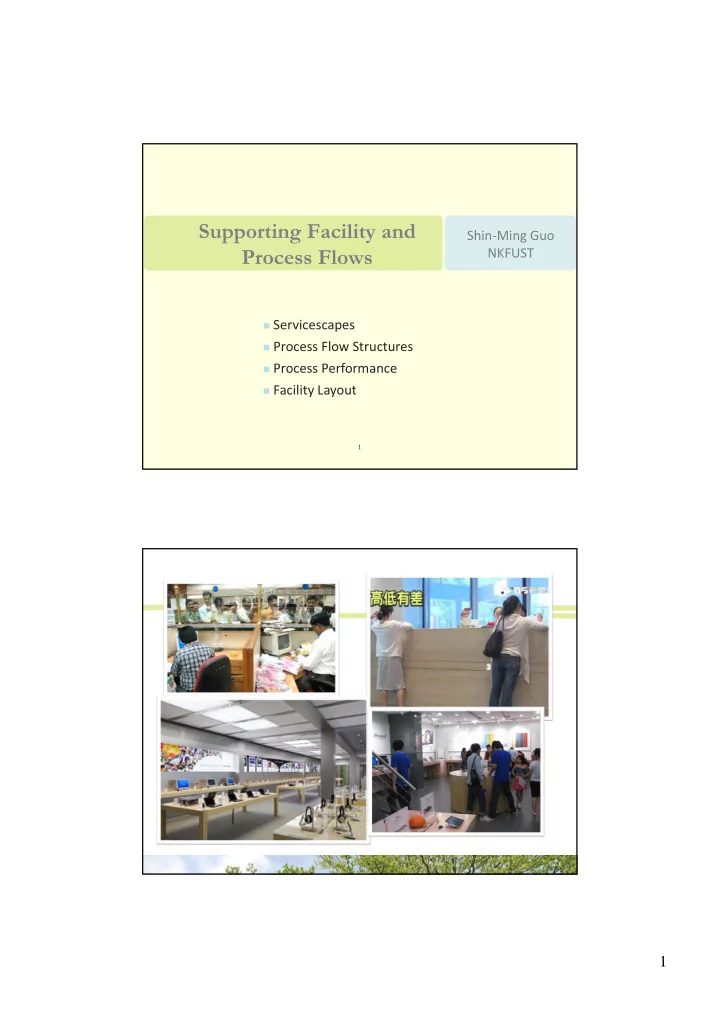
Supporting Facility and Shin Ming Guo Process Flows NKFUST Servicescapes Process Flow Structures Process Performance Facility Layout 1 1 Environmental Psychology & Orientation Need for spatial cues to orient visitors

slide-1
SLIDE 1

1

Supporting Facility and Process Flows

1

 Servicescapes  Process Flow Structures  Process Performance  Facility Layout

Shin‐Ming Guo NKFUST

slide-2
SLIDE 2

2

Environmental Psychology & Orientation

 Need for spatial cues to orient visitors  Place orientation (e.g., "Where am I?")  Function orientation (e.g., "How does this

  • rganization work, and what do I do next?").

 Formula facilities draw on previous experience  Anxiety and a sense of helplessness can result if

spatial cues are not present.

6

slide-3
SLIDE 3

3

Environmental Dimensions of Servicescape

7

Ambient conditions Background characteristics (temperature, music, illumination, scent) Spatial layout and functionality Circulation path of customers, groupings of merchandise Signs, symbols, and artifacts Carry special meaning or have social significance.

Definition of a Business Process

9

Factory

wood metal guitars

University

students alumni Distribution center bulk items small parcels Calculate credit risk mortgage applications approved loans rejected loans

 A process is a set of activities that accepts inputs and

produces outputs.

 Processes can involve both goods and services.

slide-4
SLIDE 4

4

Process Flowcharting

 Process flowcharting is the use of a diagram to present the

major elements of a process. Basic elements include

 The design of a product or services has a major impact on the

process design.

 What operations are needed? What is the right sequence? 10

An ellipsoid denotes the start or the end of a process

Flowchart of Graduate School Admissions

11

slide-5
SLIDE 5

5

Process Flow of Mortgage Service

12

Gantt Chart of Mortgage Service

13

slide-6
SLIDE 6

6

Two Sides of the Same Coin

From the perspective of the Server Why is there waiting time? Why is the resource under‐utilized? ∵ limited supply and variable demand From the egocentric perspective of the customer Long wait time despite arriving on time. ∵ poor planning ∴ perception of low quality

14

Types of Services Processes

Process Type Service Example Characteristic Management Challenge Project Consulting One‐of‐a‐kind engagement Staffing and scheduling Job Shop Hospital Many specialized departments Balancing utilization and scheduling patients Batch Airline Group of customers treated simultaneously Pricing of perishable asset (seat inventory) Flow Cafeteria Fixed sequence of

  • perations

Adjust staffing to demand fluctuations Continuous Electric Utility Uninterrupted delivery Maintenance and capacity planning

15

slide-7
SLIDE 7

7

Job Shop

16

Small batches of different products with different processing sequences

1 1 1 2 2 2 3 3 3 4 4 A B C Raw materials Assembly Drilling work center Painting work center Milling work center Lathe work center D

Batch Process and Continuous Flow

17

Bread production

slide-8
SLIDE 8

8

A Flow Line at IKEA’s Cafeteria

18

Process Flow Structures

20

Job Shop Batch Process Worker‐paced line Machine‐paced line Continuous process

Low Volume (unique) Medium Volume (high variety) High Volume (lower variety) Very high volume (standardized) Utilization of fixed capital generally too low Unit variable costs generally too high Commercial Printer Apparel Production High volume Auto assembly Oil refinery Low volume Auto Assembly

Hospital, Department Store Airline Cafeteria Fast food Internet provider

slide-9
SLIDE 9

9

Process Analysis of Slot Machines

21

Insert coin and pull Collect payout if win Machine spinning wait Play again The faster the customer plays, the more money the casino will earn.

Process Analysis Terminology

  • Cycle Time is the average time between completions of

successive units.

  • Bottleneck is the factor that limits production usually the

slowest operation.

  • Capacity is a measure of max. output per unit of time.
  • Throughput rate is the actual output per unit of time.
  • Capacity Utilization is a measure of how much output is

actually achieved.

22

slide-10
SLIDE 10

10

Process Analysis Terminology (cont.)

  • Throughput Time is the time to complete a process from time
  • f arrival to time of exit.
  • Rush Order Flow Time is the time to go through the system

without any queue time.

  • Total Direct Labor Content is the sum of all the operations

times.

  • Direct Labor Utilization is a measure of the percentage of time

that workers are actually contributing value to the service.

23

Flow Lines and Cycle Time

  • Process Cycle time = 1 min. Capacity = 60/hour.
  • Direct labor content = 2.5 min. Direct Labor Utilization =

2.5/(5×1)=50%

24

0.1 min 0.7 min 1.0 min 0.5 min 0.2 min 0.5min 0.5 min 0.5 min 0.5 min 0.5 min

 Process Cycle time = 0.5 min. Capacity = 120/hour.  Direct labor content = 2.5 min.  Direct Labor Utilization = 2.5/(5×0.5)=100%

slide-11
SLIDE 11

11

Inventory Turns (retail service)

25

 Throughput rate = average daily sales  Throughput time = days of supply  Days of supply =  Inventory turn =

Cost of Goods Sold

_______________________

average inventory value average daily sales average inventory value

________________________ Order Receipt On Shelf Sales

Comparing Kohl’s and Wal-Mart

26

2011 2010 2009 2008 2007 Kohl’s Revenue 18391 17178 16389 16474 15544 Cost of Goods Sold 11359 10679 10332 10459 9890 Inventory 3036 2923 2799 2856 2588 Net Income 1114 991 885 1084 1109 Inventory Turn 3.74 3.65 3.69 3.66 3.82 Walmart Revenue 418952 405046 401244 374526 344992 Cost of Goods Sold 307646 297500 299419 280198 258693 Inventory 36318 33160 34511 35180 33685 Net Income 16389 14335 13118 12884 12036 Inventory Turn 8.47 8.97 8.68 7.96 7.68

slide-12
SLIDE 12

12

27

Design a process to improve flow rate. Design a process to offer more selections. Design a process to reduce wait times. Design a process to control inventory.

Product Layout: How to Allocate Work?

28

Process cycle time = min. cycle time = 60 seconds Process Capacity = Capacity of the bottleneck = 60/hour

slide-13
SLIDE 13

13

Improved Layout of Driver’s License Office

29

Process cycle time = min. cycle time = 30 seconds Process Capacity = Capacity of the bottleneck = 120/hour

Flexible Layout

  • Process cycle time = 30 sec.
  • Process Capacity = 120/hour
  • No waiting in between.
  • No need to repeat information.
  • Flexible staffing.

30

slide-14
SLIDE 14

14

Process Layout: Where to Locate Departments?

31 10 6 6 10 7 5 6 20 4 3 6 6 20 1 7 10 15 2 8 3 10 15 8 8 20 6 30 15 30 8 10 40 12 6 8 5 30 10 10

A B C D E F A B C D E F A B C D E F

Net flow

Flow matrix Triangularized matrix Description of attractions: A=killer whale, B=sea lions, C=dolphins, D=water skiing, E=aquarium, F=water rides.

Ocean World Theme Park (Proposed Layout)

32

(a) Initial layout (b) Move C close to A

Pair Flow distances Pair Flow distances AC 30 x 2 = 60 CD 20 x 2 =40 AF 6 x 2 = 12 CF 8 x 2 =16 DC 20 x 2 = 40 DF 6 x 2 = 12 DF 6 x 2 = 12 AF 6 x 2 = 12 Total 124 CE 8 x 2 = 16 Total 96

(c ) Exchange A and C (d) Exchange B and E and move F

Pair Flow distances Pair Flow distances AE 15 x 2 = 30 AB 15 x 2 = 30 CF 8 x 2 = 16 AD 0 x 2 = 0 AF 6 x 2 = 12 FB 8 x 2 = 16 AD 0 x 2 = 0 FD 6 x 2 = 12 DF 6 x 2 = 12 Total 58 Total 70 A B C D E F A C D B E F C A D B F E A F C E D B

slide-15
SLIDE 15

15

Case 5.4: Central Market

33

  • Answer both questions.
  • Comment on this: www.youtube.com/watch?v=g3IwOgA3Ngw
  • Due 12:00 noon, 3/31

Summary

A successful firm needs to have good products and good processes Three performance measures

 High contact service: throughput rate, wait times  Retail service: inventory

Process analysis can identify the bottleneck and improve the throughput time. Facility layout improves the efficiency and minimizes the travel distance.

34