Supervised Self-Organising Maps similarity/distance (Kohonen, - - PowerPoint PPT Presentation

supervised self organising maps
SMART_READER_LITE
LIVE PREVIEW

Supervised Self-Organising Maps similarity/distance (Kohonen, - - PowerPoint PPT Presentation

Self-organising maps Map high-dimensional data to a 2D grid of units according to Supervised Self-Organising Maps similarity/distance (Kohonen, 1982). Ron Wehrens Institute of Molecules and Materials, IMM Radboud University


slide-1
SLIDE 1

Supervised Self-Organising Maps

Ron Wehrens Institute of Molecules and Materials, IMM Radboud University Nijmegen, The Netherlands Self-organising maps

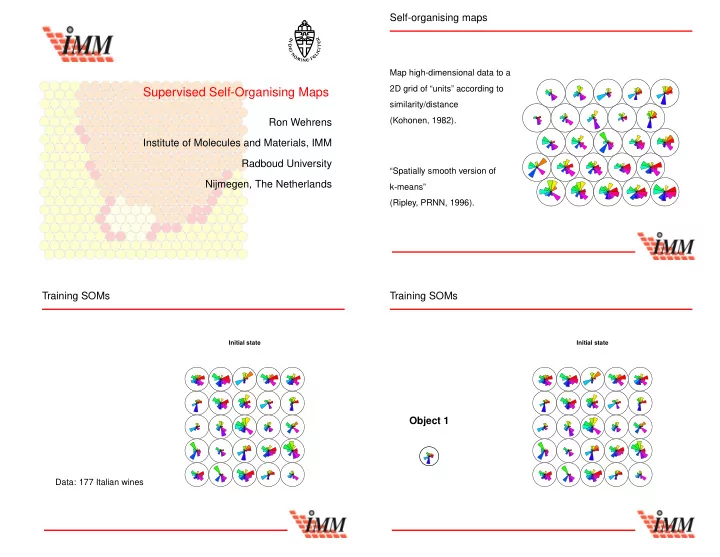
Map high-dimensional data to a 2D grid of “units” according to similarity/distance (Kohonen, 1982). “Spatially smooth version of k-means” (Ripley, PRNN, 1996).

Training SOMs

Data: 177 Italian wines

Initial state

Training SOMs Object 1

Initial state

slide-2
SLIDE 2

Training SOMs Object 1

Winner 1

Training SOMs Object 1

Update 1

Training SOMs

Algorithm:

✎ Pick random object ✎ Determine winner in map ✎ Update winner and environment ✎ Periodically, decrease environment and learning rate

R code:

> library(kohonen) > data(wines) > somnet <- som(scale(wines), gr = somgrid(5, 5), rlen=100) > plot(somnet, "codes")

Mapping

Wines: codebook vectors mapping

slide-3
SLIDE 3

Supervised SOMs ✎ use of all information ✎ better reproducibility ✎ better interpretability ✎ better predictions

W.J. Melssen, R. Wehrens and L.M.C Buydens, Chemom. Intell. Lab. Syst. (2006), in press.

Supervised SOMs ✎ use of all information ✎ better reproducibility ✎ better interpretability ✎ better predictions ✎ treat Y as a special (set of) variables ✎ separate range scaling of distances in X

and Y

✎ explicit weighting of distances in X and Y ✎ for regression as well as classification

W.J. Melssen, R. Wehrens and L.M.C Buydens, Chemom. Intell. Lab. Syst. (2006), in press.

Supervised SOMs ✎ use of all information ✎ better reproducibility ✎ better interpretability ✎ better predictions ✎ treat Y as a special (set of) variables ✎ separate range scaling of distances in X

and Y

✎ explicit weighting of distances in X and Y ✎ for regression as well as classification

> library(kohonen) > data(wines) > xyfnet <- xyf(scale(wines), classvec2classmat(wine.classes), gr = somgrid(5, 5), rlen=100, xweight = .5)

W.J. Melssen, R. Wehrens and L.M.C Buydens, Chemom. Intell. Lab. Syst. (2006), in press.

X-ray powder patterns

2θ 5 10 15 20 25 30 35 I A2 A6 B12 B14 N19 N20 C15 D16 E17 F18

Descriptor of crystal structure: similar patterns should correspond to similar structures

2θ 12 14 16 18
slide-4
SLIDE 4

Package wccsom ✎ Self-organising maps for

powder patterns

✎ Supervised and

unsupervised mapping

✎ Special similarity

function (WCC) with one parameter: triangle width

Data set: steroids

Space group # compounds label P212121 978 19 P21 843 4 P1 93 5 C2 99 1 Total 2013 Training set (1342 compounds) and a test set (671 compounds).

Mapping using cell volume

> xyfnet <- xyf(X[training,], Y[training], + gr = somgrid(20, 20, "hexagonal"), + rlen = 250, xweight = .5) > plot(xyfnet, "predict")

Training time: 1 h 20’ (P 3.2GHz)

log2(cell volume)

  • 8

10 12 14

Mapping using space group

  • 1

19 4 5

Space Group

SOM: no Space Group information

  • 1

19 4 5

XYF: including Space Group information

  • 1

19 4 5

XYF: Volume and Space Group information

> sompredictions <- + predict(somnet, trainY = classvec2classmat(Ycl[training])) > plot(somnet, "property", + property = sompredictions$unit.predictions) > plot(xyfnet, "predict")

slide-5
SLIDE 5

Prediction results (test set)

Volume prediction (correlation coefficients)

Seed 7 Seed 13 Seed 31 SOM .01

  • .04

.01 XYF (class only) .36 .41 .41 XYF (class and volume) .72 .28 .68

Space group prediction (percentage correct)

Seed 7 Seed 13 Seed 31 SOM 43% 43% 24% XYF (class only) 87% 86% 85% XYF (class and volume) 79% 46% 66%

Conclusions ✎ SOMs (supervised and unsupervised) are ideally suited for analysing

databases of chemical structures

✎ Special distance measures can/must be used ✎ Supervised SOMs have many advantages: better predictions, easier to

interpret, and better stability

✎ Training can take a long time but mapping is relatively fast ✎ Including space group information is important in predicting properties of

crystals

Acknowledgements

Library ’class’ by B.D. Ripley Edwards & Oman, RNews 3(3), 2003

✎ René de Gelder ✎ Willem Melssen ✎ Egon Willighagen