Superusers Learning aim Identify groups supporting in IT use - - PDF document

superusers
SMART_READER_LITE
LIVE PREVIEW

Superusers Learning aim Identify groups supporting in IT use - - PDF document

INF 3280, 23 April, 2019 Superusers Learning aim Identify groups supporting in IT use Specify conditions for these groups Basis for Assignment 3 Literature Chapter 11 Bjrge et al. (2015) Training Mentors of Health


slide-1
SLIDE 1

Jens Kaasbøll INF 3280, 23 April, 2019

Superusers

Learning aim – Identify groups supporting in IT use – Specify conditions for these groups – Basis for Assignment 3

  • Literature

– Chapter 11 – Bjørge et al. (2015) Training Mentors of Health Information Systems Through eLearning – Gallivan, M., Spitler, V. & Koufaris (2005) Does Information Technology Training Really Matter? A Social Information Processing Analysis of Coworkers' Influence on IT Usage in the Workplace. – McNeive (2009) Super Users Have Great Value in Your Organization

1

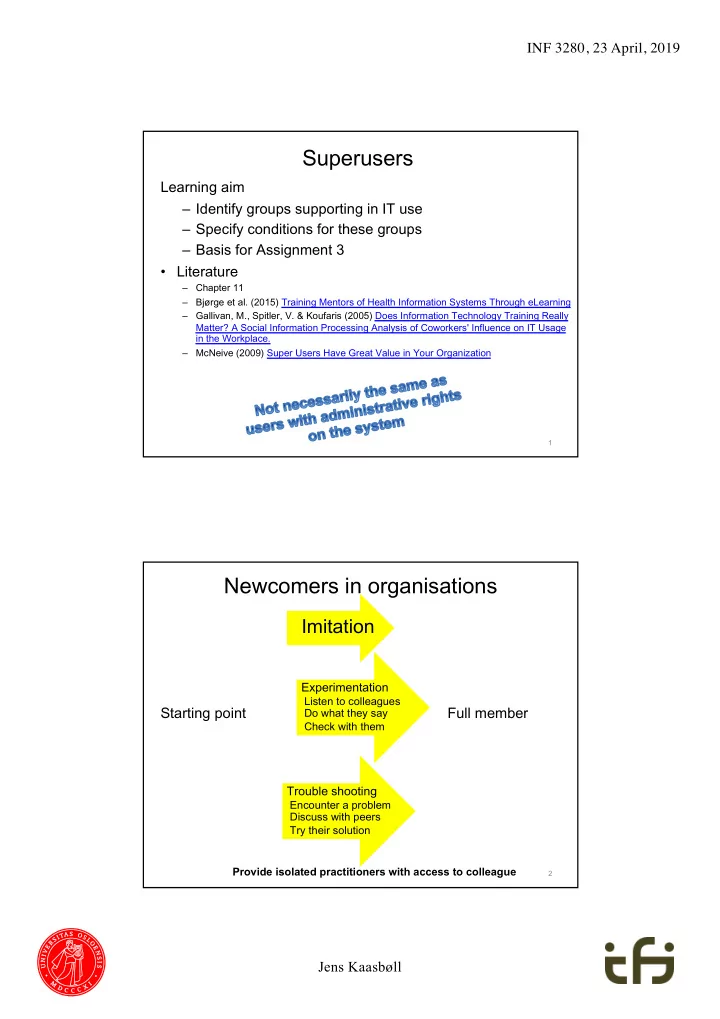
Newcomers in organisations

Starting point Full member

2

Imitation

Experimentation

Listen to colleagues Do what they say Check with them

Trouble shooting

Encounter a problem Discuss with peers Try their solution Provide isolated practitioners with access to colleague

slide-2
SLIDE 2

Jens Kaasbøll INF 3280, 23 April, 2019

Superusers

Double affiliation

IT and Users

Superuse ser group for learning from colleagues

3

Superusers’ roles and relations

4

Superusers

Chauffeur Problem solver Trainer Mentor Champion Help requester Learner Mentee Broker Users IT personnel

slide-3
SLIDE 3

Jens Kaasbøll INF 3280, 23 April, 2019 Superuse sers s during implementation

5

  • Public institution in USA

– 3000 employees

  • Legacy IS → Enterprise Resource Planning (ERP)

– Semi finished software covering all functions of a company – Tailoring

  • Configuration by parameters designed by the vendor
  • Customisation by adding functionality

– Efficient data processing – Long and costly adaptation – Freezes the organizational structure

  • Technical installation on time and on budget
  • Voluntary training

– Few attended

Boudreau and Robey (2005) Enacting Integrated Information Technology: A Human Agency Perspective

6

Three stages of implementation

1 – Superusers enter data – Avoidance – Superficious 2 – Improvised learning – Initiated by other superusers – No predetermined structure, schedule or method 3 – Experimentation – Compensating for limited knowledge and perceived system deficiencies – Workarounds I’m not doing things online yet. I’m by printing off a copy and then I fill it in and then send it through to power users I can’t tell you how many things that we learned, not because of training, not because the trainers knew it, but because somebody figured it out, and it became kind of folk knowledge On a purchase order, if you find that you have to add money, you can’t just go and change the line amount. It’s not going to work; something is going to happen and Disbursements won’t be able to pay it. So, a workaround we have here is to add an additional line to say ”Increase PO by x amount of dollar” just so the dollar amount equals what you need it to be equal.

Boudreau and Robey (2005) Enacting Integrated Information Technology: A Human Agency Perspective

slide-4
SLIDE 4

Jens Kaasbøll INF 3280, 23 April, 2019 Tr Trainers

  • IT support personnel
  • Teachers
  • Superusers

Trainers’ s’ main co competence ce

  • IT
  • Knowing how to learn
  • Connecting IT and business

7

Superusers as trainers

Superusers

Trainer and mentor Users

Superusers need specific competence on how to help others

8

  • 1. Users learn more by operating the computer

themselves than by a trainer demonstrating on the user’s computer.

  • 2. If a trainer takes over the keyboard, the user may feel

stupid and his self-efficacy can be lowered. à Make the user use the keyboard and mouse, don’t take over.

Bjørge and Jønsson (2015) Cultivating local champions for mentoring colleagues through integrated e-learning within District Health Information System: A quasi field experiment in Malawi. Master thesis. Department of Informatics, University of Oslo

Scaffold for superusers who guide skill learning

slide-5
SLIDE 5

Jens Kaasbøll INF 3280, 23 April, 2019

Negotiating

9

Yo You u sa say y tha hat none of yo you u are able to ha handle the n e new u ew user er i inter erfac ace? e? Yo You u se see, most st of my y colleague ues s don’t ’t find their way in the new UI. Can’t ’t you revert to the old one? Superusers

Broker Users IT personnel

Technology Acceptance Model – 2003

10

Perceived usefulness Perceived ease of use Social influence

  • Super-users

Facilitating conditions

  • Training
  • Support from IT personnel
  • Support from super-users

Time of use

Superusers

Champion Users

slide-6
SLIDE 6

Jens Kaasbøll INF 3280, 23 April, 2019

Survey

11

  • 200 users

– 80% female – University degree

  • Non-profit
  • US
  • Hypotheses:

Gallivan et al. (2005) Does Information Technology Training Really Matter? A Social Information Processing Analysis of Coworkers' Influence on IT Usage in the Workplace

Results

12

slide-7
SLIDE 7

Jens Kaasbøll INF 3280, 23 April, 2019

Scaffolds for superusers who Champion a system through motivating others

13

Consider tasks where you use pivot tables. Explain the task to the user and motivate the user by demonstrating why pivot tables are useful for this task. Check that relevant data and indicators exist in the system.

Guideline for pivot table session

What is your most important dashboard item? Show it to the user and explain why it is important for you. Prepare some tables, charts etc. that the user can add to the dashboard.

Guideline for dashboard session

Bjørge and Jønsson (2015)

A Training module for superusers to read and prepare before guiding a collague

6. 6. Ove vervi view of yo your data – Dash shboard

Prerequisi sites Before you start guiding a user on Dashboard, you need to prepare some tables, charts etc. that the user can add to the Dashboard. What is your most important dashboard item? Guidelines Guidelines Make the user make a graph and store it as a Favorite.

  • 1. Show your most important dashboard item to the user and explain why it is

important for you.

  • 2. Make the user explain a strategy for making a dashboard (the idea of

collecting exactly these data in the same dashboard)

  • 3. Tell the user that one can make several dashboards for analysis. Make the

user add several dashboards. Co Commo mmon e erro rrors rs

  • Users can get confused by the shared dashboard at district level, and the

personal (the one you create on your own).

  • Users have trouble finding their stored favourites. Make sure that your users

names his/hers favourites such that they can remember the name.

14

slide-8
SLIDE 8

Jens Kaasbøll INF 3280, 23 April, 2019

Organising for mass learning

+ Superuse sers

  • 1. Develop material for learning

– Publish on the web

  • 2. Select superusers

– One per geographical unit

  • Floor
  • 3. Train superusers thoroughly

– Inform all users of introduction – Inform all users of the superuser – If neccessary, train all users briefly

  • Superusers involved as trainer
  • 4. Organise regular superuser

meetings − Casca scade training

  • 1. Develop material
  • 2. Select 2nd level trainers
  • 3. Train these
  • 4. Let them train users

15

They don’t know the business. They disappear.

Summary

  • 8. Identify, organise, authorise and cultivate superusers.
  • 9. Include superusers as trainers and champions for new

IT systems.

16