
SLIDE 1
Daniel Feldman
Supersymmetry: LHC, Dark Matter, and the Scale of New Physics
SUSY 2011, Fermilab
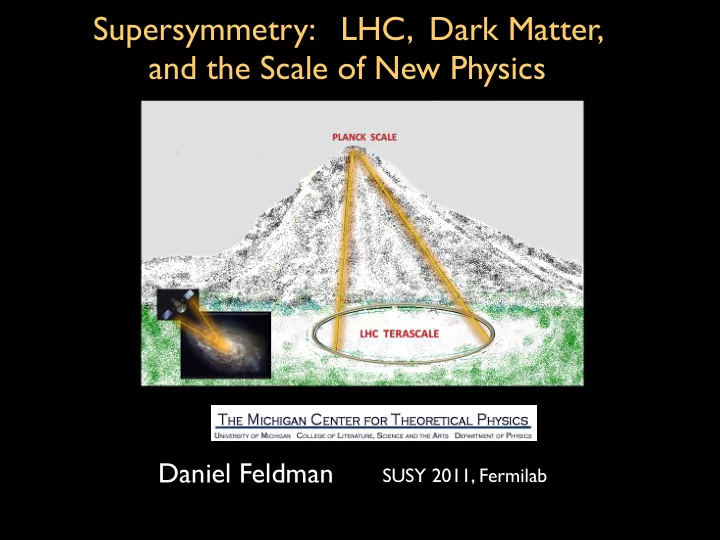
Supersymmetry: LHC, Dark Matter, and the Scale of New Physics - - PowerPoint PPT Presentation
Supersymmetry: LHC, Dark Matter, and the Scale of New Physics Daniel Feldman SUSY 2011, Fermilab Todays 30 minutes... SUGRA, LHC, DM and SIGNATURES EWSB in SUGRA and STRINGS ORIGIN OF DARK FORCES, HIDDEN SECTOR DM and SUSY
Daniel Feldman
SUSY 2011, Fermilab
where Cα = QL, uc
L, dc L, LL, ec L, H1, H2,
Lsoft = 1 2(Ma λa λa + h.c.) − m2
α
C∗α Cα
1 6Aαβγ Yαβγ Cα Cβ Cγ + B µ H1 H2 + h.c.
L + Ye(hm)LLH1ec L]
W = ˆ W(hm)µ(hm)H1H2 +
[Yu(hm)QLH2uc
L
2 4 6 8 10 12 14 16 18
Log10(Q/1 GeV)
100 200 300 400 500 600 Mass [GeV] m0 m1/2
(µ
2+m0 2) 1/2squarks sleptons
M1 M2 M3
Hd Hu
gg →
g,
q∗
j ,
gq →
qi, qq →
g,
q∗
j ,
qq →
qj,
qq →
i
C−
j ,
Nj, u qq →
i
−
j ,
ν∗
ud → C+
i
d ud → +
L
ν
+ . . .
Super Higgs: Gravitino becomes massive : SUSY
S.P. M.
Large Hadron Collider Break EW-Symmetry Break Super-Symmetry DM within Earth ˜ N1 ˜ N1 → SM SM′
˜ N1q → ˜ N1q
DM in the Galaxy
Naturally incorporate gravity via the gauging of global SUSY Mass generation for super-partners via super-Higgs breaking SUSY Unification of gauge couplings manifest Dynamic triggering of spontaneous electroweak symm. breaking through RGE Dark matter candidate consistent with R-parity Predictive - unification scale boundary cond. determine TeV scale phenomena Testable - colliders and flavor physics, dark matter scattering and annihilation + ... Basis for contact with string theory (determine W, K, f) - string phenomenology
DM evolution in the Universe Ωh2
G(φM, φ∗
M) = K(φM, φ∗ M) + log |W(φM)|2
V (φM, φ∗
M) = eG
GMKM ¯
NG ¯ N − 3
+VD
R − odd
(Φ = (h, H, A))
R − even
(˜ q˜ q, ˜ q˜ g, ˜ g˜ g . . .)
considerations with the gaugino sector sub-TeV to order TeV.
(which is minimal SUGRA) and LARGER in extensions. LHC 2011
Low MA ∼ MH now highly constrained Constraint on gluino ˜ g is significantly weaker Constraint on ˜ q3 is significantly weaker (in particular ˜ t)
than the constraint on ˜ q
[GeV]
A
m
100 150 200 250 300 350 400 450 500
10 20 30 40 50 60
CMS observed theory
± CMS expected
D0 7.3 fb LEP CMS 2010 observed CMS 2010 expected
95% CL excluded regions
CMS Preliminary 2011 1.1 fb
= 1 TeV
SUSY
scenario, M
max h
MSSM m
[GeV] m
500 1000 1500 2000 2500 3000 3500
[GeV]
1/2
m
200 300 400 500 600
(600) g ~ (800) g ~ (1000) g ~ (1200) g ~ ( 6 ) q ~ (1000) q ~ ( 1 4 ) q ~
>0 ! = 0, = 10, A ! MSUGRA/CMSSM: tan
=7 TeV s ,
= 1.04 fb
intL 0 lepton 2011 combined
Preliminary ATLAS
0 lepton 2011 combined
1 "" # LEP2
<0, 2.1 fb ! =3, ! , tan q ~ , g ~ D0
<0, 2 fb ! =5, ! , tan q ~ , g ~ CDF Theoretically excluded
CL median expected limit
sCL
Reference point 2010 data PCL 95% C.L. limit
I.Vivarelli - Albert Ludwigs Universität, Freiburg
On behalf of the ATLAS collaboration
mSUGRA
Simone Gennai (CERN/INFN)
big impact on dark matter searches
~
=
Akula, Peim, Chen, Liu, Nath, DF 1103.1197, PLB
http://www.ep.ph.bham.ac.uk/general/seminars/slides/ben-allanach.pdf
see: Allanach, Khoo, Lester, Williams
Sven Heinemeyer’s talk See talk with W. de Boer et al
Sparticle Mass Hierarchies, along with scale and mass splittings dictate what types of sparticles can decay into one another and can significantly alter signatures of new physics at the LHC. What are the collection of the possible ways the masses can stack up ? Scanning over the Landscape of mass configurations, what does this imply for the LHC ? Dark Matter ? Mass Hierarchical Patterns “Sparticle Landscape”
For a review see: arXiv:0908.3727
Sparticle Mass Hierarchies
Feldman, Liu, Nath: Phys. Rev. Letters 99: 251802, (2007) Phys.Lett.B662:190-198, (2008), JHEP 0804, 054 (2008)
mSP Mass Pattern µ mSP1 e χ0 < e χ±
1 < e
χ0
2 < e
χ0
3
µ± mSP2 e χ0 < e χ±
1 < e
χ0
2 < A/H
µ± mSP3 e χ0 < e χ±
1 < e
χ0
2 < e
τ1 µ± mSP4 e χ0 < e χ±
1 < e
χ0
2 < ˜
g µ± mSP5 e χ0 < e τ1 < e lR < e ντ µ± mSP6 e χ0 < e τ1 < e χ±
1 < e
χ0
2
µ± mSP7 e χ0 < e τ1 < e lR < e χ±
1
µ± mSP8 e χ0 < e τ1 < A ∼ H µ± mSP9 e χ0 < e τ1 < e lR < A/H µ± mSP10 e χ0 < e τ1 < e t1 < e lR µ+ mSP11 e χ0 < e t1 < e χ±
1 < e
χ0
2
µ± mSP12 e χ0 < e t1 < e τ1 < e χ±
1
µ± mSP13 e χ0 < e t1 < e τ1 < e lR µ± mSP14 e χ0 < A ∼ H < H± µ+ mSP15 e χ0 < A ∼ H < e χ±
1
µ+ mSP16 e χ0 < A ∼ H < e τ1 µ+ mSP17 e χ0 < e τ1 < e χ0
2 < e
χ±
1
µ− mSP18 e χ0 < e τ1 < e lR < e t1 µ− mSP19 e χ0 < e τ1 < e t1 < e χ±
1
µ− mSP20 e χ0 < e t1 < e χ0
2 < e
χ±
1
µ− mSP21 e χ0 < e t1 < e τ1 < e χ0
2
µ− mSP22 e χ0 < e χ0
2 < e
χ±
1 < ˜
g µ−
Table: The Sparticle Landscape of Mass Hierarchies in mSUGRA.
NUSP Mass Pattern Model NUSP1 e χ0 < e χ±
1 < e
χ0
2 < e
t1 NU3,NUG NUSP2 e χ0 < e χ±
1 < A ∼ H
NU3 NUSP3 e χ0 < e χ±
1 < e
τ1 < e χ0
2
NUG NUSP4 e χ0 < e χ±
1 < e
τ1 < e lR NUG NUSP5 e χ0 < e τ1 < e ντ < e τ2 NU3 NUSP6 e χ0 < e τ1 < e ντ < e χ±
1
NU3 NUSP7 e χ0 < e τ1 < e t1 < A/H NUG NUSP8 e χ0 < e τ1 < e lR < e νµ NUG NUSP9 e χ0 < e τ1 < e χ±
1 < e
lR NUG NUSP10 e χ0 < e t1 < ˜ g < e χ±
1
NUG NUSP11 e χ0 < e t1 < A ∼ H NUG NUSP12 e χ0 < A ∼ H < ˜ g NUG NUSP13 e χ0 < ˜ g < e χ±
1 < e
χ0
2
NUG NUSP14 e χ0 < ˜ g < e t1 < e χ±
1
NUG NUSP15 e χ0 < ˜ g < A ∼ H NUG DBSP1 e χ0 < e τ1 < e ντ < A/H DB DBSP2 e χ0 < e τ1 < e ντ < e lR DB DBSP3 e χ0 < e τ1 < e ντ < e νµ DB DBSP4 e χ0 < e t1 < e τ1 < e ντ DB DBSP5 e χ0 < e ντ < e τ1 < e νµ DB DBSP6 e χ0 < e ντ < e τ1 < e χ±
1
DB
Table: New patterns in NUSUGRA ; no new patterns seen in NUH.
NUG - non-universal gauginos NUH - non-universal Higgses NU3 - non-universal 3rd gen squarks
Can we map out the entire landscape? Intensive ... Larger sugra par. space searches should reveal even more. However, one really needs to understand the mapping of the mass hierarchies into LHC and Dark Matter Signatures
Higgs Patterns Chargino Patterns Stau patterns Stop Patterns
! "!! #!!! #"!! $!!! $"!! %!!! ! $!! &!! '!! (!! #!!! #$!!
!"#$$%"&'%(%)&*+,-&./01-%2 '3*&4&56&78!5
977%:,#(%&;<--&=>%?@ A+/8%"&17&9(%B,-
C;DE66 /CF5&&&=*F@ /CFE&&&=CGF@ /CF55&=CHF@ /CF5I&=3F@
! "!! #!!! #"!! $!!! $"!! %!!! ! #!! $!! %!! &!! "!!
F1-,&!"#$$%"&'%(%)&*+,-&./01-%2 '3*&4&56&78!5
977%:,#(%&;<--&=>%?@ A+/8%"&17&9(%B,-
E&-J",=C;@ /CF5&&&=*F@ /CFE&&&=CGF@ /CF55&=CHF@ /CF5I&=3F@
Figure: Effective mass (
Jet P Jet T
+ P miss
T
) distributions for different mSPs; Trigger and Post Trigger Level Cuts are crucial: Stops and Chargino Patterns are narrow, Stau and Higgs are broad; need specialized cuts per mass hierarchy.
!"#$%#&'' (!)*+,!++
1#23245
0<=#7-./06 )738#9:#"66
>0?@ABC6!6D656E6F&GG'6H2"6>0)I60:H<6)H::#72' /H''6*0)6,#<:7H$&236!66J@#KL "6M!6=N6J9>OL
(!)*+,6PQ/B16 )738#9:#"66
>0)4P >0)4I >0)4R >0)I ! "!! #!! $!! %!! &!! '!! (!! )!! *!! "!!! "! !%) "! !%( "! !%' "! !%& "! !%% "! !%$ "! !%# "! !%"!"#$%#&'' (#=$&2!++
1#23245
0<=#7-./06 )738#9:#"66
>0?@ABC6!6D656E6>0)46-SH7G&236H2"6:S#60:3=6)H::#72' /H''6*0)6,#<:7H$&236!66J@#KL "6M!6=N6J9>OL
(!)*+,6PQ/B16 )738#9:#"66
>0)4 >0)44 >0)4O >0)4Tmeff =
4
pT (ji) + / ET, H
χ0q scattering
some examples
Xenon is now here
arXiv: 0711.4591
Can Separate at the LHC and in Dark Matter Direct Detection
enhancements at large tb low Higgs mass, & largish Higgsino component for a mostly bino LSP.
(note: 14 TeV analysis)
Baer, Balazs, Belyaev,O’Farrill hep-ph/0305191 Chattopadhyay, Corsetti, Nath hep-ph/0303201
hep-ph/9710473 Chan, Chattopadhyay, Nath hep-ph/9908309 Feng, Matchev, Moroi
Higgs Patterns msp(14-16) Chargino Patterns msp(1-4) Stau patterns msp(5-10) Stop Patterns msp(11-13)
arXiv:0808.1595
Cohen, Phalen, Pierce
arXiv:1001.3408
DF, Liu, Nath
Chargino WALL on HB/FP
σSI
χp(WALL) ∼
m2
pµ2 χpg2 2
324πm4
hM 2 W
(gY n1 − g2n2)2
h W
×(n4 + αn3)2(9fp + 2fpG)2.∼ 10−8 pb = 10−44 cm2
Analytic result :
SI cross section
Hyperbolic Branch / Focus Point
Feng, Matchev, Wilczek hep-ph/0004043
Farina et al arXiv:1104.3572 Aukla et al arXiv:1103.5061
See talk by Aaron Pierce
DF, Liu, Nath arXiv:0711.4591
mSUGRA Models Above XENON-100 σSI Limit (Passing Other Experimental Constraints) m0 (GeV) m1/2 (GeV) 500 1000 1500 2000 2500 3000 200 400 600 800 1000 1200
NLSP χ+
1
NLSP τ NLSP A or H LHC-7 35/pb LHC-7 1/fb
m0 (GeV) m1/2 (GeV) mSUGRA Models Below XENON-100 σSI Limit (Passing Other Experimental Constraints) 500 1000 1500 2000 2500 3000 200 400 600 800 1000 1200 1400 1600 1800 2000
Sujeet Akula, DF, Zuowei Liu, Pran Nath, and Gregory Peim, arXiv:1103.5061 MPLA, and recent: 1107.3534
All models shown have consistent bsmumu, bsg, g-2, Relic Density (double sided), and prev. mass limits
HB/FP region (filled with Chargino Patterns) - part constrained. Higgs Patterns in the Bulk - some are removed. Note, h-pole extends well beyond 3 TeV .... on the edge ... in or out ...? No Stop Patterns constrained by XENON (~total bino), some by LHC (Stop NLSPs = ) in the right plot.
Allowed model space is HUGE (and with a denser search more models arise). No constraint at this time by any experiment above red curve in right plot.
... uncertainties become important
(Ellis, Olive, Savage, Giedt et al) ...note also sensitivity above i.e. regions overlap Reality Check : One is looking for one model (represented by ~ pixel in these planes). ALSO: non-universal soft breaking even more models allowed, see arXiv:1103.5061
However...
New Constraints on Dark Matter from the NEW CONSTRAINTS: XENON and the LHC
Akula, DF, Nath, Peim, arXiv:1107.3535, arXiv:1103.5061
..suggests upper limits on scalar masses, if it holds up, and if SUSY is the source, then SUSY can appear at the LHC.
(Recent: Dutta/Santoso, Kelso/Hooper, Carena et al, Akeroyd, Mahmoudi, Martinez Santos. ) Early SUSY analysis: (1999-2002) Choudhury, Gaur, Bobeth et al, Buras et al, Arnowitt, Dutta et al, Ibrahim, Nath ...
LHC is ripping into the testable space of Dark Matter experiments. Xenon constraints are very significant for lower LSP mass as
s search region are in excess of
the background predictions. A fit to the data determines B(B0
s → µ+µ−)= (1.8+1.1 −0.9) × 10−8 including all uncer-
tainties. Although of moderate statistical significance, this is the first indication of a B0
s → µ+µ− signal.
Search for B0
s → µ+µ− and B0 → µ+µ− Decays with CDF II
4.6 × 10⁻⁹ < Br(B0
s → µ+µ−) < 3.9 × 10−8.e 90% C.L.
g 7 fb−1 of integrated luminosity.
with 1.14 fb−1 at √s = 7 TeV
B(B0
s → µ+µ−)
< 1.9 × 10⁻⁸ (95% C.L.)
the CMS exp
s → −→
−
Barrel Endcap B0 → µ+µ− B0
s → µ+µ−B0 → µ+µ− B0
s → µ+µ−εtot (3.6 ± 0.4) × 10−3 (3.6 ± 0.4) × 10−3 (2.1 ± 0.2) × 10−3 (2.1 ± 0.2) × 10−3 Nexp
signal0.065 ± 0.011 0.80 ± 0.16 0.025 ± 0.004 0.36 ± 0.07 Nexp
comb0.40 ± 0.23 0.60 ± 0.35 0.53 ± 0.27 0.80 ± 0.40 Nexp
peak0.25 ± 0.06 0.07 ± 0.02 0.16 ± 0.04 0.04 ± 0.01 Nobs 2 1 1
LHCb preliminary results (EPS 2011, 300/pb)
Note: Light CP even Higgs-pole Region
densely populated with models (in and out of CDF region)
Hints of B0
s → µ+µ− ?
from : arXiv:1107.2304v1 [hep-ex] (1/2)m1/2 ∼ LSP mass
Large parameter space is untouched, but LSP mass in mSUGRA has a considerable
arXiv:1103.5061. IN FACT, NON-UNIVERSAL GAUGINO MASSES ARISE IN MANY MODELS OF SOFT-BREAKING. arXiv:1107.3535, arXiv:1103.5061
Observe larger m0 in these plots, and that mu < ~ 500 GeV in mSUGRA is by XENON at 90% C.L. Higgsino content larger - this is only PART of the hyperbolic branch.
XENON and LHC constrain similar spaces when including the 1 fb result.
Akula, Peim, Nath, DF
1107.3534
Effective Mass (GeV)
200 400 600 800 1000 1200 1400 1600 1800 2000
Events/50 Gev/5 fb
50 100 150 200 250 300 350 400 450
Effective Mass (GeV)
200 400 600 800 1000 1200 1400 1600 1800 2000
Events/50 Gev/5 fb
50 100 150 200 250 300 350 400 450
SM Background
25) GeV ± = (725
peak eff
m = 476 GeV
g ~
m
f mpeak
eff
/m˜
g = 1.52 ± 0.055.
meff =
4
pT (ji) + / ET, H
CUT C1 : n() = 0, pT(j1) ≥ 150 GeV, pT(j2, j3, j4) ≥ 40 GeV
2m˜
χ0
1 m˜
χ±
1 m˜
χ0
2 1
4m˜
g
ΩCDMh2 = 0.1120 ± 0.0056
˜ χ0
1 ˜
χ0
1 → h → b¯
b, τ ¯ τ, c¯ c . . . (2m˜
χ0
1 mh)
β m˜
g mh m˜ χ0
1 m˜
χ±
1
m˜
q
m˜
t1 mA mH
476 119 60 117 2959 1668 2608
σ˜
χ±
1 ˜
χ0
2/σtotal; 47%±2.5%)
i.e. σ˜
g˜ g/σtotal; 28%±3.3%)
i.e. σ˜
χ±
1 ˜
χ∓
1 /σtotal; 23% ± 1.3%)
is, ˜ g → qi¯ q
i ˜
χ±
1 and ˜
g → qi¯ qi ˜ χ0
2 w
s ˜ χ0
2 → /
ET + 2 fermions
→ → nd ˜ χ±
1 → /
ET + 2 fermions.
(today)
LHC CAN OBSERVE THIS NOW WITH ~(1-5) fb IF IT EXISTS
LHC and Dark Matter: DF, Katie Freese, Brent Nelson, Pran Nath, Gregory Peim 1102.2548, PRD
Recent work, Utpal Chattopadhyay, D. Das, D. K. Ghosh and M. Maity, Phys. Rev. D 82, 075013 (2010). Higgs Pole: P. Nath and R. L. Arnowitt, Phys. Rev. Lett. 70, 3696 (1993); A. Djouadi, M. Drees and J. L. Kneur, Phys. Lett. B 624, 60 (2005);
50 55 60 65 10
47
10
46
10
45
10
44
10
43
10
42
m˜
χ0
1 (GeV)σSI(˜ χ0
1n) (cm2)
Density of Models in m1/2 GeV
125 130 135 140 145 150 155 160 165 170 CDMS09 XENON100
DF, Katie Freese, Pran Nath, Brent Nelson, Gregory Peim 1102.2548
h-res : Most Sensitive region to SI bounds ~ (50 - 65) GeV squarks > few TeV , gluino < 550 GeV (Ma =m1/2) Dilepton edge (Baer/Tata/Paige/Chen ’95)
OSSF dilepton Invariant Mass (GeV)
20 40 60 80 100 120 140Events/10 Gev/5 fb
5 10 15 20 25 30 35 40OSSF dilepton Invariant Mass (GeV)
20 40 60 80 100 120 140Events/10 Gev/5 fb
5 10 15 20 25 30 35 40 SM Background= 58 GeV
1OSSF dilepton Invariant Mass (GeV)
20 40 60 80 100 120 140Events/10 Gev/5 fb
10 15 20 25 30 35 40OSSF dilepton Invariant Mass (GeV)
20 40 60 80 100 120 140Events/10 Gev/5 fb
10 15 20 25 30 35 40 SM Background= 54 GeV
1e predicted to be 60 GeV and 55 GeV
m˜
χ0
1
2 sample models which capture the ~invariant features of all these models:
Specifically, 2L will be seen or excluded 1102.2548
No CoGeNT Solution in models with only MSSM spectra with radiative breaking via RGE flow (this is SUGRA with non-universal soft breaking) upper limit on cross section obtained.
NMSSM probes : J. Gunion, T. Tait, D. Hooper, A. Belikov, P. Draper, T. Liu, C. Wagner, L.T. Wang , H. Zhang et al
MSSM attempts with Majorana LSP fail : bsgamma, bsmumu, Higgs LHC/Tevatron
(after all constraints)
[ ]
Well motivated theories do lead to ~ sub-TeV gauginos with scalars that are rather ‘heavy’.
SUSY scalars several TeV, 10s of TeV, or more - Gaugino three body decays and radiative decays Gluino decays into 2 jets + Dark Matter Gluino decays into 1 jet + Dark Matter Gluinos decay into n jets + Dark Matter via Chargino & heavier Neutralino cascades
˜ g → g ˜ χ0
1
˜ g → q¯ q ˜ χ0
1
˜ g → q¯ q ˜ χ0
k>1
Gluino decays Haber/Kane ’82 Barbieri, Gamberini, Giudice, Ridolfi Baer, Tata, Woodside
˜ g → qd¯ qu ˜ χ+
m=1,2 + h.c.
GNLSP out of the Sparticle Landscape
One of the interesting possibilities that arises within the landscape of possible sparticle mass hierarchies is that the gluino (˜ g) is the next to the lightest supersymmetric particle (NLSP) where neutralino dark matter produces the correct relic abundance of such matter consistent with the WMAP observations. NUSP Mass Pattern NUSP13
g < χ±
1
χ0
2
NUSP14
g < t1 < χ±
1
NUSP15
g < A ∼ H
Table: Hierarchical sparticle mass patterns for the four lightest sparticles, where ˜
χ0 ≡ ˜ χ0
1 is the
LSP neutralino, and where the gluino is the NLSP that arises in the NUSUGRA models. Mass patterns given in FLN arXiv:0711.4591, Phys.Lett.B662:190-198, (2008)
constraints are satisfied as the GNLSP class of models.
σeff =
γiγjσij σ˜
g˜ gγ2 ˜ g + 2σ˜ g ˜ χ0
1γ˜
gγ˜ χ0
1 + σ˜
χ0
1 ˜
χ0
1γ2
˜ χ0
1 σ˜
g˜ gγ2 ˜ g ,
singlet + nonsinglet F breaking in E6, SO(10), SU(5)
G N L S P ? ! (DF’s invasion of this slide)
GNLSP signal is challenging due to mass splittings as governed by neutralino dark matter density
LHC as Gluino Factory; FLN arXiv:0905.1148, PRD 09 σpp(= ˜ g˜ g)/σpp(SUSY) % GNLSP Models
! " # $ % &! &" &# &$ &% "! "! #! $! %! &!! &"! &#! &$! &%! "!!
!"#$!%&!%!'()*+,!-%./,01!
σpp (pb) NLSP gluino mass GeV LHC √ s = 14 TeV σpp(SUSY) σpp(gg → ˜ g˜ g) σpp(q¯ q → ˜ g˜ g) ˜ g is the NLSP Ωh2 ∈ WMAP5
'!! #!! (!! $!! )!! %!! *!! &!
!"
&!
!
&!
"
&!
#
Overwhelming dominance of the ˜ g˜ g production process for the GNLSP. Actually, a large number of events pass triggers .... Gluino ∼Detailed Balance Ωh2 ↔ LHC subprocess Gluino-Neutralino Coannhilation (GNLSP) satisfies Relic Density Constraints. GNLSP is a motivated example of a simplified model. Present constraint LHC-7 1/fb on GNLSP ~ 400-450 GeV (see 1011.1246) PRD 2011
∆co = (m˜
g − m˜ χ)/m˜ χ
∈ (10 − 20)%
GNLSP via RGE
DF, Liu, Nath 0711.4591,0802.4085, 0905.1148, 1011.1246 Alwall, Wacker, Nojiri, Maltoni et al
showers and matrix elements.
see e.g. 0803.0019
(see talk by T. Li)
Signal is challenging due to mass splittings as governed by neutralino dark matter density
working in the limit that Planck Scale interactions can be ignored.
moduli, modulinos, ....
interactions can have important cosmological consequences.
SUGRA and STRINGS scalar soft breaking masses/couplings generically of size : Weinberg G-problem is re-interpreted in terms of moduli masses
Mass parameters in gaugino mass matrix can be suppressed: Examples of gaugino mass suppression in SUGRA/STRINGS:
(Conlon,Quevedo ’06), (Acharya, Bobkov. Kane, Kumar, Shao ’07, Achayra et al 2011) (common feature: non-pertub super potential and multiple moduli) Remark: -Suppression can happen with multiple moduli.
( ˆ mα, ˆ Aαβγ, ˆ Bαβ) ∼ O(M3/2)
30 years ago is was deduced that if the gravitino, M3/2, coupled to SM fields, then M3/2 10 TeV is need to avoid constraints on its decay from cosmology; (destruction of light elements) (Weinberg 1982).
Γφ = α M3
φ/M2 P ,
TR ∼
Mφ ∼ M3/2
Moduli mass (30 -50) TeV, (WMAP) Assumes energy density is completely converted into radiation Both bounds above are model dependent (coupling size, mass LSP, cross section etc)
(Arnowitt/Cham/Nath ’82)
Remark: this assumes minimal field content Early Realization In context of the Polonyi field: Coughlan, Fischler, Kolb, Raby, Ross, Ovrut, Steinhardt
implications ...
(being revisited)
String motivated models within the sugra paradigm do suggest a new approach to rather natural EWSB with (10-50) TeV scalars. Feldman, Kane, Kuflik, Lu arXiv:1105.3765
How can EWSB be broken naturally with huge scalar masses ? Suggests the “moduli-Higgs Hierarchy problem*”
*( DF at Upenn SVP meeting 2011)
M3/2 Mφ,mod mSoft Higgs ∼ (100 − 1000)MZ ?
... the solution is built into REWSB to appear in Phys. Lett. B
M3/2 = 1 MP Fφmodulus
MV = gφhiggs
Mφ ∼ M3/2
30 TeV
∼
30 100TeV
246 GeV
!"#$%&'(&))*+ ,&--%.+(&./0/123! "#$% &'()*+!$,-.+*+/0(
MPlanck = 1
7(6 × 6 × 6)(π·e) GeV
MP = MPlanck/( √ 8π)
(&))*+!.1204&*56++ !"#$%&'()(*&!"#$%"# &!##'(##)*$'+#,$-()"$#$- 7$8./+(&))*+!.1204&*56++ !+",-.-*()!"#$%"# &!##'(##)*$'+#,.-$ /(0"/&1)#2%+34)566%.+5&&'+%"7-*$& /(0"/&1$"#$%34)566%.+5&'+%"7-*$& *%!/.,0) 1$23'.-4 *!24() 1$23'.-4 String Vacuum Project University of Pennsylvania May 25th 2011
Explaining the Little Hierarchy: Heavy Moduli & Electroweak Symmetry Breaking
(DF)
Soft Parameters, well known to trace out trajectories : m2
Hu(t) = M2 0 fM0(t) + A2 0fA0(t) + M2 3 (0)f3(t) + M3(0)A0fmix(t) + . . .
New Result : M0 ∼ (10 − 50) TeV can lead to rather natural EWSB
(Feldman, Kane, Kuflik, Lu) : M0 ∼ (10 − 50) TeV, fM0 is positive and fA0 is
positive (it is formally a magnitude |A0|2 above) and (last 2 terms are small corrections) leading to: m2
Hu(t)
1 2(3δ(t) − 1)
1 2(δ(t) − δ2(t))
fM0(t) = 1 2(3δ(t) − 1), fA0(t) = 1 2(δ(t) − δ2(t)). For heavy scalars when EWSB happens fM0 ∼ fA0 ∼ 1/10. Intersection Point (IP) = near intersection, of the 2 terms in square brackets, suppresses large size of M0 = M3/2 A0, with M0 ∼ (10 − 50) TeV, (Feldman, Kane, Kuflik, Lu). δ(t) (top yukawa) receives corrections from QCD/stop-gluino loops
[Pierce, Bagger, Matchev, Zhang, ’97]
Feldman, Kane, Kuflik, Lu arXiv:1105.3765
Full 2-loop (RGEs) for the soft supersymmetry breaking masses and couplings, with radiative corrections to the gauge and Yukawa couplings etc.
|/M |A
0.5 0.6 0.7 0.8 0.9 1 1.1 1.2 1.3
/M
u
H
m
10
10
10
10
10
10
10
M0 = 30 TeV
m2
Hu ≃ (fM0 − fA0)M 2 3/2 ≃ 10−2M 2 3/2
M3/2 = M0 ∼ |A0|
Large Suppression of mu Gauginos are sub-TeV
Figure: M3/2 = M0 = 30 TeV and µ ∈ (0.9, 2) TeV with largest suppression
M3/2 = 10 TeV, |A0|/M3/2 ∼ 0.9, µmin ∼ 300 GeV M3/2 = 30 TeV, |A0|/M3/2 ∼ 1.2, µmin ∼ 900 GeV
More Generally: Intersection of RG Coefficients “Intersection Points” Feldman, Kane, Kuflik, Lu arXiv:1105.3765
The IP will drive down the µ term : µ2 = −M2
Z/2 +
¯ m2
Hd − ¯
m2
Hu tan2 β
tan2 β − 1 Bµ = 1 2 sin 2β( ¯ m2
Hu + ¯
m2
Hd + 2µ2)
¯ m2
Hi
= m2
Hi − Ti/vi ,
M2
Z = M2 Z,bare + ΠT ZZ(M2 Z)
Because m2
Hd barely runs, its value is really just M2 3/2 while
B = few × M3/2 in our model space. For tan β not too large, using ¯ m2
Hd ¯
m2
Hu the solution for the reduced µ is
µ2 ≈ ¯ m2
Hu
1 (B2/ ¯ m2
Hd) − 1 ∼ ¯
m2
Hu/2 = O
1 102
3/2
Reduction via RG running (Intersection Point) and from the tadpole corrections tadpole + tree ’tracks’ the solution at the point where the loop corr. is minimized. Analytic solution for tan β ∈ (4, 15) - larger values do arise. Even lowers values of µ are obtained.
Let me now emphasize, There is a built in cancellation in sugra and string motivated models,
square of the up type Higgs mass which suppresses µ. µmin ∼ (0.3 − 1) TeV for M3/2 ∼ (10 − 30) TeV ∼ |A0| ”lets put the trlinear coupling to zero” then you essentially miss this massive suppression For the scalars of size (10-50) TeV the reduced value of µ is when scalars and trilinears are of the same magnitude as the gravitino mass, as is suggested by string motivated models of soft breaking. The IP represents a new approach to the little hierarchy problem for models which are cosmologically viable : µ is of natural size about (0.3-3) TeV, for M0 = (10 − 50) TeV when |A0|/M0 is close to unity. (Feldman, Kane, Kuflik, Lu)
i
LHC as a Gluino Factory : Low Lums 7, 10, 14 TeV - EARLY LHC
!"#$%&
' (
)
*++ **+ ,++ ,*+ -++ -*+ .++ .*+ /++ /*+
!"01&
2324
! 500$6789$!
+ :+++ ;+++ <+++ =+++ *+++ ,+++
> :
!;++!?1 " @
> :
!.++!?1 " @!
LHC as a Gluino Factory. Can collect data from gluino decays to look for EW SUSY production. Kane, Lu Ran, Feldman, Nelson 1002.2430, PLB 2010
Recent related work : Gian Giudice, Tao Han, Kai Wang, Lian-Tao Wang, arXiv:1004.4902 Gluino as dominate mode also in : FLN arXiv:0905.1148, PRD 09
PAMELA - Galactic Positrons - What’s the connection?
!"#$%&'()#*+
, ,- ,--
'++
.
(# ! +/'
/
(# ! +'0'(
/
(# ! 12345$2"'6$78542"''''
PAMELA
”Observation of an anomalous positron abundance in the cosmic radiation” By PAMELA Collaboration, e-Print: arXiv:0810.4995 [astro-ph] ( Nature) and e-Print: arXiv:0810.4994 [astro-ph], ( PRL).
ΩCDMh2 ∝ [
Annihilating Dark Matter in the Halo
Several particle physics models that can simultaneously explain BOTH WMAP Ωh2
CDM ∼ 0.10 and PAMELA data
without huge adhoc boost factors put in by hand .
1
Breit-Wigner Enhancement (BWE) of dark matter annihilations in the halo Feldman, Liu, Nath, arXiv:0810.5762, Ibe, Murayama, Yanagida, arXiv:0812.0072
2
Thermal wino like LSP with a weakly interacting co-annihilating hidden sector HS Feldman,Liu, Nath, Nelson, arXiv:0907.5392
3
Thermal Higgsino LSP! Not constrained by Photons and can produce PAMELA ! Chen,Feldman,Liu, Nath, Peim arXiv:1010.0939
4
Non-thermal wino LSP with the relic abundance explained via moduli decay Randall and Moroi 99, Kane et. al (Kane, Lu, Watson 09) Common Feature is mass sensitivity:
1
BWE sensitive to mass MZ ∼ 2mDirac
2
Thermal wino-like and Higgsino-like mLSP =e
χ0 ∼ mξa
3
Non-thermal wino me
χ0 ∼ me χ±
1
SUSY Models can lead to a light gluino at the LHC
Kane, Lu Ran, Feldman, Nelson 1002.2430, PLB 2010 LHC (PGS) ⇐ ⇒ PAMELA (Galprop)
!"#$%&'()#*+ , ,- ,-- +
..#
/0(#
.#
,2-')#*'34"5 ,67')#*'34"5 8--')#*'34"5 9:;<%$5="> ?@A!B@ @AC D!@E
'(89'F:%'/'-B+'()#*+
#GGA 8-- H-- I-- 7-- J-- 2-- 6-- K-- ,--- ,,-- ,8-- !L#"FM08-')#*07'G9/,(N,IE#*+
8- H- I- 7- J- 2-
C4%":O.P:;<%$5="> P:;<%$5=">'Q',2-')#*
34"5
A 'Q'77-')#*
% R
A
Models are dominantly wino-like with lighter gluinos Dominant production pp → [(˜ g˜ g), ( W C1), ( C±
1 ,
C∓
1 )].
˜ g Decays: ˜ g → [( e N2t¯ t), (f Wb¯ b),(f W q¯ q), ( e C−
1 ¯
bt + h.c.), ( e C−
1 ¯
du + h.c.)] Secondary decays e N2 → e C1W ∗ → ( e C1lνl), ( e C1q¯ q) and e C1 → f W W ∗ → (f W lνl), (f W q¯ q) Tertiary SM t → W b and W → [(qu¯ qd), (lνl)].
Typically requires no more than 2-3 branchings = predictive + large jet signatures from the light gluino.
Remark: ¯ p is fine. See additional slides
Turner, Wilczek, Kamionkowski, Griest, Randall, Moroi, Feng, Matchev, Kane, Wells, Wang, Pierce, Watson, Grajek, Phalen, Hisano, Kawasaki, Khori, Nakayama, Lu, DF, Nath, Liu, Nelson
W-
+
Wino-LSP being probed. Admixture of Higgsino can support large < σv >W W and has smaller < σv >γZ. The constraint on < σv >γZ where monochromatic photons arise via loop diagrams in the neutralino annihilation processes χχ → γγ, γZ . I argue this is the strongest constraint on SUSY models from astrophysics to date.
!"#$%&#$'()%*+$,- ./0 .10 .20 .30 .40 .50 600 6.0 78-
9
:;%*<=
! >
" ?
@63
.0
@62
.0
+6%ABC$D8 +6@D"E$%ABC$D8 F"#B@D"E$%ABC$D8 G$'="%*H8BIJ$'=KD- G$'="%*LGF-
Kane,Lu Ran, Feldman, Nelson 1002.2430, PLB 2010
Photons from LSP ann: Bergstrom, Ullio, Bern, Gondolo, Perelstein /s)
3
v> (cm
! Z
" < 2 4 6 8 10 12 14 16 18
10 × /s)
3
v> (cm
WW
" < 0.5 1 1.5 2 2.5 3 3.5 4
10 ×
| < 1
12
0.95 < |N | < 0.95
12
0.85 < |N | < 0.85
12
0.7 < |N
LSP Mass
140 GeV 220 GeV PAMELA Preferred Fermi-Lat Preferred wino content
Z(4M2 LSP)−1.
E GeV ¯ e/(¯ e + e)
!"#$%&'($!$)$*+,*$-./01%2($"3$)$4
56-78$%9:.;<
!"#$%"&'()(& !"#$%"&'()(&*+)(),&
$ $PAMELA and LHC: Higgsino and Mixed Wino
Kinetic Energy T GeV ¯ pTOA
flux !"#!$%$!$%&$!$'()*!+
,-./0-$1232$#4+4 567829%$:$;2<=7&>?8@
+4
!++4
4+4
++4
#+4
!A+4
!B+4
!C+4
!D+4
!#+4
!+ !" " !" ! !" # !" !$ !" !% !" !& !" !' !" !#“String Photini”
“Stino”, “Stueckelino”,
hep-ph/0610133, arXiv:0907.5392 DF, Boris Kors, Pran Nath, Zuowei Liu, Brent Nelson,
Higgsino ALSO avoids Photon constraint Relic Density can be ENHANCED relative to MSSM (“Boost” in the Relic Density )
In the Degenerate limit one has for n U(1)s BCo (1 + dh dv )2 BMAX
Co
= (1 + 2n)2 Here ds =
s gs, for s = (v, h) .
BCo = Ωh2MSSM⊗Hidden Ωh2MSSM =
∞
xf σabvγaγb dx x2
∞
xf σABvΓAΓB dx x2
, γa = ga(1 + ∆a)3/2e−∆ax
(MSSM) ΓA = gA(1 + ∆A)3/2e−∆Ax
(MSSM ⊗ Hidden).
LSP is mostly Higgsino or mixed Wino with very weak components in the hidden sector
!"#$%&& '!"($)&%&'!"*$+&%&!"#$,&&
!"##$%&"'( ((()$%&"'( (((*+,+-.$ ((()$%&"'(
).")!/!)/&0)$ 12&0&34567
(((/+00$#((( ((1!)$%&"'(
((12345
"""8,/8%$
Figure: New matter arises from Dark sector and interacts with visible sector and interaction made possible through a connector sector. Include standard gauge Lagrangian and chiral interactions for U(1)X,Y but have chiral connector fields Dµφ± = (∂µ ± igXQXCµ ± igY YφBµ)φ± FID terms LFI = ˜ ξXDC + ˜ ξY DB VFID = g2
X
2
2 + g2
Y
2
2
Feldman, K¨
Feldman, Kors, Nath, (2006)
Dual to Stueckelberg Mass Generation in limit of large vev
Cµ Bµ D D
Dirac Fermion
∆LStKM = −1 4CµνCµν − δ 2BµνCµν − 1 2(M1Cµ + M2Bµ + ∂µσ)2 + gXJµ
XCµ + Lg.f.
Dark Matter = χ ≡ D
Hidden dark matter, kinetic & mass mixing + MASSIVE vector
neutral under U(1)X and Hidden secto : QSM|Hidden = QX|SM = 0. (
U(1)X × GSM × Z′
µ
Feldman, Kors, Nath, Liu (2006,2007), Cheung, Yuan (2007), Pospelov, Ritz, Voloshin (2007), Arkani-Hamed et al (2008) + ...
Dark Sectors, Dark Forces : hep-ph/0610133 (FKN) hep-ph/0702123 (FLN)
Stueck Mass
Conserved Vector Current gXQXJµ
XCµ
M2/M1 → 0 then Aµ coupling → 0
Boost in the σv from the Hidden Sector Pole Breit-Wigner Enhancement Mechanism:
!!"!#$%!&"!"!$#$! !'(!)(!"!'*+
,
!123!!#!$ $!4567 !8!!9:/;< !=%!>!?!!!9@ABCD<
$ % E B F G H I J K %$
!EH%$
!EGL7DM3.7N!-.5@3M7N L7DM3.7N!ON/.'P!O/Q!:/;
! !
%$
$%$
%%$
E%$
!E%$
!%R-S!A/T!9A7T/6!U< R-S!AMN!9+E< R-S!A/T R-S!A5V!9+%< +77./!A5V!9+%< LW+OXW!Y535 W+*!$% 4/53!U7AZMN/T
σvHalo = σvfreeze, and specifically in region of pole Large boost generated in the halo relative to freezeout. One must peform the integral over the pole in the relic density calculation. ξZ
L,R = CZ ψ CZ fL,R[s − M2 Z + iΓZMZ]−1, (Dirac DM narrow Z)
Breit-Wigner Enhancement - where WMAP constraints are satisfied (FLN hep-ph/0702123 PRD). Hidden sector, kinetic and mass mixings and a new massive boson, hep-ph/0610133 PRD, hep-ph/0701107 JHEP , hep-ph/0702123 PRD (New Jargon : ”Dark Force, Dark Photon, Vector Portal, etc...” )
D Zero Probing Narrow Stueckelberg Resonances
D0 Collaboration (Abazov et al.). FERMILAB-PUB-10-300-E, Aug 2010, e-Print: arXiv:1008.2023 [hep-ex]
!"#$%&
'(
)
*++ ,++ -++ .++ /++ 0++ 1++ 2++ 3+++33++
!$$&!"45& ! !67"'(! ! !'(&! ! ! 8 "8 "
3 3+
*
3+ 95:$;<$= >?8$@A$= " 3 " >?8$@A$=! " * " >?8$@A$=! BB)!'( !C!+D+* # !
BAB)
'( !C!+D+, # !
BAB)
'( !C!+D+- # !
BAB)
'( !C!+D+. # !
BAB)
'( !C!+D+/ # !
BAB)
'(
!"#
$%&!'()!*+ 2.E!FGH
Figure: Tevatron Probing Stueckelberg Extensions.
See FLN, PRL hep-ph/0603039
Narrow Stueckelberg Resonances at the LHC
Model → Pythia + PGS , - DF
!"#$%!$"&'(!)*+*,&%-"'.$//'01*23 455 465 755 765 655 665 855 9#*"&/ 5 :5 75 85 ;5 <55 <:5 <75 <85 <;5
=&=>'?@'=!A"$+
)<
B'C'6'DE
' C ' < 7 ' F * 2 /
B<'F%!AA*%/ BGH 'C'5I58 !
White Paper BSM-LHC Hidden Sector Signatures (DF, Z.Liu, L.T. Wang, K. Zurek)
LHC 7 TeV , arXiv:1108.1582
MSSM × U(1)X
http://arxiv.org/abs/1001.2693
Huge parameter space of SUSY models exist even after all the recent experimental results. But, significant dents in the parameter space are evident. Look at possible Sparticle Mass Hierarchies to help sort out signatures and models. Connection between Flavor physics, Dark Matter and Colliders - leads to Multi-Probes of New physics: (remarkable - very different experiments reaching comparable sensitivities). Dark matter direct detection + LHC constraints + bsmumu ... HB/FP being tested... Higgs pole region, unified gaugino masses, can infer dark matter mass, (in or out ?) No CoGeNT with MSSM neutralino ... Higgs searches, bsgamma, bsmumu remove this possibility.
Gluino NLSP (GNLSP) well motivated simplified model - degeneracy gives relic density
New Solution for Electroweak Symmetry breaking Breaking - Intersection points
with ratio close to unity, with sub-TeV to TeV scale gluino = Solution to cosmic moduli problem with rather natural EWSB. Look for rich n-jet signatures of gluinos - LHC will test this. PAMELA wino, mixed wino and higgsino (higgsino weaker photon signal - wino can give signal) Extended Gauge Symmetries of the SM and MSSM - Stueckelberg Mechanism. Origin of Hidden sector dark matter (aka Dark Force) - massive U(1)hidden mass & kinetic mixing. Narrow Stueckelberg Resonances at colliders - Dark Forces at colliders. Breit-Wigner Enhancement in galactic halo consistent with Relic Density and produces PAMELA.
See recent talk : http://hepg.sdu.edu.cn/THPPC/conference/z0-factory-2011/liuzuowei.pdf
Extended MSSM - can lead to Enhancement in Relic Density - can also explain PAMELA.