
SLIDE 1
Georg Raffelt, MPI Physics, Munich ITN Invisibles, Training Lectures, GGI Florence, June 2012
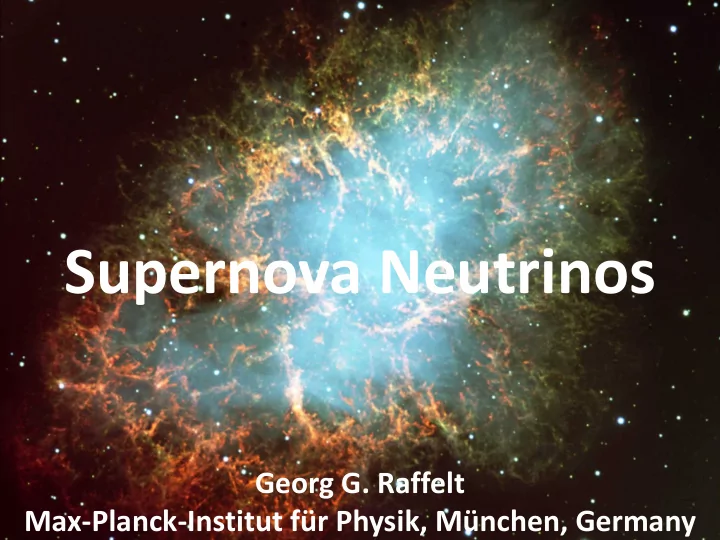
Crab Nebula
Supernova Neutrinos
Georg G. Raffelt Max-Planck-Institut für Physik, München, Germany
Supernova Neutrinos Georg G. Raffelt Max-Planck-Institut fr Physik, - - PowerPoint PPT Presentation
Crab Nebula Supernova Neutrinos Georg G. Raffelt Max-Planck-Institut fr Physik, Mnchen, Germany Georg Raffelt, MPI Physics, Munich ITN Invisibles, Training Lectures, GGI Florence, June 2012 Sanduleak -69 202 Sanduleak 69 202 Tarantula
Georg Raffelt, MPI Physics, Munich ITN Invisibles, Training Lectures, GGI Florence, June 2012
Crab Nebula
Georg G. Raffelt Max-Planck-Institut für Physik, München, Germany
Georg Raffelt, MPI Physics, Munich ITN Invisibles, Training Lectures, GGI Florence, June 2012
Sanduleak -69 202 Sanduleak −69 202
Large Magellanic Cloud Distance 50 kpc (160.000 light years) Tarantula Nebula
Georg Raffelt, MPI Physics, Munich ITN Invisibles, Training Lectures, GGI Florence, June 2012
Sanduleak -69 202 Sanduleak −69 202
Large Magellanic Cloud Distance 50 kpc (160.000 light years) Tarantula Nebula
Supernova 1987A
23 February 1987
Georg Raffelt, MPI Physics, Munich ITN Invisibles, Training Lectures, GGI Florence, June 2012
Crab Nebula
Georg Raffelt, MPI Physics, Munich ITN Invisibles, Training Lectures, GGI Florence, June 2012
The Crab Pulsar
Chandra x-ray images
Georg Raffelt, MPI Physics, Munich ITN Invisibles, Training Lectures, GGI Florence, June 2012
Supernova Remnant in Cas A (SN 1667?)
Non-pulsar compact remnant
Chandra x-ray image
Georg Raffelt, MPI Physics, Munich ITN Invisibles, Training Lectures, GGI Florence, June 2012
Baade and Zwicky
Baade and Zwicky were the first to speculate about a connection between supernova explosions and neutron-star formation [Phys. Rev. 45 (1934) 138] Walter Baade (1893–1960) Fritz Zwicky (1898–1974)
Georg Raffelt, MPI Physics, Munich ITN Invisibles, Training Lectures, GGI Florence, June 2012
Stellar Collapse and Supernova Explosion
Hydrogen Burning Main-sequence star Helium-burning star Helium Burning Hydrogen Burning
Georg Raffelt, MPI Physics, Munich ITN Invisibles, Training Lectures, GGI Florence, June 2012
Stellar Collapse and Supernova Explosion
Hydrogen Burning Main-sequence star Helium-burning star Helium Burning Hydrogen Burning Onion structure
Degenerate iron core: ρ ≈ ρ ≈ 109 g cm−3 T ≈ 1010 K MFe≈ 1.5 Msun RFe ≈ 3000 km
Collapse (implosion)
Georg Raffelt, MPI Physics, Munich ITN Invisibles, Training Lectures, GGI Florence, June 2012
Stellar Collapse and Supernova Explosion
Collapse (implosion) Explosion Newborn Neutron Star
Georg Raffelt, MPI Physics, Munich ITN Invisibles, Training Lectures, GGI Florence, June 2012
Stellar Collapse and Supernova Explosion
Newborn Neutron Star
Neutrino cooling by diffusion
Georg Raffelt, MPI Physics, Munich ITN Invisibles, Training Lectures, GGI Florence, June 2012
Neutrino Signal of Supernova 1987A
Kamiokande-II (Japan) Water Cherenkov detector 2140 tons Clock uncertainty ±1 min Irvine-Michigan-Brookhaven (US) Water Cherenkov detector 6800 tons Clock uncertainty ±50 ms Within clock uncertainties, all signals are contemporaneous
Georg Raffelt, MPI Physics, Munich ITN Invisibles, Training Lectures, GGI Florence, June 2012
Interpreting SN 1987A Neutrinos
Jegerlehner, Neubig & Raffelt, PRD 54 (1996) 1194 Contours at CL 68.3%, 90% and 95.4%
Recent long-term simulations (Basel, Garching)
Theory
Georg Raffelt, MPI Physics, Munich ITN Invisibles, Training Lectures, GGI Florence, June 2012
Predicting Neutrinos from Core Collapse
Georg Raffelt, MPI Physics, Munich ITN Invisibles, Training Lectures, GGI Florence, June 2012
Flavor Oscillations
Georg Raffelt, MPI Physics, Munich ITN Invisibles, Training Lectures, GGI Florence, June 2012
Why No Prompt Explosion?
Dissociated Material (n, p, e, ν)
nuclear binding energy ≈ 1.7 × 1051 erg
explosion energy
within the iron core
by dissociating the remaining layer of iron
Georg Raffelt, MPI Physics, Munich ITN Invisibles, Training Lectures, GGI Florence, June 2012
Neutrinos Rejuvenating Stalled Shock
Neutrino heating increases pressure behind shock front Picture adapted from Janka, astro-ph/0008432
Georg Raffelt, MPI Physics, Munich ITN Invisibles, Training Lectures, GGI Florence, June 2012
Delayed Explosion
Wilson, Proc. Univ. Illinois Meeting on Num. Astrophys. (1982) Bethe & Wilson, ApJ 295 (1985) 14
Georg Raffelt, MPI Physics, Munich ITN Invisibles, Training Lectures, GGI Florence, June 2012
Exploding Models (8–10 Solar Masses)
Kitaura, Janka & Hillebrandt: “Explosions of O-Ne-Mg cores, the Crab supernova, and subluminous type II-P supernovae”, astro-ph/0512065
Georg Raffelt, MPI Physics, Munich ITN Invisibles, Training Lectures, GGI Florence, June 2012
3D Simulation (Garching group)
Georg Raffelt, MPI Physics, Munich ITN Invisibles, Training Lectures, GGI Florence, June 2012
Standing Accretion Shock Instability (SASI)
Mezzacappa et al., http://www.phy.ornl.gov/tsi/pages/simulations.html
Georg Raffelt, MPI Physics, Munich ITN Invisibles, Training Lectures, GGI Florence, June 2012
Gravitational Waves from Core-Collapse Supernovae
Müller, Rampp, Buras, Janka, & Shoemaker, astro-ph/0309833 “Towards gravitational wave signals from realistic core collapse supernova models”
Bounce GWs from asymmetric neutrino emission GWs from convective mass flows
Georg Raffelt, MPI Physics, Munich ITN Invisibles, Training Lectures, GGI Florence, June 2012
Three Phases of Neutrino Emission
Prompt νe burst Accretion Cooling
Cooling on neutrino diffusion time scale
Fischer et al. (Basel group), A&A 517:A80, 2010 [arxiv:0908.1871]
Georg Raffelt, MPI Physics, Munich ITN Invisibles, Training Lectures, GGI Florence, June 2012
Flavor Oscillations
Georg Raffelt, MPI Physics, Munich ITN Invisibles, Training Lectures, GGI Florence, June 2012
Operational Detectors for Supernova Neutrinos
Super-K (104) KamLAND (400) MiniBooNE (200)
In brackets events for a “fiducial SN” at distance 10 kpc
LVD (400) Borexino (100) IceCube (106) Baksan (100) HALO (tens) Daya Bay (100)
Georg Raffelt, MPI Physics, Munich ITN Invisibles, Training Lectures, GGI Florence, June 2012
Super-Kamiokande Neutrino Detector
Georg Raffelt, MPI Physics, Munich ITN Invisibles, Training Lectures, GGI Florence, June 2012
Simulated Supernova Burst in Super-Kamiokande
Movie by C. Little, including work by S. Farrell & B. Reed, (Kate Scholberg’s group at Duke University) http://snews.bnl.gov/snmovie.html
Georg Raffelt, MPI Physics, Munich ITN Invisibles, Training Lectures, GGI Florence, June 2012
IceCube as a Supernova Neutrino Detector
Pryor, Roos & Webster (ApJ 329:355, 1988), Halzen, Jacobsen & Zas (astro-ph/9512080) SN signal at 10 kpc 10.8 Msun simulation
[arXiv:0908.1871]
Accretion Cooling
Georg Raffelt, MPI Physics, Munich ITN Invisibles, Training Lectures, GGI Florence, June 2012
Variability seen in Neutrinos
Luminosity Detection rate in IceCube Lund, Marek, Lunardini, Janka & Raffelt, arXiv:1006.1889 Using 2-D model of Marek, Janka & Müller, arXiv:0808.4136 Probably smaller in realistic 3D models
Georg Raffelt, MPI Physics, Munich ITN Invisibles, Training Lectures, GGI Florence, June 2012
Quark-Matter Phase Transition Signature in IceCube
Dasgupta, Fischer, Horiuchi, Liebendörfer, Mirizzi, Sagert & Schaffner-Bielich arXiv:0912.2568
Georg Raffelt, MPI Physics, Munich ITN Invisibles, Training Lectures, GGI Florence, June 2012
Next Generation Large-Scale Detector Concepts
Memphys Hyper-K DUSEL LBNE Megaton-scale water Cherenkov 5-100 kton liquid Argon 100 kton scale scintillator LENA HanoHano
Georg Raffelt, MPI Physics, Munich ITN Invisibles, Training Lectures, GGI Florence, June 2012
SuperNova Early Warning System (SNEWS)
http://snews.bnl.gov Early light curve of SN 1987A
Coincidence Server @ BNL Super-K
Alert
Borexino LVD IceCube
before photons
hours in advance
Georg Raffelt, MPI Physics, Munich ITN Invisibles, Training Lectures, GGI Florence, June 2012
Flavor Oscillations
Georg Raffelt, MPI Physics, Munich ITN Invisibles, Training Lectures, GGI Florence, June 2012
Local Group of Galaxies
Current best neutrino detectors sensitive out to few 100 kpc With megatonne class (30 x SK) 60 events from Andromeda
Georg Raffelt, MPI Physics, Munich ITN Invisibles, Training Lectures, GGI Florence, June 2012
Core-Collapse SN Rate in the Milky Way
References: van den Bergh & McClure, ApJ 425 (1994) 205. Cappellaro & Turatto, astro-ph/0012455. Diehl et al., Nature 439 (2006) 45. Strom, Astron. Astrophys. 288 (1994) L1. Tammann et al., ApJ 92 (1994) 487. Alekseev et al., JETP 77 (1993) 339 and my update.
Gamma rays from
26Al (Milky Way)
Historical galactic SNe (all types) SN statistics in external galaxies No galactic neutrino burst Core-collapse SNe per century 1 2 3 4 5 6 7 8 9 10
van den Bergh & McClure (1994) Cappellaro&Turatto (2000) Diehl et al. (2006) Tammann et al. (1994) Strom (1994) 90 % CL (30 years) Alekseev et al. (1993)
Georg Raffelt, MPI Physics, Munich ITN Invisibles, Training Lectures, GGI Florence, June 2012
High and Low Supernova Rates in Nearby Galaxies
M31 (Andromeda) D = 780 kpc NGC 6946 D = (5.5 ± 1) Mpc
Last Observed Supernova: 1885A Observed Supernovae: 1917A, 1939C, 1948B, 1968D, 1969P, 1980K, 2002hh, 2004et, 2008S
Georg Raffelt, MPI Physics, Munich ITN Invisibles, Training Lectures, GGI Florence, June 2012
The Red Supergiant Betelgeuse (Alpha Orionis)
First resolved image of a star
Distance (Hipparcos) 130 pc (425 lyr) If Betelgeuse goes Supernova:
(few days warning!), need neutron tagging [Odrzywolek, Misiaszek & Kutschera, astro-ph/0311012]
Georg Raffelt, MPI Physics, Munich ITN Invisibles, Training Lectures, GGI Florence, June 2012
Flavor Oscillations
Georg Raffelt, MPI Physics, Munich ITN Invisibles, Training Lectures, GGI Florence, June 2012
Diffuse Supernova Neutrino Background (DSNB)
Beacom & Vagins, PRL 93:171101,2004
Georg Raffelt, MPI Physics, Munich ITN Invisibles, Training Lectures, GGI Florence, June 2012
Supernova vs. Star Formation Rate in the Universe
Horiuchi, Beacom, Kochanek, Prieto, Stanek & Thompson arXiv:1102.1977 Measured SN rate about half the prediction from star formation rate Many “dark SNe” ?
Georg Raffelt, MPI Physics, Munich ITN Invisibles, Training Lectures, GGI Florence, June 2012
Neutron Tagging in Super-K with Gadolinium
200 ton water tank Selective water & Gd filtration system Transparency measurement Mark Vagins Neutrino 2010
Georg Raffelt, MPI Physics, Munich ITN Invisibles, Training Lectures, GGI Florence, June 2012
Average spectral properties from DSNB
Adapted from Yüksel, Ando & Beacom, astro-ph/0509297 90% CL sensitivity to average SN spectrum from DSNB after 5 years
Georg Raffelt, MPI Physics, Munich ITN Invisibles, Training Lectures, GGI Florence, June 2012
Flavor Oscillations
Georg Raffelt, MPI Physics, Munich ITN Invisibles, Training Lectures, GGI Florence, June 2012
Do Neutrinos Gravitate?
Early light curve of SN 1987A
Georg Raffelt, MPI Physics, Munich ITN Invisibles, Training Lectures, GGI Florence, June 2012
Millisecond Bounce Time Reconstruction
Super-Kamiokande IceCube
Halzen & Raffelt, arXiv:0908.2317 Pagliaroli, Vissani, Coccia & Fulgione arXiv:0903.1191 Onset of neutrino emission
measured SN 1987A data
a few tens of milliseconds
10 kpc
Georg Raffelt, MPI Physics, Munich ITN Invisibles, Training Lectures, GGI Florence, June 2012
Neutrino Limits by Intrinsic Signal Dispersion
Time of flight delay by neutrino mass “Milli charged” neutrinos
Nature 329 (1987) 21
Loredo & Lamb Ann N.Y. Acad. Sci. 571 (1989) 601 find 23 eV (95% CL limit) from detailed maximum-likelihood analysis Assuming charge conservation in neutron decay yields a more restrictive limit of about 3×10⁻²¹ e
Path bent by galactic magnetic field, inducing a time delay SN 1987A signal duration implies SN 1987A signal duration implies
Georg Raffelt, MPI Physics, Munich ITN Invisibles, Training Lectures, GGI Florence, June 2012
Supernova 1987A Energy-Loss Argument
SN 1987A neutrino signal Late-time signal most sensitive observable Emission of very weakly interacting particles would “steal” energy from the neutrino burst and shorten it. (Early neutrino burst powered by accretion, not sensitive to volume energy loss.)
Neutrino diffusion Neutrino sphere
Volume emission
Georg Raffelt, MPI Physics, Munich ITN Invisibles, Training Lectures, GGI Florence, June 2012
Axion Bounds and Searches
Direct searches Too much CDM (misalignment) Tele
scope
Experiments
Globular clusters (a-γ-coupling) SN 1987A Too many events Too much energy loss Too much hot dark matter CAST ADMX (Seattle & Yale)
103 106 109 1012 [GeV] fa eV keV meV
µeV
ma neV 1015
Globular clusters (helium ignition) (a-e coupling) Too much cold dark matter (misalignment with Θi = 1) String/DW decay Anthropic Range
Georg Raffelt, MPI Physics, Munich ITN Invisibles, Training Lectures, GGI Florence, June 2012
Diffuse Supernova Axion Background (DSAB)
Raffelt, Redondo & Viaux work in progress (2011)
extra-galactic background light (EBL), approx 10% of CMB energy density
Georg Raffelt, MPI Physics, Munich ITN Invisibles, Training Lectures, GGI Florence, June 2012
Dirac Neutrino Constraints by SN 1987A
Right-handed currents Dirac mass Dipole moments Milli charge e p n N N p p
exist that are “sterile” (non-interacting)
Georg Raffelt, MPI Physics, Munich ITN Invisibles, Training Lectures, GGI Florence, June 2012
Degenerate Fermi Seas in a Supernova Core
Trapped lepton number is stored in e− and νe
n p e- νe νµ ντ
Particles Anti- particles
In true thermal equilibrium with flavor mixing, only one chemical potential for charged leptons and one for neutrinos. No chemical potential for Majorana neutrinos (lepton number violation)
Georg Raffelt, MPI Physics, Munich ITN Invisibles, Training Lectures, GGI Florence, June 2012
Degenerate Fermi Seas in a Supernova Core
n p e- νe νµ ντ
Equilibration by flavor lepton number violation, but flavor oscillations ineffective (matter effect) Non-standard interactions could be effective, most sensitive environment Equilibration by lepton number violation, but Majorana masses too small R-parity violating SUSY interactions? TeV-scale bi-leptons? Consequences in core collapse should be studied numerically
Georg Raffelt, MPI Physics, Munich ITN Invisibles, Training Lectures, GGI Florence, June 2012
Bi-Leptons and Core Collapse
Georg Raffelt, MPI Physics, Munich ITN Invisibles, Training Lectures, GGI Florence, June 2012
Flavor Oscillations
Georg Raffelt, MPI Physics, Munich ITN Invisibles, Training Lectures, GGI Florence, June 2012
Flavor Oscillations in Core-Collapse Supernovae
Neutrino sphere MSW region Neutrino flux Flavor eigenstates are propagation eigenstates Neutrino-neutrino refraction causes a flavor instability, flavor exchanged between different parts of spectrum
Georg Raffelt, MPI Physics, Munich ITN Invisibles, Training Lectures, GGI Florence, June 2012
Flavor Oscillations