Superannuation issue for the Direct Recruits 1. Background : 1.1 The - - PDF document

superannuation issue for the direct recruits 1 background
SMART_READER_LITE
LIVE PREVIEW

Superannuation issue for the Direct Recruits 1. Background : 1.1 The - - PDF document

AIGETOA Presentation to Higher Level Committee regarding Pay scale, Pay- Parity and Superannuation issue for the Direct Recruits 1. Background : 1.1 The workforce in CPSEs consists broadly of two categories of employees viz. 1) Board level


slide-1
SLIDE 1

AIGETOA Presentation to Higher Level Committee regarding Pay scale, Pay- Parity and Superannuation issue for the Direct Recruits

  • 1. Background:

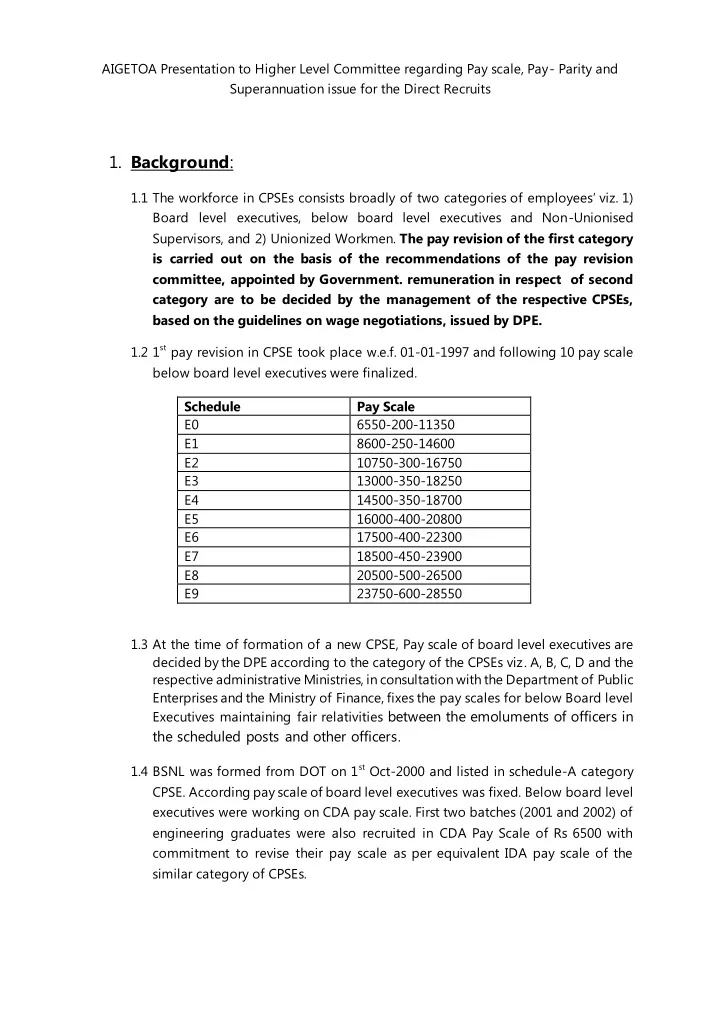
1.1 The workforce in CPSEs consists broadly of two categories of employees’ viz. 1) Board level executives, below board level executives and Non-Unionised Supervisors, and 2) Unionized Workmen. The pay revision of the first category is carried out on the basis of the recommendations of the pay revision committee, appointed by Government. remuneration in respect of second category are to be decided by the management of the respective CPSEs, based on the guidelines on wage negotiations, issued by DPE. 1.2 1st pay revision in CPSE took place w.e.f. 01-01-1997 and following 10 pay scale below board level executives were finalized. Schedule Pay Scale E0 6550-200-11350 E1 8600-250-14600 E2 10750-300-16750 E3 13000-350-18250 E4 14500-350-18700 E5 16000-400-20800 E6 17500-400-22300 E7 18500-450-23900 E8 20500-500-26500 E9 23750-600-28550 1.3 At the time of formation of a new CPSE, Pay scale of board level executives are decided by the DPE according to the category of the CPSEs viz. A, B, C, D and the respective administrative Ministries, in consultation with the Department of Public Enterprises and the Ministry of Finance, fixes the pay scales for below Board level Executives maintaining fair relativities between the emoluments of officers in

the scheduled posts and other officers.

1.4 BSNL was formed from DOT on 1st Oct-2000 and listed in schedule-A category

  • CPSE. According pay scale of board level executives was fixed. Below board level

executives were working on CDA pay scale. First two batches (2001 and 2002) of engineering graduates were also recruited in CDA Pay Scale of Rs 6500 with commitment to revise their pay scale as per equivalent IDA pay scale of the similar category of CPSEs.

slide-2
SLIDE 2

1.5 After 1st pay revision all schedule-A category CPSEs were recruiting engineering graduate at minimum of E2 pay scale i.e. 10750-300-16750. Hence equivalent IDA pay scale of executives recruited with minimum qualification of engineering graduate in BSNL should not have been less than E2. 1.6 BSNL finalized IDA pay scale in year-2003-04 and fixed the engineering graduate at non-standard pay scale of E1A (Rs 9850) which was even less then MTNL (Rs 10750). MTNL and BSNL both are working in same sector and under the same administrative ministry. Both have recruited engineering graduates with similar recruitment rules and work profile of engineering graduate in these organizations is same. Ranking of BSNL in schedule-A CPSEs was also higher than MTNL. Therefore, the pay scale of engineering graduates in BSNL cannot be less than MTNL. 1.7 BSNL had fixed non-standard and lower pay scale than MTNL just to compensate the pension contribution to Government, being made for absorbed executives under rule 37A of CCS pension rule but same was not extended to direct recruits executives of BSNL hence in no case pay scale of direct recruits engineering graduate should have been lower than MTNL. For proper compensation against superannuation benefits proper stage translation in respect of BSNL recruited executives is necessary. Compromised stage of mapping will lead to lower contribution and defeat the purpose of future social security. Thus, it is of utmost importance to properly place the initial pay scale in the band

  • f standard pay scale before projecting the future effect of superannuation
  • benefits. Hence pay scale of JTO/JAO in BSNL prior to 2nd PRC must be minimum

E2 (10750-300-16750), same as of MTNL and other Schedule-A category CPSEs.

  • 2. Brief of 2nd PRC

2.1 Pay revision (compensation package) of board and below board level executives working in CPSEs are done by government of India through Department of Public Enterprises in every 10 years and CPSEs are bound to implement in letter and spirit. 2.2 Basic motto of pay revision is to structure the compensation package of CPSE employees on account of economic and social development and the global scenario and competitive environment. India is a developing country and CPSEs have played major role in economic and social development of the country. Hence primary motto

  • f the pay revision is to enhance the compensation package of CPSE’s employee to

upgrade the social status in synch with the development of the country. Secondly CPSEs are facing direct competition with private sectors, hence total compensation package of CPSE’s employees must be restructured in such a way that it can promote efficiency, performance, productivity and attract talent and loyalty. 2.3 2nd pay revision of board and below board level executives working in CPSEs was due

  • n 01.01.2007, hence pay revision committee headed by Justice Rao was constituted.
slide-3
SLIDE 3

After 18 months of extensive study, committee recommended the total compensation package of executives working in CPSEs based on category, affordability and profitability. The said recommendations of the 2nd PRC were put up before Committee of secretaries (CoS) for consideration and getting final approval of the Government. CoS has considered the recommendations a 2nd PRC and the same got approved by the government with some changes as suggested by CoS (Cabinet Note attached herewith and Marked as Annexure-1) 2.4 2nd PRC had categorized CPSEs in five category A+, A, B,C,D based on some parameter and recommended the pay scale and compensation package of the executives in CPSEs based on the said category i.e. compensation package of executives working in A+ CPSEs was higher than A category CPSEs and so on. But CoS denied the said recommendation on the basis that CPSEs working on same sector like NTPC, NHPC, POWER GRID IN power sector- ONGC, OIL in Oil Sector- SAIL, MECON, RINL in steel sector- BSNL and MTNL in telecom sector, are placed in different category and executives working on same sector but in different CPSEs cannot be given different compensation else this may result in serious discontentment among the executives working in different CPSEs in same sector (Para 5.1 (A) of Annexure-1). 2.5 CoS has recommended that all the recommendations of 2nd PRC with suggested modifications by CoS will be implemented as a package (Para-6 of Cabinet Note Annexure-1) which includes fitment benefit, DA, HRA, leased accommodation, CCA,

  • ther allowances/perks, Variable Pay/PRP, MoU, PMS, Remuneration Committee,

Long Term Incentives, Cost to the Company, Retirement Age, Non Unionized Supervisory staff, Pay of Executives moving from holding CPSEs to subsidiaries or vice-versa on deputation/transfer, pay of government officers on deputation to CPSEs and superannuation benefits etc. 2.6 Consequent to the acceptance of the recommendations of 2nd Pay Revision Committee for CPSEs and suggestions of CoS, Government of India through the Department of Public Enterprise has issued various orders on employee’s benefits. These orders perspicuously states that all the employee’s benefits will be on IDA pattern and inter-alia provides for the following benefits to the employees of CPSEs. i. Basic or serving Benefits (Basic + IDA + HRA); ii. Retiral Benefits (EPF + Gratuity + Post Retirement Medical + Pension) with the ceiling of 30% of Basic + IDA; iii. Perks & Allowances with the ceiling 50% of Basic iv. PRP/Variable Pay up to 40 to 200% of Basic All the above four benefits are uniform for all category of CPSEs except pay scale of board level executives which is based on category of CPSEs. Out of above 4 benefits to the executives first 3 are fixed benefit based on affordability, capacity to pay and sustainability of CPSE but completely independent of profit and loss of the CPSEs.

slide-4
SLIDE 4

Fourth benefit i.e. PRP/Variable pay (40 to 200% of basic) is based on profit of the CPSEs and makes substantive part of total package of the executives. 2.7 DPE has clearly defined the affordability of CPSEs. As per the para-3 of DPE OM dated 26/11/2008 in respect of implementation of 2nd PRC, CPSEs shall implement all these benefits subjected to the condition that additional outgo by such revision for a period of 12 months should not result in more than 20% dip in profit before tax for the financial year 2007-2008 in respect of executives as well as non-unionized supervisory staff taken together. CPSE that cannot afford to pay full package can implement with either part PRP or no PRP. 2.8 Apart from above facts, Sequence to implement the above benefits, If additional

  • utgo on implementation of above benefits is more than 20% of profit before tax for

the financial year 2007-2008, is clearly illustrated in page number 127 to 129 of chapter-6 of 2nd PRC (Annexure-2) recommendations which clearly states that First, company has to pay serving benefits (Basic + DA + HRA) in totality and then Retiral benefits and then only other benefits like perks & allowances and PRP. 2.9 PBT (profit before tax) of BSNL during the financial year 2007-2008 was about 4,500 Cr and additional outgo on implementation of full package of pay revision in respect

  • f executives for a period of 12 months is much less than 20% of PBT. BSNL must

implement all the 4 benefits in totality including perks & Allowance and PRP up to year 2008-09, till BSNL was in profit. 2.10 DPE has clearly defined the affordability of the company which is based on profit before tax for the financial year 2007-2008 and not to the subsequent years till the next pay revision. PRC has also clarified that CPSEs can enter into loss from profit during span of 10 years but first 3 benefits of executives cannot be withdrawn. It is

  • nly PRP which makes substantive part of package can be withdrawn.

2.11 DPE has proposed a uniform fitment benefit of 30% on basic plus DA @78.2% as on 01.01.2007, 10 standard pay scales from E0 to E9 and four different standard pay scales for board of director based on the category of CPSE. 2.12 DPE has denied any intermediate pay scale but given full liberty to board of directors to fit the direct recruits at any initial pay without changing the lower and upper limit

  • f particular pay scale.

2.13 As per para-14 of the DPE order, the company car would be provided to the Directors and CMDs. The Executive Directors/General Managers heading the project of CPSEs may also be provided with company car.

  • 3. Issue related to standard pay scale and pay parity of direct

recruits Engineering Graduate (JTO/JAO) in BSNL recruited on

  • r after 01.01.2007 followed by 2nd pay revision.
slide-5
SLIDE 5

3.1 Direct recruits Engineering Graduate (JTO) and JAO of MTNL is placed at E2 pay scale and all similarly placed CPSEs had been providing minimum E2 pay scale hence with the reason mentioned in para 1.1 to 1.7 and para 2.4 the pay scale of direct recruit JTO/JAO cannot be less than E2 (10750-300-16750) from Oct-2000 to 31.12.2006. 3.2 Para 2.2.6 of terms of reference of 2nd PRC clearly says that while finalizing it’s report the committee will also take into account the report of the sixth pay commission hence 2nd pay revision of CPSE executives is not completely independent of sixth pay commission. Followed by sixth pay commission recommendations all government department including our administrative ministry has upgraded the pay scale of Engineering Graduate from pre-revised Rs 6500-10500 to Rs 7450-11500. Now every government department has to recruit engineering graduate with revised pay in pay band-2 (9300-24800) with initial pay

  • f 12540 and grade pay of 4600 instead initial pay of 9300 and grade pay of 4200.

3.3 Same JTO as of BSNL and MTNL opted to work in DOT are also upgraded from pre-revised 6500-10500 to 7450-11500. BSNL itself has placed JTO in upgraded pay scale who have opted for DOT but worked in BSNL on deemed deputation (Annexure-3). These JTOs had been recruited with same recruitment rule and performing same job as of BSNL. Moreover, taking the inference from the same all Schedule-A CPSEs have upgraded the pay scale of Engineering Graduate to minimum of E3 (24900-) pay scale of DPE. (Annexure-4). 3.4 As explained earlier, administrative ministry of BSNL/MTNL has finalized the pre- revised CDA Pay scale 6500-10500 which is equivalent to pre-revised IDA pay scale E2 (10750-300-16750). Now administrative ministry DOT has upgraded the pay scale of engineering graduate from CDA pay scale 6500-10500 to 7450- 11500 which is equivalent to pre-revised IDA pay scale of E3 (13000-350-18250). It will be high injustice to the executives recruited with minimum qualification of Engineering Graduate in BSNL if they are not placed at minimum of E3 (24900-) pay scale of DPE from 01.01.2007 and this may definitely result in serious discontentment among the Engineering Graduates working in BSNL. 3.5 It is the matter of fact that administrative ministry DOT has derived E1A (9850-) pay scale for JTO/JAO which was lower than E2 (10750-) Pay Scale of MTNL just to compensate the contribution for government pension under rule-37A of CCS pension rule for absorbed executives. Directly recruited executives of BSNL were not covered under CCS pension rule. It was ordered by the Government that BSNL has to devise its own pension scheme for direct recruits (Annexure-5) which was never implemented in BSNL. Hence pay scale of direct recruits JTOs/JAOs should have been only E2 (10750-) till 31.12.2006. instead of upgrading direct recruits JTO/JAO to E3, it is high injustice that BSNL has placed

  • n E1A (9850-) pay scale to direct recruit till 31.12.2006 and now further
slide-6
SLIDE 6

degrading to E1 (16400- ) pay scale after 2nd pay revision w.e.f. 01.01.2007 and trying to compensate E1A with five additional increments on E1. 3.6 DPE has finalized 10 pay scales (E0 TO E9) for below board level executives followed by 2nd PRC and ordered that every CPSEs has to fit their executives in the given (E0 TO E9) pay scale. As CPSE’s board has every right to make new recruitment at any level, hence these E0 to E9 pay scales are to be utilized for the new recruitments in CPSEs. JTOs/JAOs in BSNL is not a new recruitment and recruitment of the executives at JTO/JAO cadre was already prevailing prior to pay revision, hence pay scale of JTO/JAO recruited after 01.01.2007 must be fixed in such a way that there must be fair relativity/parity of pay among the JTOs/JAOs recruited before 01.01.2007 and after 01.01.2007 to avoid any discontentment among these two set of executives belonging to the same cadre and performing the same job. 2nd PRC had recommended 30% fitment for Schedule-A+ CPSE and 11 new Pay scales. Minimum of new pay scales as per those recommendations was in fact higher than 30% fitment simply to attract the new talent. Government, However did not consider these recommendations which were based on the category of the CPSEs and approved 10 new pay scale uniformly for all the CPSEs which was quite lower than that recommended by 2nd PRC for Schedule-A+ CPSE. However, Government has given full liberty to the CPSEs to fix the pay scale of executives recruited on or after 01.01.2007 in such a way that parity exist between executives recruited before and after 01.01.2007 on same cadre. Considering this fact, all other CPSEs have worked out suitable calculations and upgraded the pay scale of the entry level executives to maintain a fair relativity amongst the executives recruited before and after 01.01.2007, so that benefit of pay revision can be extended to all in true letter and spirit. (Annexure-4). If JTO/JAO recruited after 01.01.2007 will be placed at E1+5 (19020-) as proposed by BSNL, there will be substantial difference in initial basic pay (22680-19020=3660) between the JTO/JAOs recruited before and after 01.01.2007 which will have a cumulative and multiplying effect in future and will definitely become a reason for discontentment between executives. As mentioned in para 2.4 above, the basic reason behind government not considering the pay of the executives according to the category of CPSEs was the decision to maintain the parity among the same sector executives. Hence there should not be any reason to deny the pay parity among the same cadre executives in same company. 3.7 It is needless to mention that apart from perks, allowances and incentives, Statuary component of compensation for executives working at particular cadre in CPSE are Basic+IDA +Superannuation Benefit. These three statuary components of compensation are formulated to compensate the skill, status, inflation, social and family security. (Basic of any cadre is fixed to compensate the skill and status compensation, IDA is to compensate the inflation, and Superannuation Benefit is to compensate the family and social security). India is

slide-7
SLIDE 7

developing country and executives working in CPSEs have been playing major role in the said development. Pay revision of executives takes place once in 10 years to restructure the compensation package of executives so that share of economic development of the country can be provided. Pay revision formula is New Basic = (Basic+IDA) + fitment benefit. Fitment benefit is just to extend the share for economic development of the country. Hence primary motto of pay revision to extend the share of economic development of the country hence compensation for Skill, status, inflation, social and family security of executives working at JTO/JAO cadre in BSNL cannot be lowered after pay revision. Apart from the relativity/Parity of pay as mentioned in Para 3.6, if BSNL will offer E1+5 for JTO/JAO recruited on or after 01.01.2007, the primary motto of pay revision will also be defeated as the revised benefit of JTO/JAO cadre become less than the pre-revised benefit in tune of 5 to 10 thousand per month over the time span

  • f next pay revision. (Annexure-6).

3.8 It is clear from the facts submitted above that Pre-Revised pay scale of JTO/JAO who are not covered under CCS pension rule is E2 (10750-) not E1A (9850-). Hence committee is requested to consider the E2 (10750-300- 16750) pay scale for JTO/JAO recruited between 1st Oct-2000 and 31st Dec-

  • 2006. It is also clear from the fact submitted above that executives recruited

with minimum qualification of engineering graduate are upgraded in Government (6500- to 7450-) as well as CPSEs (20600- to 24900-) followed by pay revision hence committee may consider the upgradation of Direct Recruits JTO/JAO to E3 (24900-) w.e.f. 01.01.2007 followed by 2nd pay

  • revision. Further, as evident from above, there should not be any disparity in

Pay of the executives recruited before and after 01.01.2007.

  • 4. Issue related to superannuation benefit of direct recruits in

BSNL as ordered by Government of India through DPE followed by 2nd PRC.

4.1 Implementation of all the four components of pay revision benefit as mentioned in Para 2.6 above One of the recommendations of the 2nd PRC approved by GOI is superannuation benefit for CPSE executives with the ceiling of 30% of Basic+DA through defined contribution scheme which includes (EPF, Gratuity, Pension and post retirement medical benefit). 4.2 Unlike private companies there is fixed age of retirement in CPSEs hence Superannuation benefit is nothing but emoluments to the executives after superannuation from the company or attaining the age of retirements which also help in attracting the talent and loyalty to the CPSEs. Government of India has derived this figure of 30% of Basic+DA to be contributed as superannuation benefit so that CPSE executives can get minimum emoluments after their

slide-8
SLIDE 8

superannuation to ensure post retirement survival of their family. Superannuation benefit is directly proportional to the serving benefit (Basic+IDA) of the executives so that that they can maintain their social and family status after retirement. 4.3 If any CPSE is not able to afford the cost of pay revision, PRC has recommended the different stages of extending benefits of pay revision as mentioned in Para 2.8 above which clearly states that First, company has to pay serving benefits (Basic + DA + HRA) in totality and then Retiral benefits and then only other benefits like perks & allowances and PRP. BSNL has extended serving benefit and retiral benefit in totality in respect of about 3 lakhs employees including non-executives and also extended some part of the perks and allowances to all but so far retiral benefit of hardly 12000 direct recruits executives has not been implemented in totality. 4.4 As mentioned in Para 2.5 above, all the benefits of the pay revision will be implemented as package and as mentioned in Para 2.7 to 2.10 above BSNL fulfils all the conditions of affordability to implement these benefits. BSNL must have implemented all the benefits as approved by government followed by 2nd PRC in

  • totality. At least BSNL should have maintained the balance in implementation of

serving and retiral benefit of executives. 4.5 BSNL board should have approved the 30% superannuation benefit at the time of seeking presidential order from administrative ministry in year 2009 itself in respect of implementation of pay revision benefits but we believe that BSNL management has ignored this benefit as they were not benefited out of this implementation and only the direct recruits executives working at lower rung of executives were the beneficiaries of implementation of superannuation benefit. This association took up this issue in year 2009 itself before BSNL management but management put forth wrong data (stating BSNL is already contributing 39%

  • f Basic+IDA as superannuation benefit for direct recruits) in the agenda meeting

held in Feb-2010 under the chairmanship of then CMD BSNL which resulted in formation of committee to verify the data (point 3 of Record of the meeting is attached herewith and marked as Annexure-7). However, after persuasions at all levels, management finally agreed that the contribution is limited to 18%. But even then, the implementation of superannuation benefit is being delayed on one

  • r other pretext for reasons best known to management.

4.6 Now, after passing of more than 7 years from date of effect i.e. 01.01.2007 just due to inefficiency and lack of interest on management part, denying the implementation of superannuation benefit in totality to the direct recruits citing today’s financial and or any other grounds is highly unjustified and unfair on the part of management.

slide-9
SLIDE 9

4.7 It is also learnt that, contribution towards superannuation benefit of direct recruits is being compared with the contribution towards superannuation benefit

  • f absorbed executives. It is worth mentioning here that benefit of pay revision

for CPSEs executives is finalized by government of India and before finalization of quantum of superannuation benefit, inference have already been taken from the benefit available to government employees under rule 37 of CCS pension rule. There is no scope for the CPSE to further compare and modify the superannuation benefits. Pensionary benefits of absorbed executives are defined benefit and have no relation with contribution paid by BSNL as far as return is

  • concerned. Pensionary benefit of absorbed executives is highly secured and will

increase with inflation and subsequent pay revisions even after their retirement. Contribution for defined benefit cannot be fixed by BSNL and will have to be paid in totality as and when decided by government of India. On the other hand superannuation benefit for direct recruits in CPSEs is under defined contribution scheme and return is directly proportional to contribution paid by BSNL. This benefit is not secured and return is highly uncertain. Absorbed executives of BSNL have opted their retirement benefit under defined benefit scheme as available for employees working in government department but same option is not available for the direct recruits of BSNL. BSNL is bound to pay the contribution in totality in respect of absorbed executives as and when decided by government. Similarly BSNL must pay the contribution towards superannuation benefit in totality for CPSE executives under the defined contribution scheme as decided by the government of India through DPE. Absorbed executives may be allowed to opt superannuation benefit of CPSE but there is no justification to compare contribution in respect of two sets of retirement benefit. 4.8 DPE has already decided the date of effect of various benefits followed by 2nd PRC , CPSE have no scope to decide the date of effect of pay revision benefit. Administrative ministry vide para-8 of the presidential order issued on 27th Feb- 2009 (Annexure-8) have already extended the covering approval in respect of implementation of superannuation benefit in accordance with the guidelines and instructions issued by DPE. 4.9 Considering the above facts and submission committee may be requested to consider the implementation of 30% of Basic+IDA as superannuation benefits in totality in respect of direct recruit’s executives of BSNL w.e.f. 01.01.2007 in accordance with the guidelines and instructions issued by DPE.