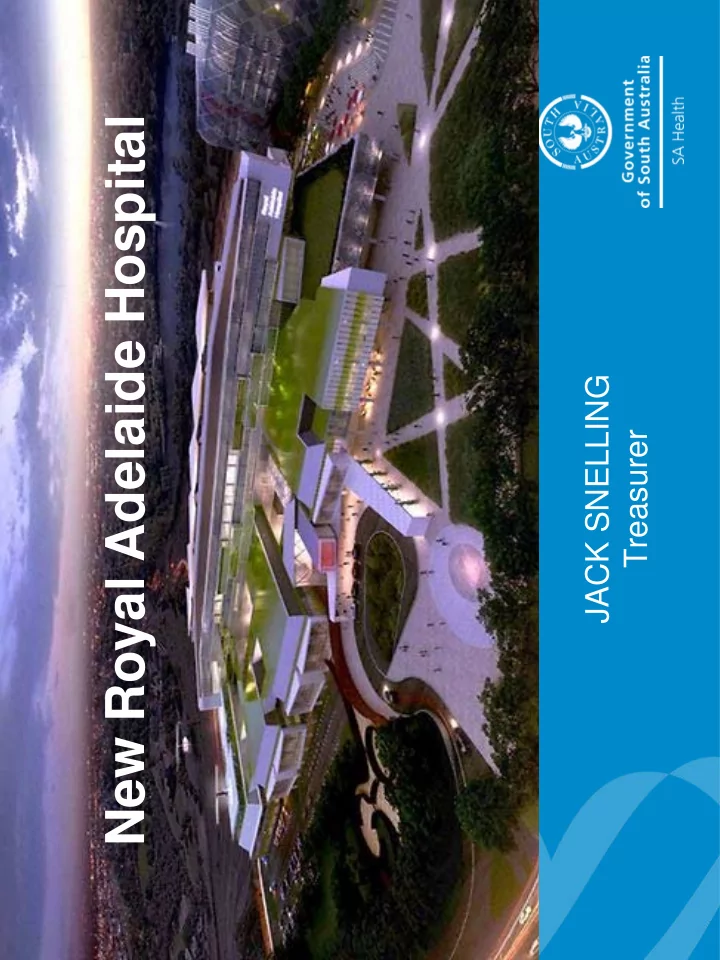
New Royal Adelaide Hospital JACK SNELLING Treasurer New Royal - - PDF document

new royal adelaide hospital
SMART_READER_LITE
LIVE PREVIEW

New Royal Adelaide Hospital JACK SNELLING Treasurer New Royal - - PDF document

New Royal Adelaide Hospital JACK SNELLING Treasurer New Royal Adelaide Hospital (new RAH) PPP > The new RAH is a major investment by the State in health care reform and capacity for the State > World class contract and quality


slide-1
SLIDE 1

JACK SNELLING Treasurer

New Royal Adelaide Hospital

slide-2
SLIDE 2

2

New Royal Adelaide Hospital (new RAH) PPP

> The new RAH is a major investment by the State in health care reform and capacity for the State > World class contract and quality consortium > Overall, good value for money

slide-3
SLIDE 3

3

Roles in the new RAH PPP

> SA Health Partnership (SAHP) will, under a 35-year contract:

  • Design and build the new RAH
  • Maintain the new RAH as new
  • Provide non-clinical support services

> State Government will:

  • Provide all clinical services
  • Provide clinical staffing, teaching, training,

research

> Operation of the hospital will revert to the State in 2046 in as new condition

slide-4
SLIDE 4

4

Total capital cost

Design and construction (SAHP) $1.85 billion State works $244.7 million CAPITAL COST $2.09 BILLION

SAHP’s cost of $1.85b is a fixed price to design and build the new RAH to meet the State’s service specifications

slide-5
SLIDE 5

5

SAHP’s capital cost includes

> Remediation of the site > Design and construction of the hospital > Landscaping and civic space

slide-6
SLIDE 6

6

Medical Equipment/State Works ($244.7 million) includes

> Upgrade and connection of utilities > Key clinical equipment (eg linear accelerators, CT scanners) > State project management

slide-7
SLIDE 7

Capital cost comparison

7

Nominal $m SAHP’s proposal State’s estimate Difference PPP works 1,849.8 1,782.7 ‐236.1 Risk valuation (included above) 303.2 State works 244.7 244.7 — TOTAL ESTIMATE 2,094.5 2,330.6 ‐ 236.1

slide-8
SLIDE 8

8

Reasons for increase in capital cost estimate

> Increase in floorspace of 12,354m2 to 167,400m2 to meet functional requirements > Better ICT systems to integrate clinical and non-clinical services > Updated estimates for connecting utilities > Refresh of nominal cost to reflect actual construction start

slide-9
SLIDE 9

9

Risk valuation

> Previous estimate of $1.7b excluded risk valuation > Examples of capital cost risks:

  • Deficient design
  • Construction defects
  • Site difficulties
  • Labour, plant or materials shortages
slide-10
SLIDE 10

10

Risk valuation

> Valuing project risks is critical in identifying value for money > Risk value is conservative but realistic for a complex project like the new RAH > Risk valuation finalised in May 2011 > Earlier disclosure of State’s risk value may have prejudiced the State’s negotiations

slide-11
SLIDE 11

11

PPP Service Payments

> Average full year service payment is $397m, varying slightly with lifecycle costs > This is less than 9% of SA Health’s annual budget for 2010-11, and declines as a percentage of the budget over the life of the PPP > This will be partly offset by the cost of running the existing RAH

slide-12
SLIDE 12

12

PPP Service Payments

> Includes capital, non-clinical operating and lifecycle costs > Capital cost to be paid over 30 years > Service costs are subject to periodic market review to ensure value for money > Payments start in 2016 after hospital is built and certified as “fit for purpose”

slide-13
SLIDE 13

13

Value for Money (VfM)

> VfM is demonstrated because the PPP

  • ption costs less than the Public Sector

Comparator (PSC) for the new RAH > The PSC includes the State’s estimates for the capital cost plus 30 years of lifecycle and non-clinical operating costs > PSC and PPP proposal presented on a net present cost (NPC) to provide a fair comparison

slide-14
SLIDE 14

14

Finance costs

> The State can borrow more cheaply than the private sector > However, under a PPP, taxpayers transfer capital and operating risks to the private sector > Risks transferred include:

  • Construction cost and delay
  • Services performance
  • Assets always “fit for purpose”

> Despite the private sector premium, SAHP’s overall proposal offers value for money to the State

slide-15
SLIDE 15

Value for money

15

Net Present Cost ($million) based on discount rate range Low Mid High Risk‐adjusted PSC 3,298.0 3,298.0 3,298.0 SAHP’s Proposal 3,217.6 3,160.6 3,109.5 Value for money benefit 80.4 137.4 188.5

> SAHP’s proposal is $137 million (4.2%) better value for money than the State’s PSC

slide-16
SLIDE 16

16

Accounting treatment

> Accounting Standards require the State to record the PPP contract as a financial lease liability in 2016 when new RAH becomes available for use by the State

$m Design and construction costs 1,850 Interest costs during construction 639 Other project costs 203 Net present cost of lifecycle payments 128 TOTAL 2,820

Finance lease liability - 2016

slide-17
SLIDE 17

17

Economic benefits to SA

> Up to 1,800 people working on site at peak of project > Opportunities for local businesses > Another 6 cranes on site > Rejuvenation of city’s West End

slide-18
SLIDE 18

18

PPPs in South Australia

> PPPs have been used in South Australia to deliver public infrastructure, including:

  • 6 brand new State schools
  • Regional police stations
  • Courts Administration Authority facilities

New Blair Athol North School

slide-19
SLIDE 19

19

PPPs in Australia

> PPPs have been used in Australia and around the world for well over 20 years > Governments of all persuasions have used PPPs to successfully deliver hospitals including:

  • Royal Women’s Hospital VIC
  • Royal Children’s Hospital VIC
  • Royal North Shore Hospital Stage 2 NSW
slide-20
SLIDE 20

20

Transparency

> In 2007, joint research by the Allen Consulting Group and the University of Melbourne concluded:

  • “In contrast to commonly held perceptions about

the relative transparency of PPPs, we found that PPP projects were far more transparent than traditional projects…”

  • “Public Private Partnerships are the best method

available to Australia’s governments to deliver large, complex and expensive projects, achieving significant savings in both time and cost.”

  • “Our overall conclusion is that PPPs provide

superior performance in both the cost and time dimensions, and that the PPP advantage increases (in absolute terms) with the size and complexity of projects.”

slide-21
SLIDE 21

21

Why use PPPs?

> In 2008, further research by the University of Melbourne concluded:

  • “PPPs delivered projects for a price that is far

closer to the expected cost than if the project was procured in the Traditional manner.”

slide-22
SLIDE 22

22

SA Liberals and PPPs

> Liberal Opposition planned to use a PPP for their proposed RAH patch up > No construction cost in Liberals’ four-year policy costings > Then Deputy Leader Stephen Griffiths on Radio 5AA on Election Eve, 19 Mar 2010:

  • “that’s important to emphasise that will be a

public private partnership...as the Labor proposal is for a public private partnership.”

slide-23
SLIDE 23

Opinion by Dr. Tim Stone CBE

> Chairman of KPMG’s Global Infrastructure and Projects Group > Expert adviser to the UK Government > Independently reviewing the new RAH project since 2007

23

slide-24
SLIDE 24

24