SLIDE 1
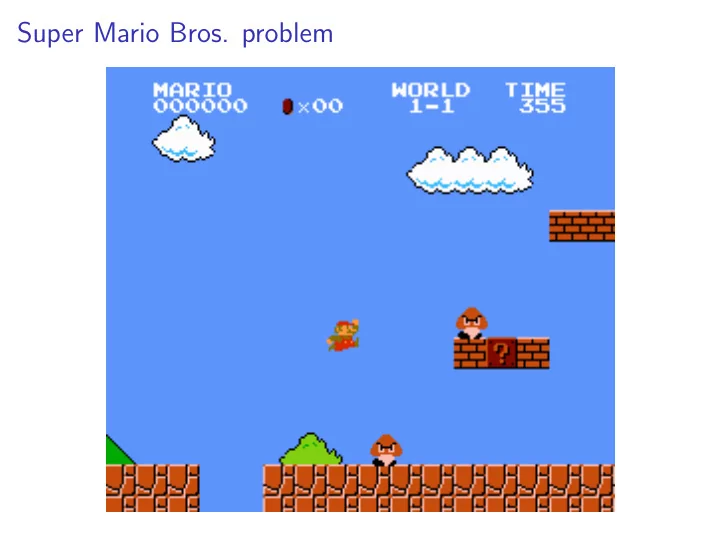
Super Mario Bros. problem
SLIDE 2
Input space
◮ 5 buttons per frame ◮ 24000 frames ◮ 524000 ≈ 1.9 × 1016775 possible input sequences
Exhaustive search won’t work here.
SLIDE 3
Tuning process
SLIDE 4 Naive Representation
1http://youtu.be/nyYdq1jJQrw
SLIDE 5 Naive Representation
◮ Bad, because most configurations make no sense. ◮ Just mashing random buttons. ◮ Doesn’t work at all (Video 1).
1http://youtu.be/nyYdq1jJQrw
SLIDE 6 Better Representation
◮ Movements (list):
◮ Direction (left, right, run left, or run right) ◮ Duration (frames)
SLIDE 7 Better Representation
◮ Movements (list):
◮ Direction (left, right, run left, or run right) ◮ Duration (frames)
◮ Jumps (list):
◮ Start frame ◮ Duration (frames)
SLIDE 8 Better Representation
◮ Movements (list):
◮ Direction (left, right, run left, or run right) ◮ Duration (frames)
◮ Jumps (list):
◮ Start frame ◮ Duration (frames)
Choosing the right representation is critical
◮ Search space size 106328 ◮ Winning run found in 13641 (≈ 104) attempts ◮ Under 5 minutes of training time
SLIDE 9
Super Mario Bros Results
1000 1500 2000 2500 3000 3500 60 120 180 240 300 Pixels Moved Right (Progress) Autotuning Time (seconds) Win Level OpenTuner
SLIDE 10 StreamJIT
Synchronous dataflow programs are graphs of (mostly) stateless workers with statically-known data rates. Using the data rates, the compiler can compute a schedule
- f worker executions, fuse
workers and introduce buffers to remove synchronization, then choose a combination of data, task and pipeline parallelism to fit the machine.
x6 input LowPassFilter 5 1 FMDemodulator 1 (2) 1 DuplicateSplitter 6 1 x6 DuplicateSplitter 1 1 x2 LowPassFilter 1 (4) 1 LowPassFilter 1 (4) 1 RoundrobinJoiner 1 x2 2 Subtractor 2 1 Amplifier 1 1 RoundrobinJoiner 1 x6 6 Summer 6 1
SLIDE 11 Fusion, data-parallel fission and splitter/joiner removal
Expand BandStop Process BandPass Compress Expand BandStop Process BandPass Compress Adder BandPass Compress Process Expand BandPass Compress Process Expand BandStop BandStop Adder Adder Adder Adder Adder
SLIDE 12
Autotuning
StreamJIT delegates its optimization decisions to OpenTuner, which decides
◮ an overall schedule multiplier (to amortize synchronization) ◮ whether to fuse workers ◮ whether to remove splitters and joiners ◮ buffer implementations ◮ how to allocate fused groups to cores
SLIDE 13
Autotuning work allocation
Equal distribution across all cores is usually the best, but we need to load-balance around stateful workers.
◮ Bitset per worker, one bit per core: exponentially hard to get
equal distribution (all bits set).
◮ Array of floats summing to 1.0, one float per core: allows
load-balancing, but equal distribution is even harder.
SLIDE 14
Autotuning work allocation
Equal distribution across all cores is usually the best, but we need to load-balance around stateful workers.
◮ Bitset per worker, one bit per core: exponentially hard to get
equal distribution (all bits set).
◮ Array of floats summing to 1.0, one float per core: allows
load-balancing, but equal distribution is even harder.
◮ Permutation of cores, total count, bias count and bias
fraction: equal division across cores, biased for load balancing.
SLIDE 15
Bias fraction work allocation
Use the first count cores of the permutation, moving fraction of the work from the first bias count cores. Doesn’t cover all possibilities, but covers the good ones.
SLIDE 16
Custom techniques
StreamJIT uses custom techniques that force the obvious defaults. Other techniques make some good and some bad changes: ↑-↓--↑-↓↑↑-↓ Custom techniques will then force some of the bad changes back: ↑----↑-↓↑↑-- Bandit will learn to stop using the custom techniques when they stop working or for unusual graphs where the obvious defaults are bad.