Summer Assignment website for the convenience of teachers who wish - - PDF document

summer assignment
SMART_READER_LITE
LIVE PREVIEW

Summer Assignment website for the convenience of teachers who wish - - PDF document

Slide 1 / 104 Slide 2 / 104 New Jersey Center for Teaching and Learning Progressive Science Initiative AP Chemistry This material is made freely available at www.njctl.org and is intended for the non-commercial use of students and teachers.


slide-1
SLIDE 1

Slide 1 / 104

This material is made freely available at www.njctl.org and is intended for the non-commercial use of students and teachers. These materials may not be used for any commercial purpose without the written permission of the owners. NJCTL maintains its website for the convenience of teachers who wish to make their work available to other teachers, participate in a virtual professional learning community, and/or provide access to course materials to parents, students and others.

Click to go to website: www.njctl.org New Jersey Center for Teaching and Learning Progressive Science Initiative

Slide 2 / 104

www.njctl.org

AP Chemistry

Summer Assignment "The Basics"

Slide 3 / 104

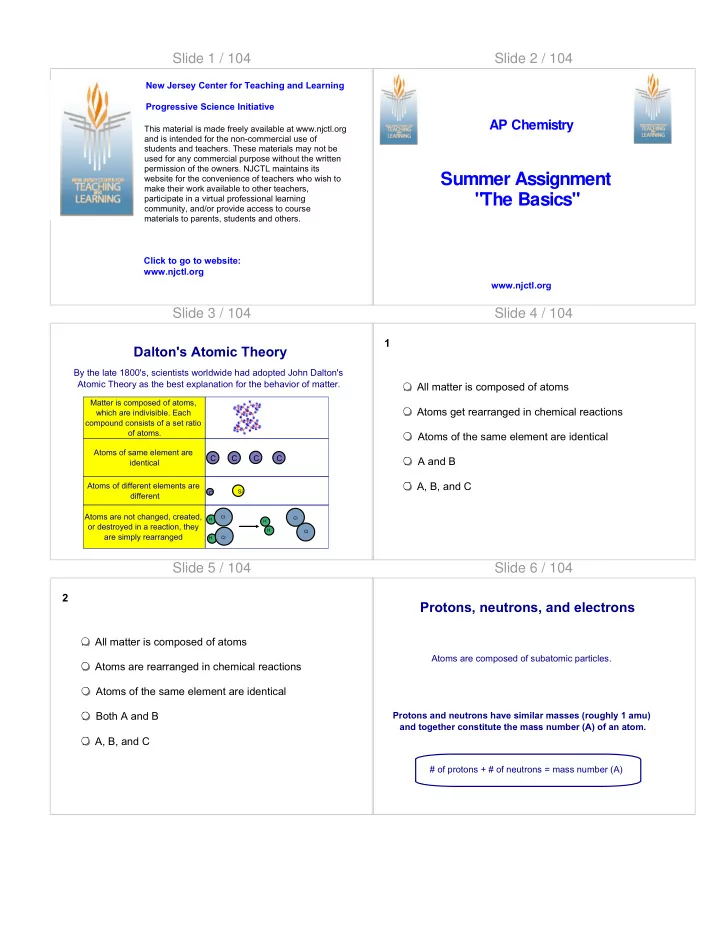
By the late 1800's, scientists worldwide had adopted John Dalton's Atomic Theory as the best explanation for the behavior of matter.

Matter is composed of atoms, which are indivisible. Each compound consists of a set ratio

  • f atoms.

Atoms of same element are identical C C C C Atoms of different elements are different

C Si

Atoms are not changed, created,

  • r destroyed in a reaction, they

are simply rearranged

H Cl H H H Cl Cl Cl

Dalton's Atomic Theory Slide 4 / 104

1 Which of the following were a part of Dalton's Atomic Theory? A All matter is composed of atoms B Atoms get rearranged in chemical reactions C Atoms of the same element are identical D A and B E A, B, and C

Slide 5 / 104

2 Which of the following components of Dalton's theory was proved incorrect by the discovery of isotopes? A All matter is composed of atoms B Atoms are rearranged in chemical reactions C Atoms of the same element are identical D Both A and B E A, B, and C

Slide 6 / 104

Protons and neutrons have similar masses (roughly 1 amu) and together constitute the mass number (A) of an atom. # of protons + # of neutrons = mass number (A)

Protons, neutrons, and electrons

Atoms are composed of subatomic particles.

slide-2
SLIDE 2

Slide 7 / 104

Each element consists of atoms which differ in the number of protons compared to atoms of different elements. The atomic number (Z) is equal to the number of protons in an atom. # of protons = atomic number (Z)

Protons, neutrons, and electrons Slide 8 / 104

If an atom is electrically neutral, the number of electrons and protons will be the same. # of protons = # of electrons (neutral atom)

Protons, neutrons, and electrons Slide 9 / 104

There are two common ways the atomic mass and number are indicated for an atom. Method 1: Provides all information A < --- mass number 119 3 Symbol Cs or H Z < --- atomic number 55 1

12.01

C

6 atomic number

Nuclide Symbols

Method 2: Must look up atomic number on the periodic table. Symbol - mass number Cs-199 or H-3

Slide 10 / 104

The number of protons and neutrons can be easily determined from the nuclear symbol. Example: How many protons and neutrons are present in the following? 220 88 protons a) Ra 220 - 88 = 132 neutrons 88 b) Au - 197 79 protons (from PT) 197 - 79 = 118 neutrons move for answer move for answer

Nuclide Symbols & protons and neutrons Slide 11 / 104

3 Barium is used to help take X-rays of the digestive

system of the human body. What is the atomic number of barium (Ba)?

A 38 B 48 C 137 D 4 E 56

Slide 12 / 104

4 Which is the correct number of protons in an atom of

vanadium (V)?

A 23 B 51 C 18 D 24 E 50

slide-3
SLIDE 3

Slide 13 / 104

5 What is the mass of an element that has 10 protons and 11 neutrons?

Slide 14 / 104

6 How many neutrons are present in an oxygen atom with a mass of 18 amu?

Slide 15 / 104

7 What is the mass of an element with 18 protons, 18 electrons, and 22 neutrons?

Slide 16 / 104

8 How many neutrons are present in atom with a mass of 13 amu and an atomic number of 7?

Slide 17 / 104

9 How many neutrons are present in a neutral atom

  • f Sr-80?

A 38 B 32 C 38 D 80 E 42

Slide 18 / 104

10 How many electrons does this neutral element

have?

Na

23 11

Sodium Atom

slide-4
SLIDE 4

Slide 19 / 104

11 How many neutrons does this element have?

Na

23 11

Sodium Atom

Slide 20 / 104

12 Which of the following has 45 neutrons?

A

80Kr

B

80Br

C

78Se

D

103Rh

Slide 21 / 104

Dalton postulated that all atoms of a given element were identical. In the early 1900's scientists determined that certain atoms of lead were more stable than others - so there must be a difference! The difference was in the mass of the different atoms of lead. Since the atoms were all lead they must have the same atomic number or number of protons. The difference in mass must be due to differing numbers of neutrons amongst the lead atoms!! Atoms of the same element with differing numbers of neutrons are called isotopes! Pb - 204 Pb - 206 82 protons 82 122 neutrons 124

Isotopes and a hole in Dalton's Theory Slide 22 / 104

When one examines even the smallest sample of an element, there are hordes of atoms present. All of the stable isotopes of that element will be in the sample but not in the same abundance. For example, in a sample of carbon atoms, roughly 99% of the atoms will be C-12 while 1% will be C-13. These percentages do not vary no matter where, when, or how the sample was taken.

Average Atomic Mass Slide 23 / 104

The mass listed on the periodic table is a weighted average of the isotopes of that particular element.

12.01

C

6 average atomic mass *Note: The average atomic mass of carbon is much closer to 12 compared to

  • 13. This is due to the much larger abundance of C-12.

Average Atomic Mass Slide 24 / 104

To find the average atomic mass of an element simply find the sum of the contribution of each isotope by multiplying the mass of each isotope by it's abundance (expressed as a decimal instead of a %) and adding them all together. Example: Neon consists of three stable isotopes: Ne-20, Ne-21, and Ne-22. If the relative abundance of these are 90.48%, 0.27%, and 9.25% respectively, what is the atomic mass of neon? 20(.9048) + 21(0.0027) + 22(0.0925) = 20.18 amu

Calculating an Average Atomic Mass

slide-5
SLIDE 5

Slide 25 / 104

If the average atomic mass is known, the % abundance of each isotope can be determined if the mass of each isotope is known. Example: There are two stable isotopes of calcium: Ca -40 (39.96) and Ca -46 (45.95). Using the average atomic mass of calcium from the periodic table, calculate the % abundance of each isotope of calcium. Step 1: Set the abundance of each isotope as equal to "x" and "y" Both decimal abundances must add up to 1. x + y = 1 so y = 1-x Step 2: Solve for x using average atomic mass equation. 39.96(x) + 45.95(1-x) = 40.08 (from PT)

  • 5.99x = -5.87 --> x = 0.98 or 98%

98% Ca-40 and 2% Ca-46

Calculating % Abundances from an Average Atomic Mass Slide 26 / 104

13 Which pair of atoms constitutes a pair of

isotopes of the same element?

X

14 7 14 6 X

A

B C

D E

X

6 12

X

14 6

X

11 21

X

20 10

X

8 17

X

17 9

X

9 19

X

19 10

Slide 27 / 104

14 Which of the following is TRUE of isotopes of an element?

A

They have the same number of protons

B

The have the same number of neutrons

C

They have the same mass

D

They have the same atomic number

E

A and D

Slide 28 / 104

15 An atom that is an isotope of potassium (K) must...

A

Have 20 protons

B

Have 19 neutrons

C

Have 19 protons

D

A mass of 39

E

A total of 39 protons and neutrons

Slide 29 / 104

16 Which species is an isotope of

39Cl?

A

40Ar+

B

34S2-

C

36Cl -

D

80Br

E

39Ar

Slide 30 / 104

17 Calculate the atomic mass of oxygen if it's

abundance in nature is: 99.76% oxygen-16, 0.04% oxygen-17, and 0.20% oxygen-18.

(liquid oxygen)

slide-6
SLIDE 6

Slide 31 / 104

18 Sulfur has two stable isotopes: S-32 and S-36. Using

the average atomic mass on the periodic table, which

  • f the following best approximates the natural

relative abundances of these isotopes of sulfur?

A

50% S-32 and 50% S-34

B

25% S-32 and 75% S-34

C

75% S-32 and 25% S-34

D

95% S-32 and 5% S-34

E

5% S-32 and 95% S-34

Slide 32 / 104

19 Copper has two stable isotopes, Cu-63 (62.93) and Cu-65 (64.93). Using your periodic table, determine the % abundance of each isotope of copper.

Slide 33 / 104 Atomic Models

The model of the atom has changed significantly over the years. Plum Pudding Model Protons and electrons are spread evenly throughout the atom

  • +

+ + +

+ Slide 34 / 104 Atomic Models

Nuclear Model Due to Rutherford's gold foil scattering experiment, it was determined the protons were clustered together in a highly dense nucleus. It was postulated that the electrons orbited this nucleus. 10-4 A

  • 1-5A
  • Nucleus containing

protons and neutrons Volume occupied by by electrons

Slide 35 / 104

Scientists noticed that light interacted with matter on the subatomic

  • scale. For example, light of the right frequency could dislodge an

electron from an atom (photoelectric effect) In order to understand atomic structure we must recall the basic properties of a wave - specifically waves of EM radiation. Properties of a EM wave Wavelength ( ) Frequency (v) Energy (E) Relationships between properties c = v and E = hv c = 3.00 x 10⁸ m/s h = 6.626 x 10⁻³⁴ J*s Energy and frequency are directly related while wavelength is inversely related to both.

Interaction of Light and Matter

Slide 36 / 104 Interaction of Light and Matter

emission spectrum absorption spectrum Scientists noticed that atoms absorbed and emitted energy of only certain frequencies thereby creating absorption and emission spectra.

slide-7
SLIDE 7

Slide 37 / 104 Atomic Models

Bohr Model Neils Bohr explained these spectral lines by postulating that electrons were only able to exist in discrete orbits of differing energies around the atom.

n = 1 n = 2 n = 3

+

Hydrogen atom

n = 4

The spectral lines were caused by electrons emitting energy as they transitioned from one specific orbit to another

Slide 38 / 104 Atomic Models

Quantum Model Although successful on a number of "levels" (haha - catch that chemistry humor?), the Bohr model proved insufficient as it could not explain why the electrons do not decay into the nucleus due to coulombic attractions. de-Broglie proved these orbits could be stable but only if we pictured the electron as behaving as wave. In 1927, electrons were shown experimentally to behave as waves, giving birth to the quantum model of the atom.

Slide 39 / 104 Atomic Models

Quantum Model In the quantum model, we cannot know the exact location of an electron at any point, just a series of possible quantum states that are allowed - some of which are favored energetically for certain electrons over others. These quantum states are described by four quantum numbers - each providing specific information. Quantum # Symbol Describes Possible Values Principal N Main Energy Level 0, 1, 2 .... Azimuthal L

  • rbital (s, p, d, f)

0,1,2... (N-1) Magnetic ml

  • rbital orientation
  • L <---> +L

Spin ms spin +1/2 or -1/2

Slide 40 / 104 Atomic Models

Quantum Model These quantum numbers serve as our basis for writing electron configurations - ie. diagraming the quantum states of electrons in an atom. This will be developed sufficiently in the course so will not be reviewed here but if you were weak on the subject - you will want to review "Models of the Atom and Periodic Table."

Slide 41 / 104

20 What experimental evidence prompted the rejection

  • f the "plum pudding" model?

A The existence of spectral lines B Atoms absorbed energy at the same frequencies it emitted them C Electrons decayed into the nucleus over time D Some Alpha particles were deflected when launched through metal foil E The plum pudding model is still held today.

Slide 42 / 104

21 What experimental evidence, if TRUE, would not have supported the Bohr model of the atom? A A few alpha particles were deflected when launched at metal foil B Only specific frequencies of light were emitted by atoms C Only certain frequencies of light were absorbed by atoms D The discovery of the neutron E A continous spectrum of light was emitted by atoms

slide-8
SLIDE 8

Slide 43 / 104

22 Which of the following is TRUE regarding the properties of a wave? A Energy and frequency are inversely related B Wavelength and frequency are inversely related C Energy and wavelength are directly related D Both A and B E Both A and C

Slide 44 / 104

23 What is the wavelength of light (in nm) of light with a frequency of 2.3 x 10¹⁵ 1/s?

Slide 45 / 104

24 What is the energy of a photon of light with a wavelength of 450 nm?

Slide 46 / 104

25 Which of the following quantum numbers determines the orbital an electron would be most likely found? A Principal B Azimuthal C Magnetic D Spin

Slide 47 / 104

26 Oxygen has it's outermost (valance) electrons in the 2nd main energy level. Which quantum number would describe the main energy level of these electrons? A Principal B Azimuthal C Magnetic D Spin

Slide 48 / 104 Periodic Table

Since the discovery of the first elements, attempts were made to group like elements together. Scientists used physical and chemical properties to do so. Recall the difference between physical and chemical properties: Physical and Chemical Properties Physical Chemical without substance OBSERVABLE? when substance changing changes mass, density, BP EXAMPLES? reactivity MP, color, hardness

slide-9
SLIDE 9

Slide 49 / 104

The first periodic tables noticed that if elements were ordered in increasing atomic mass, certain properties tended to repeat "periodically". For example, what if elements A, B, C, D, E, F, G, H each had unique chemical properties and were ordered from lowest to highest mass. The next atom of higher mass, atom "I", was found to behave just like atom "A" did, and "J" just like atom "B" and so forth throughout the table. A B C D E F G H I J .............. The result is a table that groups atoms of similar properties.

Evolution of Periodic Table

Slide 50 / 104

Evolution of the Periodic Table

One of the first periodic tables! Notice that is flipped sideways to our periodic tables!

Slide 51 / 104

The Modern Periodic Table

The modern periodic table is now arranged in order of increasing atomic number -

  • ie. an elements properties are a function of atomic number.

Slide 52 / 104 Groups and Periods

Horizontal rows are called periods or rows Vertical columns are called groups or families. Elements within a group share similar chemical properties as they have the same number of valence electrons. Periods Groups

Slide 53 / 104 Quantum Numbers and the Periodic Table

As we mentioned earlier, elements are grouped according to their chemical properties which are determined by the arrangement of their

  • electrons. The arrangement of electrons is determined by the four

quantum numbers. The periodic table can be divided into regions where certain orbitals are filling.

Slide 54 / 104 Particular Group Names

Certain groups have specific names. Alkali Metals Alkaline Earth Metals Noble Gases Halogens 1 18 2 13 14 15 16 17 3 4 5 6 7 8 9 10 11 12

slide-10
SLIDE 10

Slide 55 / 104 Ion Formation

Having a full outer s and p orbital is energetically favorable. Atoms will often gain or lose electrons to reach this state. When atoms gain electrons, they become negatively charged. F + e- --> F- When atoms lose electrons, they become positively charged. Ca --> 2e- + Ca2+ Any charged atom is called an ion.

  • ion = anion

+ ion = cation

Slide 56 / 104 Groups and Ion Formation

Stable Gain e- Lose e - Noble gases have a full outer energy level so they are inert or

  • unreactive. The other groups of elements will have to lose or gain

electrons to reach this stable state.

Slide 57 / 104 Predicting Charges

Stable Gain e- Lose e -

Predict the charge of: a) Hydrogen ion: H+ or H- (hydride) b) Magnesium ion: Mg2+ c) Phospide ion: P3- d) Selenide ion: Se2-

Slide 58 / 104

Transition or "d" block elements often lose their outermost "s" electrons and occasionally some "d" orbital electrons also. Their common ionic charge is therefore +2 but it cannot be predicted for most.

Predicting Charges Slide 59 / 104

27 Which of the following describes the location of calcium on the periodic table? A Period 4, Group 2 - The alkali metals B Period 2, Group 4 - The alkali metals C Period 2, Group 4 - The alkaline earth metals D Period 4, Group 2 - The alkaline earth metals

Slide 60 / 104

28 Elements were organized into groups by reacting the element with oxygen and determining the formula of the oxide created. Was this a physical property they were observing? Yes No

slide-11
SLIDE 11

Slide 61 / 104

29 Elements within the alkali metal group decrease in melting point as their atomic number increases. Is this a physical property that is being observed? Yes No

Slide 62 / 104

30 Which of the following is/are TRUE of our modern periodic table? A Elements are arranged in order of increasing atomic mass B Elements are arranged in order of increasing atomic number C Elements in the same period share similar properties D B and C E A, B, and C

Slide 63 / 104

31 Which of the following is correctly matched? A Na - halogen B Ca - transition metal C P = p block element D Ni = noble gas E O = s block element

Slide 64 / 104

32 Which of the following matches the correct number

  • f electrons lost or gained needed to form the ion?

A Oxygen ion = lose 2 e- B Aluminum ion = gain 3 e- C Barium ion = gaine 2 e- D Chloride ion = gain 2 e- E Magnesium ion = lose 2 e-

Slide 65 / 104

33 What is the most likely charge on a gallium ion? A +1 B -5 C +3 D +5 E No charge = it's a noble gas

Slide 66 / 104

34 Which of the following ions would be most difficult to predict the charge of? A sodium ion B bromide ion C strontium ion D chromium ion E sulfide ion

slide-12
SLIDE 12

Slide 67 / 104

Recall that ionic compounds consist of positively charged metal ions bound to negatively charged non-metal ions. The number of ions of each involved depends on how many of each is required to form a neutral compound. Example: calcium oxide Step 1: Find their charges: Ca2+ O2- Step 2: Determine how many of each is required to form a neutral compound:

  • ne of each is needed --> CaO

Writing Formulas for Ionic Compounds Slide 68 / 104

Example: copper (I) oxide Step 1: Find their charges: Cu+ O2- Step 2: Determine how many of each is required to form a neutral compound: two copper ions are required to balance the O2- charge Cu2O

Writing Formulas for Ionic Compounds Slide 69 / 104

Example: aluminum sulfide Step 1: Find their charges: Al3+ S2- Step 2: Determine how many of each is required to form a neutral compound: The least common multiple is 6. 2 x Al3+ = 6+ AND 3 x S2- = 6- Al2S3

Writing Formulas for Ionic Compounds Slide 70 / 104

As you may recall, some ions are composed of multiple atoms bound together creating a charged species - these are known as polyatomic ions.

H+ = proton

  • r hydrogen ion
  • r bicarbonate

] The formulas and charges of these ions MUST be memorized. If it ends in "ite" or "ate" it's definitely a polyatomic ion.

Ionic Compounds and Polyatomic ions

Slide 71 / 104

Writing formulas involving polyatomics is as easy as writing them for other ionic compounds. Example: aluminum sulfite Step 1: Find their charges: Al3+ SO32- Step 2: Determine how many of each is required to form a neutral compound: The least common multiple is 6. 2 x Al3+ = 6+ AND 3 x SO32- = 6- Al2(SO3)3 Note the need for parenthesis. If more than 1 polyatomic ion is present parenthesis are required.

Writing Formulas for Polyatomics Slide 72 / 104

Example: ammonium phosphide Step 1: Find their charges: NH4+ P3- Step 2: Determine how many of each is required to form a neutral compound: The least common multiple is 3. 3 x NH4+ = 3+ AND 1 x P3- = 3- (NH4)3P Note the need for parenthesis. If more than 1 polyatomic ion is present parenthesis are required.

Writing Formulas for Polyatomics

slide-13
SLIDE 13

Slide 73 / 104

35 The formula for copper (II) sulfide is

A

CuS2

B

CuS

C Cu2 S2

D (CuS)2

E

Cu2S

Slide 74 / 104

36 Which one of the following compounds is copper(I) chloride?

A

CuCl

B

CuCl2

C

Cu2Cl

D

Cu2Cl2

E Cu3Cl2

Slide 75 / 104

37 What is the formula for strontium bromide? A SrBr B SrBr2 C Sr2 Br D BrSr2

Slide 76 / 104

38 What is the formula for sodium phosphide? A SP3 B NaP C Na3 P D NaP3

Slide 77 / 104

39 The ionic compound formed between Ca and N is: A CaN B Ca2 N2 C Ca3 N2 D Ca2 N3

Slide 78 / 104

40 The formula for aluminum phosphate is:

A

AlPO4

B

Al3(PO4)

C

Al2(PO4)3

D

Al3(PO4)3

slide-14
SLIDE 14

Slide 79 / 104

41 What would be the correct formula for cobalt(III) carbonate?

A Co3CO3 B Co2CO3 C Co2(CO3)3 D Co3(CO3)2 E CoCO3

Slide 80 / 104

42 The formula for sodium hydroxide is

A

Na (OH)2

B

NaOH

C

Na(OH2)

D

Na(HO)

E

NaOH2

Slide 81 / 104

43 The formula for calcium sulfate is

A

CaSO4 B

Ca2(SO4)2

C

Ca(SO3)

D

Ca2(SO3)2

E

CaS

Slide 82 / 104

44 How many nitrate ions are present in the formula of aluminum nitrate? (Write formula first to find out)

A 1 B 2 C 3 D 4 E 5

Slide 83 / 104

45 How many total ions (cations and anions) are present in the formula of lithium acetate?

A 1 B 2 C 3 D 4 E 5

Slide 84 / 104 PRACTICE Writing Formulas for Ionic Compounds

Complete the table by filling in the formula for the ionic compound formed by each pair of cations and anions, as shown for the first pair.

slide-15
SLIDE 15

Slide 85 / 104 Mole Concept and Conversions

1 mole 6.022 x 10²³ particles molar mass mass (in grams) of 1 mole of any atom, molecule, or formula unit. This can be found on the periodic table. molar volume volume (in L) of 1 mole of any gas @STP = 22.4 L Molarity moles of solute dissolved in 1 liter of solution

Slide 86 / 104 Mole Concept and Conversions

Each of these equalities can be used to convert from one unit to another. Example: Use molar mass to convert between g and mol 127 g Cu x 1 mol Cu = 2.0 mol Cu 63.55 g

Example: Use avogadro's number to get from particles to mol

3.01 x 10²³ molecules CO x 1 mol CO = 0.5 mol CO 6.02 x 10²³ molecules CO

Slide 87 / 104 Mole Concept and Conversions

A chemical formula provides the mole and thereby mass ratio of

  • ne substance to another.

Example: Using a formula to convert from mol "X" to mol "Y" 3 mol Al2S3 x 3 mol S = 9 mol S 1 mol Al2S3

Example: Using a formula to convert from g "X" to g "Y"

75 g Al2S3 x 96 g S = 48 g S 150 g Al2S3

Slide 88 / 104 Mole Concept and Conversions

The law of conservation of mass can be used to determine how much of an element must have reacted or been produced in a chemical reaction. Example: If 61 g of KClO3 decompose, how many grams of

  • xygen gas (O2) can be produced?

61 g KClO3 x 48 g O = 24 g O = 24 g O2(g) 122 g KClO3

Slide 89 / 104 Mole Concept and Conversions

What is the mass of 2.4 moles of Cu2O? 2.4 mol Cu2O x 143.1 g = 340 g Cu2O 1 mol How many ions of S are in 3.5 moles of Al2S3? 3.5 mol Al2S3 x 3 mol S2- x 6.02 x 10²³ ions 1 mol Al2S3 1 mol S2- = 6.3 x 1024 ions S2- Practice move for answer move for answer

Slide 90 / 104 Mole Concept and Conversions

How many grams of H2S in a 11.2 L sample @STP? 11.2 L H

2S x 1 mol H2S x 34 g H2S = 17 g H2S

22.4 L 1 mol How many grams of ammonium oxide would contain 50.0 grams of N? 50.0 g N x 1 mol N x 1 mol (NH4)2O x 52 g (NH4)2O 14.0 g N 2 mol N 1 mol (NH4)2O = 92.9 g (NH4)2O move for answer move for answer More Practice

slide-16
SLIDE 16

Slide 91 / 104

46 Which contains more atoms of fluorine? A 11 grams of F2 gas B 22 grams of CaF2 solid C 22 grams of LiF D 11 grams of HF E They all contain the same number of atoms of F

Slide 92 / 104

47 Which sample contains more moles of water? A 0.34 grams of water B 0.34 L of water vapor @STP C 7.8 x 10²³ molecules of water D 1.2 moles of water E They all contain the same number of moles of water

Slide 93 / 104

48 What is the molar mass of calcium nitrite(write the proper formula first)?

Slide 94 / 104

49 How many oxygen atoms are present in a 240 gram sample of calcium nitrite?

Slide 95 / 104

50 If 36 grams of water are decomposed completely, how many grams of hydrogen gas could be produced?

Slide 96 / 104

51 A hydrated crystal contains water bound within. How many grams of water can be extracted from 500 grams of CuSO4*5H2O?

slide-17
SLIDE 17

Slide 97 / 104 Molarity

Recall that Molarity is defined as (moles solute/L solution) Solute - what is dissolved Solution - mixture of solute and solvent What is the molarity of a 250 mL aqueous solution containing 23 grams of NaCl? 23 g NaCl x 1 mol NaCl = 0.40 mol NaCl 58 g NaCl 0.40 mol NaCl = 1.6 M (mol/L) 0.250 L solution

Slide 98 / 104

How many moles of ammonium ions are present in 120 mL

  • f a 3.4 M aqueous ammonium carbonate solution?

0.120 L x 3.4 moles (NH4)2CO3 x 2 mol NH4+ = 1 L 1 mol (NH4)2CO3 M = mol L x M = mol L 0.818 mol NH4+

Molarity Slide 99 / 104

52 Which of the following would contain a higher concentration of nitrate ions? A 100 mL of 0.22 M NaNO3 B 100 mL of 0.022 M Ca(NO3)2 C 50 mL of 0.24 M Ca(NO3)2 D 50 mL of 0.15 M Al(NO

3)3

E They all contain the same number of moles of nitrate ion

Slide 100 / 104

53 What is the M of solution prepared by adding water to 34 grams of NaOH in order to reach a total solution volume of 220 mL?

Slide 101 / 104

54 What volume of solution would be required to prepare a 0.25 M aqueous solution from 20 grams of solid CaCl2?

Slide 102 / 104

55 Assuming all of the HCl dissolves, what is the molarity of an aqueous solution prepared by bubbling 10 L of HCl(g) @STP into water with a total solution volume of 450 mL?

slide-18
SLIDE 18

Slide 103 / 104 Obviously we didn't review all of our general chemistry concepts but we did review enough to be ready for the big leagues!

Let's start AP Chemistry!!

Slide 104 / 104