Summary: Netstation Properties 1. Physical Attributes - Gigabit - - PowerPoint PPT Presentation

summary netstation properties 1 physical attributes
SMART_READER_LITE
LIVE PREVIEW

Summary: Netstation Properties 1. Physical Attributes - Gigabit - - PowerPoint PPT Presentation

Netstation Summary: Netstation Properties 1. Physical Attributes - Gigabit channels. No slot limit. Bandwidth scales. LAN Hardware routing and channel host performance tracks VLSI progress. 2. Logically Interfaced Interoperability


slide-1
SLIDE 1

Netstation

UNIVERSITY OF SOUTHERN CALIFORNIA INFORMATION SCIENCES INSTITUTE

4676 Admiralty Way Marina Del Rey, CA 90292

30 4/10/94

  • G. G. Finn

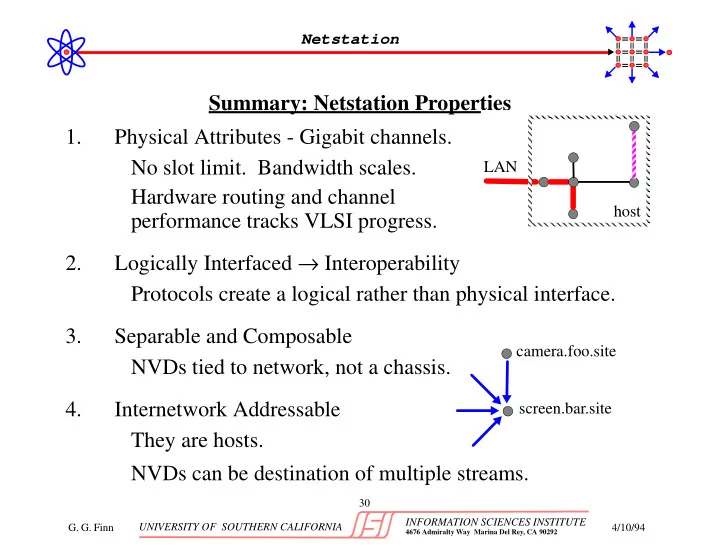
Summary: Netstation Properties 1. Physical Attributes - Gigabit channels. No slot limit. Bandwidth scales. Hardware routing and channel performance tracks VLSI progress. 2. Logically Interfaced → Interoperability Protocols create a logical rather than physical interface. 3. Separable and Composable NVDs tied to network, not a chassis. 4. Internetwork Addressable They are hosts. NVDs can be destination of multiple streams.

host LAN screen.bar.site camera.foo.site

slide-2
SLIDE 2

Netstation

UNIVERSITY OF SOUTHERN CALIFORNIA INFORMATION SCIENCES INSTITUTE

4676 Admiralty Way Marina Del Rey, CA 90292

29 4/10/94

  • G. G. Finn

Research Implications Standards: Protocols Each class of device requires a logical interface.

  • Must define protocols for displays, disks, processors, . . .
  • Host explosion . . . the single–chip host is already here.

Security: Visibility Sanctity of the chassis is gone.

  • Must acquire and retain control over one’s devices.

Routing: Multiply Addressed Location becomes a soft concept.

  • Workstation is a set of addresses and routes.
slide-3
SLIDE 3

Netstation

UNIVERSITY OF SOUTHERN CALIFORNIA INFORMATION SCIENCES INSTITUTE

4676 Admiralty Way Marina Del Rey, CA 90292

28 4/10/94

  • G. G. Finn

Speculation: As the VLSI Turns A thin-node gigabit interface already fits on the corner of a chip.

  • It will only become smaller and faster . . .
  • Can it become an ASIC cell - maybe?

Packets sent to specialized ‘hosts’ are transformed into rasterop packets. Those in turn are sent to update display memory. Rasterop packets might be generated for the display virtually anywhere. JPEG Network Graphics Frame Buffer Update 2 Gb/s switch chip

slide-4
SLIDE 4

Netstation

UNIVERSITY OF SOUTHERN CALIFORNIA INFORMATION SCIENCES INSTITUTE

4676 Admiralty Way Marina Del Rey, CA 90292

27 4/10/94

  • G. G. Finn

Logical Interface Points There are two realistic interface points. The leftmost produces a more conventional display controller.

  • Emulate a ‘frame buffer’ to allow bitmap graphics.
  • Video - JPEG, MPEG-II, or possibly uncompressed.
  • Command - Provide for device control and security.

Audio/Video Commands Bitmap Graphics Network Data Flows Graphic Packet Processing Video Packet Processing Frame Buffer and Portrayal LCD Projection

slide-5
SLIDE 5

Netstation

UNIVERSITY OF SOUTHERN CALIFORNIA INFORMATION SCIENCES INSTITUTE

4676 Admiralty Way Marina Del Rey, CA 90292

26 4/10/94

  • G. G. Finn

Display NVD Many types of data flows arrive at a display. Need to define a set of suitable protocols at an interface point. Where do you make that cut?

Audio/Video Commands Bitmap Graphics Network Data Flows Graphic Packet Processing Video Packet Processing Frame Buffer and Portrayal LCD Projection

slide-6
SLIDE 6

Netstation

UNIVERSITY OF SOUTHERN CALIFORNIA INFORMATION SCIENCES INSTITUTE

4676 Admiralty Way Marina Del Rey, CA 90292

25 4/10/94

  • G. G. Finn

Network Virtual Device - (NVD) If a device attaches only to the network --- It interacts only via protocols --- It is a virtual device. Networks + protocol standards ➔ interoperability.

  • Networking’s greatest benefit (Do you use FTP and Email?)

NVD Definition Procedure Capture device control and function logically . . . in terms of distinct data flows to and from the device.

  • Define protocols suited to each data flow, capturing its nature:

real-time, reliable transport, datagram . . .

slide-7
SLIDE 7

Netstation

UNIVERSITY OF SOUTHERN CALIFORNIA INFORMATION SCIENCES INSTITUTE

4676 Admiralty Way Marina Del Rey, CA 90292

24 4/10/94

  • G. G. Finn

Cluster Computing Support Reliance on thin-node technology places support for Gigabit message transmission in hardware. ➔ Parallel computing support is ‘built in’.

  • Little difference between cluster of workstations and a multicomputer.
  • Workstations are “fat-node” parts of a parallel supercomputer.

Network Backplane

slide-8
SLIDE 8

Netstation

UNIVERSITY OF SOUTHERN CALIFORNIA INFORMATION SCIENCES INSTITUTE

4676 Admiralty Way Marina Del Rey, CA 90292

23 4/10/94

  • G. G. Finn

All Nodes Have Equal Access Nodes have direct access to the Gigabit LAN and Internet.

  • Packets pass without requiring help of the workstation CPU.
  • Relies more upon routing hardware than software.
  • Direct support for “conferencing” applications.

Camera Camera

Internet

slide-9
SLIDE 9

Netstation

UNIVERSITY OF SOUTHERN CALIFORNIA INFORMATION SCIENCES INSTITUTE

4676 Admiralty Way Marina Del Rey, CA 90292

22 4/10/94

  • G. G. Finn

4. Consequences: Software and Hardware System Bus Becomes Superfluous

DMA . . . is replaced by . . . point-to-point packet transmission.

Enhanced Flexibility

Slot-count limitation --- gone. Want another device --- add a new host. Bus bandwidth ceiling --- gone. Network capacity scales with growth. B Simultaneous Flows D A C 2x2 Switch Chip

slide-10
SLIDE 10

Netstation

UNIVERSITY OF SOUTHERN CALIFORNIA INFORMATION SCIENCES INSTITUTE

4676 Admiralty Way Marina Del Rey, CA 90292

21 4/10/94

  • G. G. Finn

Artifacts of Centralization Removed

Data Process RasterOp Network Interface Protocol Stack

Network

Display is accessed via its own gigabit LAN interface.

Consequences

  • 1. Display has its own Internet address.

Packets are routed directly to/from it.

  • 2. Workstation OS no longer acts as an intermediary.
  • 3. OS Socket, & I/O call overhead ---- gone.

Data movement is minimized.

slide-11
SLIDE 11

Network Interface Move into kernel memory Demux Socket UNIX I/O Calls Data Process RasterOp Protocol Stack Move into user memory Copy into frame buffer BSD UNIX Receiving Display Data Packets Artifacts of Centralized Architecture

slide-12
SLIDE 12

Netstation

UNIVERSITY OF SOUTHERN CALIFORNIA INFORMATION SCIENCES INSTITUTE

4676 Admiralty Way Marina Del Rey, CA 90292

19 4/10/94

  • G. G. Finn

Netstation Architecture Give processors and major devices thin-node LAN interfaces. This results in a network-centered architecture . . . or a huge distributed parallel computer . . . depending upon your viewpoint.

HiDef Camera Image Store Processor

Network Backplane

slide-13
SLIDE 13

Netstation

UNIVERSITY OF SOUTHERN CALIFORNIA INFORMATION SCIENCES INSTITUTE

4676 Admiralty Way Marina Del Rey, CA 90292

18 4/10/94

  • G. G. Finn

Workstation Architecture Orthodox architecture is centralized. It shares one network interface. DMA achieves One-Copy operation.

  • Single network interface ➔ N:1 relationship on output, 1:N on input.
  • Protocol stack is centralized and resides inside OS.

Packet Mux and DeMux is done by software.

Unorthodox Architecture

  • Decentralize. Use thin-node interfaces. Bring the local area network

‘closer’ to each processor or major device.

  • Produces a 1:1 relationship for both output and input.
  • Protocol stack distributed. DeMux done by routing hardware.
slide-14
SLIDE 14

Netstation

UNIVERSITY OF SOUTHERN CALIFORNIA INFORMATION SCIENCES INSTITUTE

4676 Admiralty Way Marina Del Rey, CA 90292

17 4/10/94

  • G. G. Finn

RPC Transmit Performance--- SPARCstation-10 Zero Copy + ALF produced a 900% improvement. Moving the network ‘closer’ to the application works very well.

RPC/s Zero-Copy ALF 20,000 User IP/UDP sent loopback (not out the network). User to User transmitted across ATOMIC, using application layer framing and zero copy software. UNIX stack 2000 Minimal packet processing Minimal data movement

✔ ✔

No DMA No progrmmed I/O No I/O calls

slide-15
SLIDE 15

Network Interface BSD UNIX Network Copy into kernel memory Socket UNIX I/O Calls User Process User Process Network Interface Protocol Stack Protocol Stack Zero-Copy & ALF Copy into device memory

Sending RPC Packets How much improvement?

BSD UNIX Network

slide-16
SLIDE 16

Netstation

UNIVERSITY OF SOUTHERN CALIFORNIA INFORMATION SCIENCES INSTITUTE

4676 Admiralty Way Marina Del Rey, CA 90292

15 4/10/94

  • G. G. Finn

How Good Is Zero Copy and ALF? Consider remote procedure calls (RPCs).

  • Allocate/map per RPC user buffers in the network interface.
  • User puts RPC packet stencil in a buffer, using it when sending RPCs.
  • User looks in other buffers for RPC replies.

IP + UDP + Sun RPC packet -- X(a,b,c) -- ~ 96 bytes.

For each RPC sent the user changes: Destination address (possibly) Packet length Incremental checksum Procedure, program index and arguments

  • sets a go flag - interface sends - resets flag - no system I/O calls
slide-17
SLIDE 17

Netstation

UNIVERSITY OF SOUTHERN CALIFORNIA INFORMATION SCIENCES INSTITUTE

4676 Admiralty Way Marina Del Rey, CA 90292

14 4/10/94

  • G. G. Finn

Improving Network Performance Gigabit goals are met when:

Zero-Copy Application Layer Framing (ALF) (Clark, Tennenhouse)

Orthodox Path Partially meet goals by:

Not using programmed IO

  • DMA packets

Not checksumming in software

  • Make part of DMA in net interface

Not copying into destination

  • Page align and VM remap packets
slide-18
SLIDE 18

Netstation

UNIVERSITY OF SOUTHERN CALIFORNIA INFORMATION SCIENCES INSTITUTE

4676 Admiralty Way Marina Del Rey, CA 90292

13 4/10/94

  • G. G. Finn
  • 3. Motivation and Design of a New Workstation Architecture

Achieving Gigabit performance is not easy. Why? Performance Bottlenecks Hardware Architecture

  • System buses

Software Architecture

  • Protocol stack and OS

Packet Processing

  • Too costly

Gigabit Performance Rules Minimize data movement. Minimize per-packet processing.

slide-19
SLIDE 19

SBus Interface 41mm SRAM LANai SBus

slide-20
SLIDE 20

Netstation

UNIVERSITY OF SOUTHERN CALIFORNIA INFORMATION SCIENCES INSTITUTE

4676 Admiralty Way Marina Del Rey, CA 90292

11 4/10/94

  • G. G. Finn

Mosaic Successor - LANai 32-bit Transfer Signal count

VL–Bus: 30 ns 92 SBus: 40 ns 82 Turbochannel: 40 ns 44 ATOMIC: 66 ns (per-channel) 18 (channel-pair) Net I/O CPU Bus I/O

SRAM SRAM SRAM SRAM

32-bit Local Bus 500 Mb/s channels 1 Gb/s 40 meter channel interface

slide-21
SLIDE 21

Netstation

UNIVERSITY OF SOUTHERN CALIFORNIA INFORMATION SCIENCES INSTITUTE

4676 Admiralty Way Marina Del Rey, CA 90292

10 4/10/94

  • G. G. Finn

ATOMIC Performance

Flows Byte/pkt Kpkt/s Mb/s 4 54 1500 657 396 31 21 171 381 2 54 1500 5250 793 33 8 2 2 Single source. SRAM limited to 400 Mb/s. Multiple sources competing for single path. SRAMs limited to 400 Mb/s. 84 343 405 Byte/pkt Kpkt/s Mb/s Below capacity At capacity

slide-22
SLIDE 22

Netstation

UNIVERSITY OF SOUTHERN CALIFORNIA INFORMATION SCIENCES INSTITUTE

4676 Admiralty Way Marina Del Rey, CA 90292

9 4/10/94

  • G. G. Finn

A Thin-Node LAN - ATOMIC

crossbar program host interface program 1. Distribute Mosaic chips into hosts. 2. Aggregate other Mosaic chips to form switches. 3. Develop suitable cabling [AT&T 41MM differential pairs] 4. Program the assembly to emulate a LAN. ATOMIC is a physically distributed parallel computer that is programmed to be a LAN.

slide-23
SLIDE 23

Netstation

UNIVERSITY OF SOUTHERN CALIFORNIA INFORMATION SCIENCES INSTITUTE

4676 Admiralty Way Marina Del Rey, CA 90292

8 4/10/94

  • G. G. Finn

2. Local Area Network Thin-node combines computation with Gb/s routing capability. One can tailor-make a “network” with it. For example:

  • Begin with a datagram LAN.

Emulate Ethernet-style interface IDs, broadcast & multicast Perform ID → source route translation → “Ethernet” compatible LAN that runs at 500 Mb/s.

  • Recognize RPC packets.

Source chip assigns Seq# and sends, destination chip ACKs when good. Source chip retransmits RPC when ACK not received within ∆t. → Reliable message service for RPC and Network Control.

slide-24
SLIDE 24

Netstation

UNIVERSITY OF SOUTHERN CALIFORNIA INFORMATION SCIENCES INSTITUTE

4676 Admiralty Way Marina Del Rey, CA 90292

7 4/10/94

  • G. G. Finn

Thin-Node Characteristics

  • 1. Sub-chip size gigabit interface.
  • 2. Variable-length messages --- Direct datagram compatibility.
  • 3. Programmable.
  • 4. Scales with VLSI.

ROUTER

Memory

ROM

CPU

DMA

500 Mb/s channels Thin-Node Characteristic Small interface size. Direct gigabit interface to your µproc?

slide-25
SLIDE 25

Netstation

UNIVERSITY OF SOUTHERN CALIFORNIA INFORMATION SCIENCES INSTITUTE

4676 Admiralty Way Marina Del Rey, CA 90292

6 4/10/94

  • G. G. Finn

Mosaic Chips

ROUTER

Memory

ROM

CPU

DMA

Network routing and DMA account for 8% of the chip logic. 500 Mb/s channels

Memory Interface 16-bit access

500 Mb/s channels

Switch Chip Interface Chip

SRAM

CPU

slide-26
SLIDE 26

Thin-Node Fat-Node

Networking and Parallel Supercomputing

Thin-Node

small µproc small memory

  • ne-few chips

cheap/node high parallelism

Fat-Node

powerful µproc large memory many chips costly/node moderate parallelism

Internode Communication Families Shared or Distributed Memory Message Passing

Hypercube

Caltech Cosmic Cube

Caltech Mosaic iPSC Paragon discrete-length ring topology routed by ID# 1 to 3 Gb/s

+ Thin-node = “interesting”

variable-length mesh topology source routed point-to-point 0.5 to 1 Gb/s SCI - IEEE 1596 - SCIzzle Scalable Coherent Interface

slide-27
SLIDE 27

Netstation

UNIVERSITY OF SOUTHERN CALIFORNIA INFORMATION SCIENCES INSTITUTE

4676 Admiralty Way Marina Del Rey, CA 90292

4 4/10/94

  • G. G. Finn

1. Gigabit Architecture - Where is it now? Contrary to what we hear . . . 100 or 155 Mb/s is not a Gigabit. At a Gigabit things get hard.

  • Instruction time consumes a word of bandwidth
  • Network operates at DMA rate

But Gigabit Architectures and Networks Do Exist Parallel supercomputers have used Gigabit networking for years.

  • What has that community been doing?
  • Can we use this technology?

Is it practical? Is it cost effective?

slide-28
SLIDE 28

Netstation

UNIVERSITY OF SOUTHERN CALIFORNIA INFORMATION SCIENCES INSTITUTE

4676 Admiralty Way Marina Del Rey, CA 90292

3 4/10/94

  • G. G. Finn

Building Gigabit Workstations - One Designer’s Viewpoint Guiding Principle Better design envelope is obtained by decentralized design based upon gigabit networking rather than a system bus. I will present: 1. Developments in parallel supercomputing that scaled gigabit datagram networking down to chip level. 2. Performance of a Gb/s LAN built from that technology. 3. Why it is difficult to obtain Gb/s performance from today’s workstation hardware and software architectures. 4. Solution by rearchitecting around Gb/s network. Pros and cons . . . and a possible future.

slide-29
SLIDE 29

UNIVERSITY OF SOUTHERN CALIFORNIA INFORMATION SCIENCES INSTITUTE

4676 Admiralty Way Marina Del Rey, CA 90292

4/10/94

  • G. G. Finn

2

Gigabit Architecture

Workstations and applications are increasingly network-oriented.

  • Email, Network Servers, Teleconferencing, MultiMedia

Applications are pushing development of “Gigabit” technologies

  • Medical image transfer, Scientific visualization
  • Virtual reality, “Information Wonder-Highway”
  • JPEG (NTSC), HDTV (MPEG-II)

HiDef Camera Image Store Processor

Network Backplane

slide-30
SLIDE 30

UNIVERSITY OF SOUTHERN CALIFORNIA INFORMATION SCIENCES INSTITUTE

4676 Admiralty Way Marina Del Rey, CA 90292

4/10/94

  • G. G. Finn

1

Networld + Interop-94

Netstation Architecture Gigabit Communication Fabric

  • G. G. Finn

USC/Information Sciences Institute finn@isi.edu HiDef Camera Image Store Processor

Network Backplane