Success and Failure of Implementing Data-driven Upscaling Using Flux - - PowerPoint PPT Presentation

success and failure of implementing data driven upscaling
SMART_READER_LITE
LIVE PREVIEW

Success and Failure of Implementing Data-driven Upscaling Using Flux - - PowerPoint PPT Presentation

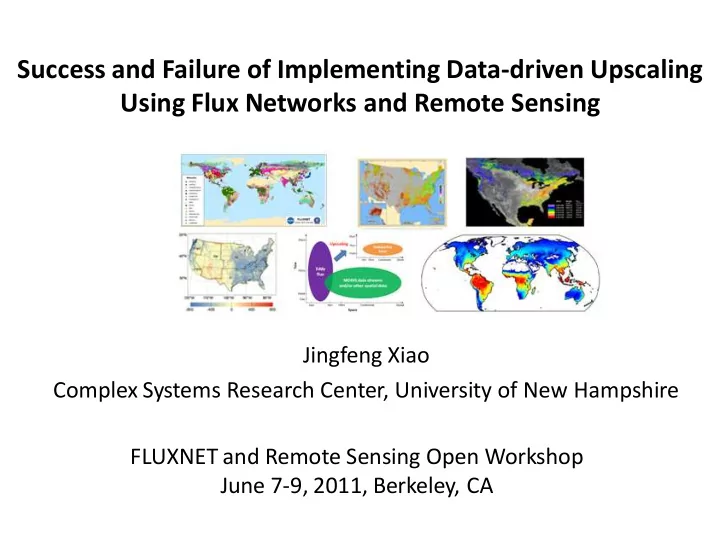
Success and Failure of Implementing Data-driven Upscaling Using Flux Networks and Remote Sensing Jingfeng Xiao Complex Systems Research Center, University of New Hampshire FLUXNET and Remote Sensing Open Workshop June 7-9, 2011, Berkeley, CA


slide-1
SLIDE 1

Success and Failure of Implementing Data-driven Upscaling Using Flux Networks and Remote Sensing

Jingfeng Xiao Complex Systems Research Center, University of New Hampshire FLUXNET and Remote Sensing Open Workshop June 7-9, 2011, Berkeley, CA

slide-2
SLIDE 2

Outline

  • Progress
  • Applications
  • Challenges and directions
slide-3
SLIDE 3

Gridded flux fields

Eddy flux Upscaling MODIS data, climate data, and other spatial data

slide-4
SLIDE 4

Upscaling methods

  • Data-driven approaches
  • Neural networks (e.g., Papale and Valentini et al. 2003)
  • Ensemble of regression models (e.g., Xiao et al. 2008, Jung et al.

2009, Zhang et al. 2011)

  • Support vector machine (e.g., Ichii et al. 2010)
  • Data assimilation techniques
  • Ecosystem models (e.g., Beer et al. 2010; Xiao et al., JGR, accepted)
  • Parameter estimation methods (e.g., Markov chain Monte

Carlo, MCMC)

slide-5
SLIDE 5

An example for data-driven methods

Xiao et al., 2008

slide-6
SLIDE 6

An example for data assimilation methods

Diagnostic model Parameter estimation:

  • Differential evolution (DE)
  • Markov chain Monte Carlo (MCMC)

Xiao et al., JGR, accepted; Xiao et al., in preparation

slide-7
SLIDE 7

Wylie et al. 2007 Zhang et al. 2011 Xiao et al., 2008, 2010, 2011 Sun et al. 2011 Ichii et al. 2010

Jung et al.2009, 2010 Beer et al. 2010 Xiao et al. in preparation

Xiao et al., JGR, accepted Papale and Valentini et al. 2003

Regional Continental Global

Yuan et al. 2010

slide-8
SLIDE 8

“Advances in Upscaling of Eddy Covariance Measurements of Carbon and Water fluxes”, a special issue in JGR – Biogeosciences, guest-editors: Jingfeng Xiao, Kenneth J. Davis, Markus Reichstein, Jiquan Chen

  • 1. Climatic and phenological controls on coherent regional interannual variability
  • f carbon dioxide flux in a heterogeneous landscape, Desai, A. R.
  • 2. Upscaling carbon fluxes over the Great Plains grasslands: sinks and sources,

Zhang, L. et al.

  • 3. Upscaling key ecosystem functions across the conterminous United States by a

water-centric ecosystem model, Sun, G. et al.

  • 4. Assessing and improving the representativeness of monitoring networks: The

European flux tower network example, Sulkava, M. et al.

  • 5. Characterizing vegetation structural and topographic characteristics sampled by

eddy covariance within two mature aspen stands using LiDAR and a flux footprint model: Scaling to MODIS, Chasmer, L. et al.

  • 6. Global patterns of land biosphere - atmosphere fluxes derived from upscaling

FLUXNET observations, Jung, M. et al.

  • 7. Upscaling carbon fluxes from towers to the regional scale: influence of parameter

variability and land cover representation on regional flux estimates, Xiao, J. et al.

slide-9
SLIDE 9
slide-10
SLIDE 10

Outline

  • Progress
  • Applications
  • Challenges and directions
slide-11
SLIDE 11

Applications

  • Examine spatial and temporal patterns of carbon and water

fluxes and water use efficiency

  • Assess impacts of extreme climate events and disturbance
  • Estimate ecosystem services (e.g., ecosystem carbon

sequestration, food and wood production, water yield)

  • Evaluate simulations of ecosystem models and inversions
  • Provide background fluxes for atmospheric inversions
slide-12
SLIDE 12

An example for assessing ecosystem carbon dynamics

Xiao et al., RSE, 2010; Agri. For. Met., 2011

EC-MOD flux fields

slide-13
SLIDE 13
  • Ecosystem models
  • North American Carbon Program (NACP) Interim Synthesis
  • CLM, TEM

Huntzinger et al. in preparation

Examples for model evaluations

slide-14
SLIDE 14

Dang et al., JGR, accepted

  • Atmospheric inversions
  • Boundary layer model
  • 104 -105 km2 regions

surrounding 4 flux sites

slide-15
SLIDE 15

Examples for model evaluations

  • Atmospheric inversions
  • e.g., a nested inversion model (Deng et al., Tellus, 2007)
  • NASA’s Carbon Monitoring System (CMS)
  • Bottom-up and top-down estimates
  • EC-MOD flux fields extending to global scale

Deng et al. in preparation

slide-16
SLIDE 16

Outline

  • Progress
  • Applications
  • Challenges and directions
slide-17
SLIDE 17

Challenges

  • Accuracy of gridded fluxes
  • Overestimation of carbon fluxes?
  • Uncertainty assessment
  • All sources of uncertainty
  • Data availability and sharing
  • Some geographical regions
  • Sustaining of flux networks
  • Essential for future carbon and water studies
slide-18
SLIDE 18

Huntzinger et al. in preparation Xiao et al., 2010, 2011

EC-MOD

slide-19
SLIDE 19
  • Do flux towers tend to be located at productive sites?
  • Possible overestimation of carbon uptake
  • Representativeness of flux networks
  • Some regions/ecosystem types are underrepresented
  • Difficult to estimate ecosystem respiration
  • Failure to fully incorporate disturbance effects

Accuracy of gridded fluxes

slide-20
SLIDE 20

EC-MOD v1.0 EC-MOD v2.0 GPP NEE

Xiao, J., et al. unpublished

slide-21
SLIDE 21

“Assessing Ecosystem Carbon Dynamics over North America by Integrating Eddy Covariance, MODIS, and New Ecological Data through Upscaling and Model-data Synthesis”, NSF, $517,685, 2011-2014, Jingfeng Xiao (PI), Scott Ollinger (Co-PI).

We are hiring too …

A Postdoctoral Research Associate in Ecosystem Modeling http://www.eos.sr.unh.edu/Faculty/Xiao

slide-22
SLIDE 22

Uncertainty assessment

  • Input data
  • Some input data may have large biases
  • Land cover representation
  • Scaling, heterogeneity, map accuracy
  • Model parameters
  • Parameter variability within PFTs
  • Model structure
  • Imperfect processes and assumptions
slide-23
SLIDE 23
  • Flux observations
  • Reanalysis data
  • Land cover maps

Uncertainty in input data

slide-24
SLIDE 24

Example: parameter variability, scaling, and land cover representation

Xiao et al., JGR, accepted

slide-25
SLIDE 25

Data availability and sharing

  • Large gaps in flux networks
  • Sharing of flux observations in some regions
  • Will fair data-use policy and coauthorship help?
slide-26
SLIDE 26

Sustaining of flux networks

  • A big challenge that flux tower PIs (and modelers) face now
  • Large synthesis projects with mini-grants to flux tower PIs?
  • Do we really need to maintain all these flux towers?
  • Complementary and new networks, e.g., National Ecological

Observatory Network (NEON)

slide-27
SLIDE 27
  • Account for effects of disturbance and nitrogen limitation

and better simulate heterotrophic respiration

  • Quantify and reduce uncertainties associated with gridded

flux estimates

  • Improve and juxtapose various upscaling methods and

gridded flux fields

  • Play a more important role in studies of carbon and water

cycles, ecosystem services, and sustainability and in evaluating Earth System Models

Directions