STUMPed for a Diagnosis Contemporary Management of Uterine Sarcomas - - PowerPoint PPT Presentation

stumped for a diagnosis contemporary management of
SMART_READER_LITE
LIVE PREVIEW

STUMPed for a Diagnosis Contemporary Management of Uterine Sarcomas - - PowerPoint PPT Presentation

Disclosures UCSF Helen Diller Family Comprehensive Cancer Center I have no financial disclosures STUMPed for a Diagnosis Contemporary Management of Uterine Sarcomas Lee-may Chen, MD Department of Obstetrics, Gynecology and Reproductive


slide-1
SLIDE 1

UCSF Helen Diller Family Comprehensive Cancer Center

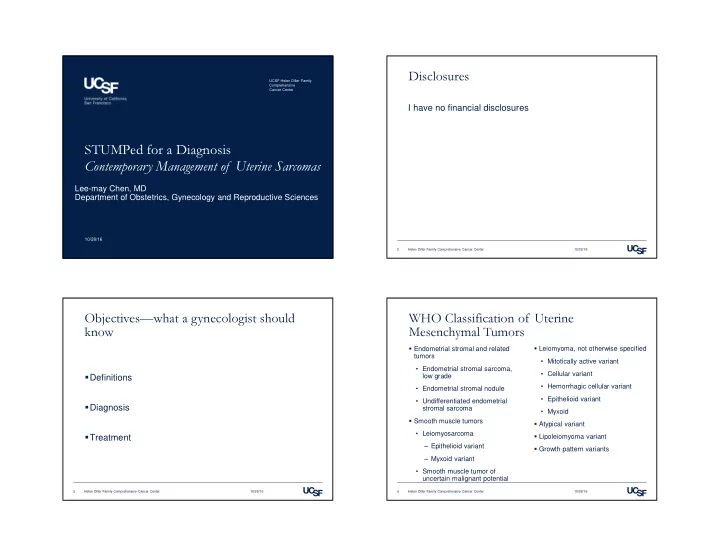
STUMPed for a Diagnosis Contemporary Management of Uterine Sarcomas

10/28/16

Lee-may Chen, MD Department of Obstetrics, Gynecology and Reproductive Sciences

Disclosures

I have no financial disclosures

10/28/16 2 Helen Diller Family Comprehensive Cancer Center

Objectives—what a gynecologist should know

Definitions Diagnosis Treatment

10/28/16 Helen Diller Family Comprehensive Cancer Center 3

WHO Classification of Uterine Mesenchymal Tumors

Endometrial stromal and related tumors

  • Endometrial stromal sarcoma,

low grade

  • Endometrial stromal nodule
  • Undifferentiated endometrial

stromal sarcoma Smooth muscle tumors

  • Leiomyosarcoma

‒ Epithelioid variant ‒ Myxoid variant

  • Smooth muscle tumor of

uncertain malignant potential Leiomyoma, not otherwise specified

  • Mitotically active variant
  • Cellular variant
  • Hemorrhagic cellular variant
  • Epithelioid variant
  • Myxoid

Atypical variant Lipoleiomyoma variant Growth pattern variants

10/28/16 Helen Diller Family Comprehensive Cancer Center 4

slide-2
SLIDE 2

WHO Classification of Uterine Mesenchymal Tumors

Diffuse leiomyomatosis Dissecting leiomyoma Intravenous leiomyomatosis Metastasizing leiomyoma Perivascular epithelioid cell tumor Adenomatoid tumor Other benign, malignant, and miscellaneous mesenchymal tumors Mixed epithelial and mesenchymal tumors

  • Carcinosarcoma
  • Adenosarcoma
  • Carcinofibroma
  • Adenofibroma
  • Adenomyoma
  • Atypical polypoid variant

10/28/16 Helen Diller Family Comprehensive Cancer Center 5

WHO Classification of Uterine Mesenchymal Tumors

10/28/16 Helen Diller Family Comprehensive Cancer Center 6

WHO Classification of Uterine Mesenchymal Tumors

Carcinosarcomas are more like metaplastic carcinomas Uterine sarcomas are heterogeneous, with different clinical presentations, responses to therapy, and outcomes

10/28/16 Helen Diller Family Comprehensive Cancer Center 7

Uterine malignancies

Sarcomas Carcinomas

Uterine sarcomas

Other ESS LMS

Epidemiology

Mean/Median age Endometrial stromal sarcoma 42-51 Leiomyosarcoma 48-57 Carcinosarcoma 58-66 Undifferentiated sarcoma 46 Smooth muscle tumor of uncertain malignant potential (STUMP) 43

Many premenopausal women

10/28/16 Helen Diller Family Comprehensive Cancer Center 8

slide-3
SLIDE 3

Epidemiology

Risk Factors

10/28/16 Helen Diller Family Comprehensive Cancer Center 9

Prior radiation

  • Possible association with carcinosarcoma, undifferentiated

sarcoma

  • Less association with leiomyosarcoma or STUMP

Hormone exposure

  • Tamoxifen?

Hereditary Predisposition

  • Hereditary leiomyomatosis and renal cell cancer (HLRCC)

Giuntoli et al, Gynecol Oncol 2003 Guntupalli et al, Gynecol Oncol 2009

Clinical Presentation

Signs & Symptoms

10/28/16 Helen Diller Family Comprehensive Cancer Center 10

Bleeding, abdominopelvic mass, presumed fibroids No reliable serum markers

  • CA125 elevated in 17-33%

Endometrial sampling should be performed as appropriate

  • Up to 86% sarcomas diagnosed, with 64% specificity

Bansal et al Gynecol Oncol 2008 Park et al, J Cancer Res Clin Oncol 2008

Preoperative Imaging

Utrasound

  • Single tumor
  • Non-myometrial origin
  • Absence of acoustic

shadowing

  • Thickened endometrium
  • Ascites

Criteria to distinguish leiomyoma from mesenchymal cancers MRI

  • Poorly defined margins
  • Intermediate or high signal

intensity in T1 or T2

  • Cystic alteration of tumor
  • Heterogeneity of

enhancement

10/28/16 Helen Diller Family Comprehensive Cancer Center 11

Bonneau et al, Acta Obstet Gynecol Scand 2014

Pre-operative Imaging

Adding LDH to Dynamic MRI

10/28/16 Helen Diller Family Comprehensive Cancer Center 12

Goto et al, Int J Gynecol Cancer 2002 Park et al, J Cancer Res Clin Oncol 2008

Sensitivity Specificity Accuracy PPV NPV LDH 100% 87.7% 86.6% 38.5% 100% MRI 100% 96.9% 97.1% 71.4% 100% Dynamic MRI 100% 87.5% 90.5% 71.4% 100% LDH + Dynamic MRI 100% 99.2% 99.3% 90.9% 100%

DLM LMS

slide-4
SLIDE 4

Preoperative Diagnosis is Poor

Norwegian Cohort Study, 2000-2012

10/28/16 Helen Diller Family Comprehensive Cancer Center 13

212 cases of leiomyosarcoma, mean age 58.1 110 (51.9%) with abnormal bleeding 49 (23.1%) diagnosed pre-op, 48 (22.6%) suspected pre-op, 115 (54.2%) diagnosed postoperatively 55/142 (38.7%) diagnosed by curettage or biopsy 45/55 (81%) suggested by MRI 64/107 (59.8%) suggested by CT Skorstad et al, Acta Obstet Gynecol Scand 2016 Skorstad et al, Acta Obstet Gynecol Scand 2016

Have an Index of Suspicion

10/28/16 Helen Diller Family Comprehensive Cancer Center 14

Surgical approach

10/28/16 Helen Diller Family Comprehensive Cancer Center 15

When choosing the route and method of hysterectomy, the physician should take into consideration how the procedure may be performed most safely and cost-effectively to fulfill the medical needs of the patient. Evidence demonstrates that, in general, vaginal hysterectomy is associated with better outcomes and fewer complications than laparoscopic or abdominal hysterectomy. When it is not feasible to perform a vaginal hysterectomy, the surgeon must choose between laparoscopic hysterectomy, robot-assisted hysterectomy, or abdominal hysterectomy. ACOG Committee Opinion 444, reaffirmed 2011

Morcellation

Power morcellation or other techniques that cut up the uterus in the abdomen have the potential to disseminate an otherwise contained malignancy throughout the abdominal cavity. For this reason, the Society of Gynecologic Oncology (SGO) asserts that it is generally contraindicated in the presence of documented or highly suspected malignancy, and may be inadvisable in premalignant conditions or risk-reducing surgery. The SGO recognizes that currently there is no reliable method to differentiate benign from malignant leiomyomas (leiomyosarcomas

  • r endometrial stromal sarcomas) before they are removed.

Furthermore, these diseases offer an extremely poor prognosis even when specimens are removed intact.

10/28/16 Helen Diller Family Comprehensive Cancer Center 16

SGO Position Statement, 2013

slide-5
SLIDE 5

Impact of Morcellation: Occult Sarcoma

Kaiser Population Cohort study, 2009-2013

10/28/16 Helen Diller Family Comprehensive Cancer Center 17

34,208 hysterectomies 125 with occult uterine sarcomas Incidence of all sarcomas: 0.36% Incidence of leiomyosarcomas: 0.23% 111 Stage I leiomyosarcomas

  • 35 cases morcellated: 7 power, 28 non-power

Higher risk of death at 1 year after morcellation: 5.12 (95% CI 1.33- 19.76, p = 0.02). Numbers too small for power morcellation effect. Raine-Bennett et al, Obstet Gynecol 2016

Impact of Morcellation: Survival

Korean Cohort study, 1989-2010

10/28/16 Helen Diller Family Comprehensive Cancer Center 18

56 cases of Stage I & II uterine leiomyosarcoma 25 uteri morcellated

  • Uterine size: 7.3 vs 9.8cm, p = 0.022
  • Ovarian preservation: 38.7 vs 72%, p = 0.013

Multivariate analysis for poorer overall survival Stage: OR 20.34 (95% CI 1.23-325.58, p = 0.033) Morcellation: OR 3.11 (95% CI 1.07-9.06, p = 0.038) Park et al, Gynecol Oncol 2011

Uterine Preservation

Pathology dependent Case reports only

10/28/16 Helen Diller Family Comprehensive Cancer Center 19

Ovarian Preservation

Low risk to keep ovaries in Leiomyosarcoma

10/28/16 Helen Diller Family Comprehensive Cancer Center 20

Major et al, Cancer 1993 Giuntoli et al, Gynecol Oncol 2003 Ovarian metastases:

  • Leiomyosarcoma: 3.1-3.7%
  • Carcinosarcoma: 12%
  • Endometrial stromal sarcoma: 13%, but usually not occult

Bilateral oophorectomy recommended for Carcinosarcoma Ovarian preservation may impact recurrence, hormonal treatment

  • ptions in Endometrial stromal sarcoma
slide-6
SLIDE 6

Lymphadenectomy

No known survival advantage to LND

10/28/16 Helen Diller Family Comprehensive Cancer Center 21

Major et al, Cancer 1993 Shah et al, Obstet Gynecol 2008 Lymph node metastases

  • Leiomyosarcoma: 7%, but <3% occult
  • Carcinosarcoma: 27%, 20% occult
  • Endometrial stromal sarcoma: 16%, 6% occult

Suggest lymphadenectomy for carcinosarcoma Consider lymphadenectomy for endometrial stromal sarcoma Resect bulky lymph nodes

Staging—Leiomyosarcomas & Endometrial Stromal Sarcomas (FIGO 2009)

Stage Definition I Tumor limited to uterus IA Less than or equal to 5cm IB More than 5cm II Tumor extends beyond the uterus, within the pelvis IIA Adnexal involvement IIB Involvement of other pelvic tissues III Tumor invades abdominal tissues (not just protruding into abdomen) IIIA One site IIIB More than one site IIIC Metastasis to pelvic and/or para-aortic lymph nodes IVA Tumor invades bladder and/or rectum IVB Distant metastases

10/28/16 Helen Diller Family Comprehensive Cancer Center 22

Staging—Adenosarcomas (FIGO 2009)

Stage Definition I Tumor limited to uterus IA No myometrial invasion IB Less than or half myometrial invasion IC More than half myometrial invasion II Tumor extends beyond the uterus, within the pelvis IIA Adnexal involvement IIB Involvement of other pelvic tissues III Tumor invades abdominal tissues (not just protruding into abdomen) IIIA One site IIIB More than one site IIIC Metastasis to pelvic and/or para-aortic lymph nodes IVA Tumor invades bladder and/or rectum IVB Distant metastases

10/28/16 Helen Diller Family Comprehensive Cancer Center 23

Staging—Carcinosarcomas are staged as endometrial carcinomas (FIGO 2009)

Stage Definition IA No or less than half myometrial invasion IB Invasion equal to or more than half of the myometrium II Tumor invades the cervical stroma but does not extend beyond the uterus IIIA Tumor invades serosa of the corpus uteri and /or adnexae IIIB Vaginal and/or parametrial involvement IIIC1 Metastasis to pelvic lymph nodes IIIC2 Metastasis to para-aortic lymph nodes, with or without positive pelvic nodes IVA Tumor invades bladder and/or bowel mucosa IVB Distant metastases including intra-abdominal and inguinal lymph nodes

10/28/16 Helen Diller Family Comprehensive Cancer Center 24

slide-7
SLIDE 7

Stage Distribution

5 Year Overall Survival—Stage I ESS: 97%

  • All stages ESS: 92%

Leiomyosarcoma: 57% Carcinosarcoma: 62% Undifferentiated sarcoma: 52% Adenosarcoma

  • IA: 84%
  • IB: 65%

10/28/16 Helen Diller Family Comprehensive Cancer Center 25

0% 10% 20% 30% 40% 50% 60% 70% 80% 90% 100% Stage I Stage II Stage III Stage IV AS UUS ESS LMS CS

Treatment--Radiation

EORTC Randomized Phase III trial—1988-2001

10/28/16 Helen Diller Family Comprehensive Cancer Center 26

Reed et al, Eur J Cancer 2008 224 patients with Stage I or II uterine sarcomas from 36 institutions

  • 99 LMS, 92 CS, 30 ESS, 3 other

Randomization of pelvic RT 5040cGy versus observation Overall relapse rate: 47% vs 50% Locoregional relapse rate: 21% vs 40%, p = 0.0004

  • Carcinosarcomas: 24% vs 47%, p < 0.05
  • Leiomyosarcomas: 20% vs 24%

Overall survival, carcinosarcomas: HR 1.58, 95% CI 0.83-3.01

NCCN Sarcoma Chemo Options

Combo:

  • Docetaxel/gemcitabine (LMS)
  • Doxorubicin/Ifosfamide
  • Doxorubicin/dacarbazine
  • Gemcitabine/dacarbazine
  • Gemcitabine/vinorelbine

Hormonal (for LGESS, ER/PR (+) & uLMS)

  • Medroxyprogesterone acetate
  • Megestrol acetate
  • Aromatase inhibitors
  • GnRH analogs

Clinical Trials strongly recommended

Single agent

  • Dacarbazine
  • Doxorubicin
  • Epirubicin
  • Gemcitabine
  • Ifosfamide
  • Doxil
  • Pazapanib
  • Temozolomide
  • Vinorelbine (cat 2B)
  • Docetaxel (cat 3)

Treatment--Hormones

ER & PR in about 56% of sarcomas

10/28/16 Helen Diller Family Comprehensive Cancer Center 28

Mostly in Endometrial Stromal Sarcomas Many case series of hormonal therapies

  • Megestrol acetate
  • Other progestational agents
  • GnRH analogues
  • Aromatase inhibitors

Trials in Leiomyosarcomas ongoing.

slide-8
SLIDE 8

Molecular Considerations

The Cancer Genome Atlas Project

10/28/16 Helen Diller Family Comprehensive Cancer Center 29

Carcinosarcomas: most resemble serous endometrial or ovarian cancers.

  • Extensive copy number variation
  • Recurrent mutations in p53, FBXW7, PIK3CA, PPP2R1A, PTEN

7 sarcoma subtypes under study

  • Uterine and non-uterine leiomyosarcoma
  • Dedifferentiated liposarcoma, desmoid sarcoma, malignant

peripheral nerve sheath tumor, myxofibrosarcoma, synovial sarcoma, undfifferentiated pleiomorphic sarcoma

So what is a STUMP?

“Uterine Smooth Muscle Tumors that no one talks about”

10/28/16 Helen Diller Family Comprehensive Cancer Center 30

Smooth muscle tumors

  • Leiomyosarcoma
  • Epithelioid variant
  • Myxoid variant

Smooth muscle tumor of uncertain malignant potential Leiomyoma, not otherwise specified Mitotically active variant Cellular variant Hemorrhagic cellular variant Epithelioid variant Myxoid Atypical variant Lipoleiomyoma variant Growth pattern variants

Not Quite a Leiomyosarcoma

Two diagnostic features are required to make the diagnosis of leiomyosarcoma

  • Significant and diffuse cytologic atypia
  • At least 10 mitoses per 10 high powered fields
  • Coagulative tumor necrosis

Excision required for thorough histologic examination Differential: metastasizing leiomyoma, metastatic low grade leiomyosarcoma

10/28/16 Helen Diller Family Comprehensive Cancer Center 31

Characterizing STUMPs

41 patients, mean age 43 (range 25-75) 10 patients had myomectomy, others hysterectomy Mean follow-up time 45 months (1-171 months) 7.3% recurrence

  • PFS: 13, 47, 68 months
  • All were diagnosed at hysterectomy
  • All 3 alive and disease free at median follow-up of 128

months MD Anderson case series, 1990-2005

10/28/16 Helen Diller Family Comprehensive Cancer Center 32

Gyntupalli et al, Gynecol Oncol 2009

slide-9
SLIDE 9

STUMPed for a diagnosis

Bland histologic appearance Synchronous or metachronous involvement of different anatomic sites

  • Pelvis, lung, soft tissue, bowel, omentum, lymph nodes, bone

Typical treatment Excision Consider hormone blockade. Pay attention to recurrences Subsequent tumors may be more aggressive

  • More aggressive tumors may warrant chemo

10/28/16 Helen Diller Family Comprehensive Cancer Center 33

Benign Metastasizing Leiomyoma

10/28/16 Helen Diller Family Comprehensive Cancer Center 34

Taftaf et al, Case Rep Oncol Med 2014

Diffuse Leiomyomatosis

10/28/16 Helen Diller Family Comprehensive Cancer Center 35

Dim et al, Niger Med J 2012

Intravenous Leiomyomatosis

10/28/16 Helen Diller Family Comprehensive Cancer Center 36

Tenzer et al, J Clin Gynecol Obstet 2015

slide-10
SLIDE 10

A rose by any other name…

10/28/16 Helen Diller Family Comprehensive Cancer Center 37

Many tumor are called sarcomas, some are mesenchymal tumors, but not high grade sarcomas Have a level of suspicion for occult lesions Ovaries and lymph nodes might be important, but can be readdressed on final pathology Get a review by a Gynecologic Pathologist Refer to Gynecologic Oncologist if consultation needed Molecular characteristics may unlock answers in the future