
SLIDE 1
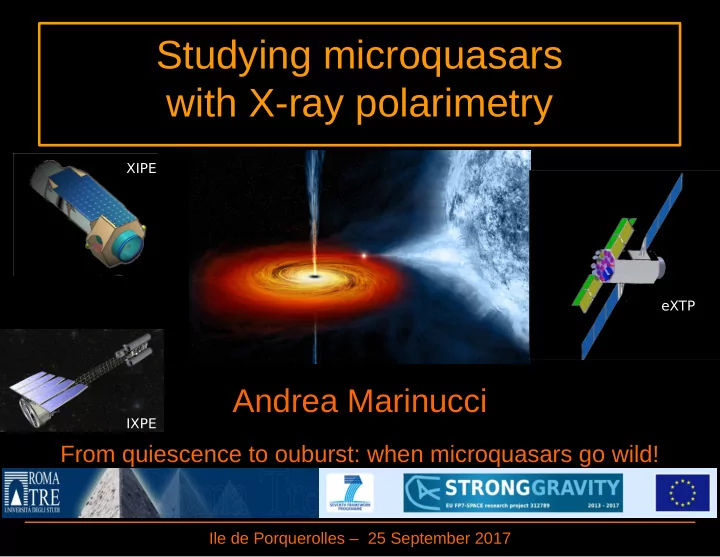
Studying microquasars with X-ray polarimetry
Andrea Marinucci
From quiescence to ouburst: when microquasars go wild!
Ile de Porquerolles – 25 September 2017
IXPE XIPE eXTP
Studying microquasars with X-ray polarimetry XIPE eXTP Andrea - - PowerPoint PPT Presentation
Studying microquasars with X-ray polarimetry XIPE eXTP Andrea Marinucci IXPE From quiescence to ouburst: when microquasars go wild! Ile de Porquerolles 25 September 2017 Outline - Introduction - Polarimetry and microquasars:
Ile de Porquerolles – 25 September 2017
IXPE XIPE eXTP
Andrea Marinucci (Roma Tre)
Andrea Marinucci (Roma Tre)
Ariel-5 OSO-8
At the beginning of X-ray astronomy, polarimeters were flown aboard rockets and aboard the OSO-8 and ARIEL-5 satellites. The introduction of X-ray optics, while producing a dramatic improvement in sensitivity, removed the need to rotate the satellite. Therefore, polarimetry based on the classical techniques, Bragg diffraction and Thomson scattering (which require rotation), became seriously mismatched with imaging and spectroscopy. In the last 10 years, with the development of sensors based on the photoelectric effect (Costa+01), polarimetry has been again considered as a realistic
instrumentation or for dedicated small missions.
Andrea Marinucci (Roma Tre) Weisskopf+78
The only positive detection was the polarization of the Crab Nebula (Weisskopf+78) and two significant upper limits were obtained
Sco X-1 (Weisskopf+78), plus many other upper limits of modest significance (Hughes+84). Instrument dependent
Andrea Marinucci (Roma Tre) Zhang+13 Done+07
Andrea Marinucci (Roma Tre)
The role of the jet The coronal geometry The BH spin
Andrea Marinucci (Roma Tre)
kTe
d=n dx e kn Tamborra+, in prep.
Andrea Marinucci (Roma Tre)
Tamborra+, in prep.
Andrea Marinucci (Roma Tre) Tamborra+, in prep.
Andrea Marinucci (Roma Tre) McNamara+09
z=0 z=0.5
Andrea Marinucci (Roma Tre)
Andrea Marinucci (Roma Tre)
Gravitational bending modifies the light geodesics causing a rotation of the plane of polarization, stronger the field larger the rotation: the polarization angle rotates with respect to the Newtonian value The effect increases with decreasing radii, i.e. with increasing temperature, i.e. with increasing photon energy rotation of the polarization angle with energy Connors+80
Andrea Marinucci (Roma Tre)
Harder photons comes from inner region of the accretion disk and then are more affected; The effect is stronger for a Kerr BH, because the disk gets closer to the compact source Courtesy: Michal Dovciak
Andrea Marinucci (Roma Tre) (adapted from Dovciak+09)
200 ks IXPE observation of GRS1915+105 Harder photons comes from inner region of the accretion disk and then are more affected; The effect is stronger for a Kerr BH, because the disk gets closer to the compact source
Andrea Marinucci (Roma Tre)
Real modulation curve derived from the measurement of the emission direction of the photoelectron. Residual modulation for unpolarized photons.
Andrea Marinucci (Roma Tre)
Polarisation sensitivity 1.8 % MDP for 2x10⁻¹⁰ erg/s cm2
(10 mCrab) in 300 ks
(CBE) Spurious polarization <0.3 % Number of Telescopes 3 Angular resolution 28’’ (CBE) Field of View 12.9x12.9 arcmin2 Focal Length 4 meters Total Shell length 600 mm Range Shell Diameter 24 shells, 272-162 mm Range of thickness 0.16-0.26 mm Effective area at 3 keV 854 cm2 (three telescopes) Spectral resolution 16% @ 5.9 keV (point source) Timing Resolution <8 μs Accuracy 150 μs Operational phase 2 yr Energy range 2-8 keV Background (req) 5x10⁻³ c/s/cm2/keV/det Sky coverage, Orbit 50 %, 540 (0o)
IXPE (Imaging X-ray Polarimetry Explorer) Selected by NASA (SMEX) for a launch in Nov. 2020 P.I.: Martin Weisskopf (MSFC) It will re-open the X-ray polarimetry window!
Andrea Marinucci (Roma Tre)
XIPE (X-ray Imaging Polarimetry Explorer). Selected by ESA (M4) for phase A study. Final selection: July 2017 – Launch: 2025. Lead Scientist: Paolo Soffitta (IAPS/INAF, Italy) A scaled-up version of IXPE (larger area, longer duration, more flexible operations). From the exploratory to the mature phase
Andrea Marinucci (Roma Tre)
eXTP (enhanced X-ray Timing and Polarimetry Mission). Proposed to CAS; selected in 2011 as one of 8 “background missions”. Phase A study in 2011-14. P.I: Shuang-Nan Zhang (Tsinghua Univ.). An international consortium (China + many european countries). Launch: 2025 ? Simultaneous spectroscopic, timing and polarimetric observations
Focal plane imaging polarimeter: 4 optics with 5.25m FL Imaging, PSF 20 arcsec HPD Gas Pixel Detector: single photon, <100µs Energy band: 2-10 keV Energy resolution: 20% FWHM @6 keV T