Study On Deep Water Exit Speed Prediction Of Torpedo Countermeasure - - PDF document

study on deep water exit speed prediction of torpedo
SMART_READER_LITE
LIVE PREVIEW

Study On Deep Water Exit Speed Prediction Of Torpedo Countermeasure - - PDF document

UDT 2020 Study On Deep Water Exit Speed Prediction Of Torpedo Countermeasure Decoys UDT 2020 Paper Study on deep water exit speed prediction of torpedo countermeasure decoys Diren ABAT [1] , mer BATMAZ [2] Defense Systems Technologies Division


slide-1
SLIDE 1

UDT 2020 UDT 2020 Paper Study On Deep Water Exit Speed Prediction Of Torpedo Countermeasure Decoys

Study on deep water exit speed prediction of torpedo countermeasure decoys

Diren ABAT[1], Ömer BATMAZ[2]

Defense Systems Technologies Division Mechanical Technologies Design Department Naval Systems Mechanical Design Team ASELSAN Inc., Anakara, Turkey e-mail: dabat@aselsan.com.tr[1], obatmaz@aselsan.com.tr [2]

Abstract — Exit speed of a torpedo countermeasure decoys/jammers at all water depths is one of the most important parameter for successful launch and safe separation from submarines. Even though it is possible to test and determine this exit speed in shallow/medium depth, it is hard to test and eventually determine this value in deep water

  • environment. Therefore computational and analytical methods with predetermined input parameters should be used for

a successful exit speed prediction. Moreover determining this input parameters requires field tests and controlled

  • measurements. In this paper an innovative and gas generator powered launcher design without gas release will be
  • introduced. The field tests and measurements performed with special designed equipment will be presented. The

computational and analytical methods to determine exit speed using the results of this tests and measurements are given as well.

1 Introduction

Torpedoes are still the most threatening weapons for the submarines. They are very quiet and very fast. After detection and classification of the threatening torpedo, it is very important to apply the correct countermeasure scenario against the torpedo by using countermeasure decoys/jammers. Because of this reality, a countermeasure system should provide several chances to the defending ship by successful launches of the countermeasure decoys/jammers with high launching reliabilities. Launching reliability is directly dependent to launching effectively programmed and confidently powered of a pre- assured working countermeasure decoy/jammer at minimum necessary launching speed (safe separation) when required in a very short reaction time. Programming effectiveness, powering scenario and working assurance of decoys/jammers are not the subject

  • f this paper but a summary of the capabilities of

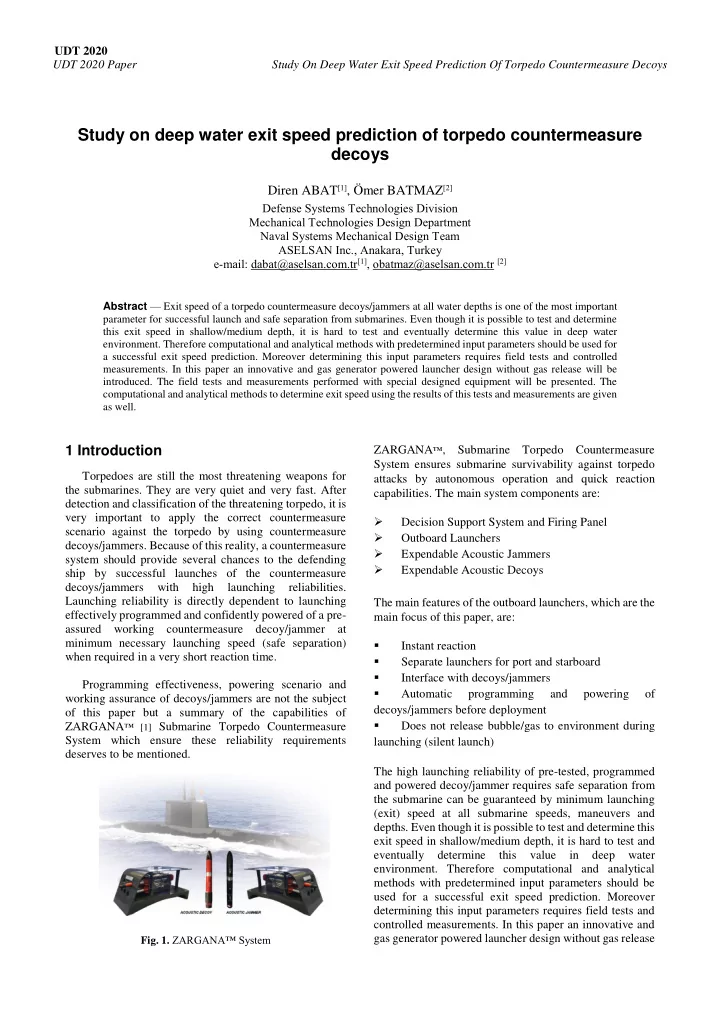
ZARGANA™ [1] Submarine Torpedo Countermeasure System which ensure these reliability requirements deserves to be mentioned.

  • Fig. 1. ZARGANA™ System

ZARGANA™, Submarine Torpedo Countermeasure System ensures submarine survivability against torpedo attacks by autonomous operation and quick reaction

  • capabilities. The main system components are:
  • Decision Support System and Firing Panel
  • Outboard Launchers
  • Expendable Acoustic Jammers
  • Expendable Acoustic Decoys

The main features of the outboard launchers, which are the main focus of this paper, are:

  • Instant reaction
  • Separate launchers for port and starboard
  • Interface with decoys/jammers
  • Automatic

programming and powering

  • f

decoys/jammers before deployment

  • Does not release bubble/gas to environment during

launching (silent launch) The high launching reliability of pre-tested, programmed and powered decoy/jammer requires safe separation from the submarine can be guaranteed by minimum launching (exit) speed at all submarine speeds, maneuvers and

  • depths. Even though it is possible to test and determine this

exit speed in shallow/medium depth, it is hard to test and eventually determine this value in deep water

  • environment. Therefore computational and analytical

methods with predetermined input parameters should be used for a successful exit speed prediction. Moreover determining this input parameters requires field tests and controlled measurements. In this paper an innovative and gas generator powered launcher design without gas release

slide-2
SLIDE 2

UDT 2020 UDT 2020 Paper Study On Deep Water Exit Speed Prediction Of Torpedo Countermeasure Decoys will be introduced. The field tests and measurements performed with special designed equipment will be

  • presented. The computational and analytical methods to

determine exit speed using the results of this tests and measurements are given as well.

2 ZarganaTM Launchers

ZARGANA™ Launcher has unique and innovative design with gas generator powered launching mechanism. It is composed of independently operating Launching Units (LU) with configurable number options (Fig.2) which is responsible for launching corresponding unit when activated and Launcher Module (LM) which carries all the LU’s and have interface for submarine integration.

  • Fig. 2. Configurable LU Number Options for ZARGANA™

Launchers

Number of LM’s can be configured according to the space available on the submarine outboard. The space available also determines the launching position of the launchers with respect to the submarine propellers which directly affects the launching effectiveness and safety of the system. The LU’s on the LM’s are responsible for launching the decoys/jammers inside when enabled at minimum launching speed at the existed launching depth. Thanks to its innovative and patented design, no bubble or gas is released during launching. Launching energy is obtained by the gas generators inside (the number and the type of the gas generators are not the concern of this paper). A sealed ram plate (Fig.3 (4)) is used to push the unit outside. The decoys/jammers can be programed and in-device test can be executed during operation.

  • Fig. 3. Single Launching Unit (LU)

3 Exit Speed Requirement Analysis

For an affective soft-kill defense, the countermeasure decoys/jammer should exit the launcher safely (guaranteed activation and working) and have enough speed for safe separation from the submarine. The safe separation of the decoys/and the jammer should be guaranteed at all submarine speeds, maneuvers and depth. In order to assure this safe separation, all submarine maneuvers are investigated (Fig.4) and multiple numbers of 6DOF simulations are performed. The angle of launcher settlement according to the submarine movement axis is also investigated with this simulations to understand the effect of launching angle on the launching safety (Fig.5).

  • Fig. 4. Some Maneuver Alternatives Analyzed for Safe

Separation

slide-3
SLIDE 3

UDT 2020 UDT 2020 Paper Study On Deep Water Exit Speed Prediction Of Torpedo Countermeasure Decoys

  • Fig. 5. An Example of a Launching Simulation Result from

Different Point of Views

With the results of similar many simulations, the minimum exit speed is determined and given as a design input for the further design stages. After the detail design process, prototypes are manufactured and assembled for testing to assure that LU’s are able to launch decoys/jammers at predetermined minimum speed.

4 Exit Speed Measurements &Tests

After the prototype integration phase, controlled test and speed measurements are put in to practice to determine the exit speed of the decoys/jammers. In order to measure the exit speed at sea water (even though at deep water), a carefully designed testing equipment is used (Fig.6)

  • Fig. 6. Working Principle of the Speed Measurement System

The working principle of the test system is based on measuring the time steps between the two peaks of disturbed magnetic signal (Fig.7).by the magnets on the test decoy (Fig.8). The system is able to take measurements up to 300 m depth. The test system also includes cameras for successful launching observations (Fig.9).

  • Fig. 8. A Sample Signal Data Obtained from the Test
  • Fig. 8. Test Decoy
  • Fig. 9. Speed Measurement Test System

Induction Coil Magnets Signal

slide-4
SLIDE 4

UDT 2020 UDT 2020 Paper Study On Deep Water Exit Speed Prediction Of Torpedo Countermeasure Decoys With the test system, several in water tests are performed at various depths. The test depth is limited because of technical and environmental difficulties. The results are tabulated and constitute as an input for further analysis to cover all working depth values of the launcher system. Table.1 Sample Exit Speed Measurements at Various Depths Depth (m) Speed (m/s) Gas Generator Configurations 1 23 Configuration 1 50 17.3 Configuration 2 100 30 Configuration 3 150 25 Configuration 4 180 20 Configuration 5

5 Exit Speed Analysis

To determine the exit speed of decoys/jammers, the launching process is divided into 4 different phases (Fig.10) Phase-1: Gas generators are activated, the pressure in the pressure chamber is increasing but the cap of the LU is not

  • pened.

Phase-2: Cap is opened, decoy is moving with ram plate by pushing the water inside. Phase-3: Ram Plate is confined and stopped. Decoy is separated from ram plate and moving while water is filling the remaining volume in the LU. Phase-4: Decoy completely leaves the LU and continues its movement.

  • Fig. 10. Launching Phases

Mathematical Model The speed of the decoy can be calculated by: The acceleration of the decoy at any time can be calculated by: Since initial speed of the decoy is 0, the speed at any time can be calculated by: And the displacement of the decoy at any time can be calculated by: The Forces on the Decoy during Launching Phases During the different launching phases, the forces which should be considered and added to the calculations can be described as:

  • The force created by the hydrostatic pressure on

the LU cap.

  • The force required to open the cap of LU
  • The friction force between the cap of LU and the

LU tube

  • The force applied on the ram plate created by the

pressure of the generated gas in the pressure chamber

  • The force created by the water flowing between

tube and decoy.

  • Drag force on the decoy
  • Added mass [2]

To ensure that correct data is given as input for the mathematical model of the force applied on the ram plate, some measurements are taken with a test equipment that can measure the pressure vs. time data after the activation

  • f gas generators in different volumes (2, 5, 7 and 10 L)

(Fig.11). Since the pressure chamber volume is changing during the movement of the ram plate, the pressure time graph is used to input correct pressure at the given time and volume for the numeric calculations. The intermediate steps are calculated by (bilinear) interpolation. (1) (2) (3) (4)

slide-5
SLIDE 5

UDT 2020 UDT 2020 Paper Study On Deep Water Exit Speed Prediction Of Torpedo Countermeasure Decoys

  • Fig. 11. Sample Pressure Measurement Graph for Sample Gas

Generator

6 Conclusion

As mentioned before, for affective soft-kill defense countermeasure decoys/jammer should exit the launcher safely (guaranteed activation and working) and have enough speed for safe separation from the submarine. The safe separation of the decoys/and the jammer should be guaranteed at all submarine speeds, maneuvers and depth. In this paper, a study on identification of exit speed requirement and a methodology for exit speed prediction for countermeasure decoys/jammers launched from underwater launchers is summarized. Predetermined exit speed measurements are obtained with field tests and these values are used for numerical methods to get the exit speed at all working depth of the system.

References

[1] Z. Sahin, I. A. Duramaz, “ZARGANA as a Comprehensive Soft-kill Torpedo Countermeasure System for Submarines”, UDT, 2013. [2] Alexandr Korotkin, Added Masses of Ship Structures, Fluid Mechanics and Its Applications, Volume 88, Springer, 2007).

Author/Speaker Biographies

[1] Mr. Diren ABAT received his B.S. and M.S. degrees

from Mechanical Engineering Department of the Middle East Technical University, in 2005 and 2009 respectively. He is currently working as mechanical design team leader

  • f naval systems in ASELSAN Inc. since 2017. His

research interests include torpedo countermeasure systems, hardkill systems, underwater and surface launcher systems.

[2] Mr. Ömer BATMAZ received his B.S. and M.S. from

Mechanical Engineering Department of the Middle East Technical University, in 2010 and 2014 respectively. He is currently working as mechanical design engineer in ASELSAN Inc. His research interests are pneumatic systems, towed arrays, underwater and surface launcher systems.

Time(ms) Pressure (bar)