Strong homotopy Lie algebras, homotopy Poisson manifolds and Courant - - PowerPoint PPT Presentation

strong homotopy lie algebras homotopy poisson manifolds
SMART_READER_LITE
LIVE PREVIEW

Strong homotopy Lie algebras, homotopy Poisson manifolds and Courant - - PowerPoint PPT Presentation

Background and Motivation Maurer-Cartan elements on homotopy Poisson manifolds 2-term L -algebras and Courant algebroids Lie 2-algebras and quasi-Poisson groupoids 3-term L -algebras and Ikeda-Uchino algebroids Strong homotopy Lie


slide-1
SLIDE 1

Background and Motivation Maurer-Cartan elements on homotopy Poisson manifolds 2-term L∞-algebras and Courant algebroids Lie 2-algebras and quasi-Poisson groupoids 3-term L∞-algebras and Ikeda-Uchino algebroids

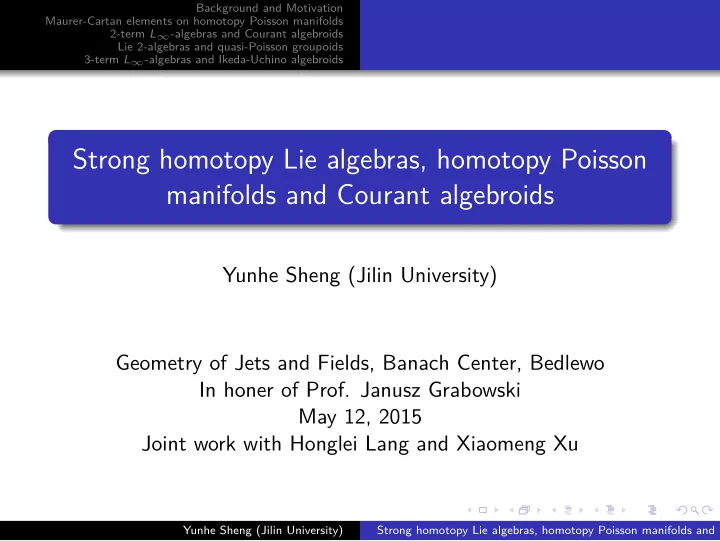
Strong homotopy Lie algebras, homotopy Poisson manifolds and Courant algebroids

Yunhe Sheng (Jilin University) Geometry of Jets and Fields, Banach Center, Bedlewo In honer of Prof. Janusz Grabowski May 12, 2015 Joint work with Honglei Lang and Xiaomeng Xu

Yunhe Sheng (Jilin University) Strong homotopy Lie algebras, homotopy Poisson manifolds and Cou

slide-2
SLIDE 2

Background and Motivation Maurer-Cartan elements on homotopy Poisson manifolds 2-term L∞-algebras and Courant algebroids Lie 2-algebras and quasi-Poisson groupoids 3-term L∞-algebras and Ikeda-Uchino algebroids

Outline

1

Background and Motivation

2

Maurer-Cartan elements on homotopy Poisson manifolds

3

2-term L∞-algebras and Courant algebroids

4

Lie 2-algebras and quasi-Poisson groupoids

5

3-term L∞-algebras and Ikeda-Uchino algebroids

Yunhe Sheng (Jilin University) Strong homotopy Lie algebras, homotopy Poisson manifolds and Courant

slide-3
SLIDE 3

Background and Motivation Maurer-Cartan elements on homotopy Poisson manifolds 2-term L∞-algebras and Courant algebroids Lie 2-algebras and quasi-Poisson groupoids 3-term L∞-algebras and Ikeda-Uchino algebroids

Lie 2-algebras are the categorification of Lie algebras. They are the infinitesimal of Lie 2-groups. Lie 2-groups are the categorification

  • f Lie groups, which describe symmetries between symmetries.

The category of Lie 2-algebras and the category of 2-term L∞-algebras (also called strong homotopy Lie algebras) are equivalent.

  • J. C. Baez and A. S. Crans, Higher-Dimensional Algebra VI:

Lie 2-Algebras, Theory and Appl. Categ. 12 (2004), 492-528.

Yunhe Sheng (Jilin University) Strong homotopy Lie algebras, homotopy Poisson manifolds and Cou

slide-4
SLIDE 4

Background and Motivation Maurer-Cartan elements on homotopy Poisson manifolds 2-term L∞-algebras and Courant algebroids Lie 2-algebras and quasi-Poisson groupoids 3-term L∞-algebras and Ikeda-Uchino algebroids

The notion of a Courant algebroid was introduced in

  • Z. Liu, A. Weinstein and P. Xu, Manin triples for Lie

bialgebroids, J. Diff. Geom. 45 (1997), 547-574.

Yunhe Sheng (Jilin University) Strong homotopy Lie algebras, homotopy Poisson manifolds and Cou

slide-5
SLIDE 5

Background and Motivation Maurer-Cartan elements on homotopy Poisson manifolds 2-term L∞-algebras and Courant algebroids Lie 2-algebras and quasi-Poisson groupoids 3-term L∞-algebras and Ikeda-Uchino algebroids

The notion of a Courant algebroid was introduced in

  • Z. Liu, A. Weinstein and P. Xu, Manin triples for Lie

bialgebroids, J. Diff. Geom. 45 (1997), 547-574. See the following paper for its history:

  • Y. Kosmann-Schwarzbach, Courant algebroids. A short history.

SIGMA Symmetry Integrability Geom. Methods Appl. 9 (2013), Paper 014, 8 pp.

Yunhe Sheng (Jilin University) Strong homotopy Lie algebras, homotopy Poisson manifolds and Cou

slide-6
SLIDE 6

Background and Motivation Maurer-Cartan elements on homotopy Poisson manifolds 2-term L∞-algebras and Courant algebroids Lie 2-algebras and quasi-Poisson groupoids 3-term L∞-algebras and Ikeda-Uchino algebroids

Many people contribute on this theory. In particular, Prof. Grabowski and his collaborators give the deformation and contraction theory of Courant algebroids.

  • J. Grabowski, Courant-Nijenhuis tensors and generalized
  • geometries. Groups, geometry and physics, 101-112, 2006.
  • J. Carinena, J. Grabowski and G. Marmo, Courant algebroid

and Lie bialgebroid contractions. J. Phys. A 37 (2004), no. 19, 5189-5202.

Yunhe Sheng (Jilin University) Strong homotopy Lie algebras, homotopy Poisson manifolds and Cou

slide-7
SLIDE 7

Background and Motivation Maurer-Cartan elements on homotopy Poisson manifolds 2-term L∞-algebras and Courant algebroids Lie 2-algebras and quasi-Poisson groupoids 3-term L∞-algebras and Ikeda-Uchino algebroids

One can obtain a Courant algebroid from a degree 2 symplectic NQ manifold.

  • D. Roytenberg, On the structure of graded symplectic

supermanifolds and Courant algebroids. In Quantization, Poisson Brackets and Beyond, 169ĺC185, Contemp. Math., 315, Amer. Math. Soc., Providence, RI, 2002.

Yunhe Sheng (Jilin University) Strong homotopy Lie algebras, homotopy Poisson manifolds and Cou

slide-8
SLIDE 8

Background and Motivation Maurer-Cartan elements on homotopy Poisson manifolds 2-term L∞-algebras and Courant algebroids Lie 2-algebras and quasi-Poisson groupoids 3-term L∞-algebras and Ikeda-Uchino algebroids

One can obtain a Courant algebroid from a degree 2 symplectic NQ manifold.

  • D. Roytenberg, On the structure of graded symplectic

supermanifolds and Courant algebroids. In Quantization, Poisson Brackets and Beyond, 169ĺC185, Contemp. Math., 315, Amer. Math. Soc., Providence, RI, 2002. A Courant algebroid could give rise to a Lie 2-algebra according to Roytenberg-Weinstein construction.

  • D. Roytenberg and A. Weinstein, Courant algebroids and

strongly homotopy Lie algebras, Lett. Math. Phys., 46(1) (1998), 81-93.

Yunhe Sheng (Jilin University) Strong homotopy Lie algebras, homotopy Poisson manifolds and Cou

slide-9
SLIDE 9

Background and Motivation Maurer-Cartan elements on homotopy Poisson manifolds 2-term L∞-algebras and Courant algebroids Lie 2-algebras and quasi-Poisson groupoids 3-term L∞-algebras and Ikeda-Uchino algebroids

The notion of a homotopy Poisson manifold of degree n was introduced in

  • R. A. Mehta, On homotopy Poisson actions and reduction of

symplectic Q-manifolds, Diff. Geom. Appl. 29(3) (2011), 319-328.

Yunhe Sheng (Jilin University) Strong homotopy Lie algebras, homotopy Poisson manifolds and Cou

slide-10
SLIDE 10

Background and Motivation Maurer-Cartan elements on homotopy Poisson manifolds 2-term L∞-algebras and Courant algebroids Lie 2-algebras and quasi-Poisson groupoids 3-term L∞-algebras and Ikeda-Uchino algebroids

The notion of a homotopy Poisson manifold of degree n was introduced in

  • R. A. Mehta, On homotopy Poisson actions and reduction of

symplectic Q-manifolds, Diff. Geom. Appl. 29(3) (2011), 319-328. There is a linear Poisson structure on the dual space of a Lie

  • algebra. It is natural to ask what is the structure on the “dual” of

a Lie 2-algebra. Motivated by this question, we find some relations between Lie 2-algebras, homotopy Poisson manifolds and Courant

  • algebroids. This is the content of this talk.

Yunhe Sheng (Jilin University) Strong homotopy Lie algebras, homotopy Poisson manifolds and Cou

slide-11
SLIDE 11

Background and Motivation Maurer-Cartan elements on homotopy Poisson manifolds 2-term L∞-algebras and Courant algebroids Lie 2-algebras and quasi-Poisson groupoids 3-term L∞-algebras and Ikeda-Uchino algebroids

Outline

1

Background and Motivation

2

Maurer-Cartan elements on homotopy Poisson manifolds

3

2-term L∞-algebras and Courant algebroids

4

Lie 2-algebras and quasi-Poisson groupoids

5

3-term L∞-algebras and Ikeda-Uchino algebroids

Yunhe Sheng (Jilin University) Strong homotopy Lie algebras, homotopy Poisson manifolds and Courant

slide-12
SLIDE 12

Background and Motivation Maurer-Cartan elements on homotopy Poisson manifolds 2-term L∞-algebras and Courant algebroids Lie 2-algebras and quasi-Poisson groupoids 3-term L∞-algebras and Ikeda-Uchino algebroids

Definition A homotopy Poisson algebra of degree n is a graded commutative algebra a with an L∞-algebra structure {lm}m≥1 on a[n], such that the map x − → lm(x1, · · · , xm−1, x), x1, · · · , xm−1, x ∈ a is a derivation of degree 2 − m − n(m − 1) + m−1

i=1 |xi|. Here, |x|

denotes the degree of x ∈ a. A homotopy Poisson algebra of degree n is of finite type if there exists a q such that lm = 0 for all m > q. A homotopy Poisson manifold of degree n is a graded manifold M whose algebra of functions C∞(M) is equipped with a degree n homotopy Poisson algebra structure of finite type.

Yunhe Sheng (Jilin University) Strong homotopy Lie algebras, homotopy Poisson manifolds and Cour

slide-13
SLIDE 13

Background and Motivation Maurer-Cartan elements on homotopy Poisson manifolds 2-term L∞-algebras and Courant algebroids Lie 2-algebras and quasi-Poisson groupoids 3-term L∞-algebras and Ikeda-Uchino algebroids

Several related structures: (i) A P∞-algebra is a graded commutative algebra a over a field

  • f characteristic zero such that there is an L∞-algebra

structure {lm}m≥1 on a, and the map x − → lm(x1, · · · , xm−1, x), is a derivation of degree 2 − m − (|x1| + · · · + |xm−1|). Their P∞-algebra is a homotopy Poisson algebra of degree 0.

  • A. S. Cattaneo and G. Felder, Relative formality theorem

and quantisation of coisotropic submanifolds. Adv. Math., 2007, 208(2): 521-548.

Yunhe Sheng (Jilin University) Strong homotopy Lie algebras, homotopy Poisson manifolds and Cou

slide-14
SLIDE 14

Background and Motivation Maurer-Cartan elements on homotopy Poisson manifolds 2-term L∞-algebras and Courant algebroids Lie 2-algebras and quasi-Poisson groupoids 3-term L∞-algebras and Ikeda-Uchino algebroids

(ii) The notion of a higher Poisson structure was introduced in

  • T. Voronov, Higher derived brackets and homotopy
  • algebras. J. Pure Appl. Algebra 202 (2005), no. 1-3,

133-153. and further studied in

  • A. Bruce, From L∞-algebroids to higher Schouten Poisson
  • structures. Rep. Math. Phys. 67 (2011), no. 2, 157-177.
  • H. M. Khudaverdian and Th. Th. Voronov, Higher

Poisson brackets and differential forms. Geometric methods in physics, 203-215, AIP Conf. Proc., 1079,

  • Amer. Inst. Phys., Melville, NY, 2008.

where the authors used the superized version of an L∞-algebra.

Yunhe Sheng (Jilin University) Strong homotopy Lie algebras, homotopy Poisson manifolds and Cou

slide-15
SLIDE 15

Background and Motivation Maurer-Cartan elements on homotopy Poisson manifolds 2-term L∞-algebras and Courant algebroids Lie 2-algebras and quasi-Poisson groupoids 3-term L∞-algebras and Ikeda-Uchino algebroids

(iii) A graded Poisson algebra of degree k is a graded commutative algebra a with a degree −k Lie bracket, such that the bracket is a biderivation of the product, namely [x, y · z] = [x, y] · z + (−1)|y|(|x|+k)y · [x, z]. Thus, a graded Poisson algebra of degree k is a homotopy Poisson algebra of degree k. In particular, the associated L∞-algebra has only one non-zero map l2.

  • A. S. Cattaneo, D. Fiorenza and R. Longoni, Graded

Poisson Algebras. Encyclopedia of Math. Phys., 2006, 2: 560-567.

Yunhe Sheng (Jilin University) Strong homotopy Lie algebras, homotopy Poisson manifolds and Cou

slide-16
SLIDE 16

Background and Motivation Maurer-Cartan elements on homotopy Poisson manifolds 2-term L∞-algebras and Courant algebroids Lie 2-algebras and quasi-Poisson groupoids 3-term L∞-algebras and Ikeda-Uchino algebroids

Example Let A be a Lie algebroid. Consider its dual vector bundle, A∗[1], which is an N-manifold of degree 1. Its algebra of polynomial functions is · · · ⊕ Γ(A) ⊕ C∞(M), where Γ(A) is of degree 1, and C∞(M) is of degree 0. The Poisson bracket is in fact the Schouten bracket [·, ·]S on Γ(∧•A). It is straightforward to see that A∗[1] is a homotopy Poisson manifold of degree 1.

Yunhe Sheng (Jilin University) Strong homotopy Lie algebras, homotopy Poisson manifolds and Cour

slide-17
SLIDE 17

Background and Motivation Maurer-Cartan elements on homotopy Poisson manifolds 2-term L∞-algebras and Courant algebroids Lie 2-algebras and quasi-Poisson groupoids 3-term L∞-algebras and Ikeda-Uchino algebroids

Example Given a 2-term L∞-algebra g = (g−1

l1

− → g0, l2, l3), its graded dual space g∗[1] = g∗

0[1] ⊕ g∗ −1[1] is an N-manifold of degree 1

with the base manifold g∗

−1. Its algebra of polynomial functions

is · · · ⊕

C∞(g∗

−1) ⊗ g0

⊕ C∞(g∗

−1).

There is a degree 1 homotopy Poisson algebra structure on it

  • btained by extending the original 2-term L∞-algebra structure

using the Leibniz rule. Thus, the dual of a 2-term L∞-algebra is a homotopy Poisson manifold of degree 1. This generalize the fact that the dual of a Lie algebra is a linear Poisson manifold. Similarly, the dual of an n-term L∞-algebra is a homotopy Poisson manifold of degree n − 1.

Yunhe Sheng (Jilin University) Strong homotopy Lie algebras, homotopy Poisson manifolds and Cour

slide-18
SLIDE 18

Background and Motivation Maurer-Cartan elements on homotopy Poisson manifolds 2-term L∞-algebras and Courant algebroids Lie 2-algebras and quasi-Poisson groupoids 3-term L∞-algebras and Ikeda-Uchino algebroids

(M, π) is Poisson manifold if and only if (T ∗[1]M, Q) is a symplectic NQ-manifold of degree 1, where the homological vector field Q is given by Q = {π, ·}. More generally, the cotangent bundle of a homotopy Poisson manifold of degree n gives rise to a symplectic NQ-manifold of degree n + 1. Theorem Given a degree n homotopy Poisson manifold (M, {li}1≤i<∞), the cotangent bundle T ∗[n + 1]M is a symplectic NQ-manifold of degree n + 1, where Q = { li, ·}, and {·, ·} is the canonical Poisson structure on T ∗[n + 1]M. Moreover, for any a1, · · · , ak ∈ C∞(M), we have lk(a1, · · · , ak) = {ak, · · · , {a2, {a1,

  • li}} · · · }|M.

(1)

Yunhe Sheng (Jilin University) Strong homotopy Lie algebras, homotopy Poisson manifolds and Cour

slide-19
SLIDE 19

Background and Motivation Maurer-Cartan elements on homotopy Poisson manifolds 2-term L∞-algebras and Courant algebroids Lie 2-algebras and quasi-Poisson groupoids 3-term L∞-algebras and Ikeda-Uchino algebroids

Corollary Given an n-term L∞-algebra g = (g0 ⊕ · · · ⊕ g−n+1, {li}1≤i≤n+1), the cotangent bundle T ∗[n]g∗[n − 1] is a symplectic NQ-manifold

  • f degree n, where the degree 1 homological vector field Q is given

by Q = {

  • li, ·},

(2) in which {·, ·} is the canonical Poisson structure, and

li ∈ Sym(g∗[−1]) ⊗ g[1 − n] is viewed as a polynomial function

  • f degree n + 1 on T ∗[n]g∗[n − 1].

Yunhe Sheng (Jilin University) Strong homotopy Lie algebras, homotopy Poisson manifolds and Cour

slide-20
SLIDE 20

Background and Motivation Maurer-Cartan elements on homotopy Poisson manifolds 2-term L∞-algebras and Courant algebroids Lie 2-algebras and quasi-Poisson groupoids 3-term L∞-algebras and Ikeda-Uchino algebroids

Definition A Maurer-Cartan element α on a degree n homotopy Poisson manifold M is a function on M satisfying the Maurer-Cartan equation

  • i

(−1)i i! li(α, · · · , α) = 0. (3)

Yunhe Sheng (Jilin University) Strong homotopy Lie algebras, homotopy Poisson manifolds and Cour

slide-21
SLIDE 21

Background and Motivation Maurer-Cartan elements on homotopy Poisson manifolds 2-term L∞-algebras and Courant algebroids Lie 2-algebras and quasi-Poisson groupoids 3-term L∞-algebras and Ikeda-Uchino algebroids

Example (quasi-Poisson g-manifolds) Let M be a manifold and (k, [·, ·]k, K) a quadratic Lie algebra. We define R ∈ ∧3k∗ by R(u, v, w) = K([u, v]k, w), ∀ u, v, w ∈ k. Then M := T ∗[1]M × k[1] is a homotopy Poisson manifold of degree 1: l1(ξ) = δ(ξ), l2(X, Y ) = [X, Y ]S, l2(X, f ) = Xf , l3(ξ, η, γ) = K(R)(ξ, η, γ), where f ∈ C∞(M), X, Y ∈ X(M), ξ, η, γ ∈ k∗, and δ : ∧•k∗ − → ∧•+1k∗ is the coboundary operator associated to the Lie algebra k.

Yunhe Sheng (Jilin University) Strong homotopy Lie algebras, homotopy Poisson manifolds and Cour

slide-22
SLIDE 22

Background and Motivation Maurer-Cartan elements on homotopy Poisson manifolds 2-term L∞-algebras and Courant algebroids Lie 2-algebras and quasi-Poisson groupoids 3-term L∞-algebras and Ikeda-Uchino algebroids

Example (continue) A degree 2 function α = π + ρ, where π ∈ ∧2X(M) and ρ ∈ k∗ ⊗ X(M), is a Maurer-Cartan element, i.e. −l1(α) + 1 2l2(α, α) − 1 3!l3(α, α, α) = 0, iff the following three conditions hold: l1(ρ) = 1 2[ρ, ρ]S, [π, ρ]S = 0, 1 2[π, π]S = 1 6K(R)(ρ, ρ, ρ). These conditions are equivalent to that ρ : k − → X(M) is a Lie algebra morphism, π is k-invariant and 1

2[π, π]S = ∧3ρ(K(R))

  • respectively. Therefore, a quasi-Poisson g-manifold gives rise to a

Maurer-Cartan element on M.

Yunhe Sheng (Jilin University) Strong homotopy Lie algebras, homotopy Poisson manifolds and Cour

slide-23
SLIDE 23

Background and Motivation Maurer-Cartan elements on homotopy Poisson manifolds 2-term L∞-algebras and Courant algebroids Lie 2-algebras and quasi-Poisson groupoids 3-term L∞-algebras and Ikeda-Uchino algebroids

Example (twisted Poisson structures) The shifted cotangent bundle T ∗[1]M of a manifold M is canonically a symplectic N-manifold

  • f degree 1. For a choice of a closed 3-form H, we define l3 by

l3(X, Y , Z) = H(X, Y , Z). The compatibility of l2 and l3 is due to the fact that H is closed. Thus, (T ∗[1]M, l2 = [·, ·]S, l3 = H) is a homotopy symplectic manifold of degree 1. Choose a local coordinate (xi, pi) on T ∗[1]M. A degree 2 function π = 1

2πij(x)pipj is a Maurer-Cartan element of T ∗[1]M

if and only if 1 2l2(π, π) − 1 3!l3(π, π, π) = 0, which is equivalent to 1

2[π, π] = ∧3π♯H, that is, π is a twisted

Poisson structure on M.

Yunhe Sheng (Jilin University) Strong homotopy Lie algebras, homotopy Poisson manifolds and Cour

slide-24
SLIDE 24

Background and Motivation Maurer-Cartan elements on homotopy Poisson manifolds 2-term L∞-algebras and Courant algebroids Lie 2-algebras and quasi-Poisson groupoids 3-term L∞-algebras and Ikeda-Uchino algebroids

Example (twisted Courant algebroids) Let E − → M be a vector bundle with a fiber metric K, and H a closed 4-form on M. Let M be its minimal symplectic realization. We define a new degree 2 homotopy Poisson algebra structure on the algebra of functions of M by adding l4(χ1, χ2, χ3, χ4) = H

a(χ1), a(χ2), a(χ3), a(χ4) ,

∀ χi ∈ A2. Choose a local coordinate (xi, pi, ξa). A degree 3 function α = ρi

apiξa − 1 3!fabcξaξbξc is a Maurer-Cartan element if and only

if 1 2l2(α, α) + 1 24l4(α, α, α, α) = 0.

Yunhe Sheng (Jilin University) Strong homotopy Lie algebras, homotopy Poisson manifolds and Cour

slide-25
SLIDE 25

Background and Motivation Maurer-Cartan elements on homotopy Poisson manifolds 2-term L∞-algebras and Courant algebroids Lie 2-algebras and quasi-Poisson groupoids 3-term L∞-algebras and Ikeda-Uchino algebroids

Example (continue) Define an anchor ρ : E → TM and a derived bracket ⌈·, ·⌉ on Γ(E) by ρ(e)f = l2(l2(e, α), f ), ⌈e1, e2⌉ = l2(l2(e1, α), e2). On the other hand, a straightforward calculation gives that l4(α, α, α, α) = ρ∗H. Thus, the condition that α is a Maurer-Cartan element is equivalent to the fact that (E, K, ρ, ⌈·, ·⌉ , H) is a twisted Courant algebroid, which arises from the study of three dimensional sigma models with Wess-Zumino term.

Yunhe Sheng (Jilin University) Strong homotopy Lie algebras, homotopy Poisson manifolds and Cour

slide-26
SLIDE 26

Background and Motivation Maurer-Cartan elements on homotopy Poisson manifolds 2-term L∞-algebras and Courant algebroids Lie 2-algebras and quasi-Poisson groupoids 3-term L∞-algebras and Ikeda-Uchino algebroids

Theorem A degree n homotopy symplectic manifold (M, {li}2≤i<∞) with a degree n + 1 Maurer-Cartan element α one-to-one corresponds to a twisted symplectic NQ-manifold (M, {·, ·}s, α) with Θ|M = 0.

Yunhe Sheng (Jilin University) Strong homotopy Lie algebras, homotopy Poisson manifolds and Cour

slide-27
SLIDE 27

Background and Motivation Maurer-Cartan elements on homotopy Poisson manifolds 2-term L∞-algebras and Courant algebroids Lie 2-algebras and quasi-Poisson groupoids 3-term L∞-algebras and Ikeda-Uchino algebroids

Theorem A degree n homotopy symplectic manifold (M, {li}2≤i<∞) with a degree n + 1 Maurer-Cartan element α one-to-one corresponds to a twisted symplectic NQ-manifold (M, {·, ·}s, α) with Θ|M = 0. Thus, associated to a degree n homotopy symplectic manifold (M, {li}2≤i<∞) with a degree n + 1 Maurer-Cartan element α, there is a AKSZ sigma model with boundary.

  • N. Ikeda and X. Xu, Canonical functions, differential graded

symplectic pairs in supergeometry, and AKSZ sigma models with boundaries, J. Math. Phys, 55, 113505 (2014).

Yunhe Sheng (Jilin University) Strong homotopy Lie algebras, homotopy Poisson manifolds and Cour

slide-28
SLIDE 28

Background and Motivation Maurer-Cartan elements on homotopy Poisson manifolds 2-term L∞-algebras and Courant algebroids Lie 2-algebras and quasi-Poisson groupoids 3-term L∞-algebras and Ikeda-Uchino algebroids

Outline

1

Background and Motivation

2

Maurer-Cartan elements on homotopy Poisson manifolds

3

2-term L∞-algebras and Courant algebroids

4

Lie 2-algebras and quasi-Poisson groupoids

5

3-term L∞-algebras and Ikeda-Uchino algebroids

Yunhe Sheng (Jilin University) Strong homotopy Lie algebras, homotopy Poisson manifolds and Courant

slide-29
SLIDE 29

Background and Motivation Maurer-Cartan elements on homotopy Poisson manifolds 2-term L∞-algebras and Courant algebroids Lie 2-algebras and quasi-Poisson groupoids 3-term L∞-algebras and Ikeda-Uchino algebroids

Given a 2-term L∞-algebra g = (g−1

l1

− → g0, l2 = l0

2 + l1 2, l3), the

cotangent bundle T ∗[2]g∗[1] is a symplectic NQ-manifold of degree

  • 2. Furthermore, symplectic NQ-manifolds of degree 2 are in
  • ne-to-one correspondence with Courant algebroids. Thus, from

T ∗[2]g∗[1], we obtain a Courant algebroid E: E = g∗

−1 × (g∗ 0 ⊕ g0) −

→ g∗

−1,

(4) in which the anchor and the Dorfman bracket are defined by the derived bracket using the degree 3 function l = − li.

Yunhe Sheng (Jilin University) Strong homotopy Lie algebras, homotopy Poisson manifolds and Cou

slide-30
SLIDE 30

Background and Motivation Maurer-Cartan elements on homotopy Poisson manifolds 2-term L∞-algebras and Courant algebroids Lie 2-algebras and quasi-Poisson groupoids 3-term L∞-algebras and Ikeda-Uchino algebroids

Proposition Consider the Courant algebroid E given above, for constant sections x, y ∈ g0, ξ, η ∈ g∗

0 and linear function m ∈ g−1, we have

(i) ρ(x)(m) = l1

2(x, m), i.e. the anchor of x is a linear vector

field; (ii) ρ(ξ) = −l∗

1(ξ), i.e. the anchor of ξ is a constant vector field;

(iii) the image of a linear function under the operator D is not a constant section, we have Dm = l1(m) − l1

2(m, ·) ∈ g0 + g∗ 0 ⊗ g−1;

(5) (iv) ⌈x, y⌉ = l0

2(x, y) + l3(x, y, ·) ∈ g0 + g∗ 0 ⊗ g−1;

Yunhe Sheng (Jilin University) Strong homotopy Lie algebras, homotopy Poisson manifolds and Cour

slide-31
SLIDE 31

Background and Motivation Maurer-Cartan elements on homotopy Poisson manifolds 2-term L∞-algebras and Courant algebroids Lie 2-algebras and quasi-Poisson groupoids 3-term L∞-algebras and Ikeda-Uchino algebroids

Given a Courant algebroid E − → M, using the skew-symmetric Courant bracket, we get a 2-term L∞-algebra structure on C∞(M) ⊕ Γ(E). Now consider the Courant algebroid (4) obtained from a 2-term L∞-algebra. Since it is linear, we pick linear functions on g∗

−1 as the degree −1 part and g0 ⊕ (g−1 ⊗ g∗ 0) as the

degree 0 part. Proposition For any x, y ∈ g0, and ξ ⊗ m, η ⊗ n ∈ g∗

0 ⊗ g−1, we have

        

x, y = x ◦ y = l0

2(x, y) + l3(x, y, ·);

x, ξ ⊗ m = ξ ⊗ l1

2(x, m) + (l0 2(x, ·)∗ξ) ⊗ m

−1

2ξ(x)

l1(m) − l1

2(m, ·)

;

ξ ⊗ m, η ⊗ n = l∗

1η(m)ξ ⊗ n − l∗ 1ξ(n)η ⊗ m.

(6)

Yunhe Sheng (Jilin University) Strong homotopy Lie algebras, homotopy Poisson manifolds and Cour

slide-32
SLIDE 32

Background and Motivation Maurer-Cartan elements on homotopy Poisson manifolds 2-term L∞-algebras and Courant algebroids Lie 2-algebras and quasi-Poisson groupoids 3-term L∞-algebras and Ikeda-Uchino algebroids

Theorem Given a 2-term L∞-algebra g = (g−1

l1

− → g0, l2 = l0

2 + l1 2, l3), we

can obtain a new 2-term L∞-algebra ˜ g = (g−1

˜ l1

− → g0 ⊕ (g−1 ⊗ g∗

0), ˜

l2 = ˜ l0

2 +˜

l1

2,˜

l3) from the corresponding Courant algebroid (4), in which ˜ l1 = D (given by (5)), ˜ l0

2 is given by (6), ˜

l1

2 and ˜

l3 are given by ˜ l1

2(x + ξ ⊗ m, n) = 1

2l1

2(x, n) + 1

2ξ, l1(n)m, ˜ l3(x1 + ξ1 ⊗ m1, x2 + ξ2 ⊗ m2, x3 + ξ3 ⊗ m3) = −1 2l3(x1, x2, x3) − 1 2

l0

2(x1, x2), ξ3m3 + c.p.

  • +some terms

Yunhe Sheng (Jilin University) Strong homotopy Lie algebras, homotopy Poisson manifolds and Cour

slide-33
SLIDE 33

Background and Motivation Maurer-Cartan elements on homotopy Poisson manifolds 2-term L∞-algebras and Courant algebroids Lie 2-algebras and quasi-Poisson groupoids 3-term L∞-algebras and Ikeda-Uchino algebroids

2-term L∞- algebra g − → homotopy Poisson manifold g∗[1] − → degree 2 symplectic NQ- manifold T ∗[2]g∗[1] − → Courant algebroid E = g∗

−1 × (g0 ⊕ g∗ 0) −

→ 2-term L∞- algebra ˜ g.

Yunhe Sheng (Jilin University) Strong homotopy Lie algebras, homotopy Poisson manifolds and Cou

slide-34
SLIDE 34

Background and Motivation Maurer-Cartan elements on homotopy Poisson manifolds 2-term L∞-algebras and Courant algebroids Lie 2-algebras and quasi-Poisson groupoids 3-term L∞-algebras and Ikeda-Uchino algebroids

Example (omni-Lie algebra) Let V be a vector space. Consider the abelian 2-term L∞-algebra (V

id

− → V , l2 = 0, l3 = 0), we get a new 2-term L∞-algebra (V

− → V ⊕ gl(V ),˜ l2,˜ l3), in which ✐ is the natural inclusion, and

    

˜ l1

2(u + A, m)

=

1 2Am,

˜ l0

2(u + A, v + B)

=

1 2(Av − Bu) + [A, B],

˜ l3(u + A, v + B, w + C) = −1

4([A, B]w + [B, C]u + [C, A]v),

for all u, v, w ∈ V0 = V , m ∈ V−1 = V and A, B, C ∈ gl(V ). This 2-term L∞-algebra is the one associated to the omni-Lie algebra V ⊕ gl(V ).

Yunhe Sheng (Jilin University) Strong homotopy Lie algebras, homotopy Poisson manifolds and Cour

slide-35
SLIDE 35

Background and Motivation Maurer-Cartan elements on homotopy Poisson manifolds 2-term L∞-algebras and Courant algebroids Lie 2-algebras and quasi-Poisson groupoids 3-term L∞-algebras and Ikeda-Uchino algebroids

Example (2-term L∞-algebra of string type) Let (k, [·, ·]k) be a Lie

  • algebra. Consider the 2-term L∞-algebra

(R − → k, l2 = [·, ·]k, l3 = 0), we get a new 2-term L∞-algebra (R − → k ⊕ k∗,˜ l2,˜ l3), where ˜ l2 and ˜ l3 are given by

    

˜ l1

2(u + ξ, r)

= 0, ˜ l0

2(u + ξ, v + η)

= [u, v]k + ad∗

uη − ad∗ vξ,

˜ l3(u + ξ, v + η, w + ζ) = −1

2([u, v]k, ζ + [v, w]k, ξ + [w, u]k, η)

This is exactly the 2-term L∞-algebra of string type.

Yunhe Sheng (Jilin University) Strong homotopy Lie algebras, homotopy Poisson manifolds and Cour

slide-36
SLIDE 36

Background and Motivation Maurer-Cartan elements on homotopy Poisson manifolds 2-term L∞-algebras and Courant algebroids Lie 2-algebras and quasi-Poisson groupoids 3-term L∞-algebras and Ikeda-Uchino algebroids

Example Consider the 2-term L∞-algebra (k

id

− → k, l2 = [·, ·]k, l3 = 0), where (k, [·, ·]k) is a Lie algebra. By Theorem 3.3, we obtain a new 2-term L∞-algebra

(k

˜ l1

− → k ⊕ gl(k),˜ l2,˜ l3), ˜ l1(m) = m − adm, ˜ l1

2(u + A, m)

= 1 2[u, m]k + 1 2Am, ˜ l0

2(u + A, v + B)

= [u, v]k + 1 2(Av − Bu) + [adu, B] + [A, adv] +1 2(adBu − adAv) + [A, B], ˜ l3(u + A, v + B, w + C) = −1 2C[u, v]k − 1 4[A, B]w −1 4([u, Bw]k + [Bu, w]k) + c.p. for all u, v, w ∈ k, m ∈ k and A, B, C ∈ gl(k).

Yunhe Sheng (Jilin University) Strong homotopy Lie algebras, homotopy Poisson manifolds and Cour

slide-37
SLIDE 37

Background and Motivation Maurer-Cartan elements on homotopy Poisson manifolds 2-term L∞-algebras and Courant algebroids Lie 2-algebras and quasi-Poisson groupoids 3-term L∞-algebras and Ikeda-Uchino algebroids

Definition A nonabelian omni-Lie algebra associated to a Lie algebra (g, [·, ·]g) is a triple (gl(g) ⊕ g, ·, ·g, {·, ·}g), where ·, ·g is the symmetric g-valued pairing given by A + u, B + vg = Av + Bu, and {·, ·}g is the bilinear bracket given by {A+u, B +v}g = [A, B]+[A, adv]+[adu, B]−adAv +Av +[u, v]g.

Yunhe Sheng (Jilin University) Strong homotopy Lie algebras, homotopy Poisson manifolds and Cour

slide-38
SLIDE 38

Background and Motivation Maurer-Cartan elements on homotopy Poisson manifolds 2-term L∞-algebras and Courant algebroids Lie 2-algebras and quasi-Poisson groupoids 3-term L∞-algebras and Ikeda-Uchino algebroids

Proposition (gl(g) ⊕ g, {·, ·}g) is a Leibniz (Loday) algebra.

Yunhe Sheng (Jilin University) Strong homotopy Lie algebras, homotopy Poisson manifolds and Cour

slide-39
SLIDE 39

Background and Motivation Maurer-Cartan elements on homotopy Poisson manifolds 2-term L∞-algebras and Courant algebroids Lie 2-algebras and quasi-Poisson groupoids 3-term L∞-algebras and Ikeda-Uchino algebroids

Proposition (gl(g) ⊕ g, {·, ·}g) is a Leibniz (Loday) algebra. Proposition (gl(g) ⊕ g, ·, ·g, {·, ·}g) is a trivial deformation of the omni-Lie algebra (gl(g) ⊕ g, ·, ·, {·, ·}0) via the Nijenhuis operator N =

  • ad
  • : gl(g) ⊕ g −

→ gl(g) ⊕ g.

Yunhe Sheng (Jilin University) Strong homotopy Lie algebras, homotopy Poisson manifolds and Cour

slide-40
SLIDE 40

Background and Motivation Maurer-Cartan elements on homotopy Poisson manifolds 2-term L∞-algebras and Courant algebroids Lie 2-algebras and quasi-Poisson groupoids 3-term L∞-algebras and Ikeda-Uchino algebroids

The Lie algebra (g, [·, ·]g) yields a Lie-Poisson manifold (g∗, πg). Then we obtain a Courant algebroid structure on Tg∗ ⊕ T ∗

πgg∗.

Denote the sets of linear vector fields and constant 1-forms on g∗ by Xlin(g∗) and Ω1

con(g∗). For any x ∈ g, denote by lx the

corresponding linear function on g∗. Let {xi} be a basis of the vector space underlying g. Then {lxi} constitute a local coordinate

  • f g∗. So { ∂

∂lxi } constitute a basis of vector fields on g∗ and {dlxi}

constitute a basis of 1-forms on g∗. For A ∈ gl(g), we get a linear vector field ˆ A =

j lA(xj) ∂ ∂lxj on g∗. Also u = i uixi ∈ g defines a

constant 1-form ˆ u =

i uidlxi on g∗.

Yunhe Sheng (Jilin University) Strong homotopy Lie algebras, homotopy Poisson manifolds and Cou

slide-41
SLIDE 41

Background and Motivation Maurer-Cartan elements on homotopy Poisson manifolds 2-term L∞-algebras and Courant algebroids Lie 2-algebras and quasi-Poisson groupoids 3-term L∞-algebras and Ikeda-Uchino algebroids

Define Φ : gl(g) ⊕ g − → Xlin(g∗) ⊕ Ω1

con(g∗) by

Φ(A + u) = ˆ A + ˆ u. Obviously, Φ is an isomorphism between vector spaces. Theorem The nonabelian omni-Lie algebra (gl(g) ⊕ g, ·, ·g, {·, ·}g) is induced from the Courant algebroid Tg∗ ⊕ T ∗

πgg∗ via the

restriction on Xlin(g∗) ⊕ Ω1

con(g∗). More precisely, we have

  • Φ(A + u), Φ(B + v)CA

= lA+u,B+vg, {Φ(A + u), Φ(B + v)}CA = Φ{A + u, B + v}g.

Yunhe Sheng (Jilin University) Strong homotopy Lie algebras, homotopy Poisson manifolds and Cour

slide-42
SLIDE 42

Background and Motivation Maurer-Cartan elements on homotopy Poisson manifolds 2-term L∞-algebras and Courant algebroids Lie 2-algebras and quasi-Poisson groupoids 3-term L∞-algebras and Ikeda-Uchino algebroids

For any bilinear map F : g × g − → g, define adF : g − → gl(g) by adF(u) = F(u, ·). Proposition Given a bilinear map F : g × g − → g, the graph of adF, which we denote by GF, is a Dirac structure of the nonabelian omni-Lie algebra (gl(g) ⊕ g, ·, ·, {·, ·}g) iff F satisfies the Maurer Cartan equation dF + 1 2[F, F] = 0, Thus, Dirac structures of the form GF characterize deformations of the Lie algebra (g, [·, ·]g).

Yunhe Sheng (Jilin University) Strong homotopy Lie algebras, homotopy Poisson manifolds and Cour

slide-43
SLIDE 43

Background and Motivation Maurer-Cartan elements on homotopy Poisson manifolds 2-term L∞-algebras and Courant algebroids Lie 2-algebras and quasi-Poisson groupoids 3-term L∞-algebras and Ikeda-Uchino algebroids

Outline

1

Background and Motivation

2

Maurer-Cartan elements on homotopy Poisson manifolds

3

2-term L∞-algebras and Courant algebroids

4

Lie 2-algebras and quasi-Poisson groupoids

5

3-term L∞-algebras and Ikeda-Uchino algebroids

Yunhe Sheng (Jilin University) Strong homotopy Lie algebras, homotopy Poisson manifolds and Courant

slide-44
SLIDE 44

Background and Motivation Maurer-Cartan elements on homotopy Poisson manifolds 2-term L∞-algebras and Courant algebroids Lie 2-algebras and quasi-Poisson groupoids 3-term L∞-algebras and Ikeda-Uchino algebroids

Let g = (g−1

l1

− → g0, l2 = l0

2 + l1 2, l3) be a 2-term L∞-algebra. The

vector bundle E = g∗

−1 × (g∗ 0 ⊕ g0) −

→ g∗

−1 can be decomposed as

A ⊕ A∗, where A = g∗

−1 × g∗ 0 −

→ g∗

−1 is a trivial vector bundle.

{l, l} = 0, where l = l1 + (l1

2 + l0 2) + l3, implies that

{l1, l1} = 0 {l1, l2} = 0, 1 2{l2, l2} + {l1, l3} = 0, {l2, l3} = 0, where {·, ·} is Kosmann-Schwarzbach’s big bracket.

Yunhe Sheng (Jilin University) Strong homotopy Lie algebras, homotopy Poisson manifolds and Cour

slide-45
SLIDE 45

Background and Motivation Maurer-Cartan elements on homotopy Poisson manifolds 2-term L∞-algebras and Courant algebroids Lie 2-algebras and quasi-Poisson groupoids 3-term L∞-algebras and Ikeda-Uchino algebroids

Let g = (g−1

l1

− → g0, l2 = l0

2 + l1 2, l3) be a 2-term L∞-algebra. The

vector bundle E = g∗

−1 × (g∗ 0 ⊕ g0) −

→ g∗

−1 can be decomposed as

A ⊕ A∗, where A = g∗

−1 × g∗ 0 −

→ g∗

−1 is a trivial vector bundle.

{l, l} = 0, where l = l1 + (l1

2 + l0 2) + l3, implies that

{l1, l1} = 0 {l1, l2} = 0, 1 2{l2, l2} + {l1, l3} = 0, {l2, l3} = 0, where {·, ·} is Kosmann-Schwarzbach’s big bracket. Theorem Let g = (g−1

l1

− → g0, l2 = l0

2 + l1 2, l3) be a 2-term L∞-algebra, then

(A, −l) is a Lie quasi-bialgebroid, and the Courant algebroid E is the double of the Lie quasi-bialgebroid (A, −l).

Yunhe Sheng (Jilin University) Strong homotopy Lie algebras, homotopy Poisson manifolds and Cour

slide-46
SLIDE 46

Background and Motivation Maurer-Cartan elements on homotopy Poisson manifolds 2-term L∞-algebras and Courant algebroids Lie 2-algebras and quasi-Poisson groupoids 3-term L∞-algebras and Ikeda-Uchino algebroids

Corollary The Lie algebroid structure on A, determined by −l1, is given by (i) for any constant section ξ ∈ g∗

0, ρA(ξ) = −l∗ 1(ξ);

(ii) for any constant sections ξ, η ∈ g∗

0, we have [ξ, η]A = 0;

(iii) for any constant section ξ ∈ g∗

0 and linear section

η ⊗ n ∈ g∗

0 ⊗ g−1, we have [ξ, η ⊗ n]A = ξ, l1(n)η;

(iv) for any linear sections ξ ⊗ m, η ⊗ n ∈ g∗

0 ⊗ g−1, we have

[ξ ⊗ m, η ⊗ n]A = l∗

1η, mξ ⊗ n − l∗ 1ξ, nη ⊗ m.

Thus, A is an action Lie algebroid of the abelian Lie algebra g∗ acting on g∗

−1 via −l∗ 1, which sends an element ξ ∈ g∗ 0 to a

constant vector field −l∗

1(ξ) ∈ g∗ −1.

Yunhe Sheng (Jilin University) Strong homotopy Lie algebras, homotopy Poisson manifolds and Cour

slide-47
SLIDE 47

Background and Motivation Maurer-Cartan elements on homotopy Poisson manifolds 2-term L∞-algebras and Courant algebroids Lie 2-algebras and quasi-Poisson groupoids 3-term L∞-algebras and Ikeda-Uchino algebroids

Corollary For all constant section x ∈ g0 of A∗, −l1

2 gives rise to an anchor

map ρA∗ of A∗ via ρA∗(x) = l1

2(x, ·),

which is a linear vector field. For all constant sections x, y ∈ g0, −l0

2 gives rise to the bracket operation on A∗:

[x, y]A∗ = l0

2(x, y).

The Jacobi identity of [·, ·]A∗ is controlled by φ = −l3 ∈ ∧3g∗

0 ⊗ g−1 ⊂ Γ(∧3A). More precisely, we have

[[x, y]A∗, z]A∗ + c.p. = dAφ(x, y, z) + φ(dAx, y, z) − φ(x, dAy, z) +φ(x, y, dAz).

Yunhe Sheng (Jilin University) Strong homotopy Lie algebras, homotopy Poisson manifolds and Cour

slide-48
SLIDE 48

Background and Motivation Maurer-Cartan elements on homotopy Poisson manifolds 2-term L∞-algebras and Courant algebroids Lie 2-algebras and quasi-Poisson groupoids 3-term L∞-algebras and Ikeda-Uchino algebroids

Corollary Given a 2-term L∞-algebra g = (g−1

l1

− → g0, l2 = l0

2 + l1 2, l3), we

  • btain a Lie quasi-bialgebroid (A, δ, φ), where the Lie algebroid

A = g∗

−1 × g∗ 0 −

→ g∗

−1 is determined by −l1,

δ : Γ(∧kA) − → Γ(∧k+1A) is the generalized Chevalley-Eilenberg

  • perator determined by the anchor ρA∗ and the bracket [·, ·]A∗, and

φ = −l3.

Yunhe Sheng (Jilin University) Strong homotopy Lie algebras, homotopy Poisson manifolds and Cour

slide-49
SLIDE 49

Background and Motivation Maurer-Cartan elements on homotopy Poisson manifolds 2-term L∞-algebras and Courant algebroids Lie 2-algebras and quasi-Poisson groupoids 3-term L∞-algebras and Ikeda-Uchino algebroids

Theorem The quasi-Poisson groupoid corresponding to (A, δ, φ) is (Γ, Π, φ = −l3), where Γ : g∗

−1 × g∗ 0 ⇒ g∗ −1 is the action groupoid

integrating A, Π is characterized by

Π(dx, dy) = −l0

2(x, y),

Π(dx, dm) = −l1

2(x, m),

Π(dm, dn) = −l1

2(l1(m), n),

where d is the usual de Rham differential, and x, y ∈ g0, m, n ∈ g−1 are linear functions on g∗

−1 × g∗ 0.

Yunhe Sheng (Jilin University) Strong homotopy Lie algebras, homotopy Poisson manifolds and Cour

slide-50
SLIDE 50

Background and Motivation Maurer-Cartan elements on homotopy Poisson manifolds 2-term L∞-algebras and Courant algebroids Lie 2-algebras and quasi-Poisson groupoids 3-term L∞-algebras and Ikeda-Uchino algebroids

Theorem The quasi-Poisson groupoid corresponding to (A, δ, φ) is (Γ, Π, φ = −l3), where Γ : g∗

−1 × g∗ 0 ⇒ g∗ −1 is the action groupoid

integrating A, Π is characterized by

Π(dx, dy) = −l0

2(x, y),

Π(dx, dm) = −l1

2(x, m),

Π(dm, dn) = −l1

2(l1(m), n),

where d is the usual de Rham differential, and x, y ∈ g0, m, n ∈ g−1 are linear functions on g∗

−1 × g∗ 0.

One can also obtain a quasi-Poisson Lie 2-group from a Lie 2-algebra via the integration of Lie 2-bialgebras directly, see

  • Z. Chen, M. Stienon and P. Xu, Poisson 2-groups, J. Diff.

Geom., 2013, 94(2): 209-240.

Yunhe Sheng (Jilin University) Strong homotopy Lie algebras, homotopy Poisson manifolds and Cour

slide-51
SLIDE 51

Background and Motivation Maurer-Cartan elements on homotopy Poisson manifolds 2-term L∞-algebras and Courant algebroids Lie 2-algebras and quasi-Poisson groupoids 3-term L∞-algebras and Ikeda-Uchino algebroids

Lie 2-algebra equivalent 2-term L∞-algebra g dual HPM g∗[1]

  • Lie quasi-bi (A, δ, φ)

integration

  • Courant algebroid E
  • T ∗[2]g∗[1]
  • Lie-quasi-Poisson gpd (Γ, Π, φ)

Yunhe Sheng (Jilin University) Strong homotopy Lie algebras, homotopy Poisson manifolds and Cou

slide-52
SLIDE 52

Background and Motivation Maurer-Cartan elements on homotopy Poisson manifolds 2-term L∞-algebras and Courant algebroids Lie 2-algebras and quasi-Poisson groupoids 3-term L∞-algebras and Ikeda-Uchino algebroids

Outline

1

Background and Motivation

2

Maurer-Cartan elements on homotopy Poisson manifolds

3

2-term L∞-algebras and Courant algebroids

4

Lie 2-algebras and quasi-Poisson groupoids

5

3-term L∞-algebras and Ikeda-Uchino algebroids

Yunhe Sheng (Jilin University) Strong homotopy Lie algebras, homotopy Poisson manifolds and Courant

slide-53
SLIDE 53

Background and Motivation Maurer-Cartan elements on homotopy Poisson manifolds 2-term L∞-algebras and Courant algebroids Lie 2-algebras and quasi-Poisson groupoids 3-term L∞-algebras and Ikeda-Uchino algebroids

One construct an Ikeda-Uchino algebroid structure on a vector bundle E from degree 3 symplectic NQ-manifold (T ∗[3]E[1], Θ), where the Q-structure is given by Θ, which is a function on T ∗[3]E[1] of degree 4:

  • N. Ikeda and K. Uchino, QP-structures of degree 3 and 4D

topological field theory. Comm. Math. Phys. 303 (2011), no. 2, 317-330.

Yunhe Sheng (Jilin University) Strong homotopy Lie algebras, homotopy Poisson manifolds and Cou

slide-54
SLIDE 54

Background and Motivation Maurer-Cartan elements on homotopy Poisson manifolds 2-term L∞-algebras and Courant algebroids Lie 2-algebras and quasi-Poisson groupoids 3-term L∞-algebras and Ikeda-Uchino algebroids

Definition An Ikeda-Uchino algebroid is a vector bundle E − → M together with a skew-symmetric bracket operation [·, ·] : Γ(∧2E) − → Γ(E), a bundle map ρ : E − → TM, a symmetric bundle map ∂ : E ∗ − → E which induces a fiber metric (·, ·)+ (not necessarily nondegenerate) on E ∗ via (α1, α2)+ := ∂α1, α2, and Ω ∈ Γ(∧4E ∗), such that for all e1, e2, e3, e4 ∈ Γ(E), α1, α2 ∈ Γ(E ∗), and f ∈ C∞(M), the following equalities are satisfied: (A1) ρ[e1, e2] = [ρ(e1), ρ(e2)], [e1, fe2] = f [e1, e2] + ρ(e1)(f )e2; (A2) [[e1, e2], e3] + c.p. = ∂Ω(e1, e2, e3); (A3) ρ ◦ ∂ = 0, δΩ = 0; (A4) ρ(e1)(α1, α2)+ = (Le1α1, α2)+ + (α1, Le1α2)+.

Yunhe Sheng (Jilin University) Strong homotopy Lie algebras, homotopy Poisson manifolds and Cour

slide-55
SLIDE 55

Background and Motivation Maurer-Cartan elements on homotopy Poisson manifolds 2-term L∞-algebras and Courant algebroids Lie 2-algebras and quasi-Poisson groupoids 3-term L∞-algebras and Ikeda-Uchino algebroids

Let g = (g0 ⊕ g−1 ⊕ g−2; l1, l2, l3, l4) be a 3-term L∞-algebra, then T ∗[3]g∗[2] is a symplectic NQ-manifold of degree 3, where the Q-structure is given by Q = { li, ·}. On the other hand, T ∗[3]g∗[2] = T ∗[3]E[1], where E = g∗

−2 × (g∗ −1 ⊕ g0) −

→ g∗

−2.

Theorem From a 3-term L∞-algebra g = (g0 ⊕ g−1 ⊕ g−2; l1, l2, l3, l4), we can get an Ikeda-Uchino algebroid E = g∗

−2 × (g∗ −1 ⊕ g0) −

→ g∗

−2.

Yunhe Sheng (Jilin University) Strong homotopy Lie algebras, homotopy Poisson manifolds and Cour

slide-56
SLIDE 56

Background and Motivation Maurer-Cartan elements on homotopy Poisson manifolds 2-term L∞-algebras and Courant algebroids Lie 2-algebras and quasi-Poisson groupoids 3-term L∞-algebras and Ikeda-Uchino algebroids

Theorem (continue) For all constant sections x, y, z, w ∈ g0, α, β ∈ g∗

−1 of

E, all constant sections ξ ∈ g∗

0, m, n ∈ g−1 of E ∗, and all linear

functions f ∈ g−2 on the base manifold, we have (i) the anchor ρ is given by ρ(x + α)(f ) = −l2

2(x, f ) − α, l1 1(f );

(ii) the skew-symmetric brackets [·, ·] is given by [x, y] = −l0

2(x, y)−l1 3(x, y, ·), [x, α] = −l1 2(x, ·)∗α, [α, β] = 0;

(iii) the symmetric pairing on E ∗ is given by (m, n)+ = l3

2(m, n),

(m, ξ)+ = l0

1(m), ξ;

(iv) the 4-form Ω on E is defined by Ω(x, y, z, w) = l4(x, y, z, w), Ω(x, y, z, α) = −l0

3(x, y, z), α.

Yunhe Sheng (Jilin University) Strong homotopy Lie algebras, homotopy Poisson manifolds and Cour

slide-57
SLIDE 57

Background and Motivation Maurer-Cartan elements on homotopy Poisson manifolds 2-term L∞-algebras and Courant algebroids Lie 2-algebras and quasi-Poisson groupoids 3-term L∞-algebras and Ikeda-Uchino algebroids

Thanks for your attention!

Yunhe Sheng (Jilin University) Strong homotopy Lie algebras, homotopy Poisson manifolds and Cou

slide-58
SLIDE 58

Background and Motivation Maurer-Cartan elements on homotopy Poisson manifolds 2-term L∞-algebras and Courant algebroids Lie 2-algebras and quasi-Poisson groupoids 3-term L∞-algebras and Ikeda-Uchino algebroids

Thanks for your attention! Happy Birthday to Janusz!

Yunhe Sheng (Jilin University) Strong homotopy Lie algebras, homotopy Poisson manifolds and Cou