
SLIDE 1
String Theory in the LHC Era
1
J Marsano (marsano@uchicago.edu)
Tuesday, May 1, 12
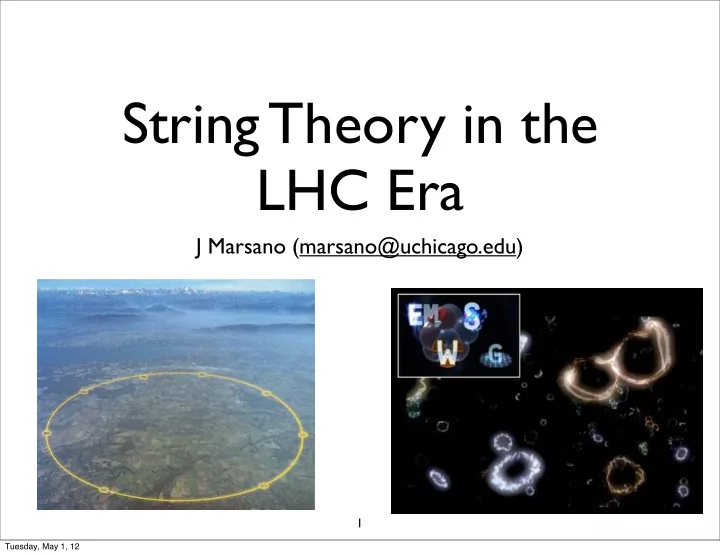
String Theory in the LHC Era J Marsano (marsano@uchicago.edu) 1 - - PowerPoint PPT Presentation
String Theory in the LHC Era J Marsano (marsano@uchicago.edu) 1 Tuesday, May 1, 12 String Theory in the LHC Era 1. Electromagnetism and 5. Physics Beyond the Standard Model Special Relativity and Supersymmetry 2. The Quantum World 6.
1
J Marsano (marsano@uchicago.edu)
Tuesday, May 1, 12
Special Relativity
and Supersymmetry
2
Tuesday, May 1, 12
3
Electromagnetism Strong nuclear force Weak nuclear force
(electrons and neutrinos)
Tuesday, May 1, 12
4
Hat tip R Lipscomb
http://mblogs.discovermagazine.com/cosmicvariance/ 2012/04/25/what-particle-are-you/
Tuesday, May 1, 12
5
Long range force
Weak bosons W ±, Z0
Short range force
Range set by 1 Mass of W ±, Z0
n νe
e− p+ W −
Photon γ
Massless force carrier Massive force carriers
e− e− γ e− e−
Gluons g Many massless force carriers Strongly coupled at long distances
q q q q g
Tuesday, May 1, 12
6
Electromagnetism Strong nuclear force Weak nuclear force Leptons (electrons and neutrinos) Quarks
All particle masses from coupling to Higgs
Tuesday, May 1, 12
6
Electromagnetism Strong nuclear force Weak nuclear force Leptons (electrons and neutrinos) Quarks
All particle masses from coupling to Higgs
Photon massless long range force Gluons massless but many
W and Z bosons massive short range force Quark and lepton masses from Higgs
Tuesday, May 1, 12
7
Tuesday, May 1, 12
8
Standard Model doesn’t incorporate gravity
More on this in the remaining lectures.....
Tuesday, May 1, 12
9
Inverse electromagnetic coupling Inverse weak interaction coupling Inverse QCD coupling
Grand Unified Theory (GUT) that gives common
Tuesday, May 1, 12
10
Tuesday, May 1, 12
11
Tuesday, May 1, 12
12
Stars near the edge of galaxies are rotating faster than they should Fritz Zwicky
New ‘dark matter’ contributes to the gravitational field that accelerates the stars
Tuesday, May 1, 12
Gravitational Lensing
Can ‘see’ dark matter more directly
Tuesday, May 1, 12
Gravitational Lensing
Can ‘see’ dark matter more directly
Tuesday, May 1, 12
Dark Matter also affects the Cosmic Microwave Background
Key component of standard cosmology
What does this mean for particle physics?
Tuesday, May 1, 12
Weakly Interacting Massive Particle
Couples to the weak interactions
not to electromagnetism
Tuesday, May 1, 12
Weakly Interacting Massive Particle
Couples to the weak interactions
not to electromagnetism
Must be stable or have lifetime longer than the age of the universe (~ 10 billion years)
Tuesday, May 1, 12
Weakly Interacting Massive Particle
Couples to the weak interactions
not to electromagnetism
Must be stable or have lifetime longer than the age of the universe (~ 10 billion years)
Tuesday, May 1, 12
...but good reason to see it soon
Dark Matter Particles Standard Model Particles Dark Matter Particles Standard Model Particles
Standard Model particles collide to make dark matter Dark matter particles annihilate back to Standard Model
Tuesday, May 1, 12
...but good reason to see it soon
Dark Matter Particles Standard Model Particles Dark Matter Particles Standard Model Particles
Tuesday, May 1, 12
...but good reason to see it soon
Roughly, particles too far apart for them to continue annihilating
Dark Matter Particles Standard Model Particles Dark Matter Particles Standard Model Particles
Tuesday, May 1, 12
Dark matter density
ΩDark ⇠ 1 hσvi ⇠ m2
Dark
g4
Rate at which dark matter annihilates into Standard Model particles
...but good reason to see it soon
Tuesday, May 1, 12
Dark matter density
ΩDark ⇠ 1 hσvi ⇠ m2
Dark
g4
∼ 0.1 for WIMP with
mDark ∼ 100 GeV
Rate at which dark matter annihilates into Standard Model particles
...but good reason to see it soon
Tuesday, May 1, 12
Dark matter density
ΩDark ⇠ 1 hσvi ⇠ m2
Dark
g4
∼ 0.1 for WIMP with
mDark ∼ 100 GeV
Rate at which dark matter annihilates into Standard Model particles
...but good reason to see it soon
Tuesday, May 1, 12
Dark matter density
ΩDark ⇠ 1 hσvi ⇠ m2
Dark
g4
∼ 0.1 for WIMP with
mDark ∼ 100 GeV
Mass scales probed at the LHC
Rate at which dark matter annihilates into Standard Model particles
...but good reason to see it soon
Tuesday, May 1, 12
Dark matter density
ΩDark ⇠ 1 hσvi ⇠ m2
Dark
g4
∼ 0.1 for WIMP with
mDark ∼ 100 GeV
Mass scales probed at the LHC
Rate at which dark matter annihilates into Standard Model particles
...but good reason to see it soon
Tuesday, May 1, 12
Get the right (observed) amount
~ Electroweak scale!
Tuesday, May 1, 12
Get the right (observed) amount
~ Electroweak scale!
Tuesday, May 1, 12
Look for dark matter colliding with heavy nuclei (Ge, I, Xe, ...) Look for signs of dark matter annihilation in the sky
Tuesday, May 1, 12
DAMA and CoGent see something but nobody else does
Tuesday, May 1, 12
Evidence for 130 GeV dark matter annihilation in galactic center?
C Weniger arXiv:1204.2797
waiting for official analysis from Fermi/LAT collaboration
Tuesday, May 1, 12
23
Tuesday, May 1, 12
24
Energy Scales
1018 GeV 10−3 GeV
Quantum gravity Weak scale Proton mass Electron mass
16 orders of magnitude
1 GeV 102 GeV
Where did this large scale separation come from?
Higgs boson breaks electroweak symmetry Generates mass for W and Z bosons
Tuesday, May 1, 12
24
Energy Scales
1018 GeV 10−3 GeV
Quantum gravity Weak scale Proton mass Electron mass
16 orders of magnitude
1 GeV 102 GeV
Where did this large scale separation come from?
Higgs boson breaks electroweak symmetry Generates mass for W and Z bosons
Tuesday, May 1, 12
25
Scale of electroweak symmetry breaking determined by Higgs physics Potential for Higgs field sets the scale of the ‘Higgs bath’
Determined by quantum effects
Higgs boson breaks electroweak symmetry Generates mass for W and Z bosons
Energy
1018 GeV 10−3 GeV
Quantum gravity Weak scale Proton mass Electron mass
16 orders of magnitude 1 GeV 102 GeV
Tuesday, May 1, 12
26
Many important contributions, including top loop
Higgs boson breaks electroweak symmetry Generates mass for W and Z bosons
Energy
1018 GeV 10−3 GeV
Quantum gravity Weak scale Proton mass Electron mass
16 orders of magnitude 1 GeV 102 GeV
Tuesday, May 1, 12
26
Many important contributions, including top loop
= ∞ (Infinity)!
Higgs boson breaks electroweak symmetry Generates mass for W and Z bosons
Energy
1018 GeV 10−3 GeV
Quantum gravity Weak scale Proton mass Electron mass
16 orders of magnitude 1 GeV 102 GeV
Tuesday, May 1, 12
27
= ∞ (Infinity)! Quantum Field Theory generates many infinities
Tuesday, May 1, 12
27
= ∞ (Infinity)! Quantum Field Theory generates many infinities
Quantum Field Theory is smarter than we are
If we get an infinite answer then we must have done something wrong
Tuesday, May 1, 12
28
Quantum Field Theory is smarter than we are
If we get an infinite answer then we must have done something wrong
Tuesday, May 1, 12
29
We always ‘sum over histories’
Richard Feynman
...so we allow virtual top quarks to carry arbitrarily high momenta/energies
If we cap this energy at Λ then the result is ∼ Λ2
The infinity comes precisely from the top quarks with very high energies
Tuesday, May 1, 12
29
We always ‘sum over histories’
Richard Feynman
...so we allow virtual top quarks to carry arbitrarily high momenta/energies
If we cap this energy at Λ then the result is ∼ Λ2
The infinity comes precisely from the top quarks with very high energies
Do we really know what physics looks like at such high energies?
Tuesday, May 1, 12
29
We always ‘sum over histories’
Richard Feynman
...so we allow virtual top quarks to carry arbitrarily high momenta/energies
If we cap this energy at Λ then the result is ∼ Λ2
The infinity comes precisely from the top quarks with very high energies
Do we really know what physics looks like at such high energies?
Tuesday, May 1, 12
30
Tuesday, May 1, 12
31
Parametrize our ignorance of short distance physics
Our old computation ‘New’, unknown short distance physics
Controlled by new parameter Must be fixed by measurement
Tuesday, May 1, 12
32
Infinities everywhere! Standard Model depends on many details of short distance physics
Miracle of the Standard Model: Depends on short distance physics
(particle masses and couplings)
Tuesday, May 1, 12
33
If we could describe physics at all distance scales, we could compute all particle masses and interactions
...but we do not know what is going on at very short distances The parameters of the Standard Model (masses and couplings) parametrize what we don’t know about this short distance physics
Tuesday, May 1, 12
34
Tuesday, May 1, 12
35
Standard Model Measured Parameter Values Predictions
How sensitive are these large mass hierarchies to our parameter values?
Higgs boson breaks electroweak symmetry Generates mass for W and Z bosons
Energy
1018 GeV 10−3 GeV
Quantum gravity Weak scale Proton mass Electron mass
16 orders of magnitude 1 GeV 102 GeV
Question about ‘robustness’ of the Standard Model
Tuesday, May 1, 12
36
Energy Scales
1018 GeV 10−3 GeV
Quantum gravity Weak scale Proton mass Electron mass
16 orders of magnitude
1 GeV 102 GeV
This hierarchy is not too sensitive to Standard Model parameters
Happens because the Standard Model effectively captures the physics that sets the proton mass
Tuesday, May 1, 12
37
Energy
1018 GeV
Quantum gravity Proton mass
1 GeV
u u d
p+
q q g
q q
g
QCD is strong at long distances Strength determines size of proton (and its mass)
Tuesday, May 1, 12
38
Standard Model Measured Parameter Values Predictions
Hierarchy problem: The electroweak hierarchy is extremely sensitive to the input parameter values
Our model for physics is ‘not robust’ Suggests that essential features are missed
Higgs boson breaks electroweak symmetry Generates mass for W and Z bosons
Energy
1018 GeV 10−3 GeV
Quantum gravity Weak scale Proton mass Electron mass
16 orders of magnitude 1 GeV 102 GeV
→ No explanation for Higgs bath in Standard Model
Tuesday, May 1, 12
39
Energy
1018 GeV
Quantum gravity Weak scale
16 orders of magnitude 102 GeV Higgs boson breaks electroweak symmetry Generates mass for W and Z bosons
Standard Model Measured Parameter Values Predictions
Hierarchy ‘problem’ a matter of taste Maybe our world is just ‘finely tuned’ ...most physicists don’t like this idea
Tuesday, May 1, 12
40
Why?
Tuesday, May 1, 12
41
Many ideas for physics beyond the Standard Model We will focus on one:
Tuesday, May 1, 12
42
‘Space-time and internal symmetries cannot be combined in any but a trivial way’
As with most ‘No-Go’ theorems, this one has a loophole
Tuesday, May 1, 12
43
Supersymmetry is an extension of space- time symmetry (rotations etc) that mixes particles of different spin
e− e− γ γ ˜ e− ˜ e−
Supersymmetry ⇒ same interaction strength
Spin 1 2 fermion
Spin 0 boson
Tuesday, May 1, 12
44
Supersymmetry → Each Standard Model particle has a ‘superpartner’
Top quark Stop squark Gluon Gluino Electron
Tuesday, May 1, 12
45
Howard Georgi Savas Dimopoulos
Don’t see superpartner particles (yet) → Supersymmetry not an exact symmetry of nature
Tuesday, May 1, 12
46
Supersymmetry is broken at some energy scale
Superpartner particle masses are around
mSUSY mSUSY No fundamental reason to expect mSUSY low enough to be accessible in near future If mSUSY ∼ 100 GeV can address many problems
Tuesday, May 1, 12
47
Energy
1018 GeV
Quantum gravity Weak scale
102 GeV Higgs boson breaks electroweak symmetry Generates mass for W and Z bosons 16 orders of magnitude
Superpartner contributes with
Contribution of high energy tops canceled by high energy stops
Tuesday, May 1, 12
48
Supersymmetry causes ‘infinities’ to ‘cancel’ Reduces sensitivity to ultra- short distance physics
Tuesday, May 1, 12
49
Energy
1018 GeV
Quantum gravity Weak scale
102 GeV Higgs boson breaks electroweak symmetry Generates mass for W and Z bosons 16 orders of magnitude
Supersymmetry also gives natural mechanism for generating Higgs potential at the scale mSUSY
can explain electroweak hierarchy if
mSUSY ∼ 100 − 1000 GeV
Tuesday, May 1, 12
50
Natural symmetry that distinguishes particles and their superpartners
‘R-parity’
Tuesday, May 1, 12
51
If we make a superpartner particle in a collision...
Tuesday, May 1, 12
51
If we make a superpartner particle in a collision...
˜ t
Standard Model Particles Superpartner particle
...but there must be at least one superpartner particle in the final state
Tuesday, May 1, 12
52
˜ t
Standard Model Particles Superpartner particle
⇒ the Lightest Superpartner Particle (LSP) is stable!
Tuesday, May 1, 12
53
Supersymmetry and Grand Unification
Inverse electromagnetic coupling Inverse weak interaction coupling Inverse QCD coupling
Grand Unification?
e− e− e− e− γ γ γ
Tuesday, May 1, 12
53
Supersymmetry and Grand Unification
Inverse electromagnetic coupling Inverse weak interaction coupling Inverse QCD coupling
Grand Unification?
e− e− e− e− γ γ γ
e− e− ˜ e− ˜ e−
with supersymmetry
Tuesday, May 1, 12
54
Supersymmetry and Grand Unification
Inverse electromagnetic coupling Inverse weak interaction coupling Inverse QCD coupling Grand Unification?
With supersymmetry at ~100 GeV, unification looks much better
Tuesday, May 1, 12
55
W and Z bosons
Tuesday, May 1, 12
56
Minimal Supersymmetric Standard Model (MSSM) has ~125 parameters
Very complicated to do a systematic search
Tuesday, May 1, 12
57
Top quark Stop squark Gluon Gluino Electron Selectron
Minimal Supersymmetric Standard Model (MSSM)
‘Hidden Sector’
Supersymmetry Broken Here ‘Messenger Sector’
What we see depends mostly on this
Gravity, Charged Messengers, etc
Tuesday, May 1, 12
57
Top quark Stop squark Gluon Gluino Electron Selectron
Minimal Supersymmetric Standard Model (MSSM)
‘Hidden Sector’
Supersymmetry Broken Here ‘Messenger Sector’
What we see depends mostly on this
Gravity, Charged Messengers, etc
Supersymmetry breaking fields Messengers Standard Model Particles
Tuesday, May 1, 12
58
Simplest framework: mSUGRA
Replace125 parameters with 5
Spin 1 2 partners of force carriers
Scalar partners of quarks, electrons, etc
Interaction between squarks/sleptons and ganginos
Higgs sector parameters
Tuesday, May 1, 12
59
Experiments must think about many possibilities Signatures vary widely
Supersymmetry not found yet but too soon to rule out
Mass scale [TeV]
10 1 10
RPV Long-lived particles DG Third generation Inclusive searches
klm ≈
ijm Hypercolour scalar gluons : 4 jets,
,miss TE MSUGRA/CMSSM - BC1 RPV : 4-lepton +
,miss TE Bilinear RPV : 1-lep + j's + µ RPV : high-mass e τ ∼ GMSB : stable SMP : R-hadrons (Pixel det. only) SMP : R-hadrons SMP : R-hadrons Stable massive particles (SMP) : R-hadrons
± 1χ ∼ AMSB : long-lived
,miss TE ) : 3-lep +
1χ ∼ 3l →
2χ ∼
± 1χ ∼ Direct gaugino (
,miss TE ) : 2-lep SS +
1χ ∼ 3l →
2χ ∼
± 1χ ∼ Direct gaugino (
,miss TE ll) + b-jet + → (GMSB) : Z( t ~ t ~ Direct
,miss TE ) : 2 b-jets +
1χ ∼ b →
1b ~ ( b ~ b ~ Direct
,miss TE ) : multi-j's +
1χ ∼ t t → g ~ ( t ~ Gluino med.
,miss TE ) : 2-lep (SS) + j's +
1χ ∼ t t → g ~ ( t ~ Gluino med.
,miss TE ) : 1-lep + b-j's +
1χ ∼ t t → g ~ ( t ~ Gluino med.
,miss TE ) : 0-lep + b-j's +
1χ ∼ b b → g ~ ( b ~ Gluino med.
,miss TE + γ γ GGM :
,miss TE + j's + τ GMSB : 2-
,miss TE + j's + τ GMSB : 1-
,miss TE +
SFGMSB : 2-lep OS
,miss TE ) : 1-lep + j's +
±χ ∼ q q → g ~ (
±χ ∼ Gluino med.
,miss TE Pheno model : 0-lep + j's +
,miss TE Pheno model : 0-lep + j's +
,miss TE MSUGRA/CMSSM : multijets +
,miss TE MSUGRA/CMSSM : 1-lep + j's +
,miss TE MSUGRA/CMSSM : 0-lep + j's +
3 GeV) ± 140 ≈
sgm < 100 GeV,
sgm sgluon mass (excl:
185 GeV (2010) [1110.2693]mass g ~
1.77 TeV (2011) [ATLAS-CONF-2012-035]< 15 mm)
LSPτ mass (c g ~ = q ~
760 GeV (2011) [1109.6606]=0.05)
312λ =0.10,
, 311λ mass (
τν ∼
1.32 TeV (2011) [1109.3089]mass τ ∼
136 GeV (2010) [1106.4495]mass g ~
810 GeV (2011) [ATLAS-CONF-2012-022]mass t ~
309 GeV (2010) [1103.1984]mass b ~
294 GeV (2010) [1103.1984]mass g ~
562 GeV (2010) [1103.1984]) < 2 ns, 90 GeV limit in [0.2,90] ns)
± 1χ ∼ ( τ mass (1 <
± 1χ ∼
118 GeV (2011) [CF-2012-034]) < 170 GeV, and as above)
1χ ∼ ( m mass (
± 1χ ∼
250 GeV (2011) [ATLAS-CONF-2012-023])))
2χ ∼ ( m ) +
1χ ∼ ( m ( 2 1 ) = ν ∼ , l ~ ( m ),
2χ ∼ ( m ) =
± 1χ ∼ ( m ,
1χ ∼ ) < 40 GeV,
1χ ∼ ( m mass ((
± 1χ ∼
170 GeV (2011) [1110.6189]) < 230 GeV)
1χ ∼ ( m mass (115 < t ~
310 GeV (2011) [ATLAS-CONF-2012-036]) < 60 GeV)
1χ ∼ ( m mass ( b ~
390 GeV (2011) [1112.3832]) < 200 GeV)
1χ ∼ ( m mass ( g ~
830 GeV (2011) [ATLAS-CONF-2012-037]) < 210 GeV)
1χ ∼ ( m mass ( g ~
650 GeV (2011) [ATLAS-CONF-2012-004]) < 150 GeV)
1χ ∼ ( m mass ( g ~
710 GeV (2011) [ATLAS-CONF-2012-003]) < 300 GeV)
1χ ∼ ( m mass ( g ~
900 GeV (2011) [ATLAS-CONF-2012-003]) > 50 GeV)
1χ ∼ ( m mass ( g ~
805 GeV (2011) [1111.4116]> 20) β mass (tan g ~
990 GeV (2011) [ATLAS-CONF-2012-002]> 20) β mass (tan g ~
920 GeV (2011) [ATLAS-CONF-2012-005]< 35) β mass (tan g ~
810 GeV (2011) [ATLAS-CONF-2011-156])) g ~ ( m )+ χ ∼ ( m ( 2 1 ) =
±χ ∼ ( m ) < 200 GeV,
1χ ∼ ( m mass ( g ~
900 GeV (2011) [ATLAS-CONF-2012-041])
1χ ∼ ) < 2 TeV, light q ~ ( m mass ( g ~
940 GeV (2011) [ATLAS-CONF-2012-033])
1χ ∼ ) < 2 TeV, light g ~ ( m mass ( q ~
1.38 TeV (2011) [ATLAS-CONF-2012-033]) m mass (large g ~
850 GeV (2011) [ATLAS-CONF-2012-037]mass g ~ = q ~
1.20 TeV (2011) [ATLAS-CONF-2012-041]mass g ~ = q ~
1.40 TeV (2011) [ATLAS-CONF-2012-033]= (0.03 - 4.7) fb Ldt
∫
= 7 TeV s
ATLAS
PreliminaryATLAS SUSY Searches* - 95% CL Lower Limits (Status: March 2012)
Tuesday, May 1, 12
60
parameters’ (particle masses and interactions) to parametrize this ignorance
Tuesday, May 1, 12