Strategies Different strategy forms in games Pure strategy: select - - PowerPoint PPT Presentation

strategies
SMART_READER_LITE
LIVE PREVIEW

Strategies Different strategy forms in games Pure strategy: select - - PowerPoint PPT Presentation

Strategies Different strategy forms in games Pure strategy: select single action and play it Mixed strategy: For a set X, let (X) be set of all probability distributions over X. Set of mixed strategies for player i is S i = (A i


slide-1
SLIDE 1

Strategies

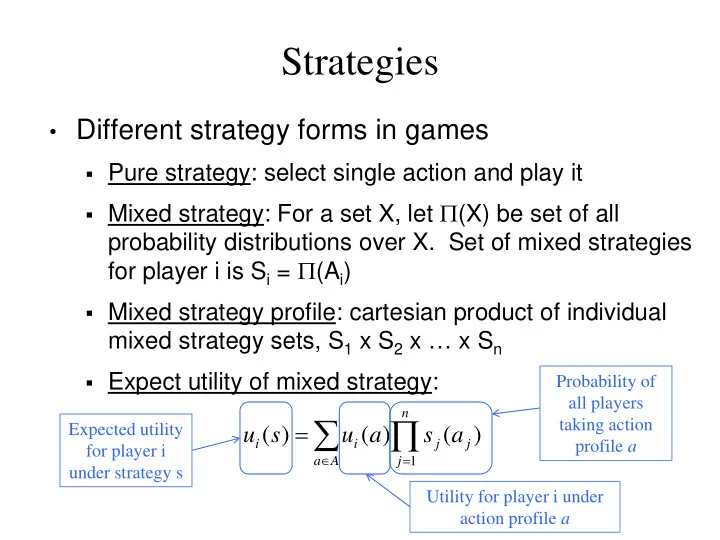
  • Different strategy forms in games
  • Pure strategy: select single action and play it
  • Mixed strategy: For a set X, let Π(X) be set of all

probability distributions over X. Set of mixed strategies for player i is Si = Π(Ai)

  • Mixed strategy profile: cartesian product of individual

mixed strategy sets, S1 x S2 x … x Sn

  • Expect utility of mixed strategy:

∏ ∑

= ∈

=

n j j j A a i i

a s a u s u

1

) ( ) ( ) (

Probability of all players taking action profile a Utility for player i under action profile a Expected utility for player i under strategy s

slide-2
SLIDE 2

Pareto Optimality

  • Strategy profile s Pareto dominates strategy

profile s’ if for all i ∈ N, ui(s) ≥ ui(s’) and there exists some k ∈ N, uk(s) > uk(s’)

  • That is, in Pareto dominated strategy, some player (k)

can be made better off while no one else is worse off

  • Strategy profile s is Pareto optimal (efficient) if

there does not exist another strategy profile s’ ∈ S that dominates s

  • Every game has at least one Pareto optimal strategy

which is pure for all players

  • Possible to have multiple Pareto optimal strategies

(e.g., in zero-sum game, all strategies Pareto optimal)

slide-3
SLIDE 3

Nash Equilibrium

  • Player i’s best response to strategy profile s-i,
  • is a mixed strategy si* ∈ Si
  • such that ui(si*, s-i) ≥ ui(si, s-i) for all strategies si ∈ Si
  • Not necessarily unique
  • Strategy profile s = (s1, …, sn) is Nash equilibrium

if, for all players i, si is a best response to s-i

  • Nash equilibrium is a stable strategy in that no player

would want to change strategy if they knew the strategies the other players were following

  • Theorem (Nash, 1951): Every game with finite players

and action profiles has at least one Nash equilibrium

slide-4
SLIDE 4

Finding Nash Equilibria

  • Generally involved, but we consider special case
  • Consider the Battle of the Sexes game:
  • Two pure strategy Nash equilibria: (SW, SW), (HP, HP)
  • Mixed strategy Nash equilbrium
  • Players need to have equal utility for either action
  • Let p = probability player 2 picks SW and U1(x) = player 1 utility

U1(SW) = U1(HP)  2p + 0(1 – p) = 0p + 1(1 – p)  p = 1/3

  • Nash equilibrium: player 2: (SW 1/3 of time & HP 2/3 of time);

(similar calculation) player 1: (SW 2/3 of time & HP 1/3 of time)

  • Expected payoff here = (1/3)(2/3)(2) + (2/3)(1/3)(1) = 2/3

SW HP SW (2, 1) (0, 0) HP (0, 0) (1, 2)

slide-5
SLIDE 5

Finding Nash Equilibria

  • Another example, recall Matching Pennies game:
  • No pure strategy Nash equilibrium
  • Mixed strategy Nash equilbrium
  • As before, players need to have equal utility for either action
  • Let p = probability player 2 picks H and U1(x) = player 1 utility

U1(H) = U1(T)  1p + -1(1 – p) = -1p + 1(1 – p) 2p – 1 = -2p + 1  p = 1/2

  • Nash equilibrium is 1/2 of time pick H, 1/2 of time pick T
  • Expected payoff here = 0
  • Recall, it is a zero-sum game

Heads (H) Tails (T) Heads (H) (1, -1) (-1, 1) Tails (T) (-1, 1) (1, -1)

slide-6
SLIDE 6

Maxmin and Minmax Strategies

  • Maxmin strategy for player i is:
  • Intuitively, best choice for player i to play if:
  • player i plays first
  • all other players see strategy (but not action)
  • then all other players choose strategies to minimize i‘s payoff
  • Minmax strategy (2-player game) for player i is:
  • Intuitively, player i is trying to minimize the maximum

payoff of other player

  • Theorem (von Neumann, 1928): In a finite, 2-player, zero-sum

game, in Nash equilibrium, both players receive payoff equal to both maxmin and minmax value

) , ( min max arg

i i i s s

s s u

i i

) , ( max min arg

i i i s s

s s u

i i

− −

slide-7
SLIDE 7

Dominated Strategies

  • Let si and si’ be two strategies of player i and S-i be

set of strategy profiles of all remaining players

  • si strictly dominates si’ if for all s-i∈S-i, ui(si, s-i) > ui(si’, s-i)
  • si weakly dominates si’ if for all s-i∈S-i, ui(si, s-i) ≥ ui(si’, s-i)

and ui(si, s-i) > ui(si’, s-i) for at least one s-i∈S-i

  • si very weakly dominates si’ if for all s-i∈S-i,

ui(si, s-i) ≥ ui(si’, s-i)

  • Consider Prisoner’s Dilemma
  • Nash equilibrium (D, D) results from strictly dominant

strategy, but is only outcome that is not Pareto optimal

C D C (-1, -1) (-4, 0) D (0, -4) (-3, -3)

slide-8
SLIDE 8

Dominated Strategy Removal

  • Consider the following game:
  • Note: G is dominated (for player 2) by E or F, so we

remove it:

  • Now, B is dominated (for player 1) by mixed strategy that

chooses A or C with equal probability, so we remove it:

E F G A (3, 1) (0, 1) (0, 0) B (1, 1) (1, 1) (5, 0) C (0, 1) (4, 1) (0, 0) E F A (3, 1) (0, 1) B (1, 1) (1, 1) C (0, 1) (4, 1) E F A (3, 1) (0, 1) C (0, 1) (4, 1)

slide-9
SLIDE 9

Signaling

  • Signaling is a way for players to communicate
  • Allows players to potentially coordinate strategies
  • Could be open communication (state declaration,

corporate policy, college degree, etc.)

  • Could be private channel communication
  • E.g., spectrum auction in 1997
  • Hawk/Dove (aka, Chicken) game (in foreign policy)
  • Some scarce good (utility 6). Hawk takes it from Dove. Two

Doves will split it without fight (3 each). Two Hawks split it (after fight that costs each 5) for total payoff of -2 each.

Hawk Dove Hawk (-2, -2) (6, 0) Dove (0, 6) (3, 3)

slide-10
SLIDE 10

It’s play time!

slide-11
SLIDE 11

Game II

  • Hawk/Dove – highest total payoff gets $20
  • Version 1: single round, no communication
  • Again, but with a different partner
  • Version 2: single round, communication allowed
  • Again, but with a different partner
  • Version 3: ??? rounds, no communication
  • Version 4: ??? rounds, communication allowed

Hawk (H) Dove (D) Hawk (H) (-2, -2) (6, 0) Dove (D) (0, 6) (3, 3)

slide-12
SLIDE 12

What happened? Discuss.