Sampling and Connection Strategies for Probabilistic Strategies for - - PDF document

sampling and connection strategies for probabilistic
SMART_READER_LITE
LIVE PREVIEW

Sampling and Connection Strategies for Probabilistic Strategies for - - PDF document

1/31/2012 Two Types of Strategies Where to sample new milestones? Sampling strategy Sampling and Connection Strategies for Probabilistic Strategies for Probabilistic Which milestones to connect? Which milestones to connect?


slide-1
SLIDE 1

1/31/2012 1

Sampling and Connection Strategies for Probabilistic Strategies for Probabilistic Roadmaps

1

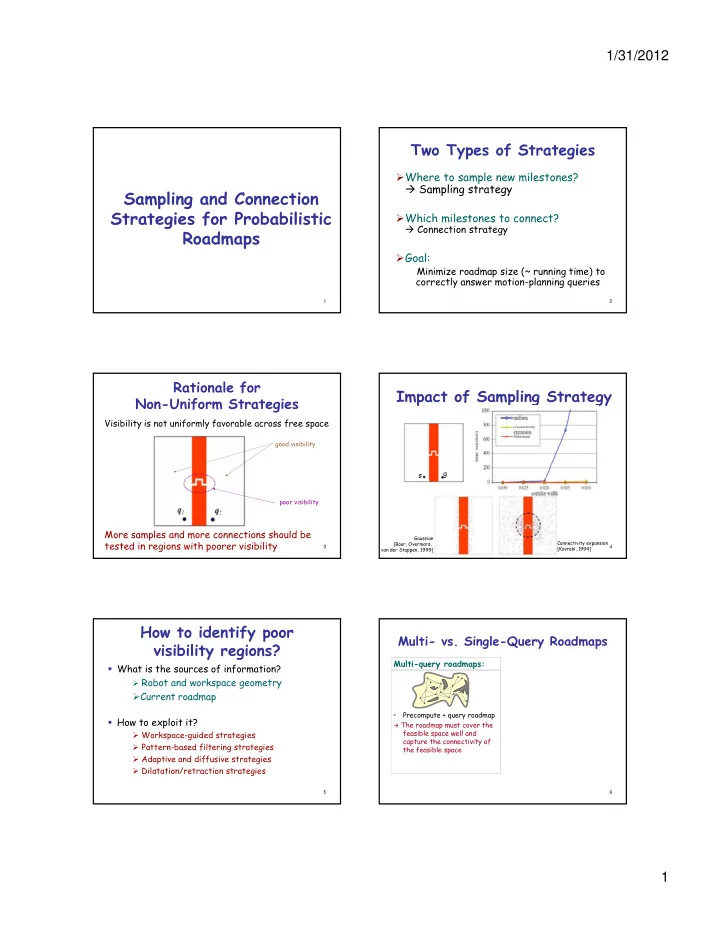
Two Types of Strategies

Where to sample new milestones? Sampling strategy Which milestones to connect? Which milestones to connect?

Connection strategy

Goal:

Minimize roadmap size (~ running time) to correctly answer motion-planning queries

2

Rationale for Non-Uniform Strategies

Visibility is not uniformly favorable across free space

good visibility

More samples and more connections should be tested in regions with poorer visibility

poor visibility

3

Impact of Sampling Strategy

4

s g

Gaussian [Boor, Overmars, van der Stappen, 1999] Connectivity expansion [Kavraki, 1994]

How to identify poor visibility regions?

What is the sources of information?

Robot and workspace geometry

Current roadmap How to exploit it?

Workspace-guided strategies Pattern-based filtering strategies Adaptive and diffusive strategies Dilatation/retraction strategies

5

Multi- vs. Single-Query Roadmaps

Multi-query roadmaps:

  • Precompute + query roadmap

The roadmap must cover the

feasible space well and capture the connectivity of the feasible space

6

slide-2
SLIDE 2

1/31/2012 2

Multi- vs. Single-Query Roadmaps

Multi-query roadmaps: Single-query roadmaps:

s g

  • Precompute + query roadmap

The roadmap must cover the

feasible space well and capture the connectivity of the feasible space

  • Compute roadmap from

scratch for each query

The roadmap should capture

just enough of the connectivity of the feasible space to connect the start and goal configurations

7

Multi- vs. Single-Query Roadmaps

Multi-query roadmaps: Single-query roadmaps:

s g

  • Precompute + query roadmap

The roadmap must cover the

feasible space well and capture the connectivity of the feasible space

  • Compute roadmap from

scratch for each query

The roadmap should capture

just enough of the connectivity of the feasible space to connect the start and goal configurations Some strategies are more suitable for multi-query roadmaps, others for single query-roadmaps

8

Workspace-guided strategies

Identify narrow passages in the workspace and map them into the configuration space

Pattern-based filtering strategies

Sample many configurations, find interesting patterns, and retain only promising configurations p y p g g

Adaptive and diffusive strategies

Adjust the sampling distribution (π) on the fly

Dilatation/retraction strategies

Dilate the feasible space to make it more expansive

9

Workspace-Guided Strategies

Rationale: Most narrow passages in the feasible space are caused by narrow passages in the workspace Method:

  • Detect narrow passages in the workspace (e g cell

Detect narrow passages in the workspace (e.g., cell decomposition, medial-axis transform)

  • Sample robot configurations that place selected robot points

in workspace’s narrow passages

  • H. Kurniawati and D. Hsu. Workspace importance sampling for probabilistic roadmap
  • planning. In Proc. IEEE/RSJ Int. Conf. on Intelligent Robots & Systems, pp. 1618–1623,

2004.

  • J.P. van den Berg and M. H. Overmars. Using Workspace Information as a Guide to Non-

Uniform Sampling in Probabilistic Roadmap Planners. IJRR, 24(12):1055-1071, Dec. 2005. 10

Workspace-Guided Strategies

Uniform sampling Workspace-guided sampling

11

Limitations

Works well for rigid objects, but not so well for articulated robots, such as manipulator arms Why? Not all narrow passages are obvious to detect in workspace

What are the narrow passages?

12

slide-3
SLIDE 3

1/31/2012 3 Non-Uniform Sampling Strategies

Workspace-guided strategies Pattern-based filtering strategies Adaptive and diffusive strategies Deformation strategies

13

Filtering Strategies

Main Idea:

Sample several configurations in the same small region

  • f configuration space

If a “pattern” is detected, then retain one of the configurations as a milestone M s mplin k b t b tt dist ib ti n f n d s More sampling work, but better distribution of nodes Less time wasted later connecting “non-interesting” milestones

Methods:

Gaussian sampling Bridge Test Hybrid

  • V. Boor, M. H. Overmars, and A. F. van der Stappen.

The Gaussian sampling strategy for probabilistic roadmap

  • planners. In Proc. 1999 IEEE Int. Conf. Robotics and

Automation, 1999, pp. 1018–1023.

  • Z. Sun, D. Hsu, T. Jiang, H. Kurniawati, and J. Reif .

Narrow passage sampling for probabilistic roadmap

  • planners. IEEE Trans. on Robotics, 21(6):1105–1115, 2005.

14

Gaussian Sampling

1) Sample a configuration q uniformly at random from configuration space 2) Sample a direction u in configuration space uniformly at random and a distance d with Gaussian distribution N[0,σ]. Set q’ to the configuration a distance d from q

[0,σ]

g along direction u 3) If only one of q and q’ is in feasible space, retain the

  • ne in feasible space as a milestone; else retain none

What is the effect? What is the intuition?

15

Gaussian Distribution

= ( ) f x

N[μ,σ](x) =

= ( ) f x

Example of Node Distribution

17

Uniform vs. Gaussian Sampling

Milestones (13,000) created by uniform sampling before the narrow passage was adequately sampled Milestones (150) created by Gaussian sampling

The gain is not in sampling fewer milestones, but in connecting fewer pairs of milestones

18

slide-4
SLIDE 4

1/31/2012 4 Bridge Test

1) Sample two conformations q and q’ using Gaussian sampling technique 2) If none is in feasible space, then if qm = (q+q’)/2 is in feasible space, then retain qm as a milestone 3) Else retain none What is the effect?

What is the intuition?

19

Example of Distribution Generated Using Bridge Test

20

Gaussian vs. Bridge Test

Gaussian Bridge test

21

8-joint robot with mobile base

Another Example of Bridge-Test Distribution

22

7-joint robot with fixed base

Another Example of Bridge-Test Distribution

23

Drawback of Gaussian and Bridge-Test Sampling

They assume the existence of nasty narrow passages They are slow when there are none! They are slow when there are none! Solution: Hybrid adaptive strategy (a combination of strategies)

24

slide-5
SLIDE 5

1/31/2012 5

One Possible Hybrid Sampling Strategy

At each sampling operation do the following: 1) With probability π1 sample a milestone using Bridge-Test sampling and exit 2) With probability π2 sample a milestone using Gaussian sampling and exit 3) Sample a milestone uniformly at random 3) Sample a milestone uniformly at random

25

Start with π1 = 0 and π2 = 0. After N1 milestones have been generated, increase π2 slowly after each sampling operation. After N2 > N1 milestones have been generated, increase π1 slowly (but at a slightly faster rate than π2).

What is the intuition?

Uniform Bridge test Uniform + Bridge test

26

Non-Uniform Sampling Strategies

Workspace-guided strategies Pattern-based filtering strategies Adaptive and diffusive strategies Dilatation/retraction strategies

27

Adaptive/Diffusive Strategies

Main idea: Use information gathered during roadmap construction to adjust the sampling probability measure Time-varying sampling measure Methods:

  • Identification of “difficult” regions
  • Diffusion
  • Adaptive steps
  • π = α1π1 + α2π2 + ... + αnπn, where the πi are constant

and the πi are adjusted, e.g., using machine learning techniques

28

Connectivity Expansion

Use work already done to detect poor- visibility regions

[Kavraki, 94]

29

Detection of “Difficult” Regions

Idea: Use failures to connect milestones to identify regions with poor visibility

[Kavraki, 94]

30

slide-6
SLIDE 6

1/31/2012 6 Example of Distribution

31

Diffusion Strategy

Idea: Grow distributions from “seed” configurations (e.g., the start and the goal configurations)

s g

32

Diffusion Strategy

Idea: Grow distributions from “seed” configurations (e.g., the start and the goal configurations)

Two main techniques: Pick a milestone q with probability proportional to the inverse of the local sampling density.

33

Sample a new configuration q’ at random around q Pick a conformation qt at random in configuration space. Identify the closest milestone q from qt. Sample a new configuration q’ at random around q, possibly in the direction of qt (RRT)

Intuition?

g

Adaptive-Step Sampling

s g

[Sánchez-Ante, 2003]

34

Non-Uniform Sampling Strategies

Workspace-guided strategies Pattern-based filtering strategies Adaptive and diffusive strategies Dilatation/retraction strategies

35

Dilatation/Retraction Strategies

Main idea: Dilate the feasible space to make it more expansive Motivation:

36

slide-7
SLIDE 7

1/31/2012 7 Feasible Space Dilatation

1. Pre-computation: Slim the robot / obstacles

  • 2. Planning:
  • Compute a path for

slimmed robot

  • Deform this path for
  • riginal robot
  • M. Saha, J.C. Latombe, Y.-C. Chang, F. Prinz. Finding Narrow Passages

with Probabilistic Roadmaps: The Small-Step Retraction Method. Autonomous Robots, 19(3):301-319, Dec. 2005.

  • H.-L. Cheng, D. Hsu, J.-C. Latombe, and G. Sánchez-Ante . Multi-level

free-space dilation for sampling narrow passages in PRM planning.

  • Proc. IEEE Int. Conf. on Robotics & Automation, 2006.

37

Free Space Dilatation

Roadmap construction and repair start

~ up to 2 orders of magnitude speedup

fattened free space widened passage free space

  • bstacle

goal

38

Connection Strategies

Limit number of connections:

  • Nearest-neighbor strategy
  • Connected component strategy

In s xp nsi n ss: Increase expansiveness:

  • Library of local path shapes [Amato 98]
  • Local search strategy [Isto 04]

Delay costly computation:

  • Lazy collision checking [Sanchez-Ante, 02]

39

g

Lazy Collision Checking

s g

X

[Sánchez-Ante, 2002]

40

g

Lazy Collision Checking

s g

[Sánchez-Ante, 2002]

x10 speedup

41

Rationale of Lazy Collision Checking

  • Connections between close milestones

have high probability of being free of collision

  • Most of the time spent in collision

checking is done to test connections checking is done to test connections

  • Most collision-free connections will not

be part of the final path

  • Testing connections is more expensive for collision-free

connections

  • Hence: Postpone the tests of connections until they are

absolutely needed

42

slide-8
SLIDE 8

1/31/2012 8

Example of Integration

SBL (http://ai.stanford.edu/~mitul/mpk/ ): Single-query planner Grows two trees from start and goal fi ti configurations Uses:

– density-based diffusive strategy – adaptive-step strategy – dilatation-retraction strategy – lazy collision-checking connection strategy 43