Strategies for E Engaging Y Young Single Males a and Experience - - PDF document

strategies for e engaging y young single males a and
SMART_READER_LITE
LIVE PREVIEW

Strategies for E Engaging Y Young Single Males a and Experience - - PDF document

09/12/2013 Strategies for E Engaging Y Young Single Males a and Experience ced Workers w with Low L Literacy Skills LMP Webinar Series www.llsc.on.ca December 9, 2013 Welcome! Whos online? This webinar is being recorded


slide-1
SLIDE 1

09/12/2013 1

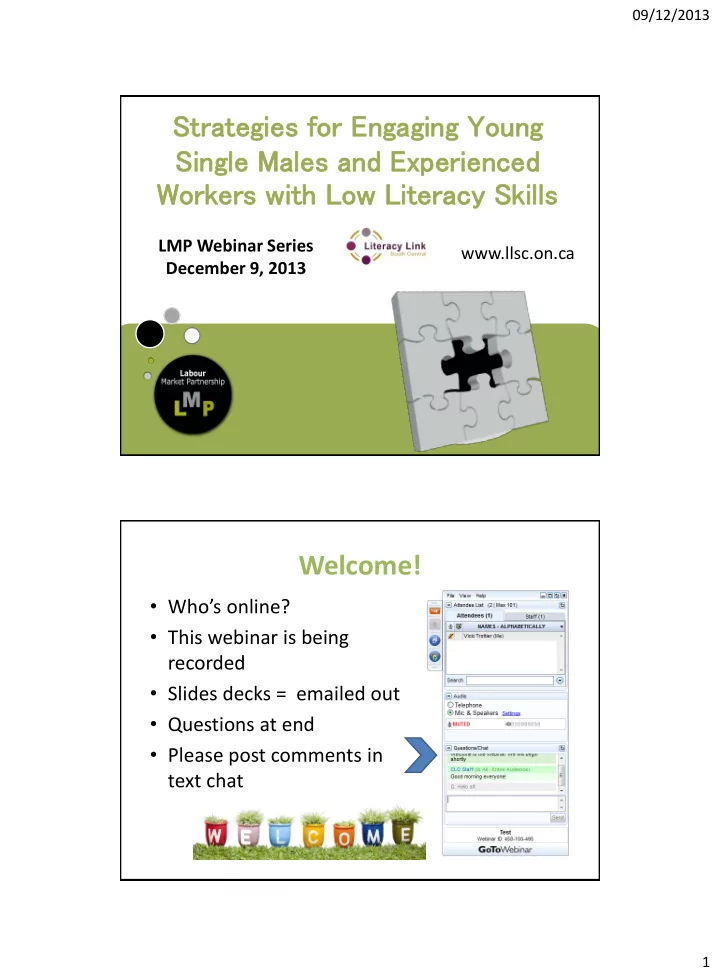
Strategies for E Engaging Y Young Single Males a and Experience ced Workers w with Low L Literacy Skills

LMP Webinar Series December 9, 2013 www.llsc.on.ca

Welcome!

  • Who’s online?
  • This webinar is being

recorded

  • Slides decks = emailed out
  • Questions at end
  • Please post comments in

text chat

slide-2
SLIDE 2

09/12/2013 2

  • Literacy Link South Central Labour Market

Partnership (LMP) project

  • 7 Literacy Networks in Ontario
  • 10 Strategies that were “designed to bring

lower-skilled and marginalized clients closer to employment”

  • An Employment Ontario project, funded by the

Ontario government

About this project

Literacy and the Young Single Male (Anne Marie Curtin) Targeted Employment Support for Job Seekers with Low Literacy Skills (Summer Burton) Webinar hosting and technical assistance (Community of Literacy of Ontario) Questions

About this webinar

slide-3
SLIDE 3

09/12/2013 3

Literacy and the Young Single Male

Anne Marie Curtin

(Since 2007) Increasing number of single males between 18 and 29 who are accessing Ontario Works (OW)

  • Est. 2000 young men in London Ontario on

OW have been on the caseload for longer than 12 months and/or who have less than Gr. 12 education

Literacy and the Young Single Male

What was the need?

slide-4
SLIDE 4

09/12/2013 4

The Lost Boys

  • Fits the work of a literacy network
  • Identified as a potential literacy gap in our

community

  • Builds on 2012-2013 project, “Targeted

Literacy Programming for Young Single Males

  • n Ontario Works”

Why LLSC?

slide-5
SLIDE 5

09/12/2013 5

  • Youth (18- 29 years of age)
  • Male
  • London area

When possible:

  • On Ontario Works
  • Single (no partner, no children)

Target Population

Advisory Group

  • Employment counsellor (Goodwill, Fanshawe College)
  • Youth employment counsellor (YOU)
  • OW caseworker (City of London)
  • Executive Director (LLSC)
  • Executive Director (Workforce Planning and

Development Board)

  • Literacy Practitioner (London District Catholic School

Board)

  • Consultant “of lived experiences” (London ON)

Who was involved?

slide-6
SLIDE 6

09/12/2013 6

Taming the Beast

Challenge

  • Males leave home earlier than females
  • No child, less motivation
  • Comfort on OW
  • Generational poverty
  • Many have criminal records
  • Technology is causing lack of socialization

Assumptions

slide-7
SLIDE 7

09/12/2013 7

  • Not interested in education
  • Employers don’t hire youth
  • Employers hire females first
  • Media and labour market reports

cause youth apathy

Assumptions continued…

  • Resources and literature
  • Employment service providers
  • Literacy and Basic Skills programs
  • Focus groups (youth engaged in

programs) and individual interviews

  • Conversations at the street level (not

engaged)

Challenge the Assumptions

slide-8
SLIDE 8

09/12/2013 8

Digital Natives vs. Digital Immigrant

Marc Prensky 2001

Students absorb and process information differently than those that have gone before them. “Our students have changed radically. Today’s students are no longer the people our educational system was designed to teach.” Youth today have short attention spans, but only for old ways of thinking. “As a result of their experiences Digital Natives crave interactivity—an immediate response to their each and every action. Traditional schooling provides very little of this compared to the rest of their world.”

Digital Natives, Digital Immigrants II

Marc Prensky 2001

slide-9
SLIDE 9

09/12/2013 9

What if? Technology in the 21st Century Classroom

(Ontario Public School Board 2009)

“Many students feel, however, that when they come into school they have to “power down” to fit into an environment that offers fewer

  • ptions for learning than are available in the

life they live outside of the school.”

Good Video Games and Good Learning

(James Paul Gee 2007)

“Lots of young people pay lots of money to engage in an activity that is hard, long, and

  • complex. As an educator, I realized that this

was just the problem our schools face — how do you get someone to learn something long, hard, and complex, and yet still enjoy it? “

slide-10
SLIDE 10

09/12/2013 10

“Young men cited wanting to work as a reason to leave school more often than young women.” Young men with children are more inclined to work than to return to their education.

High School Dropouts Returning to School

(Melanie Raymond for Statistics Canada 2008)

Clearer Sightlines to Employment

What Works for Job –Seekers with Low Educational Attainment (ESO, 2012)

“An ‘education-first’ approach is often far too removed from employment for the vast majority of adults for whom high school was not the ‘right fit’ in the first place.”

slide-11
SLIDE 11

09/12/2013 11

“….one in five youth aged 15-24 not working today has never held a job …Statistics show that youth who gain work experience and receive on the job training while studying are much more likely to find suitable and sustainable employment."

“Canadian youth facing unprecedented challenges finding quality employment” (CIBC 2013) Our Voice: Literacy + OW

Best Practices for Serving Ontario Works Clients (CLO, 2013)

  • Find ways to provide positive

reinforcement EVERY day

  • Make this positive reinforcement

INTENTIONAL and PLANNED

  • Structure learning activities so that OW

clients feel an ongoing sense of accomplishment and moving forward.

slide-12
SLIDE 12

09/12/2013 12

  • Youth are not aware of the education and skills they need

for the jobs they are pursuing

  • Unsure if having children is a variable for motivation
  • Very little participation by this target population in literacy

programs

  • Large percentage of male youth participants have criminal

records - “The more desperate the circumstances the less likely ‘right and wrong’ will enter into the equation.”

  • Need mentors
  • Easily discouraged with the long road to education and

careers

Ah ha! Employment Services Survey

  • Many youth attended LBS programs because

they were required to through Ontario Works, then leave after required visit

  • Inability to see literacy as part of their future

success

  • Having children or not didn’t influence

engagement or performance

  • Inability to communicate for the purposes of

job searching

Ah ha! Literacy Program Survey

slide-13
SLIDE 13

09/12/2013 13

  • Must see that school is useful
  • Need to earn money before going back to

school

  • “Returning to high school takes too long.”
  • Left school because it was dull and

uninteresting

  • Being on OW is depressing (they hide it)

Who can you count on?

Ah ha! Youth Focus Groups

Over one week in October met with est. 80 youth

  • the Food Bank
  • Daily Meals (provided by a church)
  • the parking lot at Labour Ready (temp agency)

during the early morning registration period

  • the men’s shelter
  • outside the library

Ah ha! Word on the Street

slide-14
SLIDE 14

09/12/2013 14

  • Youth are unaware of the literacy and

employment services that are available to them.

  • They only do things that their friends will do.
  • They lost interest in school but are interested in

learning through a hands-on approach.

  • The youth are not easily approachable and are

not very trusting of people they don’t know.

  • These youth have low self-esteem and feel like

“just a number” especially since they might belong to several “systems.”

Ah ha! Word on the Street Going Forward

Meet them where they are Bring them to us

slide-15
SLIDE 15

09/12/2013 15

Degrees of Cultural Awareness My way is the only way. I know their way but my way is best. My way and their way. Our way.

Going Forward

  • Messages
  • Strategic placement (Kijiji posting, web postings,

promote cross posting through EO system)

  • Videos for Youth Service Providers (why literacy?)

and Youth (need to show strong connections between LBS and work)

  • Peer “Ambassadors”- Successful LBS learners

doing outreach (also provides leadership development for ambassadors)

Meet them where they are

Marketing and Outreach

slide-16
SLIDE 16

09/12/2013 16

  • Gamification
  • Real Voices
  • Learn and Earn (co-op)
  • Mentorship

Meet them where they are

Program Design

  • Learning environment
  • Process
  • Expectations
  • Facilitation

Meet them where they are

Program Design

slide-17
SLIDE 17

09/12/2013 17

Anticipated Challenge

The Beast will become wild again.

Anticipated Challenge

Engaging the non-engaged.

slide-18
SLIDE 18

09/12/2013 18

Summer Burton

Targeted Employment Support for Job Seekers with Low Literacy Skills

Target Population: Experienced Job Seekers with Low Literacy Skills

Our target client base have a solid history of working but are being passed over for employment as a result

  • f the minimum OSSD or GED standards on job
  • applications. Often in crisis, these job seekers need to

return to work quickly rather than waiting the years it may take to achieve either of those certifications.

slide-19
SLIDE 19

09/12/2013 19

Advisory Committee

Nokee Kwe Native Education Centre Goodwill Industries Career Centre Employment Sector Council of London Middlesex ATN Access for Persons with Disabilities Hutton House London Employment Help Centre

Take One

Original Hypothesis: Working with Employment Services job developers and Literacy and Basic Skills (LBS) practitioners, we will explore ways to connect lower-skilled literacy learners with the Wage Subsidies offered through Employment Services to more quickly connect them with meaningful, long-term employment.

slide-20
SLIDE 20

09/12/2013 20

Take Two

Revised Project Outline: Working with Employment Services job developers and Literacy and Basic Skills (LBS) practitioners, we will explore ways to bring unemployed low-literacy learners with a history of working, but who have a significant amount of time to put in to do before they could attain a GED equivalency, to employment more quickly.

The Face-to-Face Approach

With a new focus on research and relationship building, project staff began a face-to-face outreach

  • campaign. Initial conversations:
  • Centre for Lifelong Learning
  • March of Dimes
  • Goodwill Industries Career Centre
slide-21
SLIDE 21

09/12/2013 21

LBS Client Profile Survey

Number of LBS agencies that responded to the survey – 9 Estimated percentage of LBS learners within those 9 agencies that could be considered experienced workers with low literacy skills – 42.8% Estimated percentage of those above learners who are currently connected to Employment Services as well as to their LBS program – 29.22%

LBS Client Profile Survey

Work backgrounds:

  • Factory (100%)
  • Construction (77.8%)
  • Food Service (77.8%)
  • Manufacturing (55.6%)
  • The Farm / Agriculture, Mechanical /

Automotive, and Customer Service fields were all represented as well (44.4%)

slide-22
SLIDE 22

09/12/2013 22

LBS Client Profile Survey

Barriers:

  • Other factors are a priority to resolve before

accessing ES (ex. shelter, mental health, etc.) – 77.8%

  • The client doesn't want to go through the various

stages of ES - they “just want a job” – 77.8%

  • The client doesn't think they can handle LBS & ES

at the same time – 66.7%

  • The client is waiting to complete their upgrading

before accessing ES – 55.6%

LBS Client Profile Survey

Brainstorming support solutions:

  • Flexible programming options
  • Flexible hours
  • Early identification of Literacy issues
  • Increasing partnerships between ES & LBS
  • Cross-training LBS clients on ES processes
slide-23
SLIDE 23

09/12/2013 23

Consultation and Outreach

To better understand the journey of an experienced job seeker with low-literacy skills traveling through Employment Services, project staff began an

  • utreach campaign with two focuses:
  • 1. Facilitating connections between LBS and ES

agencies

  • 2. Identifying key moments along the Employment

Services path that would impact clients within the target demographic

Walking a Mile in the Client’s Shoes

  • How does it look and feel?
  • What will the client experience during intake?
  • When is paperwork filled out, and by whom?
  • What supports do clients have access to?
  • How long does it take to get a meeting with an

Employment Councilor? To get into a workshop?

  • What expectations do clients face when moving

through the system?

slide-24
SLIDE 24

09/12/2013 24

How Can We Support ES Right Now?

  • Clarifying the differences between Literacy

Programs in our area

  • Distributing LLSC’s Information and Referral Chart
  • Offering programming information and advice by

phone and email

John Griffiths, the Director of Workforce Development, Employment and Training Services, Goodwill Industries, Ontario Great Lakes Goodwill intake specialists Julie Watson and Tricia Andary Alison Sims, Career Counsellor/Facilitator at Nokee Kwe Nadine Lalonde, Job Developer at Collège Boréal

14 Outreach Meetings

Brian Malott, Resource & Information Officer at Community Employment Services – Fanshawe Katya Noel, Employment Counsellor at Collège Boréal Susan Crane, Job Developer at the London Employment Help Centre

slide-25
SLIDE 25

09/12/2013 25

Connie Hoffman - Intake Worker & Administrative Assistant, ATN Access for Persons with Disabilities

14 Outreach Meetings

Jerry Colwell, Director of Client Services Pathways Skill Development & Placement Centre Grant Whatford, Employment Services Manager, London Training Centre Crystal Taylor, Administrative Support at Youth Opportunities Unlimited Kim Neable, Intake Specialist, Hutton House Learning Centre Lisa Rusal, Client Services Manager, WIL Employment Connections Louissa Regier, Employment Services Program Manager at the Ontario March of Dimes (via teleconference)

3 Group Intake Sessions

  • 1. Goodwill Employment Centre’s Community

Training Service group intake session for OW clients

  • 2. Goodwill Employment Centre’s "Discover Your

Options" group intake session for EOS clients

  • 3. The London Training Centre Orientation Session

for new ES clients
slide-26
SLIDE 26

09/12/2013 26

Key Learning

  • 1. The client experience /path is different from

Employment Agency to Employment Agency

  • 2. The process to complete paperwork is different

from agency to agency, even those reporting to the same funder

  • 3. There are gaps in understanding at both ES and

LBS agencies regarding what is available to support clients in the target demographic at each

  • ther’s agencies

Key Learning

  • 4. ES and LBS staff are open to partnering not only

to share program information, but to look at new ways of supporting this client demographic

  • 5. Co-located LBS and ES programs feel they are

better equipped to support experienced job seekers with low literacy skills

  • 6. There is a need for a shortened turn-around time

for clients in our target demographic

slide-27
SLIDE 27

09/12/2013 27

Recommendations

  • 1. Create an Information and Referral Chart

containing information about ES agencies

  • 2. Supply referral support tools to and cultivate a

stronger relationship with wider range of

  • rganizations outside the EO umbrella
  • 3. An unbiased ES organization assisting with

referral questions from Literacy and other agencies

Recommendations

  • 4. Clear Writing workshops and editing support for

Employment Agencies

  • 5. Training for Literacy learners that outlines the ES
  • experience. Kick it up a notch: similar workshops

for a broader audience in our target demographic,

  • utlining ES, LBS, and other support organization

experiences

slide-28
SLIDE 28

09/12/2013 28

Recommendations

  • 6. Continued outreach sessions. Kick it up a notch:

the creation of a Literacy and Employment Advocate position

  • 7. Coordinating program support and classroom

hours of operation. Kick it up a notch: offer an incentive program for learners to remain in Literacy programming even if they obtain employment

Project Outcomes

  • an increase in understanding of the opportunities,

supports, challenges and changes required to best support this client group

  • a strengthening of relationships and understanding

between Employment Services and Literacy Service providers, focused specifically on how clients in this target group are supported by Employment Services

slide-29
SLIDE 29

09/12/2013 29

1. Strategies for Engaging Young Single Males and Experienced Workers with Low Literacy Skills (December 9, 2013) 2. Mastering the Puzzle Pieces – Relationship Building (Dec. 11, 2013) Register: https://www4.gotomeeting.com/register/118999143 3. Industry and Employment Programs: Working Together in Dufferin County (December 13, 2013) Register: https://www4.gotomeeting.com/register/576647135 4. Labour Adjustment and Literacy Activities (December 16, 2013) Register: https://www4.gotomeeting.com/register/330377063 5. LBS Practitioners in Linking Learners to Employment (Dec. 17, 2013) Register: https://www4.gotomeeting.com/register/445230631

LMP Webinar Series

Conclusion

  • Thank you
  • Evaluation
  • Copy of Presentation
  • For more information on this

project, please contact us at: literacylink@bellnet.ca 519-681-7307 www.llsc.on.ca