
SLIDE 1
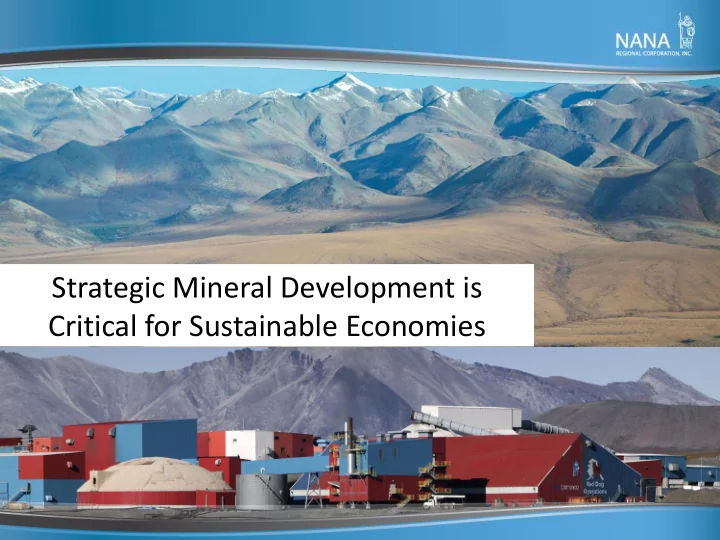
Strategic Mineral Development is Critical for Sustainable Economies - - PowerPoint PPT Presentation
Strategic Mineral Development is Critical for Sustainable Economies HR 4402 passed 256-160 in July, 2012 Requires the Department of the Interior and the Department of Agriculture to more efficiently develop domestic sources of strategic and
Requires the Department of the Interior and the Department of Agriculture to more efficiently develop domestic sources of strategic and critical minerals and mineral materials; including rare earth elements.
Defines strategic and critical minerals as those that are necessary:
1. For national defense and national security requirements;
capacity, electrical power generation and transmission, and renewable energy production;
telecommunications, healthcare and transportation infrastructure; and
4. For the Nation’s economic security and balance of trade.
– i.e. Salt (coins were made of salt) – China imposed a tax on Salt in 2200 B.C.
for the empire
scarcity?
– Population; developing countries are growing – Food security; Asian countries are investing around the world in arable land
2B people have risen out of poverty in Asia in the last 20 years = more consumption UNEP
Developing countries – The world is becoming Asia centric
UNEP
1 2 3 4 5 6 00 01 02 03 04 05 06 07 08 09 10 11 USA Europe Japan China ROW
Source : ILZSG
up 117% since 2000
growth engine up 272% since 2000
consumption has rebounded from 2009 levels - up 7% in the Americas and 30% in Europe
B A S E M E T A L M A R K E T S – Z I N C
Million tonnes
Today China only galvanizes 4% of its crude steel, US galvanizes 18% of its crude steel
Source: ILZSG, ICSG
35% global share of wire rod production 39% global share
production 39% global share
sheet production copper lead zinc
2001 2011
COPPER Mine 5% 10% #2 Refine 10% 26% #1 Consumption 16% 40% #1 LEAD Mine 20% 50% #1 Refine 18% 44% #1 Consumption 11% 45% #1 ZINC Mine 18% 33% #1 Refine 22% 40% #1 Consumption 17% 43% #1
Invest in countries with resources; regardless of politics Chinese companies have a low cost of capital Unknown ROI metrics China has 26% of all foreign owned US treasury securities and 8% of US public debut
In 2006 China consumed 23%
copper, 41% in 2010 and 55% by 2025. Yet China has 6%
copper reserve. 25% of global Cu supply comes from; Indonesia, Russia, Kazakhstan, Iran and the Democratic Republic of Congo. Wood Mackenzie recognizes in 2000 62%
from Low Risk Countries, by 2020 they estimate 44% will come from low risk countries – thus investing in higher risk countries is more likely.
Minmetals bought Anvil Mining's copper deposit in the DRC for $1.3B. CITIC’s iron project in western Australia went from $2.5B initially to $8.0B in August 2012. Looking ahead investment may not be as aggressive and will have greater due-
knows?!
US Foreign Dependence/China % of global consumption
73% (5% of global reserve)/ 43% 35% (5% of global reserve)/ 40% 90% / China accounts for 55% of global refinery production 75% (<1% of global reserve)/?? 18% (recycled lead is 91% of US consumption)/ 45% US imports basically all primary lead
Strategic Mineral Development = Sustainable Economy
4.4% (2010) of global zinc mine production 73 % (2010) of US zinc mine production ~25% of Alaska’s export in 2010 was due to Red Dog ~49% - 60%+ of Alaska’s mineral export in recent years 600 + Family- supporting jobs
in total 7(i) payments since mining began through FY ‘12
Helping All of Alaska
Nearly 50 years of on and off exploration for polymetallic deposits 15 years of community engagement and sporadic mineral exploration activity NANA - NovaCopper venture
NANA/NC
keep the cost of living down in the villages
AKDOT
AKDOT