
SLIDE 1
Foundations of Language Science and Technology Introduction
Alexander Koller October 24, 2008 based in part on slides by Hans Uszkoreit
Foundations of Language Science and Technology Introduction - - PDF document
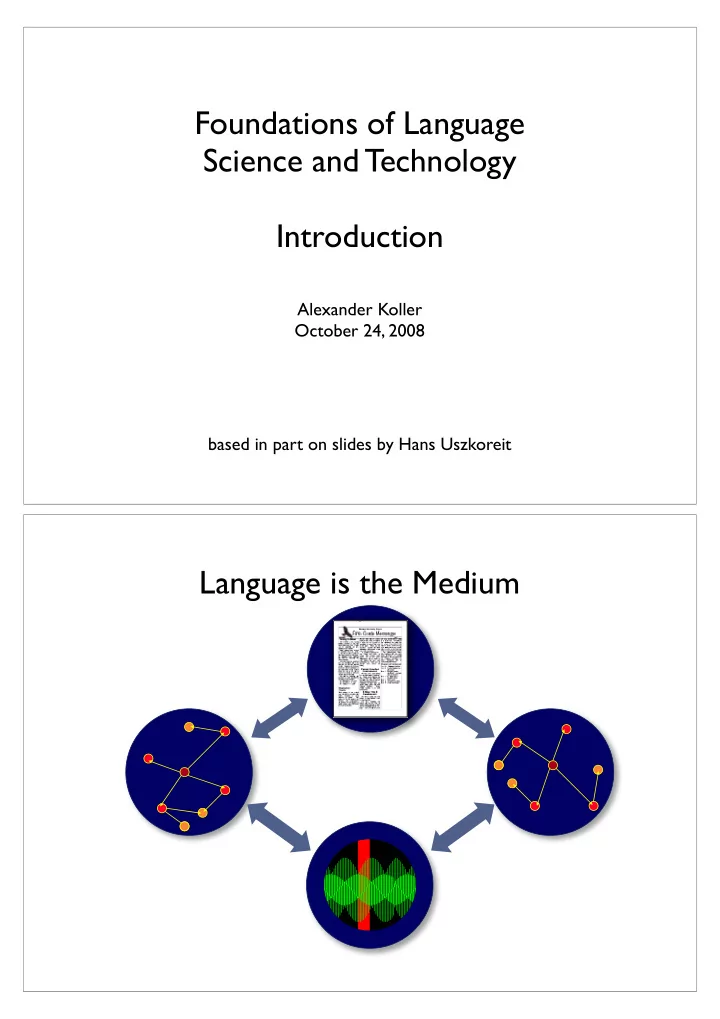
Foundations of Language Science and Technology Introduction Alexander Koller October 24, 2008 based in part on slides by Hans Uszkoreit Language is the Medium What happens in between? semantics/pragmatics S VP NP NP V NP Det N A N
Alexander Koller October 24, 2008 based in part on slides by Hans Uszkoreit
N NP A N Det V VP NP S Sue gave Paul an old penny. NP
sound waves concepts grammar
phonology/morphology semantics/pragmatics
linguistics computer science computer psychology
CL psycho- linguistics AI
„Früher stellten die Frauen der Inseln am Wochenende Kopftücher mit
in the past produced the women of the islands on the weekends scarves with
Blumenmotiven her, die ihre Männer an den folgenden Montagen auf dem
floral patterns that their husbands on the following Mondays on the
Markt im Zentrum der Hauptinsel verkauften.“
market in the center of the main island sold.
The sentence exhibits a total of 13 lexical, syntactic, and referential ambiguities. 2 x 2 x 2 x 3 x 3 x 2 x 4 x 2 x 4 x 2 x 2 x 7 x 2 = 258,048 readings
(Hans Uszkoreit)
acoustic form written form morpho-phonological representation phonetic or graphemic representation syntactic representation semantic representation representation of the full meaning phonetic processing
morpho-phonological processing syntactic processing (parsing) semantic construction pragmatic processing / knowledge processing
acoustic form written form morpho-phonological representation phonetic or graphemic representation syntactic representation semantic representation representation of the full meaning phonetic processing
morpho-phonological processing syntactic processing (parsing) semantic construction pragmatic processing / knowledge processing
acoustic form written form morpho-phonological representation phonetic or graphemic representation syntactic representation semantic representation representation of the full meaning phonetic processing
morpho-phonological processing syntactic processing (parsing) semantic construction pragmatic processing / knowledge processing
two readings each that can be combined freely.
growth of number of readings with number
10 20 30 40 50 2^n n n^2 n^3
sentence length runtime (log scale) 100 msec 1 sec 1 hour 1 day 1 year (Assumption: One parse per millisecond.)
Typ 3 Typ 2 Typ 1 Typ 0 r.e.l. cfl rl csl
natural languages: just beyond context-free
Chomsky Hierarchy: type 0: recursively enumerable type 1: context-sensitive type 2: context-free type 3: regular languages
T: Drew Walker, NHS Tayside's public health director, said: "It is important to stress that this is not a confirmed case of rabies." H: A case of rabies was confirmed.
Given a pair of sentence, decide whether second “follows from” first.
T: About two weeks before the trial started, I was in Shapiro's office in Century City. H: Shapiro works in Century City.
YES NO
written form morpho-phonological representation phonetic or graphemic representation syntactic representation semantic representation representation of the full meaning
morpho-phonological processing syntactic processing (parsing) semantic construction pragmatic processing / knowledge processing
... then compare them.
contain entries for unseen words.
all the formalized knowledge we need for semantic inferences.
and almost necessarily incomplete.
T: About two weeks before the trial started, I was in Shapiro's
H: Shapiro works in Century City.
YES
T: About two weeks before the trial started, I was in Shapiro's
H: Shapiro works in Century City.
Let’s just count word overlap! 80% overlap On RTE-3 data, this test gives the correct answer in 60% of cases.
T: Drew Walker, NHS Tayside's public health director, said: "It is important to stress that this is not a confirmed case of rabies." H: A case of rabies was confirmed.
Shallow processing doesn’t always get it right.
T: Drew Walker, NHS Tayside's public health director, said: "It is important to stress that this is not a confirmed case of rabies." H: A case of rabies was confirmed.
YES 83% overlap (but should be NO)
acoustic form written form morpho-phonological representation phonetic or graphemic representation syntactic representation semantic representation representation of the full meaning phonetic processing
morpho-phonological processing syntactic processing (parsing) semantic construction pragmatic processing / knowledge processing
(l) The student will read the paper. (/rid/) (2) The students have read the paper. (/rd/) (3) Will the students read the paper? (/rid/) (4) Have the students read the paper? (/rd/) (5) Have the students who will arrive next week read the paper yet? (/rd/) (6) Have any citizens of good will read the paper? (/rd/) (7) Please have the students read the paper. (/rid/)
many applications, and we lack resources.
faster and doesn’t care about ambiguity, but suffers from uninformative analyses.
shallow processing more informed; combine them.
can understand it in real time.
almost never notice it.
“The canoe floated down the river sank.” (vs. “The clothes put on the rack smelled.”)
master a language.
constitute the grammar of a language
human language use (production and comprehension).
brain in a real communicative situation.
(speech errors, grammar errors)
(communication with non-native speakers, children)
(preferences in generation)
(garden-path sentences)
(efficiency and control flow)
(dependence on other cognitive efforts)
robustness, world knowledge.
Computational Linguistics ?
Spin-off companies e.g. Computer Science Max Planck Institutes Languages Psychology