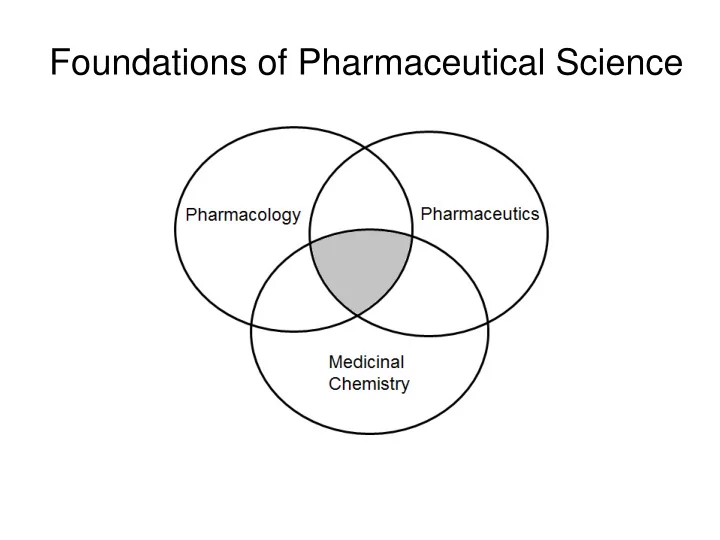
Foundations of Pharmaceutical Science Foundations of Pharmaceutical - - PowerPoint PPT Presentation

foundations of pharmaceutical science foundations of
SMART_READER_LITE
LIVE PREVIEW

Foundations of Pharmaceutical Science Foundations of Pharmaceutical - - PowerPoint PPT Presentation

Foundations of Pharmaceutical Science Foundations of Pharmaceutical Science (Hass, Voigt, Balaz) (Voigt) (Hass, Cen) Medicinal Chemistry Discipline of chemistry focused on the influence of chemical structure on the delivery and


slide-1
SLIDE 1

Foundations of Pharmaceutical Science

slide-2
SLIDE 2

Foundations of Pharmaceutical Science

(Voigt) (Hass, Voigt, Balaz) (Hass, Cen)

slide-3
SLIDE 3

Medicinal Chemistry

Discipline of chemistry focused on the influence of chemical structure on the delivery and pharmacological activity and metabolism of drug molecules Related Disciplines:

  • Organic Chemistry
  • Biochemistry
  • Pharmacology
  • Pharmaceutics
slide-4
SLIDE 4

Medicinal Chemistry

Organic Chemistry

  • Drug Structure (Functional Groups, Stereochemistry,

Physiochemical Properties)

  • Structure-Activity Relationships
  • Drug Design and Development

Biochemistry

  • Drug Transport
  • Enzymes and Enzyme Activity
  • Endogenous Compounds
slide-5
SLIDE 5

Pharmacology (Pharmacodynamics)

  • Drug-Receptor Interactions and Signal Transduction
  • Dose-Response (Potency, Efficacy)
  • Mechanism of Action

Pharmaceutics (ADME; Pharmacokinetics)

  • Drug administraton and absorption
  • Drug distribution
  • Drug metabolism and excretion
slide-6
SLIDE 6

Bioavailability

  • The extent (how much) and the rate (how fast) that the

active drug or drug metabolite reaches the systemic circulation/target site of action. action.

  • Factors influencing bioavailability
  • Drug structure/physiochemical properties
  • Mode of administration
  • Formulation
  • Drug/food interactions
  • Disease state
  • Individual metabolic differences
slide-7
SLIDE 7

Chemical Structure & Pharmacologic Activity

Pharmacophore

The minimum structural elements, functional groups and 3D arrangement of a compound necessary to cause a biological response Non-essential parts of the molecule are referred to as auxophore(s) Pharmacophore revealed through systematic structural modification and pharmacologic testing

slide-8
SLIDE 8

N OH OH H3C

Levorphanol (morphinan)

HO N O OH OH H3C

Morphine

remove dihydrofuran (analgesic, addictive)

(4X more potent analgesic, retains addictive properties)

N OH H3C

Benzomorphan

remove cyclohexene

(less potent than morphine but also less addictive)

N H3C

Meperidine

(10-12% less potent than morphine but also less addictive)

O OCH2CH3 remove cyclohexane

slide-9
SLIDE 9

Influence of Drug Structure

Physiochemical properties of drugs refers to the influence of functional groups on: polarity ionization solubility molecular shape These factors influence pharmacokinetics and pharmacodynamics

slide-10
SLIDE 10

Drug Polarity

Polarity of a drug refers to the extent of charge separation in a molecule.

  • Factors that decrease polarity (lipophilic)

– Hydrocarbon elements

  • Factors that increase polarity of a drug include:

(hydrophilic) – Formal charges (ionization) – Polar covalent bonds – Lone pair electrons – Hydrogen bonding

slide-11
SLIDE 11

Drug Polarity

N N N H O O OH N H N O S O OH

Apalicillin (antibacterial)

lipophilic region hydrophilic region

Both lipophilic and hydrophilic regions are present within most drug molecules

slide-12
SLIDE 12

Drug Polarity

N O OCH3 CH3

Femoxetine

δ+ δ− δ−

δ−

δ−

Polar covalent bonds and lone pair electrons contribute to drug polarity

slide-13
SLIDE 13

Drug Polarity

Ionizable functional groups have the potential of contributing to polarity by generating a formal charge

N N N H O O OH N H N O S O OH

Apalicillin (antibacterial)

O O R ionizable functional group

slide-14
SLIDE 14

Drug Polarity

Substituents can influence pKa and ionization

O O H EWG EWG = electron-withdrawing group (i.e., nitro)

δ+

O O EWG

δ+

EWG: Stabilizes conjugate base increases Ka, decreases pKa decrease electron density around ring by resonance or inductive effects O O H EDG EDG = electron-donating group (i.e., halogens)

δ−

O O EDG

δ−

EDG: Destabilizes conjugate base decreases Ka, increases pKa increase electron density around ring by resonance or inductive effects

slide-15
SLIDE 15

Drug Polarity

Hydrogen bonding

H-bonds are weak interactions that occur between a H atom (bonded to an electronegative element) and the lone pair electrons

  • f another atom within the same molecule (intramolecular) or

another molecule (intermolecular).

O O O O CH3 H intramolecular H-bond intermolecular H-bond O O O O CH3 H O O O O CH3 H

slide-16
SLIDE 16

Polarity and Non-Covalent Bonding Interactions

  • Non-covalent interactions are weak interactions

between functional groups of like polarity within (intra) or between (inter) molecules

  • Types of non-covalent interactions include:

– H-bonds – Dipole-dipole – Ion-dipole – Hydrophobic Interactions

slide-17
SLIDE 17

Polarity and Non-Covalent Bonding Interactions

Cl O N

Toremifene

δ+ δ+ δ− δ− δ−

Cl O N

δ+ δ+ δ− δ− δ−

Dipole-Dipole

H3CO OCH3 O H3C O O OCH3 δ+ δ− δ− folding

Intermolecular Intramolecular

slide-18
SLIDE 18

Polarity and Non-Covalent Bonding Interactions

O CH3 O N H3C H3C CH3

δ− δ− δ+

O CH3 O N H3C H3C CH3

δ− δ− δ+

Ion-Dipole

O CH3 O N H3C CH3 CH3

δ− δ+

Intermolecular Intramolecular

slide-19
SLIDE 19

Polarity and Non-Covalent Bonding Interactions

H2N H N OH O O H2N H N OH O O

Hydrophobic

H2N NH O O OH

Intermolecular Intramolecular

slide-20
SLIDE 20

Polarity and Water Solubility

O CH3 O N H3C H3C CH3

δ− δ− δ+

O H H H O H H O H

δ+ δ−

Hydrogen bonding and ion-dipole bonding contribute to water solubility Intermolecular H-bonding between drug functional groups and water increases water solubility Intramolecular H-bonding or ion dipole bonding within a drug does not allow solvation by water and diminishes water solubility

O CH3 O N H3C CH3 CH3

δ− δ+

slide-21
SLIDE 21

Molecular Shape

O O H

A B C

Receptor

Specific functional groups on drug bind to specific sites on receptor. Groups must be oriented properly to accommodate specific binding

slide-22
SLIDE 22

Molecular Shape

  • Spatial arrangement of functional groups

influences physiochemical properties of drugs

  • Isomers, molecules with the same molecular

formula but different structural arrangement of atoms, have different physiochemical and pharmacologic properties

slide-23
SLIDE 23

Isomers

Drug isomers have the same molecular formula with a different arrangement of atoms

Isomers Constitutional Configurational Skeletal Positional Functional group Conformational Stereoisomers Enantiomers Diastereomers

slide-24
SLIDE 24

Stereochemistry

  • Two general types of stereoisomers:

– Configurational: same structural formula except different arrangement of atoms around a chiral element in the molecule (enantiomers, diastereomers, cis/trans isomers) – Conformational: same structural formula different spatial arrangements due to rotation around sigma bonds

slide-25
SLIDE 25

Stereochemistry

Configurational Diastereomers Enantiomers Conformational Stereoisomers

slide-26
SLIDE 26

Geometric Isomers

O H A H H C B A B C O H A B C H H A B C

Differences in 3D orientation of functional groups results in different receptor binding

A C A C H H A C A H H C

(cis/trans; E/Z; syn/anti)

slide-27
SLIDE 27

Enantiomers

  • Non-superimposable mirror image isomers that arise due to the

chirality of an atom or of the overall molecule. Referred to as R/S, D/L or d/l (dextro/levo) isomers

  • Enantiomers have identical physical properties (i.e., energy, boiling

point, melting point, densities, etc.) except that they rotate the plane

  • f polarized light in different directions.
  • Enantiomeric drugs do not necessarily have the same biological

activity, and often have very different biological activity.

  • Many drugs are sold as racemic mixtures. Racemic mixtures are

50:50 mixtures of enantiomers. FDA requires that individual enantiomers be separated and tested for biological activity even if the drug is to be sold as a racemate.

slide-28
SLIDE 28

Enantiomers

  • d- Propoxyphene (DARVON) and l- propoxyphene (NOVRAD) are

enantiomers

  • The d- isomer (trade name DARVON) is a narcotic analgesic. Its l-

enantiomer is NOVRAD which is an antitussive agent (cough suppressant)

O O O N O N (+) propoxyphene (DARVON) (-) levopropoxyphene (NOVRAD)

slide-29
SLIDE 29

Enantiomers

A B C A B C D A B C B A D C

Differences in 3D orientation of functional groups around chiral center results in different receptor binding and different pharmacological activity

slide-30
SLIDE 30

Diastereomers

  • Diastereomers are non-superimposable, non-mirror

image stereoisomers.

  • Diastereomers arise in molecules with more than one

chiral center or chiral element

  • Diastereomers have different physical properties and

different pharmacological activity

slide-31
SLIDE 31

Enantiomers & Diastereomers

N H O O N O O HO

Enalapril (antihypertensive)

* * * N H O O N O O HO

enantiomer of enalapril

N H O O N O O HO

diastereomer of enalapril

Molecules with more than one chiral center can have both enantiomers and diastereomers.

slide-32
SLIDE 32

Conformational Isomers

  • Conformers are isomers which arise due to

rotation about a carbon-carbon single bond.

  • Rotation around carbon-carbon single bonds

may occur without any breaking of covalent bonds.

  • Some conformers or conformational isomers

may experience unfavorable interactions which give rise to higher energy conditions.

slide-33
SLIDE 33

Conformational Isomers

C C H H 3C H H H H C C H H H H CH 3 H

slide-34
SLIDE 34

Conformational Isomers

X C Z Y A B A B C B C Z Y X A A B C

slide-35
SLIDE 35

Conformational Isomers

O H H H H O CH3 N H H N O O CH3 H H Ester-binding site Hydrophobic binding site Anionic-binding site Ester-binding site Hydrophobic binding site Anionic-binding site

Acetylcholine conformers

slide-36
SLIDE 36

Structure Activity Relationships (SAR)

  • Structurally specific drugs (majority)

– act at a specific target site such as a receptor or enzyme to produce a biological effect – modification of structure gives rise to modification in activity (SAR)

  • Structurally nonspecific drugs

– no specific site of action – less dependence of activity on specific drug structure

slide-37
SLIDE 37

Drug Discovery

Structure Modification

O H OH C CH O CH3 CH3 O CH3 progesterone norgestrel HO OH C CH 17α-ethynyl estradiol HO OH H estradiol

Endogenous Synthetically Modified

Highlighted portions of molecules illustrate auxophores

slide-38
SLIDE 38

Structure Activity Relationships (SAR)

OH O O OAc OH O AcO O O OH NH O

paclitaxol

A B C D E F G H I J A N-acyl group required F Change of stereochemistry or esterification does not change activity B Phenyl or analog required G Oxetane or other small ring required for activity C Free hydroxyl or hydrolyzable group required H Removal of acetoxy reduces activity; other acyl analogs have improved activity D Acetoxy may be removed w/out loss of activity I Acyloxy required; substituted benzyloxy improves activity E Reduction of ketone improves activity slightly J Removal of hydroxyl reduces activity slightly

slide-39
SLIDE 39

Qualitative and Quantitative SAR

  • Structural Modification of Lead Compounds

(Qualitative SAR)

– Homologation – Chain branching – Ring/chain transformations – Positional isomerization – Bioisosterism (“functional group equivalents”)

  • Structural modification results in changes to

pharmacodynamics (affinity, efficacy, potency) and pharmacokinetics (ADME)

slide-40
SLIDE 40

Structural Modification of Lead Compounds

Homologation

  • Homologation refers to

progressive increases in hydrocarbon chain length (-CH2 units; methyl, ethyl, propyl, etc)

  • General trend is an increase

followed by a decrease in activity that correlates with lipophilicity (log P)

  • Increase in activity correlates

with greater bioavailability. Decrease in activity occurs when reduced water solubility interferes with transport in aqueous media or formation of micelles

1 2 3 4 5 6 7 8 9 10 11 12

Hydrocarbon chain length activity

micelle

slide-41
SLIDE 41

Structural Modification of Lead Compounds

Homologation

R OH OH

4-Alkylresorsinol antibacterial activity R = n-propyl (5%); n-butyl (22%); n-pentyl (33%); n-hexyl (51%); n-heptyl (30%); n-octyl (0%)

slide-42
SLIDE 42

Structural Modification of Lead Compounds

Chain Branching

  • Branching imposes

steric changes that affect receptor binding

  • Chain branching in the

aminoalkylphenothiazines promethazine and promazine results in binding to different receptors

N S N N S N

1 2 3 1 2 3

branched straight chain promethazine promazine ANTIPSYCHOTIC ANTIHISTAMINE

slide-43
SLIDE 43

Structural Modification of Lead Compounds

Ring Chain Transformations

  • Ring chain

transformations generally provide conformational rigidity (in the ring) and conformational flexibility (in the chain)

  • Ring structures in

local anesthetics enhance binding at active sites in the receptor by “holding” groups in place

N N CH3 CH3 CH3 CH3 N H O N

Ring Chain

CH3 CH3 N H O N H3C

Chain Lignocaine Mepivacaine Isogramine Lipophilic Dipole Anionic

slide-44
SLIDE 44

Structural Modification of Lead Compounds

Positional Isomerization

  • Altering the position of

functional groups modifies receptor binding and changes pharmacokinetics

  • Replacement of the

cathechol moeity of adrenergic agents with a resorcinol moeity enhances selectivity for β2- adrenergic receptors

  • Resorcinol derivatives

have longer duration

  • f action since the

COMT enzyme does not metabolize these compounds

HO HO NHR OH

Norepinephrine R = H Epinephrine R = CH3

cathechol COMT (catechol O-methyltransferase)

H3CO H3CO NHR OH HO NH OH OH

Metaproterenol

resorcinol COMT (catechol O-methyltransferase)

X

H3CO NH OH OCH3

slide-45
SLIDE 45

Structural Modification of Lead Compounds

Bioisosterism

  • Bioisosteres are substituents or functional

groups with steric and electronic similarities that produce broadly similar biological properties

  • Two types of bioisosteres

– Classical isosteres – Non-classical isosteres

slide-46
SLIDE 46

Structural Modification of Lead Compounds

Bioisosterism

slide-47
SLIDE 47

Structural Modification of Lead Compounds

Bioisosterism

  • Non-classical

Isosteres

– substitution of substituents with groups not defined by classical isosteric terms but still bear steric and electronic similarities

slide-48
SLIDE 48

Quantitative Structure Activity Relationships

  • Electronic effects (Hammett equation)

– assigns value (σ) to substituents to account for electron donating/electron withdrawing character of substituents based on inductive and resonance effects

  • Lipophilicity and partition coefficient (Hansch

equation)

– assigns value (P) to molecules to account for lipophilic character

  • Steric Effects (Taft Equation)

– assigns value (E) to substituents to account for steric effects

slide-49
SLIDE 49

Quantitative Structure Activity Relationships

Electronic effects (Hammett equation)

EWD = electron-withdrawing group EDG = electron-donating group Electronic Effects Resonance effects

  • alters electron density via

delocalization of pi electrons

Inductive Effects

  • alters electron density based on

differences in electonegativity (EN)

EWG

  • atom directly bonded to parent

part of another pi system

EDG

  • atom directly bonded to parent

has lone pair

EWG

  • atom directly bonded to parent more EN
slide-50
SLIDE 50

Quantitative Structure Activity Relationships

Electronic effects (Hammett equation) Both inductive and resonance effects contribute to a substituent’s ability to be an EDG or EWG.

H3CO R R OCH3 H3CO R R OCH3

para meta

H3CO R R OCH3 δ− δ+ δ+ δ− RESONANCE INDUCTION

slide-51
SLIDE 51

Quantitative Structure Activity Relationships

Electronic effects (Hammett equation)

  • For meta and para

substituted benzoic acids, Hammett showed a linear relationship between the ED-ability/EW ability of a substituent and the Ka of the acid (ortho- skewed by steric effects and does not correlate)

log Ka log k p-NO2 m-NO2 m-Cl p-Cl p-F m-CH3

  • -NO2
  • -Cl
  • -F

p-OCH3

log ks log k0

= σρ

σ = electronic parameter (substituent) ρ = reaction constant

ks = rate of ionization for substituent k0 = rate of ionization for H

slide-52
SLIDE 52

Quantitative Structure Activity Relationships

Electronic effects (Hammett equation)

  • The σ values are

used to predict electron-donating and electron- withdrawing character of substituents in drugs

  • The σmeta values

follow inductive trend; σ para follow resonance trend

  • Values are additive

and constitutive

Substituent Abbreviation σ meta σ para acetamido- AcNH- 0.21

  • 0.01

acetoxy- AcO- 0.39 0.31 acetyl- Ac- 0.38 0.50 amino- NH 2-

  • 0.16
  • 0.66

bromo- Br- 0.39 0.23 tert-butyl- (CH 3)3C-

  • 0.10
  • 0.20

chloro- Cl- 0.37 0.23 cyano- NC- 0.56 0.66 ethoxy- EtO- 0.10

  • 0.24

ethyl- Et-

  • 0.07
  • 0.15

fluoro- F- 0.34 0.06 hydrogen H- 0.00 0.00 hydroxy- HO- 0.12

  • 0.37

methoxy- MeO- 0.12

  • 0.27

methyl- Me-

  • 0.07
  • 0.17

nitro- NO2- 0.71 0.78 phenyl- Ph- 0.06

  • 0.01

trifluoromethyl F3C- 0.43 0.54 trimethylamino- (CH 3)3N +- 0.88 0.82

slide-53
SLIDE 53

Quantitative Structure Activity Relationships

Lipophilicity and Partition Coefficient

  • Partition

coefficient (lipophilicity) can be correlated with biological activity

  • Three models

– linear – parabolic – bilinear

l

  • g

1 / B R log P

  • 4

4

  • 2

2 4

  • 4
  • 2

2

slide-54
SLIDE 54

Quantitative Structure Activity Relationships

Lipophilicity and Partition Coefficient (Hansch)

  • Lipophilic character of

specific substituents can be determined and correlated with the partition coefficient

  • The value π is used to

indicate lipophilic character of specific substituents

Substituent π

H 0.00

  • CH 3

0.56

  • CH 2CH 3

1.02

  • CH 2CH 2CH 3

1.55

  • C(CH 3)3

1.53

  • OCH 3
  • 0.02
  • NH 2
  • 1.23
  • F

0.14

  • Cl

0.71

  • Br

0.86

  • I

1.12

  • CF3

0.88

  • OH
  • 0.67
  • COCH 3
  • 0.55
  • NHCOCH 3
  • 0.97
  • NO2
  • 0.8
  • CN
  • 0.57
slide-55
SLIDE 55

Quantitative Structure Activity Relationships

Lipophilicity and Partition Coefficient (Hansch) equation)

The partition coefficient (lipophilicity) of a compound can be calculated from π values of its substituents

diethylstibestrol OH HO

log P = 2πCH3 + 2πCH2 + πCH=CH + 2logPPhOH = 2(0.50) + 2(0.50) + 0.69 + 2(1.46) = 5.61 Experimental log P = 5.07

slide-56
SLIDE 56

Quantitative Structure Activity Relationships Steric Effects (Taft Equation)

  • Taft Equation
  • Es represents the steric contribution of a particular group based
  • n rates of hydrolysis α-substituted acetates

Es = logkxCO2Me – logkmethyl acetate

H3C O O CH3

H+ H2O

H3C O OH

+ HOCH3

X O O CH3

H+ H2O

X O OH

+ HOCH3 k = rate constant for acid catalyzed hydrolysis

slide-57
SLIDE 57

Quantitative Structure Activity Relationships Steric Effects (Taft Equation)

N H N CH3 CH3 Cl S(+)-dexchlorpheniramine N H Cl N CH3 CH3 R(-)-dexchlorpheniramine

The S-enantiomer is 200 times more potent than the R as 1H receptor antagonist.

How does changing the sterics affect potency?