Mineral Commodities Ltd MARKET CAPITALISATION Mineral Commodities - - PowerPoint PPT Presentation

mineral commodities ltd
SMART_READER_LITE
LIVE PREVIEW

Mineral Commodities Ltd MARKET CAPITALISATION Mineral Commodities - - PowerPoint PPT Presentation

SHARES ON ISSUE 421,091,571 PERFORMANCE RIGHTS 2,800,000 Mineral Commodities Ltd MARKET CAPITALISATION Mineral Commodities Ltd (MRC) is an ASX listed (ASX: MRC) diversified mining, A$73.7m at A$0.175 development and exploration company based


slide-1
SLIDE 1

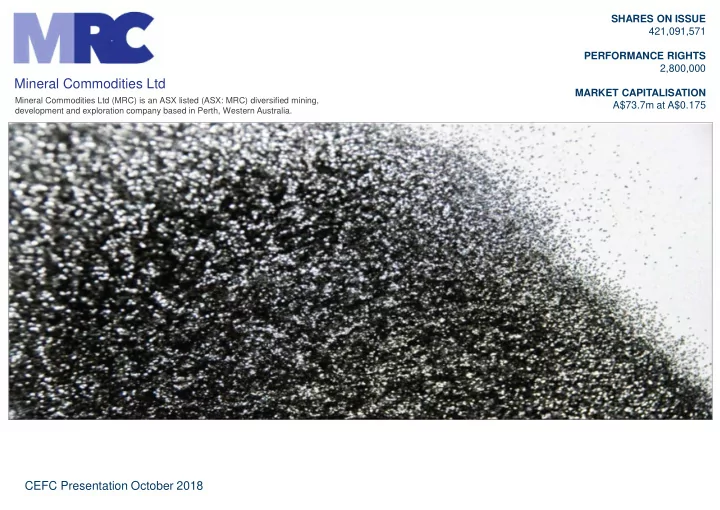
Mineral Commodities Ltd (MRC) is an ASX listed (ASX: MRC) diversified mining, development and exploration company based in Perth, Western Australia.

Mineral Commodities Ltd

CEFC Presentation October 2018

SHARES ON ISSUE 421,091,571 PERFORMANCE RIGHTS 2,800,000 MARKET CAPITALISATION A$73.7m at A$0.175

slide-2
SLIDE 2

| 2

Introduction to

4

  • Mineral Commodities Ltd (MRC) is an ASX listed (ASX: MRC) diversified mining, development and exploration company based in Perth,

Western Australia.

  • MRC have operations/projects in South Africa, Iran and Australia. The Tormin, South Africa mine currently has the highest grade mineral

sands in the world. This is in addition to a Western Australian exploration prospects portfolio of lithium, gold, copper, iron ore and vanadium.

  • The company has a highly experienced executive management team with over 155 years of combined mining experience.

Mineral Commodities Ltd - Munglinup Graphite Project

2017 Results:

slide-3
SLIDE 3

| 3

Munglinup Graphite Project

43.3%

Of global battery anode material is sourced from natural graphite

Downstream opportunities:

  • Graphene production
  • Expandable graphite
  • Battery Anode Materials
  • High purity graphite (e.g. for

lubricants, alkaline batteries)

Graphite Market

The boom in battery energy capacities stimulates further growth in the graphite market with increases in demand for lithium-ion batteries.

Current global graphite production is 1.2 million tonnes per annum

US$17 billion by 2020

54.8 ktpa

Graphite Concentrate produced

9-15%

Annual global demand increase for lithium-ion batteries

Total project cost: AUD $52M

Targeting over 90% renewable energy powered processing operations

120 construction jobs 100 ongoing jobs

Completing the loop

Australia will become the first jurisdiction globally to produce all elements required for the production of batteries

HEV mining fleet

Mineral Commodities Ltd - Munglinup Graphite Project

1.09 million tonnes CO2 savings

Per annum, Per 500,000 Electric Vehicles produced*

slide-4
SLIDE 4

| 4

Munglinup Graphite Project Overview

Project Overview

Project

The Munglinup Graphite Project will consist of the development of open pit-based graphite operations and associated high- value processing near Esperance in W.A. The project involves development of several small open pits with a subsequent high-value down-stream processing through a flotation plant to concentrate graphite ores. The mining lease is granted until 2031 on a designated mining reserve. Initial mine life has been calculated to be 9 years with expectations to exceed 20 years.

Location

Project is located 105 km west by sealed road from port of Esperance. Process water is available on site, grid power and South Coast Highway are within kilometres of the deposit. Water demands are estimated to average 1m3/t mill feed, under 14 litres per second.

Operations

High-value downstream processing occurs through a multi-cleaner flotation plant with a scrubber front end, a rougher, and attritioning between each cleaning stage. Nominal throughput of 400ktpa will produce an average of 54.8ktpa of high-value, high-purity graphite concentrate. (Measured and indicated resource of 3.6Mt at 15.3% Total Graphitic Carbon (TGC) (10% cut-off). Proved and probable reserve of 3.4Mt at 15.9% TGC). Processing plant operations targets the utilisation of over 90% renewable energy in the form of a 1.8MW solar array, wind turbines, and co-generated by diesel and/or flow battery as required.

Environment

Project has low environmental impact with no long term hazardous waste or acid, no toxic metals, and small environmental footprint.

Mineral Commodities Ltd - Munglinup Graphite Project

slide-5
SLIDE 5

| 5

Pre-feasibility Study Outcomes

(1) Refer to ASX release of 30 May 2018 (2) Discount rate of 8% real after tax (3) Includes 15% EPC Costs (A$5.5m), 15% Contingency ($6m) and all owners costs (A$3m). (4) Basket price of US$989/t used in PFS (refer to ASX release of 30 May 2018)

A$139m

Post -t ax NPV(1)(2)

48%

Post -t ax IRR(1)

A$52m

Tot al DEV CAPEX(1)(3)

2 years

Capit al PAYBACK PERIOD(1)

9 years

MINE LIFE(1)

54,800t

Average ANNUAL CONC. PRODUCTION(1)

A$47.5m

Average ANNUAL EBITDA

A$531/t

Average OPERATING CASH COST(1)

0.00% 5.00% 10.00% 15.00% 20.00%

Grade (% TGC)

Resource Grade (% TGC)

50 100 150 200 250 300

US$m

Capex (US$m)

Source: published company data

100 200 300 400 500 600

US$

Opex (US$/t)

Mineral Commodities Ltd - Munglinup Graphite Project

Prefeasibility for the project has been completed and indicates a low capital, and low operating cost model in the first quartile to produce 54,800tpa of high quality graphite over 9 years initial mine life, with expectations of mine life to exceed 20 years.

slide-6
SLIDE 6

| 6

Munglinup Graphite Project - Benefits

Short term

Project Benefits

Industry Operational

Targets of 90% renewable energy powered minerals processing Job creation ATSI support Mobilising Australia’s investment in energy efficiency

Graphite = High efficiency materials

  • Reducing energy consumption
  • Graphite foil • Graphene

Graphite = LiB anode

  • Growing EV market
  • Stationary storage growth • Offset

peak grid-energy demand (duck curve) = Lower consumer costs.

Reduced global reliance on synthetic graphite

≈ 100 direct FTEs Targets of above 95% local community employees ATSI-led Heritage Preservation Plan Risk management & mitigation

Low environmental impact operations

≈ 120 construction jobs

Mineral Commodities Ltd - Munglinup Graphite Project

slide-7
SLIDE 7

| 7

Munglinup Project’s Wider Industry Contribution

‘The largest source of carbon footprint for lithium batteries occurs in the production and transport’

  • The Munglinup processing plant targets to be powered by over 90%

renewable energy. Localised production of Graphite will also dramatically reduce supply chain costs for domestic and regional markets. ‘On average, the Australian mining sector consumes 10% of Australia’s energy’

  • The Munglinup Project will be relying on renewable energy to power

its operations in addition to a hybrid-electric mining fleet. This will further promote the uptake of renewable energy into mining

  • perations, minimising energy use and reducing total carbon

footprint. Munglinup will provide a domestic solution to the growing lithium-ion battery market Munglinup will be a vertically integrated graphite mining and processing plant. Munglinup will establish Australia as a leader in the international battery supply chain. ‘Graphene has high industry innovation potential due to its capabilities to produce flexible materials as a transparent conductive oxide’

  • MRC will collaborate with the University of Adelaide with proof of

concept works and scale up test works are due in 2019. The project scope includes evaluating a range of usage methods for graphene and associated production methodologies

Mineral Commodities Ltd - Munglinup Graphite Project

slide-8
SLIDE 8

| 8

Munglinup Project Timeline

2017 Q3 Q4

Signed JV

MRC Executed Joint Venture with Gold Terrace 20 November 2017

01

2018 Q1 Q2 Q3 Q4

Pre-Feasibility Study

Completed May 2018

02

2019 Q1 Q2 Q3 Q4

Feasibility Study

Completed December 2018

03

Construction

Plant Construction and Earthworks Q1 2019

04

Finance Funding/Offtake Negotiations

Q2 2018

Today

Q3 2018 Commenced June 2018 - Ongoing Submission of EP Act & EPBC Act Referral

Commissioning

Proposed Commissioning of Plant Q4 2019

05

Mineral Commodities Ltd - Munglinup Graphite Project

slide-9
SLIDE 9

| 9

Battery compositions

Mineral Commodities Limited - Munglinup Graphite Project Essential components within a Li-ion battery

Anode

Stores and releases lithium ions from the cathode, enabling currents to pass through an external circuit. The anode is predominantly sourced from graphite.

Cathode

Provides the source of lithium ions. The cathode can use a number of materials, and is often composed of Lithium salts in an organic solvent.

Electrolyte

Allows the movement of ions between the cathode and anode. This is made up of different material formulations depending on the required application. Examples include Cobalt, Manganese, Nickel and Iron.

1

2

3

1,000 563

EV battery material consumption

Graphite Lithium Metal

*Quantities represent the total grams of material required to produce each kilowatt/hour of energy in a typical (EV) LiB

Sourcing battery anode material 65%

Natural spherical graphite

30%

Synthetic graphite

5%

Lithium tintate, silicon and tin

Market share based on battery composition

70% =

Market share of Lithium-ion batteries when compared to the wider battery market

slide-10
SLIDE 10

| 10

Graphite Market

Graphite comes in two forms with the combined graphite market worth around

$13 Billion, and forecasted to reach $17 Billion by 2020. The two forms of Graphite include:

► Synthetic Graphite

Manufactured product processed by high temperature treatment of amorphous carbon materials in an energy and time intensive process which requires graphitisation of petroleum coke. Due to Chinese state regulations, synthetic graphite production will be restricted due to its environmental impacts. With this and similar trends likely to continue, the importance and reliance of natural graphite will grow into the future.

► Natural Graphite

Mined resource which is found in three types including Flake, Amorphous and Vein. They are subsequently processed and treated relevant to their applications. Consumption areas for graphite include:

► Refractories ► Foundries ► Batteries ► Lubricants/metallurgy powders ► Building material (flame retardant and temperature regulation) ► High energy electronics (temperature regulation and energy efficiency)

Mineral Commodities Ltd - Munglinup Graphite Project

slide-11
SLIDE 11

| 11

Market Drivers

Technological advancements and the drive towards electrification of cars will see exponential growth in the current graphite market with respect to extensions in battery technology. Demand for spherical graphite will experience rapid growth due to required use in lithium-battery anodes. Furthermore, increasing energy density and reduction of cost will be a significant factor in the future battery market. A rapid growth for graphite demand can lead to supply constraints if supply chain sustainability issues remain unaddressed. The steel industry currently accounts for 70% of refractory consumptions, correspondingly steel and refractories account for 41% of the graphite market. Expandable graphite will also contribute to growing graphite demand due to its varied applications in building materials.

Market Analysis

“World graphite mine production in 2016 totalled 1.2 million tonnes, with forecasted growth to 4 million tonnes per annum to meeting rising steel and battery sector demands.” US Geological Survey, Mineral Commodity Summaries. January 2017.

Currently Germany & the US are the largest importers of graphite, with expected global demand growth driven by national and state policies. Combustion engines will not perform to set targets, meaning a gradual mandatory transition to battery and hybrid vehicles will occur:

  • EU Legislation sets mandatory emission reduction targets which specify CO2 limits per kilometre for all new cars by 2021. The framework

combines CO2 targets for 2025-2030 with a technology neutral incentive mechanism for zero emission (battery powered vehicles) & low- emission vehicles (hybrids).

  • California state regulations including the ZEV requirements, GHG Standards, and recent state commitments of 5 million ZEV (Zero

Emission Vehicles) by 2030, set a market trajectory to full adoption of battery powered vehicles state wide.

Mineral Commodities Ltd - Munglinup Graphite Project

slide-12
SLIDE 12

| 12

Country of graphite processing and production

Market Analysis Electric Vehicles

Forecasted market potential has been quoted to increase 9-15% annually for lithium, this directly contributes to the increased demand on the combined graphite market. Correspondingly, the global market for graphite is predicted to increase at a CAGR of around 6% annually from 2018-2022. The growing market for lithium-ion batteries has stimulated growth and demand for graphite, with expectations of higher production of downstream products such as spherical graphite and battery anode materials.

Battery anode to market Estimates predict 19% of all light vehicles in Australia to be electric by 2037.1 The global uptake of electric cars is predicted to increase to 16% by 2025.2 China will account for 57% of the global EV market by 2020.3

60% 13% 8% 2% 2% 1.7%

Natural graphite

China India Brazil Canada Mozambique Russia 100%

Spherical graphite

China

Mineral Commodities Ltd - Munglinup Graphite Project

  • 1. ‘2018 Electricity Forecasting Insights’ March 2018. Australian Energy Market Operator (AEMO)
  • 2. ‘Global Auto Survey’ August 2018. UBS Asset Management
  • 3. Macquarie Group Asia Research – Electric Vehicles
slide-13
SLIDE 13

| 13

Future Activity Areas

Expandable Graphite Battery Anode Material (BAM) Graphene

Summary

MRC have undertaken preliminary investigation into the development of techniques and supporting infrastructure to produce expandable graphite. This has included:

  • Discussions with University of Adelaide regarding

collaboration to develop new processes for high quality expandable graphite;

  • Collaboration with graphite consultancies, including:
  • Initial test work demonstrating high expansion

volumes of MRC course flakes;

  • Preparation for a PFS, incorporating additional test

work (expansion reagents, purification of coarse flakes and scalability processes) and PFS-level cost estimates; and

  • Discussions with global stakeholders within the

expandable graphite logistics supply chain. Future activity may include:

  • Development of new purification

processing capabilities (R&D) to produce high purity graphite fines;

  • Development of new plant

infrastructure to produce high grade spheroidised graphite;

  • Test work and PFS on purification,

spheronisation and coating;

  • Partnership with major stakeholders

within the battery supply chain (e.g. Panasonic, Samsung). Preliminary research has indicated the viability

  • f transforming Munglinup graphite

concentrate into graphene. Research is continuing on potential end-use applications and assessing the potential to produce functionalised graphene and graphene oxide. MRC will look to develop processes for producing graphene and related products (such as graphene oxide and functionalised graphene) from its graphite concentrates, specifically targeting process routes that can achieve commercial scale production.

Potential

  • utcomes

The development of new infrastructure and capabilities for expandable graphite production will enable MRC to participate in a number of expandable graphite markets. Identified opportunities include:

  • Application within various building materials, as both a

flame retardant and measure for improving temperature regulation and energy efficiency; and

  • Application within high-energy electronics to improve the

regulation of processing temperatures, and hence energy efficiency. Outcomes may include:

  • Establishment of MRC within the

global supply chain for battery development; and

  • Penetration of niche market areas

such as dry lubrication (e.g. for titanium hips). MRC have identified a range of potential downstream applications, including the development of many layer, few layer, pristine and graphene oxide for application within:

  • Electronics;
  • Biomedical products;
  • Energy storage;
  • Coatings; and
  • Composites and construction additives

(green concrete).

The Munglinup Graphite Project not only poses a great opportunity for the Australian graphite and battery industries, it also enables a number

  • f additional market opportunities. These are summarised in the table below.

Mineral Commodities Ltd - Munglinup Graphite Project
slide-14
SLIDE 14

| 14

Alignment to CEFC mandate

Since its inception in 2012, the CEFC has been tasked with increasing the flow of finance into Australia’s clean energy sector, often by providing financial assistance to commercialise renewable energy, energy efficiency or low emissions technologies. By investing in the Munglinup Graphite processing facility, the CEFC will catalyse Australian produced natural flake graphite and set a precedent for renewable- powered mineral processing facilities in Australia, making Australia the first jurisdiction to have all battery material in production.

In turn, this will: Facilitate the growth of renewable energy, energy efficiency and low emissions technologies for electric vehicles and stationery storage; Allow Australia to enter the global battery market as a graphite producer as there are no operational graphite mines in Australia; Trial a sustainable, market-first approach to renewables-based graphite mining operations with low environmental impact; Reduce national and global supply chain reliance on harmful synthetic graphite production, Create operations in the domestic Australian market with local community engagement.

Mineral Commodities Ltd - Munglinup Graphite Project

slide-15
SLIDE 15

| 15

The CEFC Act and Investment Mandate

To achieve complying investment status, the CEFC must only make investments that follow the mandated Investment

  • Constraints. The Munglinup Graphite Project is aligned to these criteria as outlined below.

Investment Constraint Project Alignment

Are in “clean energy technologies” Including businesses that supply goods or services needed to develop or commercialise, or are needed for use in, clean energy technologies Graphite is a building block for many clean energy technologies. For example, high grade spherical graphite is used as the anode component within Li-ion batteries. In addition, the project will look to power its facilities with targets of 90% renewable energy, promoting sustainable manufacturing in Australia. Are not a prohibited technology This project is not captured by section 62 of the CEFC Act as it does not require investment in technology for carbon capture or storage, nuclear technology or nuclear power. Are solely or mainly based in Australia This project is located in the Esperance Shire of Western Australia. MRC have engaged with the Traditional owners of the land and will further train and employ local and Indigenous Australians at the new facility. Take the form of a financial asset MRC will undertake discussions with the CEFC to ascertain the most appropriate structure of debt finance to satisfy both the MRC project, and CEFC investment criteria. Have developed Australian Industry Participation Plans (where applicable) Pending the outcome of project viability discussions, MRC will work collaboratively to develop an Australian Industry Participation Plan prior to any submission for funding. Mineral Commodities Ltd - Munglinup Graphite Project

slide-16
SLIDE 16

| 16

Public Policy Objectives

Emissions Reduction and Environmental Benefits Alignment with project outcomes

Technology expansion and development

Lack of domestic supply for renewable energy materials has contributed to a reliance on higher cost imports. In turn, this has created pricing barriers for Australian participants, and dramatically slowed research and development, commercialisation and market uptake of renewable energy technologies. This project will overcome the above issues by:

  • First project in Australia to provide domestic supply of high grade graphite concentrate;
  • Reducing import related logistics costs; and
  • Making Australia the first geography globally, to possess all required supply chain components for the production
  • f Li-ion batteries.

Increasing supply and lowering raw material costs will encourage research and development activities. In turn, this will produce greater knowledge transfer, and consequently increase performance capacity of various renewable technologies (e.g. EV’s, graphene, expandable graphite). Increased capacity, coupled with lower input costs being passed down to the technology consumer will result in greater market traction and acceptance.

Expansion of investor base Dispersion and uptake Building industry capacity and sector skills

Graphite is a fundamental building block for many downstream market applications. This project will assist Australian industry by promoting the Lithium Valley Initiative and reducing supply costs for raw material inputs which are required for the development and commercialisation of:

  • Renewable energy technologies (Li-ion batteries and stationery storage);
  • Expandable graphite (building insulation to promote efficient temperature regulation); and
  • Graphene products (electrical components such as sensors, batteries, composites and ion-exchange

membranes). Mineral Commodities Ltd - Munglinup Graphite Project

slide-17
SLIDE 17

| 17

Public Policy Objectives

Emissions Reduction and Environmental Benefits Alignment with project outcomes

Employment / economic growth

This project is anticipated to create:

  • 100 direct full-time contractors
  • 120 direct construction positions

In 2017, Ravensthorpe (bordering LGA) was impacted by devastating floods, closing major tourist attractions which resulted in the loss of significant tourism revenue. In addition, the closure of Ravensthorpe nickel mine from September 2017 resulted in the loss of 250 employees and 250 contractors that contributed significantly to the jobs and economic activity delivered through Esperance Port. Finally, as a part of their pre-feasibility activity, Mineral Commodities Ltd worked closely with the region’s Aboriginal and Torres Strait Islander community. This included working collaboratively to develop a Heritage Preservation Plan, as well as risk management and mitigation processes. These activities will encourage continual ATSI community involvement and employment throughout the life of the mine.

Community benefits Demonstration

This transaction will demonstrate the viability of, and introduce new supply chain opportunities, for the domestic production of graphite concentrate and downstream graphite products in Australia, as well as the use of renewable energy to power large scale manufacturing and processing facilities.

Industry diversity

Australia currently does not produce graphite. While a number of deposits are currently in the exploration stage, market penetration is largely restricted by Chinese producers. Significant opportunity exists to promote Australian industry in the booming global marketplace. Mineral Commodities Ltd - Munglinup Graphite Project

slide-18
SLIDE 18

| 18

Mineral Commodities Ltd - Munglinup Graphite Project

Questions and discussion

slide-19
SLIDE 19

| 19

DISCLAIMER This document has been prepared by Mineral Commodities Ltd (MRC or the Company) and comprises written materials / slides for a presentation concerning MRC. This is not a prospectus, disclosure document

  • r offering document.

This document is for information purposes only and does not constitute or form part of any offer or invitation to acquire, sell or otherwise dispose of, or issue, or any solicitation of any offer to sell or otherwise dispose of, purchase or subscribe for, any securities, nor does it constitute investment advice, nor shall it or any part of it nor the fact of its distribution form the basis of, or be relied on in connection with, any contract or investment decision. Certain statements in this presentation are forward looking statements. You can identify these statements by the fact that they use words such as “anticipate”, “estimate”, “expect”, “project”, “intend”, “plan”, “believe”, “target”, “may”, “assume” and words of similar import. These forward looking statements speak only as at the date of this presentation. These statements are based on current expectations and beliefs and, by their nature, are subject to a number of known and unknown risks and uncertainties that could cause the actual results, performances and achievements to differ materially from any expected future results, performance or achievements expressed or implied by such forward looking statements. No representation, warranty or assurance (express or implied) is given or made by MRC that the forward looking statements contained in this presentation are accurate, complete, reliable or adequate or that they will be achieved or prove to be correct. Except for any statutory liability which cannot be excluded, each of MRC, its related companies and the respective officers, employees and advisers expressly disclaim any responsibility for the accuracy or completeness of the forward looking statements and exclude all liability whatsoever (including negligence) for any director in direct loss or damage which may be suffered by any person as a consequence of any information in this presentation or any error or omission there from. Subject to any continuing obligation under applicable law or any relevant listing rules of the ASX, MRC disclaims any obligation or undertaking to disseminate any updates or revisions to any forward looking statements in these materials to reflect any change in expectations in relation to any forward looking statements or any change in events, conditions or circumstances on which any statement is based. Nothing in these materials shall under any circumstances create an implication that there has been no change in the affairs of MRC since the date of this presentation. COMPETENT PERSONS STATEMENT The information in this presentation which relates to Mineral Resources for Munglinup is based on information compiled by Mr Adriaan du Toit who is a member of the AusIMM and an independent consultant to Gold Terrace Pty Ltd. Mr du Toit is the Director and Principal Geologist of AEMCO Pty Ltd and has over 26 years’ of exploration and mining experience in a variety of mineral deposits and styles. Mr du Toit has sufficient experience which is relevant to the style of mineralisation and type of deposit under consideration and to the activity he is undertaking to qualify as a Competent Person as defined by the JORC Code (2012). The information from Mr du Toit was prepared under the JORC Code (2012). Mr du Toit consents to inclusion in the report of the matters based on this information in the form and context in which it appears. The information in this presentation which relates to the Ore Reserve for Munglinup is based on information compiled by Mr Daniel Hastings, who is a Member of the AusIMM. Mr Hastings is an employee of Hastings Bell Pty Ltd and a consultant to the Company. Mr Hastings has sufficient experience relevant to the type of deposit under consideration to qualify as a Competent Person as defined by the JORC Code (2012). Mr Hastings consents to the inclusion in the report of the matters based on the reviewed information in the form and context in which it appears. The information in this presentation that relates to metallurgy, the process plant and infrastructure design for Munglinup is based on information compiled and reviewed by Mr David Pass, who is a Member of the

  • AusIMM. Mr Pass is an employee of Battery Limits Pty Ltd. Mr Pass has sufficient experience relevant to process plant and infrastructure design thereof to qualify as a Competent Person as defined by the JORC

Code (2012). Mr Pass consents to the inclusion in the report of the matters based on the reviewed information in the form and context in which it appears.

DISCLAIMER AND COMPETENT PERSONS STATEMENT

Mineral Commodities Ltd - Munglinup Graphite Project