Story Arc The Ohio State University Jon Johnson Walton College - - PowerPoint PPT Presentation

story arc the ohio state university
SMART_READER_LITE
LIVE PREVIEW

Story Arc The Ohio State University Jon Johnson Walton College - - PowerPoint PPT Presentation

Story Arc The Ohio State University Jon Johnson Walton College Professorship of Sustainability Sam M. Walton College of Business 1 The Basics The Sustainability Consortium (TSC) Vision To advance science to drive a new generation of


slide-1
SLIDE 1

The Ohio State University

Jon Johnson

Walton College Professorship of Sustainability Sam M. Walton College of Business

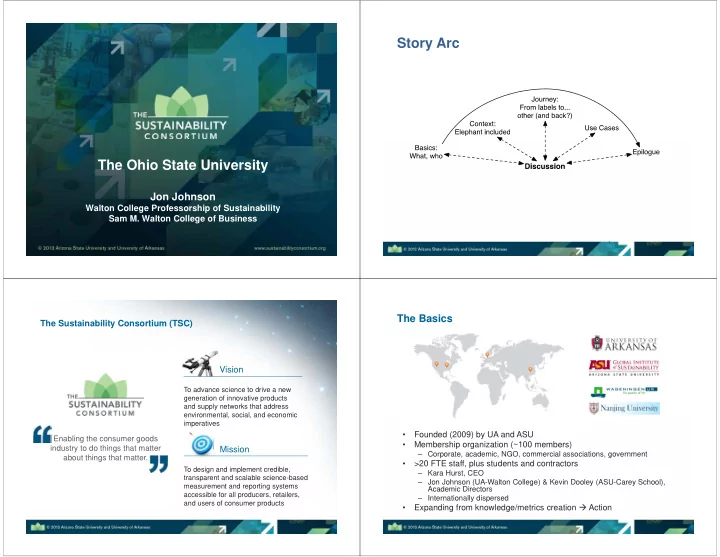
Story Arc

1

Vision

To advance science to drive a new generation of innovative products and supply networks that address environmental, social, and economic imperatives

Mission

To design and implement credible, transparent and scalable science-based measurement and reporting systems accessible for all producers, retailers, and users of consumer products

The Sustainability Consortium (TSC)

Enabling the consumer goods industry to do things that matter about things that matter.

The Basics

  • Founded (2009) by UA and ASU
  • Membership organization (~100 members)

– Corporate, academic, NGO, commercial associations, government

  • >20 FTE staff, plus students and contractors

– Kara Hurst, CEO – Jon Johnson (UA-Walton College) & Kevin Dooley (ASU-Carey School), Academic Directors – Internationally dispersed

  • Expanding from knowledge/metrics creation  Action
slide-2
SLIDE 2

Board of Directors Administering Universities Corporate Advisory Council Civil Society Advisory Council Academic Advisory Council

TSC’s multi-stakeholder approach allows for pre-competitive collaboration…

TSC’s Board of Directors represent all stakeholder groups across several industries… Governance Academic Partners Civil Society Organizations Corporations

TSC’s membership represent over $1.5 trillion in revenue… And is growing… Academic collaborators include… Industry partners contribute to the success of TSC everyday…

slide-3
SLIDE 3

Structured into industry defined working groups (+)

ELECTRONICS FOOD BEVERAGE & AGRICULTURE HOME & PERSONAL CARE PAPER, PULP, & FORESTRY PACKAGING TOYS RETAIL MEASUREMENT SCIENCE* CLOTHING, FOOTWEAR & TEXTILES

Context: The Walmart Problem

$0 $20,000 $40,000 $60,000 $80,000 $100,000 $120,000

  • Initial driver and funder of TSC
  • TSC output supports the Walmart

“Index”

  • Strong supporter of multistakeholder

collaboration, including other retailers

Context: The Walmart Problem in High Relief

$0 $50,000 $100,000 $150,000 $200,000 $250,000 $300,000 $350,000 $400,000 $450,000 $500,000

  • Perception that Walmart controls

TSC: They do not.

  • TSC has many retailers, ~100

members

  • Perception that Walmart’s actions

have industry-wide consequences (vertical and horizontal): They do.

  • They are obviously an important

player, but not the only important player.

Context: Interests Between Stakeholder Groups

  • Resources

– Money – Expertise – Credibility

  • Governance

– Organizational – Technical

  • Interests

– Complex dyads+

  • Membership

– Selection – Recruitment – Management

11

Corporations NGOs Academics Trade Associations Government Agencies Consultants- Certifiers- DB Providers

slide-4
SLIDE 4

Context: Interests Across Supply Chains

12

Producers Branded Manufacturers Retailers Consumers Input Providers Producer Groups Trade Associations Trade Associations NGOs Contract Manufacturers

Initial Vision: Scientific basis for a harmonized system of product labels in a world of…

Ecolabelling.org

And…

SMRS V1.0: Life Cycle Assessment Based, Product Level

(SMRS = “Sustainability Measurement and Reporting Standards”)

Finished Good Assembly

Direct Emissions (scope 1) Direct Extractions Purchased Inputs Product Output

LCA 101: The Unit Process

slide-5
SLIDE 5

SMRS V1.0: Unit Processes  Product Life Cycles SMRS V1.0: Life Cycles Span Supply Networks SMRS V1.0: LCA Based, Product Level

18

TSC SCOPE

SMRS V2.0: A hybrid approach

(SMRS: “Sustainability Measurement and Reporting Systems”)

A pure LCA approach is not economically scalable across all consumer products A pure "best practices" approach lacks precision and tends to weigh each best practice equally, regardless of impact

19

BASELINE LCA MODEL FOR PRODUCT CATEGORY SUSTAINABILITY PERFORMANCE DRIVERS (VARIABLES & ATTRIBUTES) PRIMARY DATA IMPACTS

slide-6
SLIDE 6

SMRS V2.0: Three step reporting

20

Reporting Category 1 Reporting Category 2 Reporting Category 3 Reporting Category 4 :

PRIMARY DATA AND THEIR IMPACTS BASELINE LCA FOR PRODUCT CATEGORY PRE-DEFINED SUSTAINABILITY PERFORMANCE DRIVERS AND THEIR IMPACTS

  • 1. Every product

has same scores

  • 2. Every product with

same attributes has same scores

  • 3. Every product potentially has

different scores (optional)

http://www.open-io.org

SMRS V2.0: US Tax Code analogy

1040 EZ 1040 LONG FORM

Other Schedules & forms

1040

BASELINE MODEL SUSTAINABILITY PERFORMANCE DRIVERS PRIMARY OR PROPRIETARY DATA

REQUIRED OPTIONAL FOR POSITIVE DRIVERS OPTIONAL

A SMRS should support all three reporting alternatives

21

SMRS V3.0: Product Category Level

Category Dossier

Collection of evidence on product category and its supply chain, environmental and social hotspots, and improvement opportunities

Category Sustainability Profile (CSP)

Synthesis of product sustainability knowledge and improvement

  • pportunities

Key Performance Indicators (KPIs)

Metrics / questions to measure and track product category sustainability

  • Knowledge products aimed at B2B actors, focused on product categories
  • Entirely new system and processes

SMRS V3.0: Process Flow

TSC members, invited experts form Panel to address a set of categories DOSSIER List of hypothesized hotspots and improvement opportunities Panel is surveyed, generates hotspots and improvement

  • pportunities

TSC staff aggregate hotspot survey data, published research, and relevant previous work CSP List of assessed hotspots and improvement opportunities TSC staff assess published research  classify as hotspot, additional issue, stakeholder concern; document in Dossier and final CSP Develop KPI’s through workshops KPI’s 1 2 3 4 5

slide-7
SLIDE 7

Buyers

Communicate efficiently and effectively with suppliers:

  • Ask category-specific questions
  • Track supplier performance using KPIs

Suppliers

Address product sustainability more effectively and efficiently:

  • Use a single reporting tool across buyers
  • Enhance product development
  • Reduce spending on sustainability

research and reporting

  • Evaluate quality of input materials

v v v v

…to be used by buyers and suppliers to address product sustainability in a cost efficient way

Improved product sustainability and cost efficiency

  • Hotspots
  • Improvement
  • pportunities
  • Key Performance

Indicators

  • Category

Sustainability Profiles

TSC provides

v v v v v v v v v

Hotspot: Sustainability focused social and environmental high impact areas

SMRS V3.0: SAP driven reporting platform rolling out now… Reporting Platform(s)

Manufacturers Retailers TSC

KPI Questions KPI Response Supplier Request

Walmart Use Case

Company 1 Company 2 Company 3 Company 4 Company 5 Company 6 Company 7 Company 8 Company 9 Company 10 Company 11

“The Sustainability Consortium has begun delivering tools to

  • ur product buyers to help us

evaluate product and supplier sustainability...We have started integrating this work into our buying processes.”

– Dunc an Mac Naughton, Walmar t

“I’m really proud of what the merchandisers have done…[The sustainability index] is really complicated stuff, and it's giving buyers information to help form decisions and compare products.

– R

  • b Walton, Walmar

t

Marks & Spencer Use Case

TSC has revolutionized the process… Before 2009

1. Wine team requests attribute in bulk shipping 2. Sustainability Manager spends weeks on Google, talking to wine experts and trying to find LCA information on bulk shipping 3. Sustainability Manager cannot find appropriate information and tells the buyer that the category is not approved 4. The buyer is completely discouraged and gives up in sustainability 5. No progress is made in the wine category

2012 and beyond

1. Wine team requests attribute in bulk shipping 2. Sustainability Manager looks up the product Category Sustainability Profile (CSP) and looks at the hotspots. The Manager also finds that Bulk Shipping does appear in the Key Performance Indicators 1. Sustainability Manager looks at the Dossier and finds that the supplier in question is 50% less than the industry standard in carbon footprint. 2. Sustainability Manager sends an email the same day to notify the team that Bulk Shipping is approved.
slide-8
SLIDE 8

Ahold Use Case Proactive Innovation

The Future

Key environmental and social hotspots

After establishing the SMRS knowledge base…

  • Update and maintain SMRS
  • Shift focus to “action projects”--

multistakeholder, supply chain wide collaborations that build on SMRS

  • Expand services (e.g., training,

analytics, consultation) After establishing the SMRS knowledge base…

  • Update and maintain SMRS
  • Shift focus to “action projects”--

multistakeholder, supply chain wide collaborations that build on SMRS

  • Expand services (e.g., training,

analytics, consultation)

Transparent, standardized and harmonized systems

"There is space for everyone at The Sustainability Consortium no matter what point along the sustainability journey you are on."

Brandon Tidwell, Darden Restaurants

On-going Challenges

  • Long term structure, governance and

decision making

  • Academic engagement
  • Diversified revenue model
  • International expansion

30

Membership Dues Contributions

Corporations Tier I $100,000 Annually (companies with more than $500m annual revenue) $25,000 Annually (fewer than 500 employees and/or less than $500m in revenue) Tier II $50,000 Annually (companies with more than $500m annual revenue) $10,000 Annually (fewer than 500 employees and/or less than $500 in revenue) Tier I $25,000 Annually (non-profits with assets more than $50M US) $10,000/Year (assets less than $50M US) Tier II $10,000 Annually (non-profits with assets more than $50M US) $5,000 Annually (assets less than $50M US) All Members $10,000 annually

NOTE: All dues contributions are paid through a 501c3, institution of higher education. Consult a tax professional about the tax deductibility.

Civil Society Organizations Regulatory Entities

slide-9
SLIDE 9