SLIDE 1 Registered in England No 06458621 Registered Office: The Compass Centre, Nelson Road, Hounslow, Middlesex, TW6 2GW
BAA Limited
The Compass Centre, Nelson Road Hounslow, Middlesex, TW6 2GW T: +44 (0)20 8745 7224 F: +44 (0)20 8745 6061 E: heathrowmediacentre@baa.com W: baa.com
25 April 2012
BAA (SP) Limited Results for the three months ended 31 March 2012
BAA (SP) Limited owns BAA’s two London airports of Heathrow and Stansted. Throughout this document, BAA (SP) Limited and its subsidiaries are referred to as the Group. BAA (SH) plc is the parent company of BAA (SP) Limited.
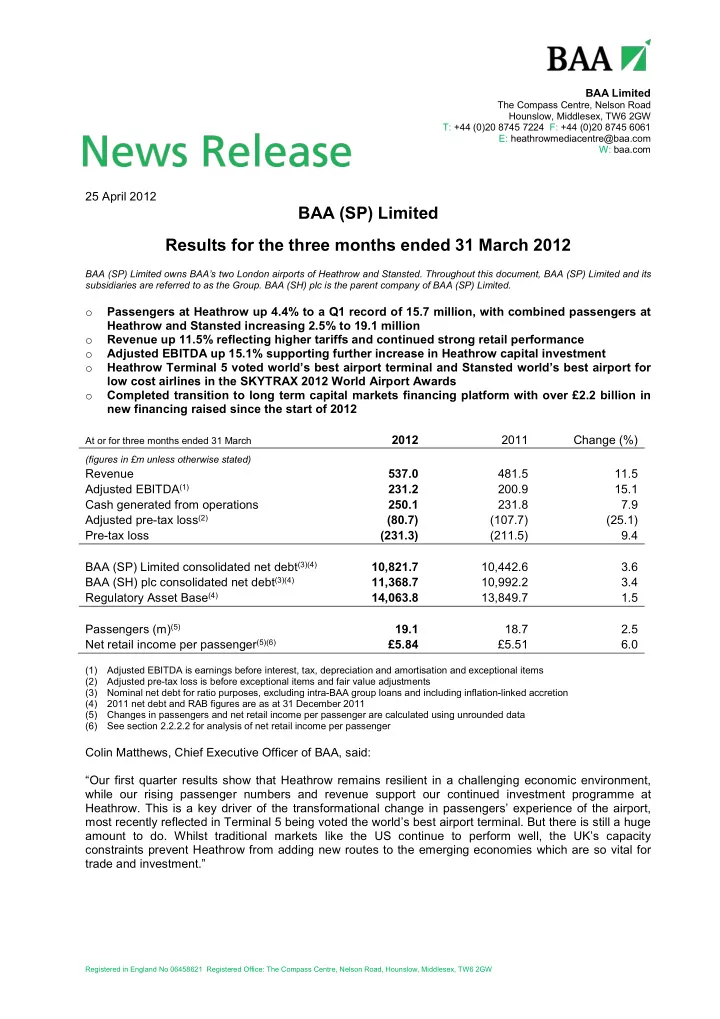
- Passengers at Heathrow up 4.4% to a Q1 record of 15.7 million, with combined passengers at
Heathrow and Stansted increasing 2.5% to 19.1 million
- Revenue up 11.5% reflecting higher tariffs and continued strong retail performance
- Adjusted EBITDA up 15.1% supporting further increase in Heathrow capital investment
- Heathrow Terminal 5 voted world’s best airport terminal and Stansted world’s best airport for
low cost airlines in the SKYTRAX 2012 World Airport Awards
- Completed transition to long term capital markets financing platform with over £2.2 billion in
new financing raised since the start of 2012
At or for three months ended 31 March
2012 2011 Change (%)
(figures in £m unless otherwise stated)
Revenue 537.0 481.5 11.5 Adjusted EBITDA(1) 231.2 200.9 15.1 Cash generated from operations 250.1 231.8 7.9 Adjusted pre-tax loss(2) (80.7) (107.7) (25.1) Pre-tax loss (231.3) (211.5) 9.4 BAA (SP) Limited consolidated net debt(3)(4) 10,821.7 10,442.6 3.6 BAA (SH) plc consolidated net debt(3)(4) 11,368.7 10,992.2 3.4 Regulatory Asset Base(4) 14,063.8 13,849.7 1.5 Passengers (m)(5) 19.1 18.7 2.5 Net retail income per passenger(5)(6) £5.84 £5.51 6.0
(1) Adjusted EBITDA is earnings before interest, tax, depreciation and amortisation and exceptional items (2) Adjusted pre-tax loss is before exceptional items and fair value adjustments (3) Nominal net debt for ratio purposes, excluding intra-BAA group loans and including inflation-linked accretion (4) 2011 net debt and RAB figures are as at 31 December 2011 (5) Changes in passengers and net retail income per passenger are calculated using unrounded data (6) See section 2.2.2.2 for analysis of net retail income per passenger
Colin Matthews, Chief Executive Officer of BAA, said: “Our first quarter results show that Heathrow remains resilient in a challenging economic environment, while our rising passenger numbers and revenue support our continued investment programme at
- Heathrow. This is a key driver of the transformational change in passengers’ experience of the airport,
most recently reflected in Terminal 5 being voted the world’s best airport terminal. But there is still a huge amount to do. Whilst traditional markets like the US continue to perform well, the UK’s capacity constraints prevent Heathrow from adding new routes to the emerging economies which are so vital for trade and investment.”
SLIDE 2
2 For further information please contact BAA Media enquiries Simon Baugh 020 8745 7224 Investor enquiries Andrew Efiong 020 8745 2742 RLM Finsbury Andrew Dowler or Don Hunter 020 7251 3801
There will be a conference call today at 3.00 pm (UK time)/4.00 pm (Central European time)/10.00 am (Eastern standard time) for bondholders and bank lenders to the Group and BAA (SH) plc and credit analysts to discuss the results for the three months ended 31 March 2012. The call will be hosted by José Leo, BAA’s Chief Financial Officer. Dial-in details for the call are: UK free phone: 0800 368 1950; US free phone: 1866 928 6049; UK local/standard international: +44 (0)20 3140 0668. Participant PIN code is 494489#. It will also be possible to view online the presentation (using event password: 384038) as it is used during the call at: https://arkadin-event.webex.com/arkadin-event/onstage/g.php?t=a&d=703093026
SLIDE 3
3 BAA (SP) Limited Consolidated results for the three months ended 31 March 2012 Index 1 Key business developments 1.1 Passenger traffic 1.2 Investment in modern airport facilities 1.3 Service standards 1.4 Competition Commission inquiry into the supply of UK airport services by BAA 2 Financial review 2.1 Basis of preparation 2.2 Profit and loss account 2.3 Cash flow 2.4 Pension scheme 2.5 Recent financing activity 2.6 Financing position 2.7 Outlook Appendix 1 Unaudited consolidated financial information for BAA (SP) Limited Appendix 2 Analysis of turnover and operating costs by airport and activity 1 Key business developments 1.1 Passenger traffic Passenger traffic for the three months ended 31 March 2012 at the Group’s airports is analysed below:
(figures in millions unless otherwise stated)
2012 2011 Change (%)(1) Passengers by airport Heathrow 15.7 15.0 4.4 Stansted 3.5 3.7 (5.3) Total passengers(1) 19.1 18.7 2.5 Passengers by market served UK 1.4 1.5 (6.3) Europe(2) 9.3 9.1 2.1 Long haul 8.4 8.0 4.6 Total passengers(1) 19.1 18.7 2.5
(1) These figures have been calculated using un-rounded passenger numbers (2) Includes North African charter traffic
In the three months ended 31 March 2012, the Group’s passenger traffic increased 2.5% to 19.1 million passengers (2011: 18.7 million). The year on year growth was driven by Heathrow where traffic increased 4.4% to 15.7 million passengers (2011: 15.0 million), a record for the first quarter of the year. In the year to 31 March 2012, Heathrow annual rolling traffic exceeded 70 million for the first time ever, having passed 60 million in 1998. Heathrow’s strong performance was partially offset by a 5.3% decline in traffic at Stansted to 3.5 million passengers (2011: 3.7 million), in line with expectations. Adjusting for 2012 being a leap year, underlying growth is estimated at 1.4%, with an increase of 3.3% at Heathrow and a decline of 6.4% at Stansted. Performance is also likely to have been impacted by the timing of Easter, with more Easter holiday related traffic in March than was the case in 2011 when Easter fell towards the end of April. Heathrow’s performance was driven by North Atlantic traffic which increased 9.2% to 3.3 million passengers (2011: 3.0 million) owing to the continued success of American Airlines’ and British Airways’ joint transatlantic services launched in March 2011 and new routes introduced by Delta Air Lines. Heathrow’s European traffic also grew robustly, increasing 4.6% to 6.3 million passengers (2011: 6.0
SLIDE 4 4 million). However, unlike other major market segments, domestic traffic declined 4.4% to 1.1 million passengers (2011: 1.2 million) largely reflecting cessation of bmi’s Glasgow service in March 2011. Heathrow’s traffic during the first quarter has been characterised by higher than expected load factors (69.5% versus 67.4% in the first quarter of 2011). There were marginally higher numbers of flights (115,797 compared to 115,751 in the first quarter of 2011) meaning that, as in 2011, the airport operated
- ver 99% of its maximum permitted departures and arrivals in the last 12 months. The proportion of
transfer traffic at Heathrow was 36% (2011: 36%). Stansted’s traffic declined 5.3% to 3.5 million passengers (2011: 3.7 million). Declines in traffic occurred in most market segments and, as was the case in 2011, continued to be particularly significant in the domestic market, which declined 12.2% principally due to cessation of services to Prestwick and
- Newcastle. Long haul traffic has been impacted particularly by the cessation in October 2011 of Air Asia
X’s services from Stansted. Stansted’s core European scheduled market saw traffic decline 3.1% to 2.7 million passengers (2011: 2.8 million). Capacity reductions have been most noticeable at easyJet in the early months of 2012. As in 2011, Stansted has continued to experience record load factors that reached 73.8% in the first three months of 2012 (2011: 73.3%), suggesting limited deterioration in demand dynamics. 1.2 Investment in modern airport facilities Heathrow continues to be the focus of the capital investment programme, a key enabler of the Group’s strategic objective of enhancing Heathrow’s leading position in the global aviation industry and particularly its long-standing role as the UK's gateway to the world. The investment programme’s current focus is on the construction of the new Terminal 2, which is due to open in 2014. In addition, significant investment continues on Heathrow’s baggage infrastructure. Over £250 million was invested at Heathrow in the first quarter of 2012. The new Terminal 2 building was made weather-tight in February 2012. Fit out of terminal systems, including outbound baggage systems, escalators and travelators, is also underway. Approximately one third of the terminal’s escalators are now
- installed. Work has also started on fitting out the terminal’s interior including ceilings, walls and floors.
In parallel with the construction of the main terminal building, work continues on building the second phase of Terminal 2’s satellite building (Terminal 2B). The excavation of the extensive basement and tunnel structures to house the tracked transit train and baggage systems was completed in March. These systems will connect the satellite to the main building once the main terminal’s second phase is
- constructed. Completion of the excavation was a significant milestone and involved the removal of the
equivalent of 250 Olympic size swimming pools of material without disruption to the operation of the
- airport. Completion of the excavation works has enabled construction of the steel frame of the central
section of the satellite building to commence which will connect the southern and northern sections where construction is more advanced and mechanical and electrical equipment is already being installed. The whole second phase of the satellite building is expected to be weather-tight in late 2012. There has also been significant progress on Terminal 2’s multi-storey car park. The first span of the ramps which will take the road up to the car park has been installed and the pre-cast columns to support the car park are currently being delivered and installed. Commissioning of the underground automated baggage transfer system between Terminals 3 and 5 is now substantially complete. Operational trials are due to be completed imminently with full live operation
- f the facility expected by mid-2012. Elsewhere in Heathrow’s baggage investment programme, works on
the superstructure for Terminal 3’s new integrated baggage system are now well under way. The main elements of the baggage system have been manufactured off-site and are expected to be delivered to Heathrow in the next few months. 1.3 Service standards The Group’s focus on delivering transformational change in passengers’ experience of its airports continues to receive significant endorsement from the travelling public, demonstrating that passengers are noticing the improvements made by the airports. Most importantly, Heathrow Terminal 5 has just been
SLIDE 5 5 named the world’s best airport terminal in the 2012 SKYTRAX World Airport Awards. In addition, Stansted was named as the world’s best airport for low cost airlines in the same awards. Further, Heathrow achieved its highest ever overall passenger satisfaction in the Airport Service Quality survey (produced by Airports Council International) for the first quarter of 2012, scoring 3.92 compared to its previous highest score of 3.89 achieved in the first quarters of both 2010 and 2011. Individual service standards continue to perform robustly at Heathrow and Stansted. On departure punctuality, the proportion of aircraft departing within 15 minutes of schedule during the three months ended 31 March 2012 was 81% (2011: 82%) at Heathrow and 89% (2011: 89%) at Stansted. Further, Heathrow’s baggage misconnect rate was 14 per 1,000 passengers (2011: 15). On security queuing, passengers passed through central security within periods prescribed under service quality rebate schemes 96.3% (2011: 97.4%) of the time at Heathrow and 99.0% (2011: 98.8%) of the time at Stansted during the three months ended 31 March 2012. This compares with 95.0% service standards. 1.4 Competition Commission inquiry into the supply of UK airport services by BAA On 1 February 2012, the Competition Appeal Tribunal (‘CAT’) found in favour of the Competition Commission’s decision of 19 July 2011 that required BAA to sell Stansted airport. BAA believes that the judgment is flawed and has sought leave to appeal the CAT’s decision at the Court of Appeal. 2 Financial review 2.1 Basis of preparation BAA (SP) Limited (‘BAA (SP)’) is the holding company of a group of companies that owns Heathrow and Stansted airports and operates the Heathrow Express rail service (the ‘Group’). The Group’s statutory accounts are prepared under UK GAAP. Unaudited consolidated financial information is set out in Appendix 1. A detailed analysis of turnover and operating costs both by airport and activity is set out in Appendix 2. 2.2 Profit and loss account 2.2.1 Introduction The profit and loss account below provides more detailed disclosure than the statutory format in Appendix 1 in order to enable a better understanding of the results of the Group's operations. 2012 2011 Three months ended 31 March £m £m Group turnover 537.0 481.5 Adjusted operating costs(1) (305.8) (280.6) Adjusted EBITDA(2) 231.2 200.9 Exceptional items – pensions(3) (128.9) 22.6 Exceptional items – impairment(3)
EBITDA 102.3 212.5 Depreciation – ordinary (128.8) (116.9) Operating (loss)/profit (26.5) 95.6 Net interest payable and similar charges (183.1) (191.7) Fair value loss on financial instruments (21.7) (115.4) Total net interest payable and similar charges (204.8) (307.1) Loss on ordinary activities before taxation (231.3) (211.5) Tax credit on loss on ordinary activities 87.6 90.4 Loss on ordinary activities after taxation (143.7) (121.1)
(1) Adjusted operating costs are stated before depreciation, amortisation and exceptional items (2) Adjusted EBITDA is earnings before interest, tax, depreciation and amortisation and exceptional items (3) See section 2.2.6 for further discussion of exceptional items
SLIDE 6
6 2.2.2 Turnover In the three months ended 31 March 2012, turnover increased 11.5% to £537.0 million (2011: £481.5 million). This reflects increases of 16.8%, 7.9% and 3.7% in aeronautical, retail and other income respectively. 2012 2011 Three months ended 31 March £m £m Change (%) Aeronautical income 294.8 252.5 16.8 Retail income 119.5 110.7 7.9 Other income 122.7 118.3 3.7 Total 537.0 481.5 11.5 2.2.2.1 Aeronautical income Aeronautical income increased 16.8% to £294.8 million (2011: £252.5 million). Average aeronautical income per passenger increased 13.9% to £15.40 (2011: £13.52). Aeronautical income by airport 2012 2011 Three months ended 31 March £m £m Change (%) Heathrow 269.4 228.4 18.0 Stansted 25.4 24.1 5.4 Total 294.8 252.5 16.8 At Heathrow, the growth primarily reflects passenger traffic trends as well as the headline 12.2% increase in its tariffs from 1 April 2011. This has continued to be partially offset by lower than expected yields which led to aeronautical income being approximately £2 million lower than expected during the three months ended 31 March 2012. This shortfall (or yield dilution) will be recovered through the ‘K factor’ true- up mechanism in the year commencing 1 April 2013. At Stansted, with its year-on-year decline in traffic, growth in aeronautical income reflects principally the headline 6.33% increase in its tariffs from 1 April 2011 together with reduced tariff discounts for certain airlines. The headline maximum allowable yields at Heathrow and Stansted increased 12.7% and 6.83% respectively from 1 April 2012. 2.2.2.2 Retail income The Group’s retail business has started 2012 well, continuing the consistent trend of recent years. Net retail income (‘NRI’) per passenger increased 6.0% to £5.84 (2011: £5.51) in the three months ended 31 March 2012, with growth of 5.6% at Heathrow and 4.9% at Stansted. Gross retail income increased 7.9% to £119.5 million (2011: £110.7 million) and NRI increased 8.6% to £111.8 million (2011: £102.9 million). Net retail income per passenger by airport(1) 2012 2011 Three months ended 31 March £ £ Change (%) Heathrow 6.24 5.91 5.6 Stansted 4.06 3.87 4.9 Total 5.84 5.51 6.0
(1) These figures have been calculated using un-rounded passenger numbers and, in the case of the percentage changes, un- rounded net retail income per passenger figures
SLIDE 7 7 At Heathrow, gross retail income increased 10.3% to £104.1 million (2011: £94.4 million) and NRI per passenger increased 5.6% to £6.24 (2011: £5.91). The strong performance was broad based with particularly good growth in duty and tax-free, airside specialist shops, bureaux de change and car parking. Heathrow’s duty and tax-free and airside specialist shops saw significant increases in the average spend
- f passengers purchasing items in the in-terminal retail facilities. This was driven by factors including an
increased proportion of higher spending non-EU passengers, the major refurbishment of Terminal 3’s airside specialist shops and the new walk through area in the World Duty Free store in Terminal 3. In airside specialist shops, trading was particularly buoyant in the luxury and fashion segments. A strong performance in bureaux de change was due to a combination of increased passenger traffic and improvements in contract terms with business partners. Car parking income grew well ahead of passenger growth due to tariff increases together with the success of initiatives to increase car park usage and yield. These included improved web-based customer acquisition and conversion rates, targeted promotion of different services and enhancements in the range of services such as mobile booking. Stansted's gross retail income declined 5.5% to £15.4 million (2011: £16.3 million) which, combined with retail expenditure reducing to £1.3 million (2011: £2.1 million), resulted in NRI per passenger increasing 4.9% to £4.06 (2011: £3.87). On a per passenger basis landside shops, catering and bureaux de change showed increases, although this was partially offset by a decline in car parking income due to both reduced usage and a decrease in the length of stay. 2.2.2.3 Other income Income from activities other than aeronautical and retail increased 3.7% to £122.7 million (2011: £118.3 million). This partly reflects rail income increasing 8.1% to £27.9 million (2011: £25.8 million) due to both a 1.7% increase in Heathrow Express passenger numbers to 1.46 million (2011: 1.43 million) and fare increases effective from 1 January 2012. Operational facilities and utilities income increased 7.9% to £42.2 million (2011: £39.1 million) due mainly to higher demand, increases in tariffs and a change in charging structure for electricity. Property rental income also increased 2.6% to £27.8 million (2011: £27.1 million). The remaining revenue streams included in other income declined 5.7%, principally due to the reduction in income from the remaining agreements with Gatwick to provide transitional services following its disposal in late 2009. 2.2.3 Adjusted operating costs Adjusted operating costs exclude depreciation, amortisation and exceptional items. In the three months ended 31 March 2012, adjusted operating costs increased 9.0% to £305.8 million (2011: £280.6 million), lower than budgeted for the first quarter. The phasing of year on year cost increases in 2012 is expected to be weighted to the first half of the year, reflecting factors such as Olympics related costs falling into the first half and the fact that Terminal 5C only became operational in June 2011. 2012 2011 Three months ended 31 March £m £m Change (%) Employment costs 89.6 79.7 12.4 Maintenance expenditure 40.6 32.7 24.2 Utility costs 30.4 29.7 2.4 Rents and rates 34.8 30.7 13.3 General expenses 61.4 57.1 7.5 Retail expenditure 7.7 7.8 (1.3) Intra-group charges/other 41.3 42.9 (3.7) Total 305.8 280.6 9.0 The main drivers of the increased adjusted operating costs were higher employment costs, maintenance expenditure, rents and rates and general expenses.
SLIDE 8 8 Employment costs were up 12.4% reflecting principally budgeted pay rises and an increase in the defined benefit pension scheme service charge which will be higher than originally forecast through 2012. The increase in maintenance expenditure was partly due to the impact of the adverse winter weather in early February 2012 together with the costs of the Olympic terminal which are being expensed. Increases in rents and rates were driven primarily by the annual inflation linked increase in property rates as well as additional rateable property (such as Terminal 5C that opened in June 2011). The growth in general expenses reflected increases across a range of cost categories including air traffic control, ground transport and cleaning. In the three months ended 31 March 2012, the Group incurred approximately £6 million in costs in relation to preparations for the role that principally Heathrow will play as the main arrival and departure point for participants in the 2012 Olympic and Paralympic Games. Appendix 2 provides an analysis of adjusted operating costs for Heathrow and Stansted. 2.2.4 Adjusted EBITDA In the three months ended 31 March 2012, Adjusted EBITDA increased 15.1% to £231.2 million (2011: £200.9 million), resulting in an Adjusted EBITDA margin of 43.1% (2011: 41.7%) in what is normally the weakest quarter of the year in terms of both Adjusted EBITDA and Adjusted EBITDA margins. The significant increase in Adjusted EBITDA from 2011 reflects improved traffic and increased aeronautical and retail income per passenger. Adjusted EBITDA at Heathrow (including Heathrow Express Operating Company Limited) increased 16.0% to £221.3 million (2011: £190.8 million). The significant increase in Heathrow’s Adjusted EBITDA reflects the factors referred to above in relation to the growth in the Group’s Adjusted EBITDA. Stansted’s Adjusted EBITDA declined 2.0% to £9.9 million (2011: £10.1 million) due principally to higher aeronautical income being more than offset by reduced retail income and increased employment costs (including pension service charges). 2.2.5 Operating loss/profit The Group recorded an operating loss for the three months ended 31 March 2012 of £26.5 million (2011: £95.6 million profit). The difference between Adjusted EBITDA and operating profit results from £128.8 million in depreciation (2011: £116.9 million) and a net £128.9 million exceptional charge (2011: £11.6 million credit). A reconciliation between Adjusted EBITDA and statutory operating loss is provided below. 2012 2011 Three months ended 31 March £m £m Change (%) Adjusted EBITDA 231.2 200.9 15.1 Depreciation – ordinary (128.8) (116.9) 10.2 Exceptional items – pensions (128.9) 22.6 n/a Exceptional items – impairment
(100.0) Operating (loss)/profit (26.5) 95.6 n/a 2.2.6 Exceptional items (including impairment charges) In the three months ended 31 March 2012, there was a net exceptional £128.9 million pre-tax charge (2011: £11.6 million credit) to the profit and loss account. This reflected a non-cash pension related charge arising principally from the Group’s share of the movement in the BAA Airports Limited defined benefit pension scheme from a surplus to a deficit. See section 2.4 for further discussion of the movement in the defined benefit pension scheme deficit. 2.2.7 Taxation The tax credit for the three months ended 31 March 2012 results in an effective tax credit rate for the period of 37.9% (2011: 42.7%). This reflects a tax credit arising on ordinary activities of £77.4 million (2011: £78.4 million) and a tax credit of £10.2 million (2011: £12.0 million) due to the further reduction in the rate of corporation tax from 1 April 2012. The tax credit for the three months ended 31 March 2012 on ordinary activities results in an effective tax credit rate of 33.4% (2011: 37.1%). This credit is calculated by applying the forecast estimated average annual effective tax rate for each entity to the results for the three months ended 31 March 2012. For
SLIDE 9 9 each entity, the effective tax rate for the period differs from the UK statutory rate of corporation tax of 24.5% due to the impact of phasing results through the year and permanent differences arising from non- qualifying depreciation. The effective tax rate for the Group reflects the proportionate contribution of each entity’s results in each interim accounting period and will vary as those proportions change. On 21 March 2012, the Government announced its intention to introduce legislation for further reductions in the rate of corporation tax to 24% from 1 April 2012 and 23% from 1 April 2013. The reduction in the corporation tax rate to 24% was substantively enacted on 26 March 2012 and as a result the Group's deferred tax balances, which were previously provided at 25%, were re-measured at the rate of 24%. This has resulted in a reduction in the net deferred tax liability of £4.9 million, with £10.2 million credited to the profit and loss account and £5.3 million charged to reserves. 2.3 Cash flow 2.3.1 Summary cash flow 2012 2011 Three months ended 31 March £m £m Net cash inflow from operating activities 250.1 231.8 Net interest paid (88.7) (93.5) Taxation – group relief paid
Cash flow after interest and tax 161.4 135.7 Net capital expenditure (272.0) (210.1) Pension and other payments related to disposal of Gatwick airport (0.3) (2.8) Dividends paid (395.0)
- Net cash outflow before management of liquid resources and financing
(505.9) (77.2) Management of liquid resources 2.9 20.6 Cancellation and restructuring of derivatives (12.4)
- Increase in amount owed to BAA (SH) plc
201.0 134.8 Movement in borrowings and other financing flows 323.0 (65.3) Increase in cash 8.6 12.9 2.3.2 Cash flow from operating activities Net cash inflow from operations in the three months ended 31 March 2012 increased 7.9% to £250.1 million (2011: £231.8 million) which compares with Adjusted EBITDA of £231.2 million (2011: £200.9 million). The operating cash flow was around £18 million higher than Adjusted EBITDA due principally to a prepayment of property rates and a VAT receipt. 2.3.3 Capital expenditure In the three months ended 31 March 2012, the cash flow impact of the Group’s capital investment programme was £272.0 million (2011: £210.1 million) with £267.1 million at Heathrow (2011: £204.7 million) and £4.9 million at Stansted (2011: £5.4 million). The most significant areas of capital expenditure at Heathrow were on the new main Terminal 2 building, the second phase of the satellite building for the new Terminal 2 and the new integrated baggage system for Terminal 3. 2.3.4 Restricted payments/dividends In the three months ended 31 March 2012, there was a net £214.2 million of payments made out of the
- Group. This reflected £20.2 million of interest payments on the debenture between BAA (SP) and BAA
(SH) plc (‘BAA (SH)’) and £395.0 million of dividend payments, of which £201.0 million was lent back to the Group. The net amount distributed out of the Group, together with £0.8 million of cash at BAA (SH), was utilised to meet £20.2 million of interest payments on BAA (SH)’s external debt financing and to make £194.8 million of distributions beyond BAA (SH) that was utilised in repaying accrued interest on the toggle facility held at ADI Finance 1 Limited and, as previously disclosed, making the first quarterly dividend payment (of £60.0 million) to BAA’s ultimate shareholders since it was acquired by the Ferrovial-led consortium in 2006.
SLIDE 10 10 2.4 Pension scheme At 31 March 2012, the BAA Airports Limited defined benefit pension scheme had a deficit of £103.3 million as measured under IAS 19, of which £86.8 million was attributable to the Group under the Group's shared services agreement with BAA Airports Limited. This compares with a scheme surplus of £38.7 million at 31 December 2011 of which £32.5 million was attributable to the Group. The change from a scheme surplus to a deficit is due principally to the impact of changes in forecast inflation rates. 2.5 Recent financing activity Since the beginning of 2012, the Group has completed eight capital markets transactions raising over £2.2 billion across a range of currencies, ratings levels and formats. They included: £1 billion in Class B issuance through two transactions – a £600 million twelve year bond and a £400 million eight year bond; a debut CHF400 million five year Class A bond placed with a largely new investor base for the Group in Switzerland; a €700 million five year Class A bond; a £95 million (£120 million proceeds) tap of the existing 2039 Class A index-linked bond; two €50 million twenty year Class A private placements (the second of which settled after the period end); and a £180 million ten year Class A index-linked private placement earlier this month. The success of this financing activity has enabled the Group to repay its maturing €1,000 million bond in February 2012; reduce drawings under its revolving capital expenditure facility to £412.1 million at 31 March 2012; and repay £400 million of its £625 million Class B term loan after the period end. In so doing, the Group completed its transition to a predominantly capital markets financing platform. Overall, the Group, together with BAA (SH), has raised a total of close to £7 billion in new financing in the last two and a half years. The Group had a total of £1,625 million in Class B debt (after repaying £400 million of the Class B loan in April), comprising £1,400 million in bonds maturing between 2018 and 2024 and £225 million of the Class B loan facility maturing in September 2014. This represents 11.6% of RAB as at 31 March 2012. As a result, the Group has sufficient Class B debt for the remainder of the current regulatory period. In the remainder of 2012, the financing priorities for the Group will be to continue its capital markets issuance programme in order further to extend its maturity profile and reduce drawings on revolving bank facilities, potentially including further currency diversification beyond Sterling, Euro, US dollars and Swiss
- francs. The Group has also begun the process of refinancing its capital expenditure and liquidity facilities
with new facilities maturing in 2017. The refinancing is expected to complete before the summer. 2.6 Financing position 2.6.1 Consolidated net debt and liquidity at BAA (SP) Limited The analysis below focuses on the Group's external debt and excludes the debenture between BAA (SP) and its parent company, BAA (SH). It includes all the components used in calculating gearing ratios under the Group's financing agreements including index-linked accretion. During the three months ended 31 March 2012, the Group's nominal net debt increased 3.6% from £10,442.6 million to £10,821.7 million. The increase in net debt primarily reflects three factors: funding of capital investment at Heathrow; use of surplus cash flow previously retained in the Group to make the restricted payments referred to in section 2.3.4; and accretion on the Group’s index-linked swaps and bonds. The Group's nominal net debt at 31 March 2012 comprised £9,133.6 million outstanding under bond issues, £412.1 million outstanding under the Group’s capital expenditure facility, £909.9 million
- utstanding under other loan facilities, £399.9 million in index-linked derivative accretion and cash at bank
and term deposits of £33.8 million (compared with cash and current asset investments of £38.9 million shown on the balance sheet). Nominal net debt comprised £8,796.7 million in senior (Class A) net debt and £2,025.0 million in junior (Class B) debt.
SLIDE 11 11 The accounting value of the Group's net debt at 31 March 2012 was £10,384.5 million (31 December 2011: £10,254.4 million). The average cost of the Group’s external gross debt at 31 March 2012 was 4.63% (31 December 2011: 4.17%) taking into account the impact of interest rate, cross-currency and index-linked hedges but excluding index-linked accretion. Including index-linked accretion, the Group’s average cost of debt at 31 March 2012 was 6.67% (31 December 2011: 6.45%). The increase in the average cost of debt is the result of a number of factors including increases in the proportion of fixed rate debt and Class B debt. At 31 March 2012, and after allowing for the repayment in April of £400 million of the Group’s Class B loan facility made by drawing on the revolving capital expenditure facility, the Group had approximately £2.0 billion in undrawn bank facilities and cash resources. As a result, the Group currently has sufficient liquidity to meet all its obligations in full including capital investment, debt service costs and debt maturities until the final maturity of its revolving capital expenditure facility in August 2013. On completing the refinancing of that facility, the Group’s medium term liquidity position will be significantly strengthened. 2.6.2 Consolidated net debt at BAA (SH) plc Taking into account the Group’s nominal net debt discussed in section 2.6.1, together with £550.0 million
- f gross debt and £3.0 million of cash held at BAA (SH), BAA (SH)’s consolidated net debt at 31 March
2012 was £11,368.7 million, an increase of 3.4% from £10,992.2 million at 31 December 2011. 2.6.3 Regulatory Asset Base (‘RAB’) Set out below are RAB figures for Heathrow and Stansted at 31 December 2011 and 31 March 2012. RAB figures are utilised in calculating gearing ratios under the Group's financing agreements. Heathrow Stansted Total £m £m £m 31 December 2011 12,490.2 1,359.5 13,849.7 31 March 2012 12,704.2 1,359.6 14,063.8 The increase in the total RAB during the three months ended 31 March 2012 reflected the addition of approximately £265 million in capital expenditure; RAB profiling adjustments of close to £15 million; indexation adjustment of around £80 million; offset by regulatory depreciation of around £140 million and a modest amount of disposals. 2.6.4 Net interest payable and net interest paid In the three months ended 31 March 2012, the Group's net interest payable was £183.1 million (2011: £191.7 million) excluding fair value losses on financial instruments. Underlying interest payable was £187.1 million (2011: £186.4 million), after adjusting for £13.8 million (2011: £7.1 million) in capitalised interest and £9.8 million (2011: £12.4 million) in non-cash amortisation of financing fees and bond fair value adjustments. The marginally increased underlying interest payable relative to the comparable period in 2011 is due to the overall increase in net debt and the increase in the average cost of debt, both referred to in section 2.6.1, offset by lower accretion and interest charges on index-linked swaps. Within interest payable is also recorded a non-cash net fair value loss on financial instruments of £21.7 million (2011: £115.4 million). Net interest paid in the three months ended 31 March 2012 was £88.7 million (2011: £93.5 million). This consisted of £68.5 million (2011: £76.3 million) paid in relation to external debt and £20.2 million (2011: £17.2 million) under the debenture between BAA (SP) and BAA (SH). The decrease in net interest paid
- n external debt between 2011 and 2012 largely reflects timing differences and the benefit of additional
index-linked swaps entered into since January 2011. The increased interest paid on the debenture between BAA (SP) and BAA (SH) is due primarily to an increase in the size of the debenture, higher underlying variable interest rates and the impact of the new £50 million BAA (SH) loan facility put in place in December 2011. The difference between net interest paid and net interest payable is largely accounted for by: an amortisation charge of £14.0 million (2011: £19.8 million) in net interest payable relating to prepayments
- f derivative interest made in earlier periods; £53.0 million (2011: £63.3 million) non-cash accretion on
SLIDE 12 12 index-linked instruments; the non-cash amortisation of financing fees and bond fair value adjustments; and movement in interest accruals; partially offset by capitalised interest. 2.6.5 Financial ratios The Group and BAA (SH) continue to operate comfortably within required financial ratios. At 31 March 2012, the Group’s senior (Class A) and junior (Class B) gearing ratios (nominal net debt to RAB) were 62.5% and 76.9% respectively (31 December 2011: 68.0% and 75.4% respectively) compared with trigger levels of 70.0% and 85.0% under its financing agreements. BAA (SH)’s gearing ratio was 80.8% (31 December 2011: 79.4%) compared to a covenant level of 90.0% under its financing
- agreements. The increase in the Group’s junior gearing ratio and BAA (SH)’s gearing ratio since 31
December 2011 is due to the increase in net debt described in 2.6.1. Assuming the repayment of £400 million of the Group’s £625 million junior term loan that occurred after the period end (by drawing the same amount under the senior tranche of its capital expenditure facility) had happened on 31 March 2012, the Group’s senior gearing ratio at that date would have been 65.4%. 2.7 Outlook The Group delivered a strong operational and financial performance in the first quarter of 2012, in line with expectations. As a result, the Group continues to expect turnover and Adjusted EBITDA for 2012 as a whole to be consistent with the forecasts set out in the investor report issued in December 2011 at approximately £2.5 billion and £1.28 billion respectively.
SLIDE 13 13
Appendix 1 – Financial information BAA (SP) Limited Consolidated profit and loss account for the three months ended 31 March 2012
Unaudited Three months ended 31 March 2012 Unaudited Three months ended 31 March 2011 Audited Year ended 31 December 2011 Note £m £m £m Turnover – continuing operations 1 537.0 481.5 2,280.0 Operating costs – ordinary (434.6) (397.5) (1,656.8) Operating (costs)/gain – exceptional: pensions 2 (128.9) 22.6 (40.3) Operating costs – exceptional: other 2
(10.8) Total operating costs (563.5) (385.9) (1,707.9) Total operating (loss)/profit – continuing operations 1 (26.5) 95.6 572.1 Gain on disposal of Gatwick airport – discontinued operations 2
Interest receivable and similar income 3 60.1 52.3 220.4 Interest payable and similar charges 3 (243.2) (244.0) (1,010.3) Fair value loss on financial instruments 3 (21.7) (115.4) (45.9) Net interest payable and similar charges (204.8) (307.1) (835.8) Loss on ordinary activities before taxation (231.3) (211.5) (255.8) Tax credit on loss on ordinary activities 4 87.6 90.4 64.3 Loss on ordinary activities after taxation (143.7) (121.1) (191.5)
SLIDE 14 14
BAA (SP) Limited Consolidated balance sheet as at 31 March 2012
Unaudited 31 March 2012 Unaudited 31 March 2011 Audited 31 December 2011 Note £m £m £m Fixed assets Tangible fixed assets 12,330.0 11,772.3 12,160.5 Financial assets – derivative financial instruments 318.2 340.5 369.1 Total fixed assets 12,648.2 12,112.8 12,529.6 Current assets Stocks 8.6 6.1 8.0 Debtors 231.6 330.9 305.9 Financial assets – derivative financial instruments
170.9 Current asset investments 18.1 20.4 21.0 Cash at bank and in hand 20.8 19.0 12.2 Total current assets 279.1 574.4 518.0 Current liabilities Creditors: amounts falling due within one year 5 (765.7) (1,917.5) (1,553.2) Net current liabilities (486.6) (1,343.1) (1,035.2) Total assets less current liabilities 12,161.6 10,769.7 11,494.4 Creditors: amounts falling due after more than one year 5 (12,309.8) (9,962.2) (11,096.0) Deferred tax (55.5) (211.5) (123.1) Provisions for liabilities and charges (30.6) (58.5) (33.8) Net (liabilities)/assets (234.3) 537.5 241.5 Capital and reserves Called up share capital 11.0 11.0 11.0 Share premium reserve 499.0 499.0 499.0 Revaluation reserve 1,535.8 1,470.4 1,514.4 Merger reserve (4,535.6) (4,535.6) (4,535.6) Fair value reserve (354.8) (151.5) (396.3) Profit and loss reserve 6 2,610.3 3,244.2 3,149.0 Total shareholder’s funds (234.3) 537.5 241.5
SLIDE 15 15
BAA (SP) Limited Consolidated summary cash flow statement for the three months ended 31 March 2012
Unaudited Three months ended 31 March 2012 Unaudited Three months ended 31 March 2011 Audited Year ended 31 December 2011 Note £m £m £m Operating (loss)/profit – continuing operations (26.5) 95.6 572.1 Adjustments for: Depreciation (including impairment) 128.8 127.9 519.9 Gain on disposal of tangible fixed assets
Working capital changes: Decrease/(increase) in stock and debtors 41.2 39.8 (34.6) (Increase)/decrease in creditors (10.1) 3.1 30.6 Net release of provisions (2.6) (3.1) (7.3) Difference between pension charge and cash contributions (9.6) (8.9) (35.7) Exceptional pension charge/(credit) 128.9 (22.6) 40.3 Exceptional working capital settlement of intercompany balance
Net cash inflow from operating activities – continuing 250.1 231.8 1,132.2 Net interest paid (88.7) (93.5) (388.8) Taxation – group relief paid
(27.2) Net capital expenditure (272.0) (210.1) (864.7) Disposal of subsidiary – pension and disposal costs (0.3) (2.8) (6.1) Dividends paid 6 (395.0)
Net cash outflow before use of liquid resources and financing (505.9) (77.2) (179.4) Management of liquid resources 2.9 20.6 20.0 Issuance of bonds 5 1,995.4
Repayment of bonds 5 (680.2)
- (Repayment)/drawdown of capital expenditure facility
5 (982.9) (40.0) 95.0 Repayment of facilities and other items 5 (9.3) (10.3) (1,339.8) Increase in amount owed to BAA (SH) plc 5, 6 201.0 134.8 31.8 Settlement of accretion on index-linked swaps
(15.0) Cancellation and restructuring of derivatives (12.4)
Net cash inflow from financing 511.6 69.5 165.5 Increase in cash 8.6 12.9 6.1
SLIDE 16
16
BAA (SP) Limited General information and accounting policies
General information
The financial information set out herein does not constitute the Group’s statutory financial statements for the year ended 31 December 2011 or any other period. Statutory financial statements for the year ended 31 December 2011 have been filed with the Registrar of Companies on 28 February 2012. The annual financial information presented herein for the year ended 31 December 2011 is based on, and is consistent with, the audited consolidated financial statements of the BAA (SP) Limited group (the ‘Group’) for the year ended 31 December 2011. The auditors’ report on the 2011 financial statements was unqualified, did not contain an emphasis of matter paragraph and did not contain any statements under section 498(2) or (3) of the Companies Act 2006.
Accounting policies
Basis of preparation The consolidated financial statements of BAA (SP) Limited have been prepared under the historical cost convention, as modified by the revaluation of certain tangible fixed assets and financial instruments, in accordance with the Companies Act 2006 and United Kingdom Accounting Standards (United Kingdom Generally Accepted Accounting Practice). The accounting policies adopted in the preparation of this consolidated financial information are consistent with those applied by the Group in its audited consolidated financial statements for the year ended 31 December 2011 with the exception of tax accounting (see note 4) which is in accordance with the United Kingdom Accounting Standards Board’s Statement : ‘Half-Yearly Financial Reports’.
SLIDE 17 17
BAA (SP) Limited Notes to the consolidated financial information for the three months ended 31 March 2012
1 Segment information The Group’s primary reporting format is business segments. The operating businesses are primarily the individual airports, which are organised and managed separately. All turnover originated in the UK. Unaudited Unaudited Turnover Three months ended 31 March 2012 Three months ended 31 March 2011 Audited Year ended 31 December 2011 £m £m £m Heathrow 489.9 435.4 2,045.6 Stansted 47.1 46.1 234.4 Total 537.0 481.5 2,280.0 Unaudited Unaudited Operating (loss)/profit Three months ended 31 March 2012 Three months ended 31 March 2011 Audited Year ended 31 December 2011 £m £m £m Heathrow (5.4) 91.1 526.8 Stansted (22.4) 3.2 39.4 Other entities and adjustments1 1.3 1.3 5.9 Total (26.5) 95.6 572.1 Unaudited Unaudited Audited Net assets/(liabilities) 31 March 2012 31 March 2011 31 December 2011 £m £m £m Heathrow 1,355.4 1,680.0 1,452.0 Stansted 881.6 923.5 887.6 Other entities and adjustments1 (2,471.3) (2,066.0) (2,098.1) Total (234.3) 537.5 241.5
1 The ‘Other entities and adjustments’ business segment includes Heathrow Express Operating Company Limited, BAA Funding Limited, BAA
(AH) Limited and the parent company BAA (SP) Limited. Reconciliation of Adjusted EBITDA and operating profit Adjusted EBITDA has been used to provide a clearer indication of the performance of the individual airports and to assist better comparison with the prior period. Adjusted EBITDA is earnings before interest, tax, depreciation, amortisation and exceptional items. Unaudited Three months ended 31 March 2012 Adjusted EBITDA Operating exceptional items Depreciation1 Operating profit £m £m £m £m Heathrow 219.8 (106.8) (118.4) (5.4) Stansted 9.9 (21.9) (10.4) (22.4) Other entities and adjustments2 1.5 (0.2)
Total 231.2 (128.9) (128.8) (26.5) Unaudited Three months ended 31 March 2011 Adjusted EBITDA Operating exceptional items Depreciation1 Operating profit £m £m £m £m Heathrow 189.4 8.0 (106.3) 91.1 Stansted 10.1 3.7 (10.6) 3.2 Other entities and adjustments2 1.4 (0.1)
Total 200.9 11.6 (116.9) 95.6 Audited Year ended 31 December 2011 Adjusted EBITDA Operating exceptional items Depreciation1 Operating profit £m £m £m £m Heathrow 1,039.2 (44.1) (468.3) 526.8 Stansted 87.0 (7.1) (40.5) 39.4 Other entities and adjustments2 5.9 0.1 (0.1) 5.9 Total 1,132.1 (51.1) (508.9) 572.1
1 Depreciation excluding impairment which is included within operating exceptional items. 2 The ‘Other entities and adjustments’ business segment includes Heathrow Express Operating Company Limited, BAA Funding Limited, BAA
(AH) Limited and the parent company BAA (SP) Limited.
SLIDE 18 18
BAA (SP) Limited Notes to the consolidated financial information for the three months ended 31 March 2012
2 Operating and non-operating exceptional items Unaudited Unaudited Three months ended 31 March 2012 Three months ended 31 March 2011 Audited Year ended 31 December 2011 £m £m £m Operating costs – exceptional: pension Pension (charge)/credit (128.9) 22.6 (40.3) Operating costs – exceptional: other Impairment
(11.0) Reorganisation credit
Total operating exceptional items – continuing (128.9) 11.6 (51.1) Gain on disposal of Gatwick airport – discontinued operations
Total non-operating exceptional items
Taxation on exceptional items 30.9 (5.9) 10.0 Total exceptional items after tax (98.0) 5.7 (33.2) Operating costs – exceptional: pension Under the Shared Services Agreement (‘SSA’) the current period service cost for the BAA Limited group (‘BAA Group’) pension schemes are recharged to the Group’s airports and Heathrow Express Operating Company Limited (‘HEX’) on the basis of their pensionable salaries. This charge is included within Operating costs - ordinary. Cash contributions are made directly by the Group’s airports to the BAA Airports Limited pension schemes on behalf of BAA Airports Limited. The Group’s airports and HEX have had an obligation since August 2008 to fund or benefit from their share of the BAA Airports Limited defined benefit pension scheme deficit or surplus and Unfunded Retirement Benefit Scheme and Post Retirement Medical Benefits pension related liabilities under the SSA. These provisions or assets are based on the relevant share of the actuarial deficit or surplus and allocated on the basis
- f pensionable salaries. Movements in these provisions are recorded as exceptional items due to their size and nature.
For the three months ended 31 March 2012 an exceptional pension charge of £128.9 million (three months ended 31 March 2011: £22.6 million credit; year ended 31 December 2011: £40.3 million charge) was incurred. This reflects the Group’s share of the movement in the BAA Airports Limited defined benefit pension scheme from a surplus to a deficit. Operating costs – exceptional: other The impairment charge of £11.0 million in both the three months ended 31 March 2011 and year ended 31 December 2011 was in relation to an impairment charge on the Airtrack rail project which the Group has decided not to pursue. The £0.2 million credit in the year ending 31 December 2011 was due to the release of provisions that were no longer required. Non-operating exceptional items During the second half of 2011, £7.9 million excess provisions for Gatwick disposal costs were released to the profit and loss account. This related to costs expected to be associated with the disposal including legal fees and other separation costs.
SLIDE 19 19
BAA (SP) Limited Notes to the consolidated financial information for the three months ended 31 March 2012
3 Net interest payable and similar charges Unaudited Unaudited Three months ended 31 March 2012 Three months ended 31 March 2011 Audited Year ended 31 December 2011 £m £m £m Interest receivable and similar income Interest receivable on derivatives not in hedge relationship 60.0 52.3 220.0 Interest on bank deposits 0.1
60.1 52.3 220.4 Interest payable and similar charges Interest on borrowings: Bonds and related hedging instruments1 (127.5) (102.5) (462.2) Bank loans and overdrafts and related hedging instruments (33.7) (41.7) (157.6) Interest payable on derivatives not in hedge relationship2 (78.7) (87.9) (347.4) Facility fees and other charges (6.1) (5.7) (23.3) Interest on debenture payable to BAA (SH) plc (11.0) (13.3) (46.9) (257.0) (251.1) (1,037.4) Less capitalised interest3 13.8 7.1 27.1 (243.2) (244.0) (1,010.3) Net interest payable before fair value loss (183.1) (191.7) (789.9) Fair value gain/(loss) on financial instruments Interest rate swaps: cash flow hedge4 4.8 7.8 3.1 Index-linked swaps: not in hedge relationship5 (30.5) (128.4) (88.7) Cross-currency swaps: cash flow hedge4 (1.0) 0.9 12.2 Cross-currency swaps: fair value hedge4 4.7 4.2 30.8 Fair value re-measurements of foreign exchange contracts and currency balances 0.3 0.1 (3.3) (21.7) (115.4) (45.9) Net interest payable and similar charges (204.8) (307.1) (835.8)
1 Includes accretion of £2.3 million (three months ended 31 March 2011: £3.2 million; year ended 31 December 2011: £15.4 million) on index-
linked bonds.
2 Includes accretion of £50.7 million (three months ended 31 March 2011: £60.1 million; year ended 31 December 2011: £231.8 million) on
index-linked swaps.
3 Capitalised interest included in the cost of qualifying assets arose on the general borrowing pool and is calculated by applying an average
capitalisation rate of 3.79% (three months ended 31 March 2011: 2.23%; year ended 31 December 2011: 2.08%) to expenditure incurred on such assets.
4 Hedge ineffectiveness on derivatives in hedge relationship. 5 Reflects the impact on the valuation of movements in implied future inflation and interest rates.
4 Tax on loss on ordinary activities The tax credit for the three months ended 31 March 2012 results in an effective tax credit rate for the period of 37.9%. This reflects a tax credit arising on ordinary activities of £77.4 million and a tax credit of £10.2 million due to the further reduction in the rate of corporation tax from 25% to 24% from 1 April 2012 as announced by the Government on 21 March 2012. For the three months ended 31 March 2011 the effective tax credit rate for the period was 42.7%, reflecting the tax credit arising on ordinary activities of £78.4 million and a tax credit of £12.0 million due to the reduction in the rate of corporation tax from 27% to 26% from 1 April 2011. For the year ended 31 December 2011 the effective tax credit rate was 25.1%, reflecting the tax credit arising on ordinary activities of £40.3 million and a tax credit of £24.0 million due to the reduction in the rate of corporation tax to 26% from 1 April 2011 and to 25% from 1 April 2012. The tax credit for the three months ended 31 March 2012 on ordinary activities results in an effective tax credit rate of 33.4% (three months ended 31 March 2011: 37.1%; year ended 31 December 2011: 15.8%). This credit is calculated by applying the forecast estimated average annual effective tax rate for each entity to the results for the three months ended 31 March 2012. For each entity, the effective tax rate for the period differs from the UK statutory rate of corporation tax of 24.5% due to the impact of phasing results through the year and permanent differences arising from non-qualifying depreciation. The effective tax rate for the Group reflects the proportionate contribution of each entity’s results in each interim accounting period and will vary as those proportions change. On 21 March 2012, the Government announced its intention to introduce legislation for further reductions in the rate of corporation tax to 24% from 1 April 2012 and 23% from 1 April 2013. The reduction in the corporation tax rate to 24% was substantively enacted on 26 March 2012 and as a result the Group's deferred tax balances, which were previously provided at 25%, were re-measured at the rate of 24%. This has resulted in a reduction in the net deferred tax liability of £4.9 million, with £10.2 million credited to the profit and loss account and £5.3 million charged to reserves.
SLIDE 20 20
BAA (SP) Limited Notes to the consolidated financial information for the three months ended 31 March 2012
4 Tax on loss on ordinary activities continued For the three months ended 31 March 2011, the reduction in the corporation tax rate from 27% to 26% resulted in a reduction in the net deferred tax liability of £10.0 million, with £12.0 million credited to the profit and loss account and £2.0 million charged to reserves. For the year ended 31 December 2011, the reduction in the corporation tax rate from 27% to 25% resulted in a reduction in the net deferred tax liability of £20.1 million, with £24.0 million credited to the profit and loss account and £3.9 million charged to reserves. 5 Borrowings Within Creditors: amounts falling due within one year are borrowings and financial derivatives of £39.1 million and £nil respectively (31 March 2011: £1,431.5 million and £nil respectively; 31 December 2011: £871.7 million and £nil respectively). Within Creditors: amounts falling due after more than one year are borrowings and financial derivatives of £11,182.9 million and £1,126.4 million respectively (31 March 2011: £9,232.1 million and £727.8 million respectively; 31 December 2011: £10,013.5 million and £1,081.6 million respectively). Unaudited Unaudited Audited 31 March 2012 31 March 2011 31 December 2011 £m £m £m Current borrowings Secured Syndicated term facility
39.1 39.1 39.1 Bonds: 3.975% €1,000 million due 2012
832.6 Total current borrowings 39.1 1,431.5 871.7 Non-current borrowings Secured Syndicated term facility
- 764.9
- Capital expenditure facility
412.1 1,260.0 1,395.0 Other bank loans 862.0 897.9 870.0 1,274.1 2,922.8 2,265.0 Secured Bonds: 5.850% £400 million due 2013 381.4 375.3 379.9 4.600% €750 million due 2014 580.9 593.0 588.8 12.450% £300 million due 2016 353.5 364.6 356.3 4.125% €500 million due 2016 398.9 411.2 398.5 4.375% €700 million due 2017 577.9
- 2.500% CHF400 million due 2017
275.5
- 4.600% €750 million due 2018
560.6 589.2 559.8 6.250% £400 million due 2018 397.2 396.9 397.1 6.000% £400 million due 2020 395.5
- 9.200% £250 million due 2021
280.0 282.3 280.6 4.875% US$1,000 million due 2021 649.7
5.225% £750 million due 2023 626.7 619.6 624.9 7.125% £600 million due 2024 587.7
- 6.750% £700 million due 2026
689.9 689.5 689.8 7.075% £200 million due 2028 197.5 197.4 197.5 6.450% £900 million due 2031 841.2 839.8 840.8 Zero coupon €50 million due 2032 42.0
- 3.334%+RPI £460 million due 20391 (31 March 2011: £235 million;
31 December 2011: £365 million) 536.8 249.9 416.3 5.875% £750 million due 2041 737.3
9,110.2 5,608.7 7,150.9 Unsecured BAA (SP) Limited debenture payable to BAA (SH) plc 798.6 700.6 597.6 Total non-current borrowings 11,182.9 9,232.1 10,013.5 Total borrowings 11,222.0 10,663.6 10,885.2
1 The existing index-linked bond was re-opened, generating proceeds of £154.3 million in May 2011 and £118.6 million in March 2012.
6 Dividends On 15 March 2012 BAA (SP) Limited, the parent company of the Group, paid a dividend of £395.0 million to BAA (SH) plc following which the Group’s debenture payable to BAA (SH) plc increased by £201.0 million giving a net cash outflow for the Group of £194.0 million. On 10 August 2011 the Group paid a dividend of £24.8 million.
SLIDE 21 21
Appendix 2 Analysis of turnover and operating costs for the three months ended 31 March 2012
Heathrow Airport Ltd HEX Opco Total Heathrow Stansted Total £m £m £m £m £m Turnover Aeronautical income 269.4
25.4 294.8 Retail income 104.1
15.4 119.5 Car parking 19.9
6.1 26.0 Duty and tax-free 27.0
2.0 29.0 Airside specialist shops 20.5
1.4 21.9 Bureaux de change 9.8
1.4 11.2 Catering 8.7
2.1 10.8 Landside shops and bookshops 4.8
1.0 5.8 Advertising 6.6
0.4 7.0 Car rental 2.7
0.5 3.2 Other 4.1
0.5 4.6 Operational facilities and utilities income 39.8
2.4 42.2 Property rental income 25.6
2.2 27.8 Rail income 27.9
Other income 21.6
1.7 23.3 HEX inter-company elimination (15.1) 16.6 1.5
Total income 473.3 16.6 489.9 47.1 537.0 Operating costs Employment costs 69.9 5.4 75.3 14.3 89.6 Maintenance expenditure 33.5 4.1 37.6 3.0 40.6 Utility costs 24.3 0.7 25.0 5.4 30.4 Rents and rates 30.5 0.6 31.1 3.7 34.8 General expenses 50.0 3.7 53.7 7.7 61.4 Retail expenditure 6.4
1.3 7.7 Intra-group charges/other 55.5 0.6 56.1 1.8 57.9 Loss on disposal of fixed assets
- HEX inter-company elimination
(16.6)
Adjusted operating costs 253.5 15.1 268.6 37.2 305.8 Depreciation 118.4
10.4 128.8 Exceptional items 106.8 0.2 107.0 21.9 128.9 Total operating costs 478.7 15.3 494.0 69.5 563.5 Adjusted EBITDA 219.8 1.5 221.3 9.9 231.2
SLIDE 22 22
Analysis of turnover and operating costs for the three months ended 31 March 2011
Heathrow Airport Ltd HEX Opco Total Heathrow Stansted Total £m £m £m £m £m Turnover Aeronautical income 228.4
24.1 252.5 Retail income 94.4
16.3 110.7 Car parking 18.2
6.7 24.9 Duty and tax-free 23.5
2.1 25.6 Airside specialist shops 17.9
1.5 19.4 Bureaux de change 8.7
1.4 10.1 Catering 8.0
2.1 10.1 Landside shops and bookshops 4.6
0.9 5.5 Advertising 6.4
0.5 6.9 Car rental 2.5
0.5 3.0 Other 4.6
0.6 5.2 Operational facilities and utilities income 36.9
2.2 39.1 Property rental income 25.1
2.0 27.1 Rail income 25.8
Other income 23.4
1.5 24.9 HEX inter-company elimination (14.3) 15.7 1.4
Total income 419.7 15.7 435.4 46.1 481.5 Operating costs Employment costs 61.6 5.3 66.9 12.8 79.7 Maintenance expenditure 26.1 4.1 30.2 2.5 32.7 Utility costs 24.1 0.6 24.7 5.0 29.7 Rents and rates 26.7 0.5 27.2 3.5 30.7 General expenses 46.1 3.4 49.5 7.6 57.1 Retail expenditure 5.7
2.1 7.8 Intra-group charges/other 55.7 0.4 56.1 2.5 58.6 Loss on disposal of fixed assets
- HEX inter-company elimination
(15.7)
Adjusted operating costs 230.3 14.3 244.6 36.0 280.6 Depreciation 106.3
10.6 116.9 Exceptional items (8.0) 0.1 (7.9) (3.7) (11.6) Total operating costs 328.6 14.4 343.0 42.9 385.9 Adjusted EBITDA 189.4 1.4 190.8 10.1 200.9