Storming the Sound 2018 Presentation Schedule Session 1, 10:15am - - - PowerPoint PPT Presentation

storming the sound 2018 presentation schedule
SMART_READER_LITE
LIVE PREVIEW

Storming the Sound 2018 Presentation Schedule Session 1, 10:15am - - - PowerPoint PPT Presentation

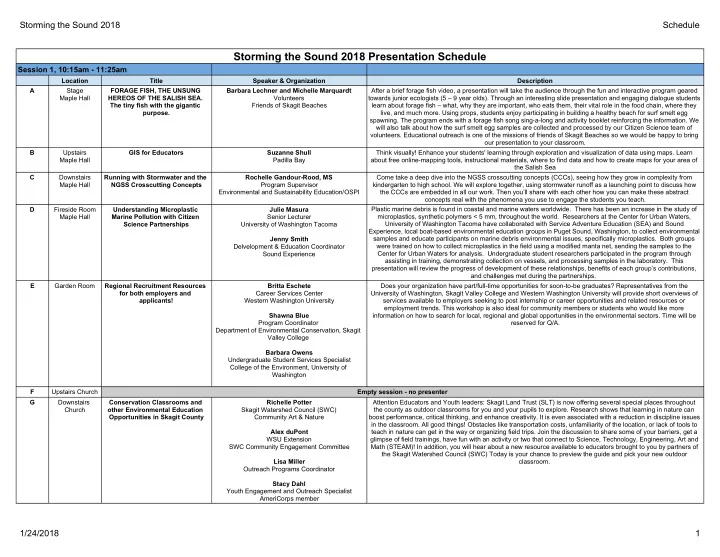
Storming the Sound 2018 Schedule Storming the Sound 2018 Presentation Schedule Session 1, 10:15am - 11:25am Location Title Speaker & Organization Description A Stage FORAGE FISH, THE UNSUNG Barbara Lechner and Michelle Marquardt


slide-1
SLIDE 1

Storming the Sound 2018 Schedule 1 1/24/2018

Storming the Sound 2018 Presentation Schedule

Session 1, 10:15am - 11:25am

Location Title Speaker & Organization Description A Stage Maple Hall FORAGE FISH, THE UNSUNG HEREOS OF THE SALISH SEA. The tiny fish with the gigantic purpose. Barbara Lechner and Michelle Marquardt Volunteers Friends of Skagit Beaches After a brief forage fish video, a presentation will take the audience through the fun and interactive program geared towards junior ecologists (5 – 9 year olds). Through an interesting slide presentation and engaging dialogue students learn about forage fish – what, why they are important, who eats them, their vital role in the food chain, where they live, and much more. Using props, students enjoy participating in building a healthy beach for surf smelt egg

  • spawning. The program ends with a forage fish song sing-a-long and activity booklet reinforcing the information. We

will also talk about how the surf smelt egg samples are collected and processed by our Citizen Science team of

  • volunteers. Educational outreach is one of the missions of friends of Skagit Beaches so we would be happy to bring
  • ur presentation to your classroom.

B Upstairs Maple Hall GIS for Educators Suzanne Shull Padilla Bay Think visually! Enhance your students' learning through exploration and visualization of data using maps. Learn about free online-mapping tools, instructional materials, where to find data and how to create maps for your area of the Salish Sea C Downstairs Maple Hall Running with Stormwater and the NGSS Crosscutting Concepts Rochelle Gandour-Rood, MS Program Supervisor Environmental and Sustainability Education/OSPI Come take a deep dive into the NGSS crosscutting concepts (CCCs), seeing how they grow in complexity from kindergarten to high school. We will explore together, using stormwater runoff as a launching point to discuss how the CCCs are embedded in all our work. Then you’ll share with each other how you can make these abstract concepts real with the phenomena you use to engage the students you teach. D Fireside Room Maple Hall Understanding Microplastic Marine Pollution with Citizen Science Partnerships Julie Masura Senior Lecturer University of Washington Tacoma Jenny Smith Delvelopment & Education Coordinator Sound Experience Plastic marine debris is found in coastal and marine waters worldwide. There has been an increase in the study of microplastics, synthetic polymers < 5 mm, throughout the world. Researchers at the Center for Urban Waters, University of Washington Tacoma have collaborated with Service Adventure Education (SEA) and Sound Experience, local boat-based environmental education groups in Puget Sound, Washington, to collect environmental samples and educate participants on marine debris environmental issues, specifically microplastics. Both groups were trained on how to collect microplastics in the field using a modified manta net, sending the samples to the Center for Urban Waters for analysis. Undergraduate student researchers participated in the program through assisting in training, demonstrating collection on vessels, and processing samples in the laboratory. This presentation will review the progress of development of these relationships, benefits of each group’s contributions, and challenges met during the partnerships. E Garden Room Regional Recruitment Resources for both employers and applicants! Britta Eschete Career Services Center Western Washington University Shawna Blue Program Coordinator Department of Environmental Conservation, Skagit Valley College Barbara Owens Undergraduate Student Services Specialist College of the Environment, University of Washington Does your organization have part/full-time opportunities for soon-to-be graduates? Representatives from the University of Washington, Skagit Valley College and Western Washington University will provide short overviews of services available to employers seeking to post internship or career opportunities and related resources or employment trends. This workshop is also ideal for community members or students who would like more information on how to search for local, regional and global opportunities in the environmental sectors. Time will be reserved for Q/A. F Upstairs Church Empty session - no presenter G Downstairs Church Conservation Classrooms and

  • ther Environmental Education

Opportunities in Skagit County Richelle Potter Skagit Watershed Council (SWC) Community Art & Nature Alex duPont WSU Extension SWC Community Engagement Committee Lisa Miller Outreach Programs Coordinator Stacy Dahl Youth Engagement and Outreach Specialist AmeriCorps member Attention Educators and Youth leaders: Skagit Land Trust (SLT) is now offering several special places throughout the county as outdoor classrooms for you and your pupils to explore. Research shows that learning in nature can boost performance, critical thinking, and enhance creativity. It is even associated with a reduction in discipline issues in the classroom. All good things! Obstacles like transportation costs, unfamiliarity of the location, or lack of tools to teach in nature can get in the way or organizing field trips. Join the discussion to share some of your barriers, get a glimpse of field trainings, have fun with an activity or two that connect to Science, Technology, Engineering, Art and Math (STEAM)! In addition, you will hear about a new resource available to educators brought to you by partners of the Skagit Watershed Council (SWC) Today is your chance to preview the guide and pick your new outdoor classroom.

slide-2
SLIDE 2

Storming the Sound 2018 Schedule 2 1/24/2018

Session 2, 1:15pm - 2:25pm

Location Title Speaker & Organization Description A Stage Maple Hall What's Your Story: What makes an effective press release, printed article or a social media posting? Ken Stern Publisher and Editor The La Conner Weekly News Bill Reynolds Reporter The La Conner Weekly News Don Coyote Photographer The La Conner Weekly News Amy Nelson Bellingham-based freelance journalist for online, print and broadcast media Mike Sato Creator of Salish Sea Communications: Truth Well Told, publisher of the daily e-digest “Salish Sea News” Attend this session to learn from a variety of perspectives, and extensive knowledge bases with regards to what constitutes meaningful environmental journalism, effectively sharing what you’re doing, how environmental news coverage has changed over the last 30 years, and looking forward. Participating in this session are representatives whose careers have included founders/publishers of weekly newspapers, editors/reporters/photographers, public relations management and communication directors working within private, public and not-for-profit sectors. B Upstairs Maple Hall STEM Outreach and Education with the Salish Sea Research Center Thayne A. Yazzie STEM Education Outreach Coordinator Northwest Indian College The Salish Sea Research Center (SSRC), located at Northwest Indian College, helps students and faculty combine cultural knowledge and traditional and non-traditional scientific methods to question, observe, and understand the natural environment. During this time, the SSRC has worked to build a bridge with science research and student communities; specifically, elementary and middle school students. DIY Plankton Nets, Ocean Acidification Labs, Water Filters, DIY Rovers and a Marine Food Web Card Game which helps students identify local animal species (including common phytoplankton and harmful algae species) teaches trophic levels, food webs, energy conservation, and includes cultural artwork and indigenous language. The SSRC is committed to conducting environmental research and STEM outreach that incorporates traditional and cultural perspectives in emergence with Western and Indigenous science. C Downstairs Maple Hall Plastics in our Watersheds –> Micro- and Macro-Plastics in Puget Sound! Heather Trim Executive Director Zero Waste Washington There is growing evidence of plastics – both macro and micro-plastics – in Puget Sound waters, including in salmon, birds and shellfish. There is, however, a big data gap! We don’t have good data about the land-based sources, including quantities and types of plastics. A collaborative approach to fill this gap is launching this winter: a Puget Sound-wide effort to quantify plastics coming in stormwater and freshwater from our watersheds. Come learn about the plastics issue, recent scientific results from Puget Sound, and worldwide context. Find out how you can participate in piloting the new assessment in your area! This is a great project for volunteers, community groups and

  • students. This session will include facts and info about plastics that you can use in your work.

D Fireside Room Maple Hall Stain Resistant Fish and Wildlife: Toxic PFAS Chemicals Contaminate Puget Sound Basin Nancy Uding Program Director Toxic-Free Future Highly fluorinated PFAS chemicals (PFCs or Teflon-like chemicals) are gaining new attention as a global toxic contaminant of concern. PFAS have stain resistant and water resistant properties and are widely used in clothing, carpeting, fire fighting foams, furniture, food packaging, and in many industrial applications. PFAS have been linked with cancer, hormone-disruption, and immune system effects and they are highly persistent and bioaccumulative. PFAS have been detected in the surface waters of Puget Sound, in lakes and streams in Washington, in wastewater treatment effluent, in freshwater fish, in salmon, and in osprey eggs. And they have been detected in almost 100% of people tested. Come learn about PFAS and ways that you can help tackle this timely toxic threat. E Garden Room The Meltese Dodo: A Murder Mystery Thriller Through Climate Science History Sharon Abreu Executive & Artistic Director Irthlingz Arts-Based Environmental Education 501(c) (3) Michael Hurwicz Author of The Meltese Dodo President, Irthlingz Arts-Based Environmental Education This workshop is a participatory reading of Michael Hurwicz's new radio play, The Meltese Dodo. The story tells the history of climate change science through a loose parody of The Maltese Falcon. The radio play is an adaptation of Hurwicz's book, The Meltese Dodo, published in 2016 (http://MelteseDodo.com), recommended by the National Science Teachers Association. It has not yet been performed, so this will be a fun and interactive launch. Characters include The Earth, The Sun, a femme fatale known as Homo Sapiens, some 19th century geniuses, a yeast, a mold, and a sand flea. There are 28 characters. If there are more participants, parts can be shared. All ages are encouraged to participate! The Meltese Dodo books and some CDs with environmental songs will be available for purchase during the session.

slide-3
SLIDE 3

Storming the Sound 2018 Schedule 3 1/24/2018

F Upstairs Church PacMam: Research and Education with a Porpoise

  • Dr. Cindy Elliser

Research Director Pacific Mammal Research Katrina MacIver, MRes Research Assistant Pacific Mammal Research Pacific Mammal Research (PacMam) is a scientific research organization based in Anacortes that studies free- ranging marine mammals in the Salish Sea, but also provides quality educational opportunities for all ages. Through research and education PacMam seeks to increase, apply and share knowledge about Salish Sea marine mammals and their environment. Our primary study is the long-term tracking of individual harbor porpoises and harbor seals through photo-identification to understand more about their life history, behavior, social structure and ecology. This type of information is crucial for their conservation and protection. But equally important is public awareness and education – you cannot save what you don’t know. To this end PacMam informs the public, from ages pre-K to 90+, through educational outlets such as presentations, hands-on classroom and field activities, workshops, and "marine biologist for a day" experiences. We have the ability to connect students to real-world research being conducted in their community; a powerful tool to get them excited about science and STEM topics. In this presentation you will learn more about PacMam and the research we conduct, as well as how we connect our research to enhance the educational outreach experiences we provide. G Downstairs Church How can we improve Equity, Diversity, and Inclusion in our youth programs? Ellie Price North Cascades Institute This is a workshop on identifying and discussing where organizations can improve in equity, diversity, and inclusion in their youth programs. We will be answering the question: How can we make our organizations and programs more accessible and relevant to the diversity of people that live in your region? I will be using the Youth Ambassadors program that I coordinate as a case study and we will define and discuss equity, diversity, inclusion, as well our role as gatekeepers. The audience will be asked to identify where they would like to improve Equity, Diversity, and Inclusion at their organization, share out their needs, and create action items they can use to work on increasing Equity, Diversity, and Inclusion in their own organizations.

Session 3, 2:40pm - 3:50pm

Location Title Speaker & Organization Description A Stage Maple Hall Interdisciplinary Extensions for Teaching Watershed Science Kyle Bradshaw Education Coordinator Nooksack Salmon Enhancement Association Vilina Sanburn-Bill Education Coordinator Nooksack Salmon Enhancement Association Educators Vilina Sanburn-Bill and Kyle Bradshaw teach watershed science and salmon ecology to elementary aged children in Whatcom County. They plan to share four interdisciplinary extension lessons that they use in their

  • classrooms. These lessons can be used by formal and informal educators to teach watershed science, however, this

presentation is applicable to anyone who is interested in watershed science or wants to have some more tools in their back pocket. Come and learn some tools for teaching while having some fun yourself! B Upstairs Maple Hall Survive the Sound: Merging Science, Art and Technology to Save Endangered Steelhead Lucas Hall Long Live the Kings Casey Ralston NOAA Fisheries Chinook and coho salmon and steelhead populations in the Salish Sea have declined by up to 90%. Come learn about the Salish Sea Marine Survival Project and get a sneak peek of Survive the Sound: an interactive web interface that uses fun imagery and real data from acoustically tagged, migrating juvenile steelhead to engage students in learning about the challenges young fish face as they head for the ocean. Find out how classrooms can follow along during the next race for survival in May 2018. C Downstairs Maple Hall Marine Renewable Energy Curriculum and collaboration Molly Grear PhD candidate University of Washington Civil and Environmental Engineering This presentation will give a brief overview of tools and ideas to get teachers thinking about how to incorporate renewable energy from the ocean into their curriculum. I will also describe opportunities for partnering with UW students, as well as how to incorporate social, economic, and environmental considerations into engineering design. D Fireside Room Maple Hall Green STEM: STEM connections through the lens of sustainability correlated with Standards Courtney Sullivan Senior Manager, Regional Education Northern Rockies, Prairies, and Pacific Region National Wildlife Federation There is significant evidence that environment-based education can become a significant part of the STEM solution. To meet the goal of fostering STEM understanding, we must rethink how we prepare and support our teachers and how we engage, motivate, and promote STEM to our K-12 students. The National Wildlife Federation's Eco-Schools USA is a holistic program that strives to make environmental awareness and action an intrinsic part of the life and culture of a school. This global program is transformative, not additive; it is a transformation in your pedagogical approach to teaching. We’ve worked the three major sets of national standards: National Science Education Standards, the Next Generation Science Standards/Washington State K-12 Science Learning Standards, the Common Core State Standards, and the WA Integrated Environmental and Sustainability K–12 Learning Standards to assist educators in weaving the Eco-Schools USA program into the existing curriculum to support Green STEM teaching. E Garden Room 15 Strategies for Keeping Your Audience Awake, Alert, and Inter- Active Cathy Angell Padilla Bay This interactive, fast-paced session will give you simple tools for making your presentations effective and engaging. You will learn how to present visuals that have impact; deliver data in a way that sticks in people’s brains; and design PowerPoint presentations that won’t leave the audience feeling bored and disconnected. The session is grounded in scientific research and academic principles for how adults learn best. Cathy has given this presentation to enthusiastic audiences of agency educators, scientists, and communication staff. Her material comes from a class she teaches called “How to Explain Science, Share Data, and Build Trust: Presentation Skills for Scientists and Public Officials.” Cathy is the Coastal Training Program Coordinator for the Padilla Bay Reserve and Department of Ecology in Washington State. She recently received a national award for transformative communications.

slide-4
SLIDE 4

Storming the Sound 2018 Schedule 4 1/24/2018

F Upstairs Church Car*less Commuting, that’s how we roll into a carbon-less future. Maribeth Crandell Island Transit Mobility Specialist Transportation is responsible for roughly 28% of Greenhouse gas emissions. How do we plan for a carbon-less future on a city scale, town scale and a human scale? See local examples of people friendly habitats that encourage low carbon living. Examine transportation options and technologies that steer us away from single occupancy

  • vehicles. Share your ideas, concerns and experiences. Save money, get exercise, make friends, pollute less and

enjoy your commute. Let’s discover what happens when we bus, bike or walk our talk. Maribeth Crandell has walked, biked and bused to work for a decade. She’s taken some low carbon vacations in the Northwest and beyond. Now she works as Mobility Specialist for Island Transit, to spread the joy, share the love of public transit. G Downstairs Church Miniature Worm Bins as Teaching Tools for Classrooms Callie Martin Waste Reduction/Recycling Education Specialist Skagit County Public Works-Solid Waste Division Red Wriggler worms are fun and helpful friends. Watch and learn how these worms turn apples cores, and banana peels into compost. Learn how to put together a mini worm bin for your classroom, and how to manage it

  • successfully. Worm bins are excellent tools to teach about food waste reduction in school cafeterias, life cycle

science and decomposition, as well as soil building and crop science for a school garden. This session will show you how to make composting simple and dynamic in a working classroom environment.