
1
Storage
Jeff Chase Duke University
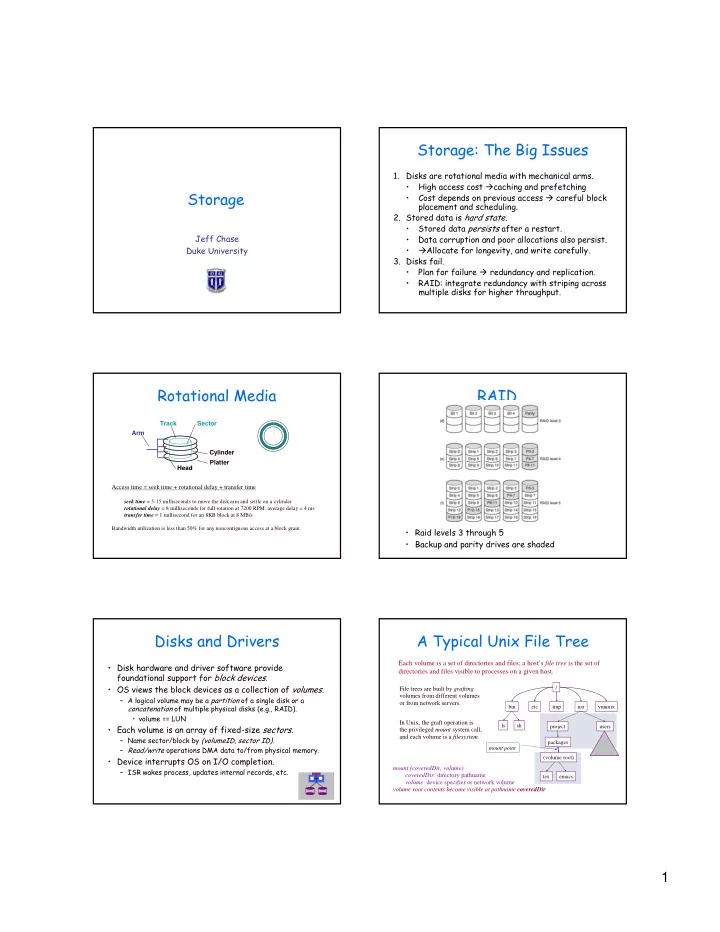
Storage: The Big Issues
1. Disks are rotational media with mechanical arms.
- High access cost caching and prefetching
- Cost depends on previous access careful block
placement and scheduling.
- 2. Stored data is hard state.
- Stored data persists after a restart.
- Data corruption and poor allocations also persist.
- Allocate for longevity, and write carefully.
- 3. Disks fail.
- Plan for failure redundancy and replication.
- RAID: integrate redundancy with striping across
multiple disks for higher throughput.
Rotational Media
Sector Track Cylinder Head Platter Arm Access time = seek time + rotational delay + transfer time
seek time = 5-15 milliseconds to move the disk arm and settle on a cylinder rotational delay = 8 milliseconds for full rotation at 7200 RPM: average delay = 4 ms transfer time = 1 millisecond for an 8KB block at 8 MB/s Bandwidth utilization is less than 50% for any noncontiguous access at a block grain.
RAID
- Raid levels 3 through 5
- Backup and parity drives are shaded
Disks and Drivers
- Disk hardware and driver software provide
foundational support for block devices.
- OS views the block devices as a collection of volumes.
– A logical volume may be a partition of a single disk or a concatenation of multiple physical disks (e.g., RAID).
- volume == LUN
- Each volume is an array of fixed-size sectors.
– Name sector/block by (volumeID, sector ID). – Read/write operations DMA data to/from physical memory.
- Device interrupts OS on I/O completion.
– ISR wakes process, updates internal records, etc.
A Typical Unix File Tree
/ tmp usr etc
File trees are built by grafting volumes from different volumes
- r from network servers.
Each volume is a set of directories and files; a host’s file tree is the set of directories and files visible to processes on a given host.
bin vmunix ls sh project users packages (volume root) tex emacs
In Unix, the graft operation is the privileged mount system call, and each volume is a filesystem.
mount point
mount (coveredDir, volume) coveredDir: directory pathname volume: device specifier or network volume volume root contents become visible at pathname coveredDir