Stokes waves with constant vorticity: Numerical computation Vera - - PowerPoint PPT Presentation

stokes waves with constant vorticity numerical computation
SMART_READER_LITE
LIVE PREVIEW

Stokes waves with constant vorticity: Numerical computation Vera - - PowerPoint PPT Presentation

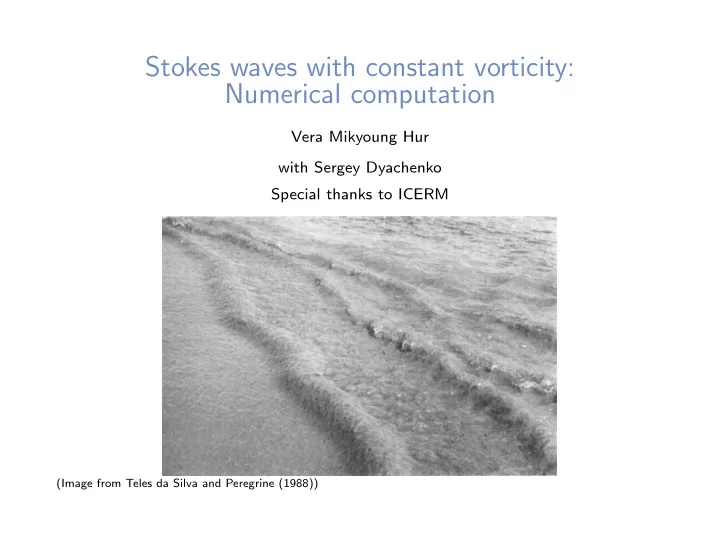
Stokes waves with constant vorticity: Numerical computation Vera Mikyoung Hur with Sergey Dyachenko F . Trlrs do, Silva (md I ) . 298 A . 11. Peregrine Special thanks to ICERM (Image from Teles da Silva and Peregrine (1988)) FICCKE 1.5. X


slide-1
SLIDE 1

Stokes waves with constant vorticity: Numerical computation

Vera Mikyoung Hur with Sergey Dyachenko Special thanks to ICERM

298 A . F . Trlrs do, Silva (md I ) .

  • 11. Peregrine

FICCKE

1.5. X surfwe shear wavr occurring naturally in backwash on a beach.

described in Peregrine (1974). That model was stimulated by the observation of steep large rounded waves in the backwash of waves incident on beaches. Such a wave arising naturally is shown in the photograph of figure 15. Another surface shear wave also described in Peregrine (1974) is the ‘wave hydraulic jump’ (see also discussion

  • f that paper).

Both of these waves are easily reproduced in the laboratory, and are usually almost stationary on a fast moving strcam. They occur over fixed beds. but also seem to have a counterpart in supercritical flow over antidunes on a mobile bed. Peregrine’s (1974) model does not depend on a specific vorticity distribution but simply characterizes the thin sheet of surface water by its momentum flux and considers its deflection due to hydrostatic pressure in the almost stagnant water beneath it. The ordinary differential equation so obtained for the shape of the wave is the same as that for the finite bending of a thin beam or elastiea. This gives an easy way of comparing Peregrine‘s solution with the figures in this paper : just take a piece

  • f paper or card and bend it whilst holding it at each side. Comparison with figure 14

will show that most of the wave closely follows such a curve. The pressurc field in figure 14(b) is easily interpreted in terms of a high-speed surface flow. A high transverse pressure gradient is required to turn the flow sharply at the bast of the wave, hence the substantial excess pressures on the bed. Then over the main portion of the wave the pressure falls below atmospheric as in Peregrine’s (1974) model, and ‘sucks’ the surface jet around in a curve which is tighter than the corresponding free-fall parabola. As the jet ‘lands’ near the bed once again high pressure gradients turn it back into a horizontal flow. To some extent the constant vortieity flow here may be a better model than Peregrine’s for very steep waves over closed eddies. This is due to the Prandtl-Batchelor result that in two-dimensional high-Reynolds-number flow steady recirculating regions with closed streamlines have constant vorticity.

:DDAC 534B97 B95B7D7BC :DDAC B9 1 /378B:DDAC 534B97 B95B7 B27BCD04B3B,AB3DC475DDD:7.34B97.B7D7BC8C7333473D

(Image from Teles da Silva and Peregrine (1988))

slide-2
SLIDE 2

Stokes waves are

  • traveling waves
  • periodic
  • at the surface of an incompressible inviscid fluid = water
  • two dimensional
  • acted on by gravity (no surface tension)
  • infinitely deep or with a rigid flat bed
slide-3
SLIDE 3

In the irrotational setting

Stokes conjectured

4/23/2017 1280px-Stokes_wave_max_height.svg.png (1280×310) https://upload.wikimedia.org/wikipedia/commons/thumb/a/a5/Stokes_wave_max_height.svg/1280px-Stokes_wave_max_height.svg.png 1/1

(Image from Wikipedia)

Amick, Fraenkel, and Toland (1982) proved that such a corner wave exists. Recently, further advances — analytical and numerical — based on Babenko’s equation: λ2H y1 “ y ` yH y1 ` H pyy1q,

y “ fluid surface, λ “ Froude number, H “ Hilbert transform.

slide-4
SLIDE 4

In the rotational setting

Constantin and Strauss (2004) worked out global bifurcation for general vorticities. Solutions do not permit critical layers, or internal stagnation. Wahl´ en (2009) observed them for constant vorticities.

slide-5
SLIDE 5

For constant vorticities

Constantin, Strauss, and Varvaruca (2014) worked out global bifurcation, permitting overhanging, critical layers, and internal stagnation. They conjectured that the limiting wave is:

  • r

By the way, the proof is non-constructive. Our goal is to numerically study the conjecture.

slide-6
SLIDE 6

Earlier works include

  • Simmen and Saffman (1985),
  • Teles da Silva and Peregrine (1988),
  • Vanden-Broeck (1994, 1996), ....

See also

  • Vasan and Oliveras (2014),
  • Ribeiro, Milewski, and Nachbin (2017),...
slide-7
SLIDE 7

Formulation

284 A , E’. Teles da Silva and D. H . Peregrine FIGURE

  • 1. Sketches indicating wave direction and shear profile. On the left (i) is the configuration

we use, and on the right (ii) the equivalent wave stationary on a stream. (a) Wave propagating upstream, positive vorticity. (b) Wave propagating downstream, negative vorticity.

Using (2.9) and comparing with the undisturbed flow we can interpret (2.10) as showing that the waves travel symmetrically with respect to thc flow at a depth

c :

tanh (kh)

W = - =

29 2k

(2.11) which gives a measure of the depth of water which influences the wave properties, or ‘wave depth’. The limiting values of W for large and small kh are 6k-’ and ih

  • respectively. The right-hand side of (2.10) shows that shear increases the wave speed
  • f linearized waves.

A critical layer occurs in the flow if at any depth

c =

  • 5Y,

let h, =

c / <

be the critical layer depth. Substitution in the linear dispersion equation (2.8) and use of the wave depth, W , gives h, = W+W(l+&), for linear waves. Thus if then: is a critical layer it is always at a depth greater than 2W, and then

  • nly ncar 2W for strong shcars. Critical laycrs only occur for waves propagating

‘ upstream ’, and when (2.12) In order to fix ideas we shall only consider positive values of c and k but allow 5 to have either sign. For convenience of description we shall refer to ‘upstream’ and ‘downstream ’ in the sense of waves propagating on a flowing stream with maximum velocity at the surface. See figure 1 (a) in which our configuration for 5 positive is shown and tho effect of a stream giving wave propagation ‘upstream’. Similarly figure l(6) shows 5 negative and the corresponding ‘downstream’

  • propagation. The

downstream case is equivalent to downwind propagation for the case of a shear generated by the wind.

:DDAC 534B97 B95B7D7BC :DDAC B9 1 /378B:DDAC 534B97 B95B7 B27BCD04B3B,AB3DC475DDD:7.34B97.B7D7BC8C7333473D

284 A , E’. Teles da Silva and D. H . Peregrine FIGURE

  • 1. Sketches indicating wave direction and shear profile. On the left (i) is the configuration

we use, and on the right (ii) the equivalent wave stationary on a stream. (a) Wave propagating upstream, positive vorticity. (b) Wave propagating downstream, negative vorticity.

Using (2.9) and comparing with the undisturbed flow we can interpret (2.10) as showing that the waves travel symmetrically with respect to thc flow at a depth

c :

tanh (kh)

W = - =

29 2k

(2.11) which gives a measure of the depth of water which influences the wave properties, or ‘wave depth’. The limiting values of W for large and small kh are 6k-’ and ih

  • respectively. The right-hand side of (2.10) shows that shear increases the wave speed
  • f linearized waves.

A critical layer occurs in the flow if at any depth

c =

  • 5Y,

let h, =

c / <

be the critical layer depth. Substitution in the linear dispersion equation (2.8) and use of the wave depth, W , gives h, = W+W(l+&), for linear waves. Thus if then: is a critical layer it is always at a depth greater than 2W, and then

  • nly ncar 2W for strong shcars. Critical laycrs only occur for waves propagating

‘ upstream ’, and when (2.12) In order to fix ideas we shall only consider positive values of c and k but allow 5 to have either sign. For convenience of description we shall refer to ‘upstream’ and ‘downstream ’ in the sense of waves propagating on a flowing stream with maximum velocity at the surface. See figure 1 (a) in which our configuration for 5 positive is shown and tho effect of a stream giving wave propagation ‘upstream’. Similarly figure l(6) shows 5 negative and the corresponding ‘downstream’

  • propagation. The

downstream case is equivalent to downwind propagation for the case of a shear generated by the wind.

:DDAC 534B97 B95B7D7BC :DDAC B9 1 /378B:DDAC 534B97 B95B7 B27BCD04B3B,AB3DC475DDD:7.34B97.B7D7BC8C7333473D

downstream “ ´ vorticity upstream “ ` vorticity

(Figures from Teles da Silva and Peregrine (1983))

Let’s write the velocity p´ωy ´ c, 0q ` ∇φ, ω “ constant vorticity, c “ wave speed. The problem is written: ∆φ “ 0 in fluid, ψ ´ 1

2ωy2 ´ cy “ 0

at surface,

1 2pφx ´ ωy ´ cq2 ` 1 2φ2 y ` gy “ B

at surface, φy “ 0 at bed, ψ “ harmonic conjugate of φ, B “ Bernoulli constant.

slide-8
SLIDE 8

Reformulation via conformal mapping

fluid air

z = x+iy w = u +iv y “ ´h v “ ´d

physical domain conformal domain

The problem becomes pc ` ωpy ` yT y1 ´ T pyy1qqq2 p1 ` T y1q2 ` py1q2 “ B ` c2 ´ 2gy.

  • Definition. T peikuq “ ´i cothpkdqeiku

for k ‰ 0 an integer. Formally, T Ñ H as d Ñ 8.

slide-9
SLIDE 9

Reformulation to Babenko type

Use the fact: pT ` iqf is the boundary value of a holomorphic function in ´d ă v ă 0 whose imaginary part “ 0 at v “ ´d. The problem is written: pc2 ` 2BqT y1 ´ gy ´ cωy ´ gpyT y1 ` T pyy1qq ´1

2ω2py2 ` T py2y1q ` y2T y1 ´ 2yT pyy1qq “ xLHSy

and xpc ` ωpy ` yT y1 ´ T pyy1qqq2y “ xpB ` c2 ´ 2gyqpp1 ` T y1q2 ` py1q2qy subject to xyp1 ` T y1qy “ 0.

slide-10
SLIDE 10

Sample waves

wave speed

5 10 15 20 25 30 0.5 1 1.5 λ ω = 1.80 ω = 3.00 ω = 6.00 P Q R S

steepness; here d “ 1

  • 10
  • 8
  • 6
  • 4
  • 2

2 4 6

  • 8 -6 -4 -2 0 2 4 6 8

P ω = 3, c = 4.70

  • 10
  • 8
  • 6
  • 4
  • 2

2 4 6

  • 8 -6 -4 -2 0 2 4 6 8

Q ω = 3, c = 13.02

  • 10
  • 8
  • 6
  • 4
  • 2

2 4 6

  • 8 -6 -4 -2 0 2 4 6 8

R ω = 3, c = 27.20

  • 10
  • 8
  • 6
  • 4
  • 2

2 4 6

  • 8 -6 -4 -2 0 2 4 6 8

S ω = 3, c = 10.20

slide-11
SLIDE 11

How to compare with earlier works?

We reproduce Simmen and Saffman (1985):

wave speed steepness; here d “ 8

For Teles da Silva and Peregrine (1988), d “ xyy ` h.

slide-12
SLIDE 12

Limiting wave ‰ highest wave

(Figure from Simmen’s thesis (1984))

slide-13
SLIDE 13

Effects of large positive vorticities

  • 6
  • 4
  • 2

2 4 6

  • 6
  • 4
  • 2

2 4 6 η(x) x, spatial coordinate (I) (II)

  • 2
  • 1.5
  • 1
  • 0.5

0.5 1 1.5 2

  • 3
  • 2
  • 1

1 2 3 w = u + iv (I), c = 32.00 (II), c = 15.80 10-4 10-3 10-2 10-1 100

Waves (left) and singularities (right) for ω “ 6, d “ 1 and c “ 15.80 (red) and c “ 32.00 (green).

slide-14
SLIDE 14

New limiting wave?

  • 2
  • 1

1 2 3 4

  • 3
  • 2
  • 1

1 2 3 η(x) x2 = y3

slide-15
SLIDE 15

Some open problems

  • c is bounded throughout the solution curve?
  • c2 ` 2B ě 0 throughout the solution curve?
  • Any C1 solution is real analytic?