Steve Finkelstein Senior Partner and Ninaad Balachandran Intern - - PowerPoint PPT Presentation

steve finkelstein
SMART_READER_LITE
LIVE PREVIEW

Steve Finkelstein Senior Partner and Ninaad Balachandran Intern - - PowerPoint PPT Presentation

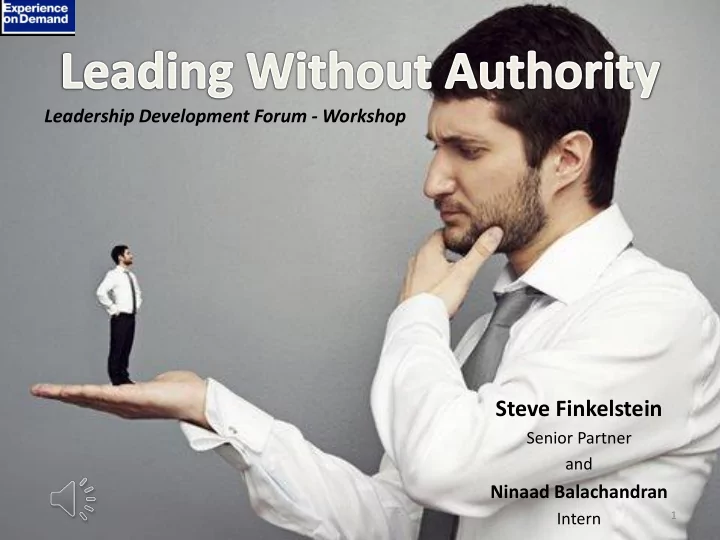
Leadership Development Forum - Workshop Steve Finkelstein Senior Partner and Ninaad Balachandran Intern 1 This Presentation May Impact Your Future Success 2 Overview Todays Objectives Key Definitions Principles to Follow


slide-1
SLIDE 1

Steve Finkelstein

Senior Partner and

Ninaad Balachandran

Intern

1

Leadership Development Forum - Workshop
slide-2
SLIDE 2

This Presentation May Impact Your Future Success

2

slide-3
SLIDE 3

Overview

  • Today’s Objectives
  • Key Definitions
  • Principles to Follow
  • Examples of Leading without Authority
  • How to Develop and Present Your Ideas
  • Examples of Developing and Presenting Ideas
  • Team Breakouts – How to Sell Ideas
  • Questions

3

slide-4
SLIDE 4

Today’s Objectives

  • To improve your ability to lead or influence

without authority.

  • To improve your ability to develop and sell

your ideas.

  • To build your self-confidence to influence and

lead.

4

slide-5
SLIDE 5

Audience Poll

  • What is your understanding of the concept of

leading without authority?

  • What is your confidence level in leading

without authority?

  • What is your confidence level in developing

and presenting your ideas?

On a Scale From 1(low) to 5(High)

5

slide-6
SLIDE 6

“Ninety-nine percent of all leadership

  • ccurs not from the top but from the

middle of an organization.”

John C. Maxwell, The 360° Leader

You may be able to grant someone a position, but you can not grant him real

  • leadership. Influence must be earned.”

John C. Maxwell, The 360° Leader

6

slide-7
SLIDE 7

Definition of Leadership

Leadership is the ability to influence

  • thers or have others follow you with
  • r without authority.
slide-8
SLIDE 8

Lead / Influence Without Authority

Background Situations Key Definitions

8

slide-9
SLIDE 9

Why The Need to Lead Without Authority?

  • Flatter or more lateral structures
  • Globalization
  • Competition
  • Cross-functional teams
  • Complexity of problems
  • Fewer middle managers

9

slide-10
SLIDE 10

Situations The Need to Lead Without Authority

  • You are heading a cross-functional team, but you

can not get everyone to cooperate

  • You are in the product development department
  • f your company but can not get the marketing

department to cooperate with you

  • You have a great idea, but you are in a lower
  • rganizational position and can not get

management to support your idea

  • You are struggling to get the attention of your

boss or peer on a particular issue

10

slide-11
SLIDE 11

Your Situations

  • Pushing a new product through development (why is this protocol

best, why is this better than other ideas, what is market)

  • Customer Service Situation - customer needs something (free

product, etc.) and manager is not available

  • Collaborative team is not working together, person not pulling

weight, therefore your work is not getting done. How to work through this, motivate/coach colleague?

  • Diplomacy - when product or protocol is failing, how do you tell

people that nicely? Closely tied to Solution Provider (below)

  • Solution Provider - when something is not working, and you need

to tell your boss, how do you come up with a plan of action before going to them? Better than just accepting defeat and asking them to solve problem for you.

  • Active Listening is important in science, and to build rapport

11

slide-12
SLIDE 12

Lead or Influence Without Authority

  • To influence, or even improve, the performance
  • f people without any formal control over

them.

  • To earn the trust and following of the people

around you in all situations.

  • To get others to do something because of the

vision you have created and not your title.

  • To strive to make the world around you better.

Lead or Influence Without Authority

12

slide-13
SLIDE 13

Barriers to Leading Without Authority

13

slide-14
SLIDE 14

Barriers

Time and Patience

Skills must be developed

  • ver time

Comfort Zone/Fear

Forced to do things outside the norm

Different Goals

Lack of compatable performance measures

Soft Skill Set

It is not something that comes naturally to everyone

Competition

Political, competitive environment

14

slide-15
SLIDE 15

Principles to Follow: Leading without Authority

15

slide-16
SLIDE 16

Principles to Follow

Leave egos at the door Enthusiasm is contagious Form a single body of authority

Create a Collaborative Environment

Have answers and examples to combat questions If you fail to plan, you plan to fail Have answers and examples to combat questions Know your audience

Be Prepared

Set objectives and measure along the way Motivate and communicate Avoid being

  • verinvested

in outcomes

Act as a Facilitator

16

slide-17
SLIDE 17

Example of Leading Without Authority

Research – Skill Gaps

17

slide-18
SLIDE 18

Why do companies hire so many consultants?

18

slide-19
SLIDE 19

Business Issues

19

50% to 60% of new hires lack these soft skills 50% to 60% of existing workforce lack these soft skills The skill-gaps continue and are getting wider

slide-20
SLIDE 20

What’s the Value Proposition to UMSL?

20

1

  • UMSL is the #1 provider of graduates to

the St. Louis workforce 2

  • Better prepare students for the workforce

3

  • Branding as a leader in higher education –

publish research

slide-21
SLIDE 21

Project Results

  • Conducted and published research in 2008,

2010 and 2012

  • Added a new class – Project Execution

21

slide-22
SLIDE 22

Skill Gap Story

22

slide-23
SLIDE 23

2012 Results - Critical Skills & Skill Gaps

23

Skill Gaps

  • 1. Leadership
  • 2. Communication – Written
  • 3. Mentoring
  • 4. Strategic Planning / Strategic thinking
  • 5. Critical/Analytical Thinking
  • 6. Active Listening
  • 7. Presentation Skills
  • 8. Creativity / Innovation
  • 9. Customer Service / Relationship –

Internal

  • 10. Decision Making

Critical Skills

  • 1. Communication – Oral
  • 2. Communication – Written
  • 3. Active Listening
  • 4. Teamwork/Collaboration

5.Time Management

  • 6. Prioritization, Focus
  • 7. Customer Service / Relationship –

External 8.Critical/Analytical Thinking

  • 9. Decision Making
  • 10. Customer Service / Relationship –

Internal

slide-24
SLIDE 24

How to Develop and Present / Sell Your Ideas

24

slide-25
SLIDE 25

Identify and Analyze the Issues

  • “If I were given one hour to save the planet, I

would spend 59 minutes defining the problem and one minute resolving it,” - Albert Einstein

Define the Problem Define the Need Define the Options Evaluate the Options

Present Recommen dation

25

slide-26
SLIDE 26

The Qwerty vs Dvorak Keyboard

Qwerty Keyboard Qwerty Keyboard

Dvorak proponents claim the Dvorak layout uses less finger motion, increases typing rate, and reduces errors compared to the standard Qwerty keyboard. Wikipedia

26

slide-27
SLIDE 27

Edison and Electric Lamps

27

slide-28
SLIDE 28

Stage Gate Process Develop and Assess Options

Problem Specification Feasibility Value and Endurance Acceptability

28

slide-29
SLIDE 29

Present and Follow Through

  • Clearly state the problem or issue
  • Reach a common understanding

Define Objective

  • Do nothing option
  • What are the 3 or 4 best options?

Develop Alternatives

  • What are the Pros and Cons for each?
  • What are the financials – cost and benefits?

Evaluate Alternatives

  • Review the analysis of the options,
  • What is the #1 recommendation? Include the

implementation plan

Make Recommendation

  • Make presentation to management
  • Recommendation approved

Decision/Approval

29

slide-30
SLIDE 30

PROCESS – SELLING AN IDEA

EXAMPLE TEAM BREAKOUTS

30

slide-31
SLIDE 31

Define Objectives - Current Situation

Issue: In order to get to work for my new job, I need a means of transportation as I live 30 miles away Objective: To find a cost-effective, and time-efficient solution to my transportation needs in order to get to work for my new job

31

slide-32
SLIDE 32

Alternatives

  • Alternative 1 – Do Nothing
  • Alternative 2 – Use public transportation
  • Alternative 3 – Buy a new car
  • Alternative 4 – Lease a car
  • Alternative 5 – Buy a used car

32

slide-33
SLIDE 33

Alternative 1 – Do Nothing

Pro’s

  • Save on money
  • May be able to work

from home

  • Save time spent on the

road Con’s

  • May lose my job
  • Tough to coordinate

with people at work from home

  • Haven’t found a means

to travel to other places

33

slide-34
SLIDE 34

Alternative 2 – Use Public Transportation

Pro’s

  • Keep my job
  • Save on money on costs

associated with a car Con’s

  • Restricted by the timing
  • f public transportation
  • Can not travel to all

places with public transportation

34

slide-35
SLIDE 35

Alternative 3 – Buy a New Car

Pro’s

  • Keep my job
  • Investment in a new car
  • Can travel to work and
  • ther places
  • Don’t have to worry

about issues with car maintenance Con’s

  • Car loans – Large, 60

months

  • Affordability
  • Have to travel 30 miles

each way

  • Other costs – gas,

insurance, etc.

35

slide-36
SLIDE 36

Alternative 4 – Lease a Car

Pro’s

  • Keep my job
  • Can travel to work and
  • ther places
  • Don’t have to worry

about issues with car maintenance Con’s

  • Affordability
  • Have to travel 30 miles

each way

  • Other costs – gas,

insurance, etc.

36

slide-37
SLIDE 37

Alternative 5 – Buy a Used Car

Pro’s

  • Keep my job
  • Can travel to work and
  • ther places
  • Investment in a used

car Con’s

  • Car loans – Small, 24

months

  • Affordability
  • Have to travel 30 miles

each way

  • Other costs – gas,

insurance, etc.

  • Maintenance Costs

37

slide-38
SLIDE 38

2 3 4 5 Evaluation Criteria 1 to 5 1 to 5 1 to 5 1 to 5 1 to 5 Cost 5 4 1 1 3 Affordability 5 4 2 2 3 Convenience 1 2 4 4 4 How well it addresses the issue 1 2 5 5 5 Timing of Option 2 4 4 4 4 16 19 16 16 Ranking 1 Alternatives 12

Alternatives Analysis - Summary

38

slide-39
SLIDE 39

Alternative # - Financials Example

Comments/Desription Total Yr 1 Yr 2 Yr 3

Benefits One Time Benefits

Rev enue 200 120 50 30 xx 200 120 50 30 xx 200 120 50 30 xx 200 120 50 30 Total One Time Benefits 800 $ 480 $ 200 $ 120 $ 800 $

Ongoing Benefits

Rev enue 200 120 50 30 xx 200 120 50 30 xx 200 120 50 30 xx 200 120 50 30 Total Ongoing Benefits 800 $ 480 $ 200 $ 120 $ Total Benefits 1,600 $ 960 $ 400 $ 240 $ Total

Costs One-Time Costs

Costs 100 20 50 30 xx 100 20 50 30 xx 100 20 50 30 xx 100 20 50 30 Total One Time Costs 400 $ 80 $ 200 $ 120 $

Ongoing Costs

Costs 100 20 50 30 xx 100 20 50 30 xx 100 20 50 30 xx 100 20 50 30 Total Ongoing Costs 400 $ 80 $ 200 $ 120 $ Total Costs 800 $ 160 $ 400 $ 240 $

Net Benefits

800 $ 800 $

  • $
  • $

Comments: Net Present Value Payback

Summary - Business Case Template

Tangible Net Benefits

39

slide-40
SLIDE 40

Recommendation – Alternative #5

  • Address Needs

– I now have a way of getting to work for my new job and also

  • ther places

– I do not risk losing my job

  • Cost/Affordability

– A used car is not as expensive as a new car

  • Convenience

– It is convenient as I do not have to rely on others

  • Timing

– I can get the car within 30 days which is before I start my new job

  • Other Benefits

– I can sell the car in the future

40

slide-41
SLIDE 41

30/60/90 Day Plan - Recommendation

Ref # Project/Action Steps

Responsibility Wk 1 Wk 2 Wk 3 Wk 4 Wk 5 Wk 1 1

Research various used car dealerships

Me

2

Determine 2- 5 cars to look at

Me

3

Visit dealers to test drive cars

Me 4

Decide on one car to buy

Me 5

Finalize deal

Me

6

Check financing

Me

7

Get insurance

Me 8

Start work

Me 9/1 August

30/60/90 Day Plan

41

slide-42
SLIDE 42

Team Breakouts – Preparing a Presentation to Sell an Idea

42

40 minutes

slide-43
SLIDE 43

Team Break-Outs – 40 Minutes

  • 1. Break into teams: 6 to 10 each
  • 2. Teams share their individual ideas to sell
  • 3. Each team selects 1 idea from the group for the

exercise

  • 4. Each team prepares a presentation to present their

idea

1. Using wall charts provided 2. Each team will have: Facilitator, Scribe, Presenter

  • 5. Each team will make their presentation
  • 6. Group discussion on lessons learned
  • 7. Each individual completes start, stop and continue

43

slide-44
SLIDE 44

Wall Charts

44

slide-45
SLIDE 45

Resistance Checklist

Criteria for Resistance to Change Ideal Setting Your Idea

Compatibility – Ability to work with pre-existing technologies High High/Med/Low Reversibility – Ability to go back to pre-existing technologies upon introduction High High/Med/Low Risk – The dangers associated with it Low High/Med/Low Complexity – Intricacy of the idea Low High/Med/Low Marketability – Ability to sell the idea to the public High High/Med/Low Relative Advantage vs. Disadvantage – Pros vs. Cons High High/Med/Low Realization – Ability of the idea to be executed High High/Med/Low Acceptability – How much the public will like the idea High High/Med/Low Perceived Need – How well it addresses the issue High High/Med/Low Continuity – Ability to conform to pre-existing habits High High/Med/Low Temporary Fad – Long-term future of the idea Low High/Med/Low 45

slide-46
SLIDE 46

Start, Stop and Continue

Start Stop Continue

46

slide-47
SLIDE 47

Audience Poll

  • What is your understanding of the concept of

leading without authority?

  • What is your confidence level in leading

without authority?

  • What is your confidence level in developing

and presenting your ideas?

On a Scale From 1(low) to 5(High)

47

slide-48
SLIDE 48

48

slide-49
SLIDE 49

Reference Material

49

slide-50
SLIDE 50

Contact Information

Steve Finkelstein Senior Partner 314-409-6869

steve.finkelstein@experience-on-demand.com Visit Us at: www.experience-on-demand.com

50