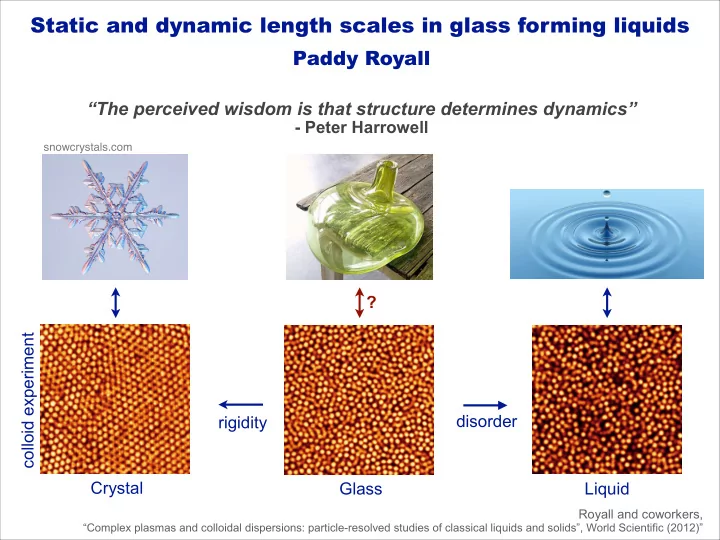
SLIDE 1 Static and dynamic length scales in glass forming liquids
“The perceived wisdom is that structure determines dynamics”
Liquid rigidity disorder Crystal Glass
Royall and coworkers,
“Complex plasmas and colloidal dispersions: particle-resolved studies of classical liquids and solids”, World Scientific (2012)” snowcrystals.com
Paddy Royall
? colloid experiment
SLIDE 2
Acknowledgements
Jens Eggers
Andrew Dunleavy Alex Malins
Thomas Speck (Mainz)
Stephen Williams (Canberra)
Karoline Wiesner
Jade Taffs
Hajime Tanaka
(Tokyo)
Tannie Liverpool Ryoichi Yamamoto (Kyoto) Rhiannon Pinney
Alex Malins
Hajime Tanaka (Tokyo) Andrew Dunleavy
Royall group, Bristol, England
SLIDE 3 The Plan Why do we expect structure to play a role in the glass transition?
- How do we measure - and identify - the relevant structure?
- Is structure really a cause for slow dynamics?
- coincidence of structural and dynamic length scales
- structural correlations in the isoconfigurational ensemble
- vitrification by changing structure - the µ-ensemble
- Royall/Structure
SLIDE 4 The Angell plot
inspired by Angell J. Non-Cryst. Solids 102, 205–221 (1988)
lines are VFT fits
HS hard sphere colloids strong fragile
Royall/Structure
Richert and Angell JCP 108, 9016 (1998)
Fragility->more than one form of relaxation
Fulcher-Tamman (VFT)
Hard spheres : equivalent to T is reduced presssure
Berthier and Witten PRE 80 021502 (2009)
Pressure from Carnahan-Starling EoS
KA HS Wahnstrom
SLIDE 5 The Angell plot
lines are VFT fits
HS hard sphere colloids strong fragile
Royall/Structure
Fragility->more than one form of relaxation
Fulcher-Tamman (VFT)
Pressure from Carnahan-Starling EoS
Silica HS Wahnstrom OPT
limit of simulations and colloids
inspired by Angell J. Non-Cryst. Solids 102, 205–221 (1988) Richert and Angell JCP 108, 9016 (1998)
Hard spheres : equivalent to T is reduced presssure
Berthier and Witten PRE 80 021502 (2009)
SLIDE 6 Cooperatively rearranging regions Adam-Gibbs and RFOT
Assume a group of molecules which relax and leave the others fixed
- Adam-Gibbs theory assumes a few (M) states
accessible to the molecules in the cavity of size ξ3
The time to rearrange between these M states is ~ Assume energy barrier to re-arrangement ~ ξ3 Random First Order Theory A first-order transition to a random mosiac state
- Like crystallisation but the low-T state has very many
configurations
- Relaxation via entropic nucleation.
Relaxation opposed by surface tension Equate for mosiac lengthscale VFT, again
Adam and Gibbs JCP 43, 139-146 (1965) pale particles are fixed Lubchenko and Wolynes Ann. Rev. Phys. Chem. 58, 235-66 (2007)
SLIDE 7 Cooperatively rearranging regions Adam-Gibbs and RFOT
Assume a group of molecules which relax and leave the others fixed
- Adam-Gibbs theory assumes a few (M) states
accessible to the molecules in the cavity of size ξ3
The time to rearrange between these M states is ~ Assume energy barrier to re-arrangement ~ ξ3 Random First Order Theory A first-order transition to a random mosiac state
- Like crystallisation but the low-T state has very many
configurations
- Relaxation via entropic nucleation.
Relaxation opposed by surface tension Equate for mosiac lengthscale VFT, again
Adam and Gibbs JCP 43, 139-146 (1965) Lubchenko and Wolynes Ann. Rev. Phys. Chem. 58, 235-66 (2007) pale particles are fixed
SLIDE 8 Both Adam-Gibbs and RFOT suggest a growing lengthscale upon supercooling
- Montanari-Semmerjian : at sufficient cooling, there must be a
growing lengthscale for super-Arrhenius dynamics
SLIDE 9
So we would expect a growing structural lengthscale ...but what is the structure?
SLIDE 10
TG
Neutron scattering on propylene glycol ~ Leheny et. al. J.Chem. Phys. 1996
“The arrangement of atoms and molecules in glass is indistinguishable from that of a liquid.”
SLIDE 11
Why have we not got a crystal?
Sir Charles Frank
Physics 1946-1998
Frank, Proc. R. Soc. 215 43 (1952)
SLIDE 12
Why have we not got a crystal?
Sir Charles Frank
Physics 1946-1998
Frank, Proc. R. Soc. 215 43 (1952)
SLIDE 13
Why have we not got a crystal?
Sir Charles Frank
Physics 1946-1998
Frank, Proc. R. Soc. 215 43 (1952)
SLIDE 14 Geometric frustration
In some non-frustrated scenario, there is a continuous transition to an “ideal glass” of the locally favoured structure (LFS) of the liquid.
- 120 spheres tesselate into icosahedra on the surface
- f a 4D hypersphere
...back in the real world... The growth of domains of LFS are frustrated. Free energy :
classical nucleation theory frustration
ξ measure of the LFS domain size δFBULK change in bulk free energy between “crystal” and liquid F(ξ,T) ξ
CNT frustration
+ = ideal glass
hypersphere Is curved space vs Euclidean space the
- nly frustration scenario?
- curved 3D space on 4D hypersphere forms
an “ideal glass” of 120 identical spheres - but we know identical spheres in 3D are not an ideal glassformer
Tarjus et al. J. Phys: Condens. Matter 17, R1143 (2005)
Royall/Structure
SLIDE 15 Geometric frustration
In some non-frustrated scenario, there is a continuous transition to an “ideal glass” of the locally favoured structure (LFS) of the liquid.
- 120 spheres tesselate into icosahedra on the surface
- f a 4D hypersphere
...back in the real world... The growth of domains of LFS are frustrated. Free energy :
classical nucleation theory frustration
ξ measure of the LFS domain size δFBULK change in bulk free energy between “crystal” and liquid F(ξ,T) ξ
CNT frustration
+ = ideal glass
hypersphere Is curved space vs Euclidean space the
- nly frustration scenario?
- curved 3D space on 4D hypersphere forms
an “ideal glass” of 120 identical spheres - but we know identical spheres in 3D are not an ideal glassformer
limiting ξ
Royall/Structure
Tarjus et al. J. Phys: Condens. Matter 17, R1143 (2005)
SLIDE 16
Structure and glass : beyond the icosahedron
SLIDE 17 Structures identified by the topological cluster classification
12A 12B 12D 12E 13A 15BCC 13HCP 13FCC 13B 5A 7A 8A 9BCC 9B 11W 10A 10B 10W 11A 11B 11F 11E 11C 13K 12K 10K 9K 8K 7K 8B 9A 6Z 6A
Malins, Williams, Eggers and Royall JCP 139 234506 (2013); Royall et.al. Nature Materials 7 556 (2008))
SLIDE 18
Toplogical cluster classification
5-membered ring cluster How to identify five-membered rings in bulk?
how to identify structures in bulk systems
Malins, Williams, Eggers and Royall JCP 139 234506 (2013); Royall et.al. Nature Materials 7 556 (2008))
SLIDE 19
Toplogical cluster classification
5-membered ring cluster How to identify five-membered rings in bulk?
how to identify structures in bulk systems
Malins, Williams, Eggers and Royall JCP 139 234506 (2013); Royall et.al. Nature Materials 7 556 (2008))
SLIDE 20
Toplogical cluster classification
5-membered ring cluster How to identify five-membered rings in bulk?
how to identify structures in bulk systems
Malins, Williams, Eggers and Royall JCP 139 234506 (2013); Royall et.al. Nature Materials 7 556 (2008))
SLIDE 21
Toplogical cluster classification
5-membered ring cluster How to identify five-membered rings in bulk? Clusters can overlap
how to identify structures in bulk systems
Malins, Williams, Eggers and Royall JCP 139 234506 (2013); Royall et.al. Nature Materials 7 556 (2008))
SLIDE 22
Strategy:
Search for clusters in bulk, for m<14.
If small clusters contained within larger, only consider larger
Also identify BCC, FCC and HCP
Toplogical cluster classification
5-membered ring cluster How to identify five-membered rings in bulk?
how to identify structures in bulk systems
Malins, Williams, Eggers and Royall JCP 139 234506 (2013); Royall et.al. Nature Materials 7 556 (2008))
SLIDE 23 5A 6A 7A 8B 9B 10B 11F 12E 13B
5A 6A 7A 8B 9B 10B 11F 12E 13B HCP FCC
Experimental “hard sphere” data
3D coordinate tracking
SLIDE 24
The icosahedron lasts much longer than all other clusters
Linking structure and dynamics
Dynamic Toplogical Cluster Classification
=
Wahnstrom Binary Lennard-Jones mixture
σA=5/6σB. Molecular
Dynamics simulation Royall/Structure
Malins, Eggers, Tanaka and Royall Faraday Disc. 167 paper 16 (2013)
SLIDE 25
But what about Lennard-Jones...and Frank’s Icosahedra?
Binary Lennard-Jones mixture (Wahnstrom) additive, σA=5/6σB. Molecular Dynamics simulation
Malins, Eggers, Tanaka and Royall Faraday Disc. 167 paper 16 (2013)
SLIDE 26
Icosahedra domain growth upon cooling
Emergence of network of icosahedral (slow) particles
Binary Lennard-Jones mixture (Wahnstrom) additive, σA=5/6σB. Molecular Dynamics simulation Royall/Structure
Malins, Eggers, Tanaka and Royall Faraday Disc. 167 paper 16 (2013)
SLIDE 27 11A lasts much longer than all other clusters
Linking structure and dynamics
Dynamic Toplogical cluster classification
Kob-Andersen (80:20), non-additive, σAA=1 σBB=0.88
11A Royall/Structure
Malins, Eggers, Tanaka and Royall Faraday Disc. 167 paper 16 (2013)
SLIDE 28 Change in dynamics...and structure
- Kob-Andersen (80:20), non-additive, σAA=1 σBB=0.88
11A
Royall/Structure
Malins, Eggers, Tanaka and Royall Faraday Disc. 167 paper 16 (2013)
SLIDE 29 11A domain growth upon cooling
T=1.00 T=0.6 T=0.5
Emergence of network of particles in 11A clusters
Kob-Andersen (80:20), non-additive, σAA=1 σBB=0.88
Royall/Structure
Malins, Eggers, Tanaka and Royall Faraday Disc. 167 paper 16 (2013)
SLIDE 30
Experiments!
effective colloid volume fraction φ
0.58
F F Glass
HS glass “Hard” spheres - “quench” by increasing density
SLIDE 31 Dynamic TCC - cluster lifetimes
Hard spheres (MD)
10B
non 10B-related clusters 10B 11C 11F 11E 11W 12A 12B 12E 12D 13A 13B HCP FCC
The 10B lasts much longer than all other clusters 12D, 13A are 10B with additional particles (and found in trace quantities)
=
Royall/Structure
Royall et al. proceedings of this meeting
SLIDE 32 molecular dynamics experiment
Change in structure in hard spheres
Similar to Lennard-Jones models 10B increases with compression. Falling out of equlibrium (φ=0.585) : 5A triangular bipyramid
Royall/Structure
Royall et al. proceedings of this meeting
SLIDE 33
Experimental data at φ=0.585. Network of 10B
SLIDE 34 Each model has its own locally favoured structure Lennard-Jones models
- Wahnstrom (50:50), additive, σAA=1 σBB=0.833
icosahedron (13A) - Coslovich 2007 ...and Frank-Kasper bonds - Pedersen 2010
- Kob-Andersen (80:20), non-additive, σAA=1 σBB=0.88
bicapped square anti-prism (11A) - Coslovich 2007
- Colloid experiments
- Particle-resolved studies of colloids
`Hard’ spheres (+ MD simulations) 6-8% polydisperse
11A 10B
Malins, Eggers, Tanaka and Royall Faraday Disc. 167 paper 16 (2013)
Royall/Structure
Royall and coworkers JCP 138 12A535 (2013) Royall et al. proceedings of this meeting
SLIDE 35 Each model has its own locally favoured structure Lennard-Jones models
- Wahnstrom (50:50), additive, σAA=1 σBB=0.833
icosahedron (13A) - Coslovich 2007 ...and Frank-Kasper bonds - Pedersen 2010
- Kob-Andersen (80:20), non-additive, σAA=1 σBB=0.88
bicapped square anti-prism (11A) - Coslovich 2007
- Colloid experiments
- Particle-resolved studies of colloids
`Hard’ spheres (+ MD simulations) 6-8% polydisperse
11A 10B
Malins, Eggers, Tanaka and Royall Faraday Disc. 167 paper 16 (2013)
Royall/Structure
Royall and coworkers JCP 138 12A535 (2013) Cheng, Sheng and Ma PRB 78, 014207 (2008)
Generality???
- Icosahedra in embedded atom
model simulations of CuZr
- 11A bicapped square anti-prisms
in Al-based alloys
- Evteev et al. Acta. Mater. 51 2665 (2003)
cf Ken Kelton’s talk
SLIDE 36
Change in structure in different systems
Royall/Structure
Royall et al. proceedings of this meeting
correlation with fragility ?? Wahnstrom KA HS
SLIDE 37 Geometric Frustration
classical nucleation theory frustration Tarjus et al. J. Phys: Condens. Matter 17, R1143 (2005)
F(ξ,T) ξ
CNT frustration limiting ξ
We see a lot of networks of locally favoured structures
- 1D length compatible with strong frustration
strong frustration : Charbonneau^2, Tarjus JCP 138 12A515 (2013)
Royall/Structure
SLIDE 38 Inverse power law (IPL) mapped to Lennard- Jones following isomorphism
- 2-point similar to Pedersen et al. PRL 105
157801 (2011), 2-point dynamics agree
Dyre PRE 87 022106 (2013)
Kob-Andersen (80:20), non-additive, σAA=1 σBB=0.88
Investigating isomorphs with the TCC
Royall/Structure
T=2.0...0.45 T=2.0...0.45
Malins, Eggers, Royall JCP 139 234505 2013 (2013)
SLIDE 39 Dyre PRE 87 022106 (2013)
Kob-Andersen (80:20), non-additive, σAA=1 σBB=0.88
Investigating isomorphs with the TCC
Royall/Structure
T=2.0...0.45 T=2.0...0.45
Malins, Eggers, Royall JCP 139 234505 2013 (2013)
Inverse power law (IPL) mapped to Lennard- Jones following isomorphism
- 2-point similar to Pedersen et al. PRL 105
157801 (2011), 2-point dynamics agree
SLIDE 40 Dyre PRE 87 022106 (2013)
Kob-Andersen (80:20), non-additive, σAA=1 σBB=0.88
Malins, Eggers, Royall JCP 139 234505 2013 (2013)
increase in 11A lifetime in LJ
Investigating isomorphs with the TCC
Royall/Structure
Inverse power law (IPL) mapped to Lennard- Jones following isomorphism
- 2-point similar to Pedersen et al. PRL 105
157801 (2011), 2-point dynamics agree
SLIDE 41 if structure were a cause for the glass transition we might expect structural lengthscales to grow with dynamic lengthscales
- Yes! Tanaka Nature Materials (2010), Nature Comms (2012), Mosayebi et al PRL (2010) and more…
Non! Famille Charboneau and Tarjus PRL (2011), Karmakar et al PNAS (2009) Kob et al. Nature Physics (2011), Charbonneau and Tarjus JCP (2013), Hocky et al PRL (2012), Dunleavy et al. PRE (2012) and more… Do the lengthscales grow together?
SLIDE 42 Dynamic lengthscales
So far - structure and local influence
- What are the dynamics (and how do they couple to the
structure)
- Spatially heterogeneous dynamics
- Cool supercooled liquid - increasing dynamic correlation
length ξ4 - lengthscale of dynamically heterogeneous regions
- ξ4 - “standard definition” - fit low q end of SSlowSlow(q) =
1/(1-ξ42 q2)
Lacevic et al. JCP 119 7372 (2003)
- Also have structural correlation lengths.
- ξS13A “standard definition” for icosahedra
- ξRg radius of gyration of domains of icosahedra
Wahnstrom Binary Lennard-Jones
Malins, Eggers, Royall, Williams and Tanaka JCP 138 12A535 (2013)
Royall/Structure
SLIDE 43 Dynamic lengthscales
So far - structure and local influence
- What are the dynamics (and how do they
couple to the structure)
- Spatially heterogeneous dynamics
- Cool supercooled liquid - increasing
dynamic correlation length ξ4 - lengthscale
- f dynamically heterogeneous regions
- ξ4 - “standard definition” - fit low q end of
SSlowSlow(q) = 1/(1-ξ42 q2) [Lacevic et al JCP 2003]
- Also have structural correlation lengths.
- ξS13A “standard definition” for icosahedra
- ξRg radius of gyration of domains of
icosahedra
Different scaling
see also Famille Charboneau and Tarjus PRL (2011), Tanaka Nature Mat (2010), Kob et al. Nature Physics (2011)
Royall/Structure
SLIDE 44 Dynamic and static lengthscales do not scale together
Kob-Andersen Dynamic lengthscales and static lengthscales do not scale together
Malins, Eggers, Royall, Williams and Tanaka JCP 138 12A535 (2013)
“hard” spheres
Malins, Eggers, Tanaka and Royall Faraday Disc. 167 paper 16 (2013)
SLIDE 45 What happens to the dynamic lengthscale ????
- Dynamic correlation length
cannot continue to increase beyond ~TMCT.
- ξdyn and ξstruct come together at
lower T?
- Non-monotonic or new scaling
behaviour of ξdyn? Kob et al (2011),
Szamel 2011,2012
- Is ξ4 the “right” choice?
Harrowell in Dyn, Het. Berthier ed. (2011)
TMCT Tg TK ξ4 ξstruct
ξ
molecular experiments eg Berthier et al Science 2005
10
limit of colloids and simulation
SLIDE 46 A different tack to the glass transition : The µ-ensemble
- we are used to cooling/compressing a system for solidification
SLIDE 47 A glass transition without cooling
s=0 no biasing (normal simulation) Kob-Andersen binary Lennard Jones
The s-ensemble
- Trajectory space sampling at T>glass transition
(T=0.6)
- Mobility c of trajectory of ~216 particles
- Apply field s such that trajectories with low
mobility (c) are selected
- Hedges, Jack, Garrahan and Chandler Science
323 1309 (2009)
Speck Malins and Royall PRL 109 195703 (2012)
Royall/Structure
SLIDE 48 A glass transition without cooling
s=s* biasing (select low-mobility trajectories)
The s-ensemble
- Trajectory space sampling at T>glass transition
(T=0.6)
- Mobility c of trajectory of ~216 particles
- Apply field s such that trajectories with low
mobility (c) are selected
- Hedges, Jack, Garrahan and Chandler Science
323 1309 (2009)
Royall/Structure
Speck Malins and Royall PRL 109 195703 (2012)
SLIDE 49 A glass transition without cooling
Evidence for first-order transition
<c>s - immobile fraction
The s-ensemble
- Trajectory space sampling at T>glass transition
(T=0.6)
- Mobility c of trajectory of ~216 particles
- Apply field s such that trajectories with low
mobility (c) are selected
- Hedges, Jack, Garrahan and Chandler Science
323 1309 (2009)
Royall/Structure
Speck Malins and Royall PRL 109 195703 (2012)
SLIDE 50 A glass transition by biasing structure??
The s-ensemble
- Trajectory space sampling at T>glass transition
(T=0.6)
- Mobility c of trajectory of ~216 particles
- Apply field s such that trajectories with low
mobility (c) are selected
- Hedges, Jack, Garrahan and Chandler Science
323 1309 (2009) What about structure?
- Jack, Hedges, Garrahan and Chandler PRL 107,
275702 (2011) :
- Very stable states from s-ensemble
- have these a different structure??
- Kob-Andersen -> increase in 11A?
- Structure as the biasing field?
- The µ-ensemble
11A
<n>s - fraction in 11A
K length of trajectory
Royall/Structure
SLIDE 51
11A s-ensemble : low mobility trajectories
µ-ensemble : high 11A trajectories
n : 11A population
A glass transition by biasing structure??
<n>s - fraction in 11A <n>µ <c>µ
Royall/Structure
SLIDE 52
Unified dynamical and structural transition
joint probability of c (mobility) and n (11A population) under s- and µ-ensembles s=µ=0 (unbiased) s=s* s=µ=0 (unbiased)
µ=µ*
Royall/Structure
SLIDE 53 µ-ensemble corresponds to exceptionally deep quench
population of 11A <n>=0.33 for µ=0.014
- corresponds to fictive T=0.35 (through
unbiased simulation)
- close to TVFT=0.325 [TMCT=0.43 - Kob (1995)]
- equilibrated system closer to a glass even
than experiments on molecular glass formers
- TVFT T at which structural relaxation time diverges according Vogel-Fulcher-Tamman law
SLIDE 54 The Angell plot
strong fragile
Royall/Structure
Silica HS Wahnstrom OPT
limit of simulations and colloids
prepare very stable glassy states µ µ-ensemble normal simulation
SLIDE 55
Out now! Thanks for your attention
SLIDE 56
Our soft matter workshop
Royall/Structure
SLIDE 57
Our soft matter workshop
Royall/Structure
Protocol for our meeting
Theorists must know the acronym PMMA
SLIDE 58 Our soft matter workshop
Royall/Structure
SiO2 OTP KA Wahn HS
Protocol for our meeting
Theorists must know the acronym PMMA Soft matter experimentalists must be able to describe the physical basis of this plot
SLIDE 59 Static and dynamic length scales in glass forming liquids
Topological cluster classification - a zoo
- f locally favoured structures
- Locally favoured structures - model-
specific
- Strong frustration - little linear growth -
network of locally favoured structures
- Decoupling between ξ4 and ξstruct in the
accessible regime. Deeper quenching???
- Isoconfigurational ensemble : local
structure for high mobility and a solution to the discrepancy in ξ4 and ξstruct ?
- Two large deviation ensembles - s and µ.
Both concern the same transition.
- µ-ensemble melting : structure->slow
dynamics
F(ξ,T) ξ
limiting ξ TCC : JCP 139 234506 (2013) Wahnstrom : JCP 138 12A535 (2013) µ-ensemble PRL 109 195703 (2012) KA : Faraday Disc. 167 paper 16 (2013) Hard spheres and frustration : proceedings of this meeting