
SLIDE 1
Lyon, September 2017
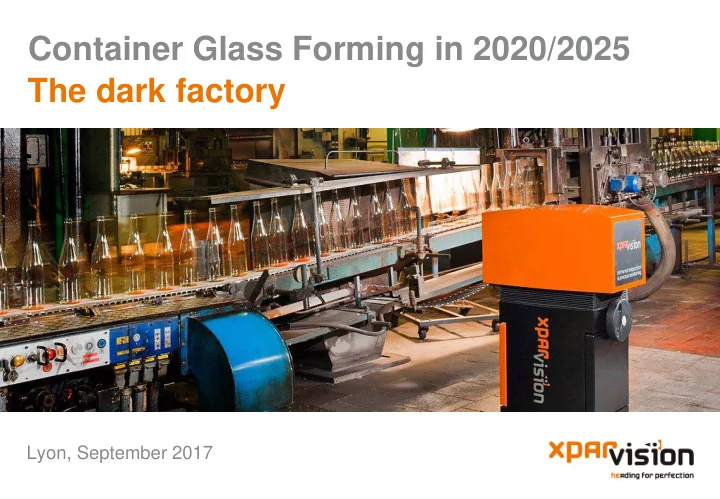
Container Glass Forming in 2020/2025 The dark factory Lyon, - - PowerPoint PPT Presentation
Container Glass Forming in 2020/2025 The dark factory Lyon, September 2017 XPAR Vision foundation and focus > 20 years track record of innovating the glass production process 1994 JD / CTI / RUG / Glass 1999 Foundation XPAR
Lyon, September 2017
> 20 years track record of innovating the glass production process
XPAR Vision foundation and focus
The dark factory
Container Glass Forming in 2020/2025
The dark factory
Main drivers: cost, quality, labour
loop
dependent
(40%)
Sustainability
Energy Material Labour
Cost Characteristics Alternatives
Main drivers: cost, quality, labour
Containers are (designed to be) too heavy
The level of (forming) process control is (very) low: efficiency and weight!!
Example: Beer bottle, customer spec. = min. thickness shoulder/body/heel 1 mm. Beer bottle, design spec. = 1.8-1.9 mm thickness
Process stability is the key towards optimization
Source: Prof. Dr.-Ing. H. Hessenkemper, Glas- und Emailtechnik (TU Bergakademie Freiberg)
Process stability is the key
Container glass forming: variation all over
/homogenity
(weight/shape/temperature) variation
Process stability requires automation (and thus sensors)
Focus on hot end forming
1927….2000: No real time factual information on forming process and bottle quality in hot end
More focus on HE pack than on HE quality
Huge savings potential!
Focus on hot end forming
Lighter and stronger containers..... produced with (almost) zero defects….. with minimal human dependency. at higher speed….
Deflector
deflector
and more and more friction will appear in this area
will start to deform:
Example process variation: deterioration and wear
Gob Assist: cavity 3 M, 15-07 00:15
Due to higher friction in delivery Example process variation: deterioration and wear
Deflector: gob changes
…but length, shape and diameter can be different when loading into the blank… At gob cut shape of gobs might look equal… …due to friction in the delivery system
Example process variation: deterioration and wear
IR-D: cavity 3 M, 15-07 00:15
Example process variation: deterioration and wear
The sensor GA sees the gob condition changing. An automated lubrication of deflector would prevent this from happening. More consistency/predictability would be the result.
Automation: Vertical Glass Distribution
From uncontrolled to controlled glass distribution
The sensor IR sees the glass distribution changing. Operator will not act upon it as the bottle still within customer specification. With an automated algorithm it is very easy to optimize/control the glass distribution. The bottle will be stronger and potential for weight decrease is huge.
Automation: Vertical Glass Distribution
The impact of automation is huge
Automation: impact
The variation of glass thickness (glass distribution) reduces!
Required step to realise weight reduction
What is available today?
Sensors and automation Bottle/cavity variations
Gob loading variations
Temperature variations
Gob Forming
Gob weight control Ware spacing control Mould temperature control (Plunger) process control Vertical glass distribution control Sensors Automation
Reduce human dependency
Besides sensors and automation robotics is critical step towards the dark factory
replace (most) functions of the hot end
Swab blank side 30% Swab blow side 20% Quality control 13% Defect correction / adjust machine 11% Check info system 7% Mold change 6% Measure weight 5% Adjust weight 4% Make spare swab 2% Fill swab oil 1% Make swab 1%
Time distribution tasks hot end operator
Huge savings potential!
Focus on hot end forming
Lighter and stronger containers….. produced with (almost) zero defects….. at higher speed….. with minimal human dependency.
Next steps
Hot end forming 2020/2025: Smart Manufacturing / Industry 4.0
robot functions
Hot end forming 2020/2025: Smart Manufacturing / Industry 4.0
The dark factory
industry