
SLIDE 1
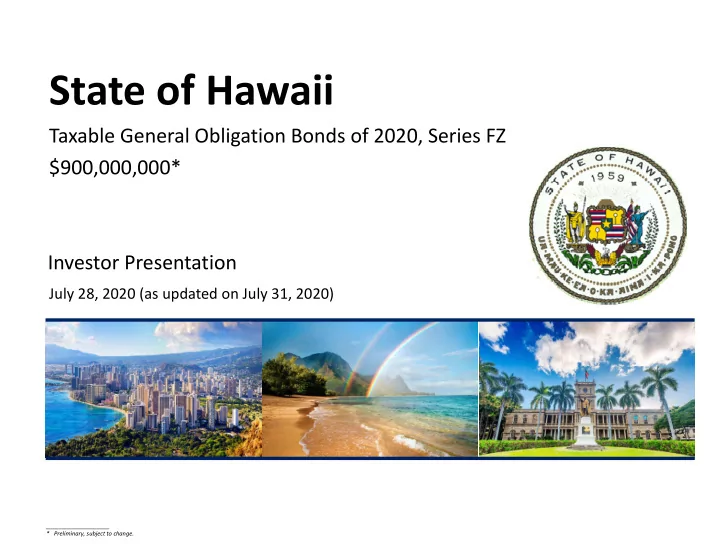
State of Hawaii
Taxable General Obligation Bonds of 2020, Series FZ $900,000,000* Investor Presentation
July 28, 2020 (as updated on July 31, 2020)
____________________ * Preliminary, subject to change.
State of Hawaii Taxable General Obligation Bonds of 2020, Series FZ - - PowerPoint PPT Presentation
State of Hawaii Taxable General Obligation Bonds of 2020, Series FZ $900,000,000* Investor Presentation July 28, 2020 (as updated on July 31, 2020) ____________________ * Preliminary, subject to change. Disclaimer The Investor Presentation you are
Taxable General Obligation Bonds of 2020, Series FZ $900,000,000* Investor Presentation
July 28, 2020 (as updated on July 31, 2020)
____________________ * Preliminary, subject to change.
The Investor Presentation you are about to view is provided as of July 28, 2020 (as updated on July 31, 2020) for a proposed offering of the State
have occurred that have a material adverse effect on the financial information presented. Neither the Underwriters mentioned in this presentation (the “Underwriters”), nor the State have undertaken any obligation to update this presentation. The information presented is not warranted as to completeness or accuracy and is subject to change without notice. You agree not to duplicate, copy, download, screen capture, electronically store, or record this presentation, nor to produce, publish or distribute this presentation in any form whatsoever. This Investor Presentation is provided for your information and convenience only. Any investment decisions regarding the State’s Series 2020 Bonds should be made only after a careful review of the complete Preliminary Official Statement. This Investor Presentation does not constitute a recommendation or an offer or solicitation for the purchase or sale of any security or other financial instrument or to adopt any investment strategy. Any offer or solicitation with respect to the State’s Series 2020 Bonds will be made by means of a Preliminary Official Statement or Official Statement that will describe the actual terms of the State’s Series 2020 Bonds. In no event shall the State or the Underwriters be liable for any use by any party of, any decision made or action taken by any party in reliance on, any inaccuracies or errors in, or any omissions from, the information contained herein and such information may not be relied upon by you in evaluating the merits of participating in any transaction mentioned herein. These materials have not been prepared with a view toward public disclosure under applicable securities laws or otherwise, and may not be reproduced, disseminated, quoted or referred to, in whole or in part. These materials may not reflect information known to other professionals in other business areas of the Underwriters and their affiliates. The Underwriters makes no representations as to the legal, tax, or accounting treatment of any transactions mentioned herein, or any other effects such transactions may have on you and your affiliates or any other parties to such transactions and their respective affiliates. You should consult with your own advisors as to such matters. Nothing in these materials constitutes a commitment by the Underwriters or any of their affiliates to enter into any transaction. Past performance is not indicative of future returns, which will vary. Transactions involving the State’s Series 2020 Bonds may not be suitable for all investors. You should consult with your own advisors as to the suitability of such securities or other financial instruments for your particular circumstances. Additional information is available upon request. Clients should contact their salesperson at, and execute transactions through, the Underwriters or their affiliated entities qualified in their home jurisdiction unless governing law permits otherwise. Neither the State, Underwriters or their affiliates provide tax advice. Any statements contained herein as to tax matters were neither written nor intended to be used and cannot be used by any taxpayer for the purpose of avoiding tax penalties that may be imposed on such taxpayer.
1
General Bond Information Issuer: State of Hawaii Par Amount: $900,000,000* Tax Status/Offering: Taxable General Obligation Bonds of 2020, Series FZ Ratings: Moody‘s: Aa2 (Stable) S&P: AA+ (Negative) Fitch: AA+ (Negative) Security: The full faith and credit of the State of Hawaii Purpose: Financing, or reimbursing the State of Hawaii for, the costs of acquisition, construction, extension or improvement of various public improvement projects, among which are public buildings and facilities, elementary and secondary schools, community college and university facilities, public libraries and parks and for other public purposes. Principal Amortization: August 1, 2025* to August 1, 2040* Coupon Type: Fixed Rate Call Option: TBD* Lead Manager: BofA Securities Co‐Senior Manager: Morgan Stanley Co‐Managers: Citigroup and Goldman Sachs & Co. Schedule
____________________
Virtual Investor Presentation: August 3, 2020* Indications of Interest: August 4, 2020* Pricing Date: August 5, 2020* Delivery Date: August 12, 2020*
2 * Preliminary, subject to change.
____________________
Hawaii is focused on both public health and the economy
Health
Update
mandatory fourteen (14) day self‐quarantine for all persons entering the State or traveling inter‐island
in coming weeks due to supply shortages on the mainland
Economic
Update
and restaurants for dining‐in (retail and shopping malls opened in May)
screenings, temperature scans and reporting requirements – a test case for an expected higher volume of incoming travelers
COVID‐19 test within three days prior to arrival
the resumption of international travel, although specific details and the start date remain to be determined Education
three approved school models for each school level – with a priority for in person learning for the earlier grade levels
24, 2020, using a hybrid model that provides a combination of online resources and on‐campus instruction.
(1) https://globalepidemics.org/key‐metrics‐for‐covid‐suppression/.
3
(2) https://health.hawaii.gov/coronavirusdisease2019/ as of July 27, 2020. (3) https://www.cdc.gov/covid‐data‐tracker/#cases.
____________________
The State’s labor market has improved in recent months
The State’s unemployment rate was 13.9% in June
(seasonally adjusted)
According to a Hawaii Commercial Rent Survey on July
8th, 84% of businesses are now open(2)
Federal (including military), state and local government
are stable components of the economy
Private health care as well as professional and business
services have grown in recent years
The construction industry remains strong with large
public and private sector capital projects ongoing
Supplemental unemployment insurance and other
federal dollars from the CARES Act have helped bolster the economy
Hawaii Employment Base ‐ 1st Quarter 2020(1)
Information Manufacturing Agriculture 1% Other Services 2% 1% Trade, Transportation Financial & Utilities Activities Leisure & Hospitality 18% Federal Federal Private Education 2% 4% 17% 4% Natural Resources, Mining, Construction 5% Local Government 3% State Government 10% Professional & Health Care & Business Social Services Assistance 10% (Civilian) 10% (Military) 5% 8%
(1) Source: State of Hawaii, Department of Labor and Industrial Relations, U.S. Bureau of Economic Analysis, U.S. Bureau of Labor Statistics.
4
Federal and military programs are important parts of the economy
All branches of the U.S. military are represented in Hawaii
In total, the defense industry provides over 102,000 jobs statewide with annual household incomes totaling $8.4 billion
The Hawaii based Indo‐Pacific Command is responsible for over 50% of global command activity and is essential to national security
FY 2021 federal spending is expected to include more than $300 million for major military construction projects in Hawaii
To date the State has received a total of $8.1 billion in COVID‐19 related federal funding through the various stimulus bills
70,000 60,000 50,000 40,000 30,000 20,000 10,000
Hawaii Military Payroll Jobs(1) (CY 2000 – 2019)
COVID‐19 Related Federal Funding
Federal Government Funding Amount ($MM)
____________________
Small Business Administration Paycheck Protection Program $2,463 Coronavirus Relief Fund 1,250 Unemployment Insurance Supplement 1,393 IRS Stimulus Checks 924 Treasury Loan (Payroll Support Program) 315 Grants 906 Small Business Administration Economic Injury Disaster Loan 866 Total $8,117 2000 2002 2004 2006 2008 2010 2012 2014 2016 2018
Source: U.S. Bureau of Economic Analysis and U.S. Department of Defense. (1) Includes reserves and National Guard. (2) Source: Senator Brian Schatz’s website.
5
____________________
Hawaii’s visitor industry has been through many economic cycles and global events
Visitor Diversification Visitors by Accommodation Type
Hostel Hotel Timeshare 53.6% 15.0% Condo Hotel 12.9% U.S. Mainland 4,280,286 65.7% 6,879,215 66.0% Region 2009 Arrivals % of Total 2019 Arrivals % of Total 0.5% Japan 1,168,080 17.9% 1,545,806 14.8% Canada 346,583 5.3% 535,267 5.1% B&B Oceania 136,717 2.1% 362,360 3.5% 0.6% China 41,924 0.6% 93,703 0.9% Korea 51,353 0.8% 225,479 2.2% Apt/Hotel 0.1% Europe 104,403 1.6% 138,550 1.3% Latin America 17,502 0.3% 25,957 0.3% Others Vacation Others 370,206 5.7% 618,658 5.9% 0.5% Rental Total 6,517,054 100.0% 10,424,995 100.0% 16.8%
Record of Resilience: Hawaii Visitor Arrivals
9/11 Terrorist SARS Global Japan's Volcanic COVID‐19
(in millions)
Epidemic Financial Crisis Tsunami Eruption Pandemic
2 4 6 8 10 12 Actual Projected
Attack Calendar Year
Source: Hawaii Department of Business, Economic Development & Tourism. (1) Projected.
6
The State and its Airports Division are implementing measures to ensure the safety of passengers
Modifications at the Airports include:
With a target date of September 1st, the new process for traveling to Hawaii without a 14‐day quarantine will include:
7
The State has a wide range of tools at its disposal to manage its finances
Budgeting
managing labor through furloughs
within the budget
has the ability to use the $191.3 million of Hawaii Hurricane Relief Fund (HHRF) in the future Sufficient Liquidity
Borrowing
Capabilities
County Update
8
The independent Council on Revenues provides quarterly revenue forecasts that are used by the State to formulate its 6‐year general fund financial plan
The Council held a virtual meeting on May 28th, 2020, to forecast revenue growth for State General Fund revenues and lowered its
forecast to ‐7.0% for FY2020 and ‐12.0% for FY2021 (actual tax collections for FY2020 were ‐6.2%)
The Council expects a rebound in revenues of 12.0% in FY2022 and a growth rate of 3.0% for each of FY2023‐2026 The Council acknowledged uncertainty surrounding the forecast figures for FY2021 and FY2022 due to the nature of the disease and
the government’s response to stop the virus in Hawaii
For the FY2021 estimate, the Council made the assumption that the 14‐day self‐quarantine period imposed on transpacific
passengers would be lifted by late July 2020
The Council also discussed the infectiousness, modes of transmission, and possible vaccines and treatments for the COVID‐19 virus,
and assumed in its analysis that a vaccine or effective treatment against the disease would be made available during FY2022
At its meeting on July 30th, the Council on Revenues forecasted that total personal income in Hawaii would decline by 7% in the
2020 calendar and there would be no growth in the 2021 calendar year
General Fund Tax Revenue Collections & Projections ($mm)
Actual Projected
$10,000 $9,000 $8,000 $7,000 $6,000 $5,000 $4,000 $3,000 $2,000 $1,000 $0
$4,426 $4,590 $4,590 $4,202 $4,364 $4,324 $4,973 $5,468 $5,371 $5,735 $6,194 $6,315 $6,796 $7,142 $7,435 $7,732 $7,964 $8,203 $8,531 $7,413 $7,413 $7,784 $8,095 $8,419 $8,756 $9,106 $6,642 $5,845 $6,546 $6,743 $6,945 $7,153 $7,368 $9,227 $8,872
COR Forecast from January 10, 2020 COR Forecast from March 11, 2020 COR Forecast from May 28, 2020
4.1% 4.0% 3.0% 3.0% 4.0% 4.0% 4.0% 3.8% 0.0% 5.0% 4.0% 4.0% 4.0% 4.0% ‐7.0% ‐12.0% 12.0% 3.0% 3.0% 3.0% 3.0%
2006 2007 2008 2009 2010 2011 2012 2013 2014 2015 2016 2017 2018 2019 2020 2021 2022 2023 2024 2025 2026 Fiscal Year 9
____________________
The State is pursuing a two‐phase approach to manage the General Fund Financial Plan
Initial Phase: Taking actions to ensure that the State can address revenue shortfalls through FY2021 FY2020
FY2021
however, Administration plans to borrow only $750 million in late 2020
Administration does not plan to use HHRF funding at the present time
emergency proclamation Second Phase: Undertaking a program review in conjunction with preparation of the fiscal biennium 22‐23 budget, that will be presented to the Legislature during the 2021 legislative session, to ensure that State expenditures are in line with reduced revenue projections (current target of $520 million) FY2021 ‐ 23
State’s Medicaid program, other budget reductions, etc.
Sources: Department of Accounting and General Services; Department of Budget and Finance, July 2019.
10
The objective of the finance plan is to create a positive balance for the next biennium through FY2023
Actual1 Est. Est. Est. Est. Est.8 Est.8
($ in millions) FY 19 FY 20 FY 21 FY 22 FY 23 FY 24 FY 25 Revenues: Executive Branch: Tax Revenues2,3 $7,141.8 $6,696.8 $5,893.2 $6,600.4 $6,798.4 $7,002.3 $7,212.4 Nontax Revenues2,4 742.4 907.8 747.4 759.9 770.3 786.5 800.8 Judicial Branch Revenues2,4 32.3 23.9 28.4 32.8 32.8 32.8 32.8 Other Revenues5 ‐ 687.1 791.7 1.7 1.7 1.7 1.7 Total Revenues $7,916.6 $8,315.5 $7,460.8 $7,394.8 $7,603.3 $7,823.4 $8,047.7 Expenditures: Executive Branch: Operating6 $7,512.2 $8,087.9 $8,047.9 $8,189.9 $8,416.3 $8,699.0 $8,848.8 CIP ‐ ‐ ‐ ‐ ‐ ‐ ‐ Specific Appropriations/CB7 Other expenditures/adjustments8 356.2 ‐ 159.9 (150.3) 179.2 (559.6) 187.1 (888.5) 187.1 (881.8) 187.1 (867.5) 187.1 (849.2) Sub‐Total Exec. Branch Legislative Branch $43.1 $42.6 $42.5 $42.5 $42.5 $42.5 $42.5 Judicial Branch 170.3 163.0 157.1 156.8 156.8 156.8 156.8 OHA 3.0 3.0 3.0 3.0 3.0 3.0 3.0 Counties 20.7 ‐ ‐ ‐ ‐ ‐ ‐ Lapses (190.9) (80.0) (80.0) (80.0) (80.0) (80.0) (80.0) Total Expenditures $7,914.7 $8,226.0 $7,790.1 $7,610.7 $7,843.9 $8,140.8 $8,309.0
1.8 89.5 (329.4) (215.9) (240.6) (317.5) (261.2) Carry‐Over Balance (Deficit) Beginning 750.3 752.1 841.6 512.2 296.2 55.6 (261.9) Ending $752.1 $841.6 $512.2 $296.2 $55.6 ($261.9) ($523.1) Emergency & Budget Reserve Fund (EBRF) 378.2 50.0 50.0 50.0 50.0 50.0 50.0 Hawaii Hurricane Relief Fund (HHRF) 183.8 191.3 191.3 191.3 191.3 191.3 191.3
____________________ Sources: Department of Accounting and General Services; Department of Budget and Finance, July 2020. Note: Due to rounding, details may not add to totals. (1)
(2) Reflects actual FY 2018 and FY2019 revenue collections as reported by the Department of Accounting and General Services. (3) Reflects preliminary actual for FY 2020 (as reported by the Department of Taxation) and FYs 2021‐2025 reflect Council on Revenues' May 2020 projections based on preliminary FY 2020 actuals. (4) Reflects FYs 2020‐2025 Council on Revenues' May 2020 projections. (5) Reflects various revenue impacts bills passed by the 2020 Legislature, including general fund to general obligation bond fund swaps, special fund transfers, and a $648 million deposit to the general fund from the Emergency and Budget Reserve Fund in FY 2020. Also includes a $750 million working capital borrowing through short term general obligation bonds or the MLF. (6) Executive Branch's FY 2019 expenditures reflect Act 49, SLH 2017 as amended by Act 53, SLH 2018; FY 2020 expenditures reflect Act 5, SLH 2019, plus Section 44 transfers; FY 2021 reflects SB 126, SD1, HD1, CD1, 2020 Legislative Session; and FYs 2022‐2025 expenditures are based on FY 2021 Executive Supplemental Budget that was updated to incorporate adjustments made by SB 126. (7) Reflects specific appropriations from 2017‐2020 Legislatures and estimated out year costs. Also includes $5 million per year for claims against the State beginning in FY 2021. (8) Includes: Forensic Facility Staff starting in FY 2022, updated employee health fund annual required cost payments starting in FY 2022, restrictions and projected fixed cost savings in FY 2020, additional interest costs for various general fund to general obligation bond swaps beginning in FY 2024, 10% furlough for most bargaining units beginning in November 2020, suspension of prefunding of other post‐employment benefit costs beginning in FY 2021, unemployment interest beginning in FY 2021, short term general obligation bonds (or MLF) repayment / interest in FYs 2022‐2024, and unspecified reductions pending completion of a program review beginning in FY 2022.
11
____________________
The State is committed to funding the pension system
FY2019 market value of assets increased to $17.2 billion with a funded ratio of 55.2% To meet the commitment that ERS achieve full funding within a 30‐year horizon, the
State enacted legislation to phase‐in higher systemwide employer contribution rates in steps through FY2021 (pictured right)
The State has appropriated the full amount for FY2021 The ERS adopted a crisis risk strategy approximately 6 years ago which will allocate
approximately 20% of its portfolio assets (presently at 16% of assets) to strategies intended to hold their value in a crisis scenario.
FY2020 total portfolio return was 1.26% 75% of the ERS portfolio is liquid, and the plan has not experienced any liquidity
issues to date
ERS has on average less exposure to illiquid private investments than its peers (25% vs
36%)
Enacted Higher Rates (Employer Contributions)
General Police & Fire FY 2017 17% 25% FY 2018 18% 28% FY 2019 19% 31% FY 2020 22% 36% FY 2021 24% 41%
The stress test shows that the ERS can withstand a ‐20% return in year 1, followed by 20 years with returns at 5% (2 percentage
points below the assumed rate) before returning to 7% and require only moderate rate increases to ensure that the funding period never extends beyond 30 years in any future annual valuation
For further information, please visit https://ers.ehawaii.gov/wp‐content/uploads/2020/01/2019‐Actuarial‐Valuation.pdf
Source: Employee’s Retirement System of the State of Hawaii.
12
16.1%
____________________
The State has built a substantial balance in its OPEB trust fund over the past six years
The State’s OPEB trust fund balance is estimated to increase to $1.8 billion in FY2019 Estimated FY2020 total portfolio return was 1.7% The General Fund Financial Plan suspends pre‐funding contributions but does not draw any funds from the State’s EUTF
balance to pay retiree premiums
EUTF Prefunding Contributions EUTF Balance and Funded Ratio
(State Only, FY2014 – 2019) (State Only, FY2015 – 2019)
$2,000
$500 Millions Millions $0 $83 $164 $230 $297 $430 $100 $117 $250 $333 $337 $430 Prefunding Requirements 2014 2015 2016 2017 2018 2019 Total Prefunding Contributions
$1,200
$300
$1,800
$450
$1,600
$400
$1,400
$350
$1,000
$250 $200
$800
$150
$600
$100
$400 $200
$50
$‐
$0
$221 $481 $880 $1,295 $1,829 2015 2016 2017 2018 2019
2.4% 4.9% 8.6% 12.1% 16.1% 19.5% Fiscal Year Fiscal Year
Source: Hawaii Employer‐Union Health Benefits Trust Fund.
13
____________________
The State has liquidity to ensure financial flexibility
The State’s treasury portfolio had a total market value of approximately $5.9 billion(1) as of June 30, 2020 Portfolio is low risk, primarily comprised of Bank CDs, U.S. Treasuries and Agency Securities with AAA ratings The effective duration of the portfolio is 0.38 years Estimated portfolio‐weighted yield (based on estimated annualized income) is 0.34% The State is able to borrow from various funds within the Treasury
Portfolio Breakdown by Security Type
AAA Rated US Treasuries 1,597,208,667 27% AAA Rated Agency Securities 2,734,489,029 46% Bank CD's 1,596,674,967 27%
(1) Does not include monies in the State’s checking account.
14
____________________
The State has a long track record of conservative debt management practices that are governed by a formal debt management policy
G.O. Debt Service Profile(1)
Principal and interest on G.O. Bonds are a first charge on the
General Fund and have a pledge of full faith and credit
Millions
$1,000 General State Projects (46%)
68%
Department of Education (40%) $800 University of Hawaii (14%)
G.O. Bonds have conservative Constitutional constraints on
$600
debt structure
$400
‒ Limits final maturity to 25 years and principal can be deferred
$200
no more than 5 years
$‐
‒ Requires level debt service or level principal amortization ‒ Maximum annual debt service can be no more than 18.5% of the average of the prior three year General Fund revenues
Fiscal Year
No statewide ballot initiatives required for debt issuance
Debt Service as % of General Fund Revenues(2)
The State conservatively manages its debt portfolio 14%
‒ Bonds issued with 20 year maturity and level debt service
12% 10%
‒ 100% fixed rate G.O. debt with no derivatives
8%
‒ 68% of principal amortizes over the next 10 years
6%
‒ BABs debt service is budgeted on a gross basis
4% 2% G.O. debt service as a percentage of General Fund revenues 0%
has been relatively constant across multiple economic cycles
2000 2001 2002 2003 2004 2005 2006 2007 2008 2009 2010 2011 2012 2013 2014 2015 2016 2017 2018 2019 2020 Fiscal Year
(1) Excludes $321 million of reimbursable G.O. Bonds and $600 million Bond Anticipation Notes. The State also has a de minimis amount of Certificates of Participation outstanding. (2) Excludes reimbursable G.O. Bond and Bond Anticipation Notes debt service.
15
‐ ‐ ‐ ‐ ‐ ‐ ‐ ‐ ‐ ‐
Please join us for a live online investor presentation on August 3rd
The State will conduct a live presentation for institutional
investors on Monday, August 3rd at 2:00 p.m. Eastern (invitation pictured right)
To access the Zoom presentation please RSVP to
dennis.farrell@ms.com and jason.tejada@ms.com
The State requests that questions regarding its credit or
financing also be submitted in advance by Thursday, July 30th
For questions, please contact the following individuals below or visit the State’s investor relations website
State of Hawai‘i, Department of Budget & Finance Craig Hirai (craig.k.hirai@hawaii.gov, 808 586 1518) Robert Yu (robert.yu@hawaii.gov, 808 586 1516) Rod Becker (roderick.k.becker@hawaii.gov, 808 586 1612) BofA Securities (Lead Bookrunner) Frank Lauterbur (frank.lauterbur@bofa.com, 213 345 9575) Craig Dussinger (craig.dussinger@bofa.com, 213 345 9579) Additional information may also be found at: http://investorrelations.hawaii.gov/ (pictured)
16
Hawaii has enduring appeal
Napali Coast – Kauai Kona Coast – Hawaii Island Waikiki Beach – Oahu Kalaupapa – Molokai
17