Stat 5421 Lecture Notes: To Accompany Agresti Ch 9 Charles J. Geyer - - PDF document

stat 5421 lecture notes to accompany agresti ch 9
SMART_READER_LITE
LIVE PREVIEW

Stat 5421 Lecture Notes: To Accompany Agresti Ch 9 Charles J. Geyer - - PDF document

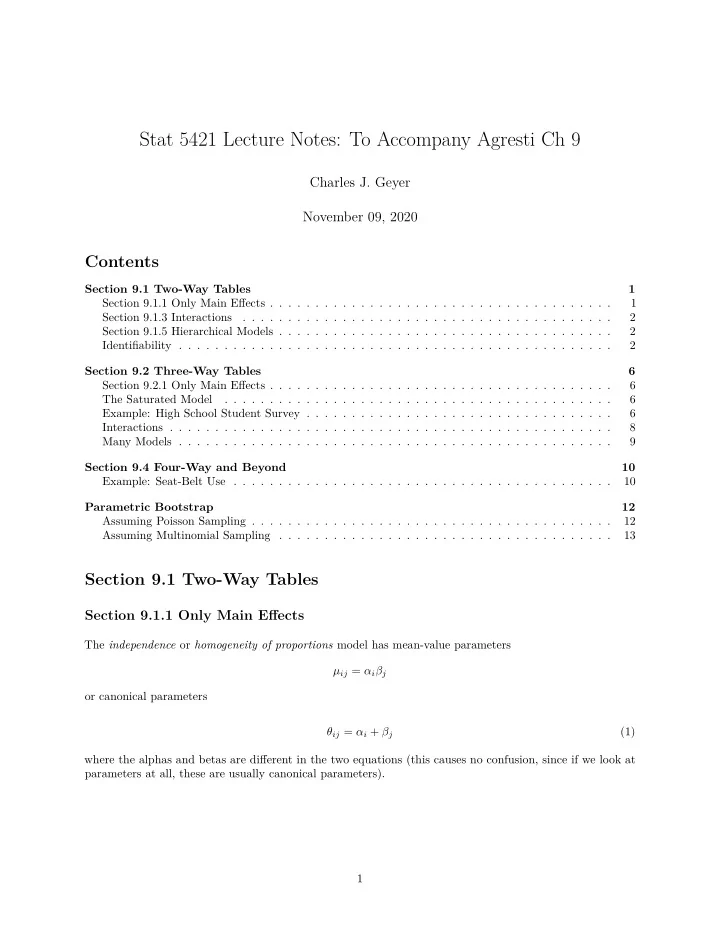
Stat 5421 Lecture Notes: To Accompany Agresti Ch 9 Charles J. Geyer November 09, 2020 Contents Section 9.1 Two-Way Tables 1 Section 9.1.1 Only Main Effects . . . . . . . . . . . . . . . . . . . . . . . . . . . . . . . . . . . . . . 1 Section


slide-1
SLIDE 1

Stat 5421 Lecture Notes: To Accompany Agresti Ch 9

Charles J. Geyer November 09, 2020

Contents

Section 9.1 Two-Way Tables 1 Section 9.1.1 Only Main Effects . . . . . . . . . . . . . . . . . . . . . . . . . . . . . . . . . . . . . . 1 Section 9.1.3 Interactions . . . . . . . . . . . . . . . . . . . . . . . . . . . . . . . . . . . . . . . . . 2 Section 9.1.5 Hierarchical Models . . . . . . . . . . . . . . . . . . . . . . . . . . . . . . . . . . . . . 2 Identifiability . . . . . . . . . . . . . . . . . . . . . . . . . . . . . . . . . . . . . . . . . . . . . . . . 2 Section 9.2 Three-Way Tables 6 Section 9.2.1 Only Main Effects . . . . . . . . . . . . . . . . . . . . . . . . . . . . . . . . . . . . . . 6 The Saturated Model . . . . . . . . . . . . . . . . . . . . . . . . . . . . . . . . . . . . . . . . . . . 6 Example: High School Student Survey . . . . . . . . . . . . . . . . . . . . . . . . . . . . . . . . . . 6 Interactions . . . . . . . . . . . . . . . . . . . . . . . . . . . . . . . . . . . . . . . . . . . . . . . . . 8 Many Models . . . . . . . . . . . . . . . . . . . . . . . . . . . . . . . . . . . . . . . . . . . . . . . . 9 Section 9.4 Four-Way and Beyond 10 Example: Seat-Belt Use . . . . . . . . . . . . . . . . . . . . . . . . . . . . . . . . . . . . . . . . . . 10 Parametric Bootstrap 12 Assuming Poisson Sampling . . . . . . . . . . . . . . . . . . . . . . . . . . . . . . . . . . . . . . . . 12 Assuming Multinomial Sampling . . . . . . . . . . . . . . . . . . . . . . . . . . . . . . . . . . . . . 13

Section 9.1 Two-Way Tables

Section 9.1.1 Only Main Effects

The independence or homogeneity of proportions model has mean-value parameters µij = αiβj

  • r canonical parameters

θij = αi + βj (1) where the alphas and betas are different in the two equations (this causes no confusion, since if we look at parameters at all, these are usually canonical parameters). 1

slide-2
SLIDE 2

Section 9.1.3 Interactions

The saturated model has completely arbitrary parameters. The mean value parameters µij have no specified

  • structure. The canonical parameters θij have no specified structure. So this is the largest model. It has the

most (arbitrarily variable) parameters.

Section 9.1.5 Hierarchical Models

The hierarchical model principle says that, if you have an interaction term of a certain order, then you have all lower-order interactions of the same variables. For the saturated model for a two-way table this says θij = αi + βj + γij (2) (but this just says θij can be anything. This is not an identifiable parameterization.

Identifiability

A statistical model (in general, not just in categorical data analysis) is identifiable if there is only one (vector) parameter value corresponding to a probability distribution. In exponential family models (Notes on Exponential Families, Section 6.2) every different mean vector corresponds to a different distribution, but different canonical parameter vectors can correspond to the same distribution. If we are assuming Poisson sampling (Notes on Exponential Families, Part I, section 7) then the canon- ical parameters are identifiable if and only if the mean-value parameters are (because the link function (componentwise log) is invertible). Clearly the specification for the two-way independence model (1) is not identifiable because one can add a constant to all of the alphas and subtract the same constant from all the betas and get the same result (αi + c) + (βj − c) = αi + βj Hence (2) is also not identifiable. But we don’t need to worry about identifiability when fitting models because the computer automatically takes care of it. For example, consider the data in Table 3.8 in Agresti counts <- c(17066, 14464, 788, 126, 37, 48, 38, 5, 1, 1) drinks <- rep(c("0", "< 1", "1-2", "3-5", ">= 6"), times = 2) malformation <- rep(c("Absent", "Present"), each = 5) data.frame(drinks, malformation, counts) ## drinks malformation counts ## 1 Absent 17066 ## 2 < 1 Absent 14464 ## 3 1-2 Absent 788 ## 4 3-5 Absent 126 ## 5 >= 6 Absent 37 ## 6 Present 48 ## 7 < 1 Present 38 ## 8 1-2 Present 5 ## 9 3-5 Present 1 ## 10 >= 6 Present 1 2

slide-3
SLIDE 3

We can fit this using R function chisq.test foo <- xtabs(counts ~ malformation + drinks) foo ## drinks ## malformation < 1 >= 6 1-2 3-5 ## Absent 14464 37 17066 788 126 ## Present 38 1 48 5 1 chisq.test(foo) ## Warning in chisq.test(foo): Chi-squared approximation may be incorrect ## ## Pearson's Chi-squared test ## ## data: foo ## X-squared = 12.082, df = 4, p-value = 0.01675 But it says “approximation may be incorrect” so try chisq.test(foo, simulate.p.value = TRUE) ## ## Pearson's Chi-squared test with simulated p-value (based on 2000 ## replicates) ## ## data: foo ## X-squared = 12.082, df = NA, p-value = 0.02999 But we can also use R function glm and its helper functions to do the job. gout.indep <- glm(counts ~ malformation + drinks, family = poisson) summary(gout.indep) ## ## Call: ## glm(formula = counts ~ malformation + drinks, family = poisson) ## ## Deviance Residuals: ## 1 2 3 4 5 6 7 8 ## 0.00659 0.02830

  • 0.09735
  • 0.05669
  • 0.14540
  • 0.12356
  • 0.53649

1.56555 ## 9 10 ## 0.86842 1.63069 ## ## Coefficients: ## Estimate Std. Error z value Pr(>|z|) ## (Intercept) 9.579183 0.008309 1152.83 <2e-16 *** ## malformationPresent -5.855811 0.103844

  • 56.39

<2e-16 *** ## drinks>= 6

  • 5.944456

0.162434

  • 36.60

<2e-16 *** ## drinks0 0.165610 0.011287 14.67 <2e-16 *** ## drinks1-2

  • 2.906219

0.036469

  • 79.69

<2e-16 *** ## drinks3-5

  • 4.737855

0.089123

  • 53.16

<2e-16 *** ## --- ## Signif. codes: 0 '***' 0.001 '**' 0.01 '*' 0.05 '.' 0.1 ' ' 1 ## ## (Dispersion parameter for poisson family taken to be 1) ## 3

slide-4
SLIDE 4

## Null deviance: 95424.044

  • n 9

degrees of freedom ## Residual deviance: 6.202

  • n 4

degrees of freedom ## AIC: 80.511 ## ## Number of Fisher Scoring iterations: 4 gout.sat <- glm(counts ~ malformation * drinks, family = poisson) summary(gout.sat) ## ## Call: ## glm(formula = counts ~ malformation * drinks, family = poisson) ## ## Deviance Residuals: ## [1] ## ## Coefficients: ## Estimate Std. Error z value Pr(>|z|) ## (Intercept) 9.579418 0.008315 1152.082 <2e-16 *** ## malformationPresent

  • 5.941832

0.162434

  • 36.580

<2e-16 *** ## drinks>= 6

  • 5.968500

0.164609

  • 36.259

<2e-16 *** ## drinks0 0.165425 0.011302 14.637 <2e-16 *** ## drinks1-2

  • 2.909920

0.036581

  • 79.547

<2e-16 *** ## drinks3-5

  • 4.743136

0.089474

  • 53.011

<2e-16 *** ## malformationPresent:drinks>= 6 2.330914 1.026354 2.271 0.0231 * ## malformationPresent:drinks0 0.068189 0.217432 0.314 0.7538 ## malformationPresent:drinks1-2 0.881772 0.477131 1.848 0.0646 . ## malformationPresent:drinks3-5 1.105550 1.017011 1.087 0.2770 ## --- ## Signif. codes: 0 '***' 0.001 '**' 0.01 '*' 0.05 '.' 0.1 ' ' 1 ## ## (Dispersion parameter for poisson family taken to be 1) ## ## Null deviance: 9.5424e+04

  • n 9

degrees of freedom ## Residual deviance: -4.7518e-13

  • n 0

degrees of freedom ## AIC: 82.309 ## ## Number of Fisher Scoring iterations: 3 anova(gout.indep, gout.sat, test = "LRT") ## Analysis of Deviance Table ## ## Model 1: counts ~ malformation + drinks ## Model 2: counts ~ malformation * drinks ##

  • Resid. Df Resid. Dev Df Deviance Pr(>Chi)

## 1 4 6.202 ## 2 0.000 4 6.202 0.1846 anova(gout.indep, gout.sat, test = "Rao") ## Analysis of Deviance Table ## ## Model 1: counts ~ malformation + drinks ## Model 2: counts ~ malformation * drinks ##

  • Resid. Df Resid. Dev Df Deviance

Rao Pr(>Chi) 4

slide-5
SLIDE 5

## 1 4 6.202 ## 2 0.000 4 6.202 12.082 0.01675 * ## --- ## Signif. codes: 0 '***' 0.001 '**' 0.01 '*' 0.05 '.' 0.1 ' ' 1 p.value.lrt <- anova(gout.indep, gout.sat, test = "LRT")[2, "Pr(>Chi)"] p.value.rao <- anova(gout.indep, gout.sat, test = "Rao")[2, "Pr(>Chi)"] p.value.chisq <- suppressWarnings(chisq.test(foo)$p.value) p.value.lrt ## [1] 0.1845623 p.value.rao ## [1] 0.01675137 p.value.chisq ## [1] 0.0167514 We notice a number of things.

  • The P-value for the Rao test (0.01675) is exactly equal to that output for the Chi-Square test because

the Pearson chi-square test is a special case of the Rao test.

  • The likelihood ratio test disagrees quite strongly with the Rao test. Of course, these test are asymptoti-

cally equivalent, but here the sample size is not “large”. The total number of subjects (3.2574 × 10⁴) is large, but the expected number in some cells of the contingency table are quite small, a lot less than what the rule of thumb says is necessary for valid asymptotics (at least five in each cell), so maybe that accounts for the difference. suppressWarnings(chisq.test(foo)$expected) ## drinks ## malformation < 1 >= 6 1-2 3-5 ## Absent 14460.59624 37.8915086 17065.13888 790.735955 126.6374102 ## Present 41.40376 0.1084914 48.86112 2.264045 0.3625898

  • The computer (R function glm) knows how to deal with identifiability. It adds an intercept, so it is

really using the formula θij = α + βi + γj for the independence model and θij = α + βi + γj + δij for the saturated model. Then it “drops” (sets equal to zero) one of the betas, one of the gammas, and all interaction terms corresponding to the dropped beta and the dropped gamma. names(coef(gout.indep)) ## [1] "(Intercept)" "malformationPresent" "drinks>= 6" ## [4] "drinks0" "drinks1-2" "drinks3-5" It keeps the “intercept” (α in our notation just above). It drops one of the coefficients for the factor malformation (and keeps the other one). It drops one of the coefficients for the factor drinks (and keeps the other four). And this gives it an identifiable model. names(coef(gout.sat)) ## [1] "(Intercept)" "malformationPresent" ## [3] "drinks>= 6" "drinks0" ## [5] "drinks1-2" "drinks3-5" 5

slide-6
SLIDE 6

## [7] "malformationPresent:drinks>= 6" "malformationPresent:drinks0" ## [9] "malformationPresent:drinks1-2" "malformationPresent:drinks3-5" It has all the parameters of the independence model plus a lot of “interaction” parameters (the ones whose names contain colons). But it drops all the “interaction” parameters that involve parameters that were “dropped” from the independence model (it contains no “interaction” terms containing malformationAbsent

  • r drinks< 1) And this gives it an identifiable model.

Section 9.2 Three-Way Tables

Three way tables are just like two-way tables except the data have three subscripts for the three dimensions

  • f the table. Our analogs of

Section 9.2.1 Only Main Effects

The independence or homogeneity of proportions model has mean-value parameters µijk = αiβjγk

  • r canonical parameters

θijk = αi + βj + γk (3) where the alphas, betas, and gammas are different in the two equations (this causes no confusion, since if we look at parameters at all, these are usually canonical parameters).

The Saturated Model

As before, the saturated model has completely arbitrary parameters. The mean value parameters µijk have no specified structure. The canonical parameters θijk have no specified structure. So this is the largest model. It has the most (arbitrarily variable) parameters.

Example: High School Student Survey

This is Table 9.3 in Agresti and can be found in R package CatDataAnalysis. # clean up R global environment rm(list = ls()) library(CatDataAnalysis) data(table_9.3) names(table_9.3) ## [1] "a" "c" "m" "count" foo <- xtabs(count ~ a + c + m, data = table_9.3) foo ## , , m = 1 ## ## c ## a 1 2 6

slide-7
SLIDE 7

## 1 911 44 ## 2 3 2 ## ## , , m = 2 ## ## c ## a 1 2 ## 1 538 456 ## 2 43 279 Since a, c, and m are categorical, we should perhaps make them factors. But since they each have only two values, it does not matter whether we make them factors or not. If they had more than two values, then it would be essential to make them factors. We can make these data look nicer by copying the names out of the book dimnames(foo) <- list(alcohol = c("yes", "no"), cigarettes = c("yes", "no"), marijuana = c("yes", "no")) aperm(foo, c(2, 3, 1)) ## , , alcohol = yes ## ## marijuana ## cigarettes yes no ## yes 911 538 ## no 44 456 ## ## , , alcohol = no ## ## marijuana ## cigarettes yes no ## yes 3 43 ## no 2 279 We needed R function aperm, which permutes the dimensions of an array, to present the data in the same

  • rder as in the book.

Of course, the order doesn’t matter and neither do the dimnames. That is just to match the book. Now R function chisq.test is useless, but R function glm has no problems. Our test of independence or homogeneity of proportions is the same, just with three “predictors” rather than two (the “predictors” are in scare quotes because they are just the dimnames) gout.indep <- glm(count ~ a + c + m, data = table_9.3, family = poisson) gout.sat <- glm(count ~ a * c * m, data = table_9.3, family = poisson) anova(gout.indep, gout.sat, test = "LRT") ## Analysis of Deviance Table ## ## Model 1: count ~ a + c + m ## Model 2: count ~ a * c * m ##

  • Resid. Df Resid. Dev Df Deviance

Pr(>Chi) ## 1 4 1286 ## 2 4 1286 < 2.2e-16 *** ## --- ## Signif. codes: 0 '***' 0.001 '**' 0.01 '*' 0.05 '.' 0.1 ' ' 1 anova(gout.indep, gout.sat, test = "Rao") ## Analysis of Deviance Table 7

slide-8
SLIDE 8

## ## Model 1: count ~ a + c + m ## Model 2: count ~ a * c * m ##

  • Resid. Df Resid. Dev Df Deviance

Rao Pr(>Chi) ## 1 4 1286 ## 2 4 1286 1411.4 < 2.2e-16 *** ## --- ## Signif. codes: 0 '***' 0.001 '**' 0.01 '*' 0.05 '.' 0.1 ' ' 1 Clearly, the independence model does not fit the data. So statistics says these variables, alcohol use, cigarette use, and marijuana use have some association. No real surprise, but the data do confirm what just about everybody assumes.

Interactions

Our saturated model has the three-way interaction a * c * m but there can also be two-way interactions. The model with all two-way interactions would have canonical parameter θijk = αij + βik + γjk (as before the terms with alphas, betas, and gammas need not match up with previous uses of these greek letters). And people who insist on the hierarchical principle would write θijk = α + βi + γj + δk + εij + ζik + ηjk but both formulas specify the same model and neither is identifiable. So let’s look at that model. gout.all.two.way <- glm(count ~ (a + c + m)^2, data = table_9.3, family = poisson) anova(gout.indep, gout.all.two.way, gout.sat, test = "LRT") ## Analysis of Deviance Table ## ## Model 1: count ~ a + c + m ## Model 2: count ~ (a + c + m)^2 ## Model 3: count ~ a * c * m ##

  • Resid. Df Resid. Dev Df Deviance Pr(>Chi)

## 1 4 1286.02 ## 2 1 0.37 3 1285.65 <2e-16 *** ## 3 0.00 1 0.37 0.5408 ## --- ## Signif. codes: 0 '***' 0.001 '**' 0.01 '*' 0.05 '.' 0.1 ' ' 1 foompter <- anova(gout.indep, gout.all.two.way, gout.sat, test = "LRT") foompter.p.values <- foompter[-1, "Pr(>Chi)"] foompter.p.values ## [1] 1.915858e-278 5.408396e-01 This says the two-way interactions model (model 2) fits as well as the three-way interactions model (model 3, the saturated model) because P = 0.5408 is not statistically significant (not even close). And it says the two-way interactions model (model 2) fits much better than the main effects only model (model 1, the independence model) because P < 2 × 10⁻¹⁶ is highly statistically significant (by anyone’s standards). We should not be overly impressed by very very small P-values because asymptotic approximation gives only small absolute errors rather than small relative errors. All this very very small P-value says is that an exact 8

slide-9
SLIDE 9

calculation (if we could do it, which we cannot) would be something small, say P < 0.001. But there is no reason to believe the P < 2 × 10⁻¹⁶ that R prints is correct to within even several orders of magnitude.

Many Models

There are many hierarchical models here, because we need not include all of the main effects or all two-way

  • interactions. The hierarchical principle says that if we have a two-way interaction, then we must have the

corresponding main effects, but that leaves θijk = α + βi + γj + δk + εij + ζik + ηjk + θijk θijk = α + βi + γj + δk + εij + ζik + ηjk θijk = α + βi + γj + δk + εij + ζik θijk = α + βi + γj + δk + εij + ηjk θijk = α + βi + γj + δk + ζik + ηjk θijk = α + βi + γj + δk + εij θijk = α + βi + γj + δk + ζik θijk = α + βi + γj + δk + ηjk θijk = α + βi + γj + εij θijk = α + βi + δk + ζik θijk = α + γj + δk + ηjk θijk = α + βi + γj + δk θijk = α + βi + γj θijk = α + βi + δk θijk = α + γj + δk θijk = α + βi θijk = α + γj θijk = α + δk θijk = α Of course, we already know many of these models don’t fit the data. We saw that the main effects only model doesn’t fit. So none of its submodels can fit either. But this is a complete listing of all hierarchical models (except for the saturated model). How can we choose among all these models? There is a methodology for that, but this is getting a bit ahead

  • f ourselves. There will be a handout for that. But for now, we just show it without much explanation.

library(glmbb)

  • ut <- glmbb(count ~ a * c * m, data = table_9.3, family = poisson)

summary(out) ## ## Results of search for hierarchical models with lowest AIC. ## Search was for all models with AIC no larger than min(AIC) + 10 ## These are shown below. ## ## criterion weight formula ## 63.42 0.6927 count ~ a*c + a*m + c*m ## 65.04 0.3073 count ~ a*c*m 9

slide-10
SLIDE 10

This says that none of the models that do not have all three two-way interactions fit the data according to the criterion: none have AIC less than the AIC for the best model (“best” according to AIC) plus 10. We don’t know what AIC is yet, but we will learn in a later handout. For now, just consider it a criterion of goodness of fit. If we want to see how bad some of those non-fitting models were, we can increase the cutoff. library(glmbb)

  • ut <- glmbb(count ~ a * c * m, data = table_9.3, family = poisson, cutoff = 90)

summary(out) ## ## Results of search for hierarchical models with lowest AIC. ## Search was for all models with AIC no larger than min(AIC) + 90 ## These are shown below. ## ## criterion weight formula ## 63.42 6.927e-01 count ~ a*c + a*m + c*m ## 65.04 3.073e-01 count ~ a*c*m ## 153.06 2.369e-20 count ~ a*c + c*m That is a huge jump up to the next best fitting model, which does not (take my word for it for now) does not fit the data well at all.

Section 9.4 Four-Way and Beyond

And so on and so forth. Higher order tables are just more complicated, but present no new issues.

Example: Seat-Belt Use

These data are given in Table 9.8 in Agresti. The are apparently not in R package CatDataAnalysis. # clean up R global environment rm(list = ls()) count <- c(7287, 11587, 3246, 6134, 10381, 10969, 6123, 6693, 996, 759, 973, 757, 812, 380, 1084, 513) injury <- gl(2, 8, 16, labels = c("No", "Yes")) gender <- gl(2, 4, 16, labels = c("Female", "Male")) location <- gl(2, 2, 16, labels = c("Urban", "Rural")) seat.belt <- gl(2, 1, 16, labels = c("No", "Yes")) data.frame(gender, location, seat.belt, injury, count) ## gender location seat.belt injury count ## 1 Female Urban No No 7287 ## 2 Female Urban Yes No 11587 ## 3 Female Rural No No 3246 ## 4 Female Rural Yes No 6134 ## 5 Male Urban No No 10381 ## 6 Male Urban Yes No 10969 ## 7 Male Rural No No 6123 ## 8 Male Rural Yes No 6693 ## 9 Female Urban No Yes 996 ## 10 Female Urban Yes Yes 759 10

slide-11
SLIDE 11

## 11 Female Rural No Yes 973 ## 12 Female Rural Yes Yes 757 ## 13 Male Urban No Yes 812 ## 14 Male Urban Yes Yes 380 ## 15 Male Rural No Yes 1084 ## 16 Male Rural Yes Yes 513 xtabs(count ~ seat.belt + injury + location + gender) ## , , location = Urban, gender = Female ## ## injury ## seat.belt No Yes ## No 7287 996 ## Yes 11587 759 ## ## , , location = Rural, gender = Female ## ## injury ## seat.belt No Yes ## No 3246 973 ## Yes 6134 757 ## ## , , location = Urban, gender = Male ## ## injury ## seat.belt No Yes ## No 10381 812 ## Yes 10969 380 ## ## , , location = Rural, gender = Male ## ## injury ## seat.belt No Yes ## No 6123 1084 ## Yes 6693 513 Looks OK.

  • ut <- glmbb(count ~ seat.belt * injury * location * gender,

family = "poisson") summary(out) ## ## Results of search for hierarchical models with lowest AIC. ## Search was for all models with AIC no larger than min(AIC) + 10 ## These are shown below. ## ## criterion weight ## 182.8 0.24105 ## 183.1 0.21546 ## 184.0 0.13742 ## 184.8 0.09055 ## 184.9 0.08446 ## 185.0 0.08042 ## 185.5 0.06462 11

slide-12
SLIDE 12

## 185.8 0.05365 ## 186.8 0.03237 ## formula ## count ~ seat.belt*injury*location + seat.belt*location*gender + injury*location*gender ## count ~ injury*gender + seat.belt*injury*location + seat.belt*location*gender ## count ~ seat.belt*injury + seat.belt*location*gender + injury*location*gender ## count ~ seat.belt*injury*location + seat.belt*injury*gender + seat.belt*location*gender + injury*location*gender ## count ~ seat.belt*injury + injury*location + injury*gender + seat.belt*location*gender ## count ~ seat.belt*injury*location + seat.belt*injury*gender + seat.belt*location*gender ## count ~ seat.belt*injury*location*gender ## count ~ seat.belt*injury*gender + seat.belt*location*gender + injury*location*gender ## count ~ injury*location + seat.belt*injury*gender + seat.belt*location*gender Now there are several models that fit these data fairly well. We will leave it at that for now.

Parametric Bootstrap

Assuming Poisson Sampling

The method of R function anova for objects of class "glm" produced by R function glm has no optional argument simulate.p.value. So here is how we could do that for our first example. # clean up R global environment rm(list = ls()) # re-establish stuff done in first section counts <- c(17066, 14464, 788, 126, 37, 48, 38, 5, 1, 1) drinks <- rep(c("0", "< 1", "1-2", "3-5", ">= 6"), times = 2) malformation <- rep(c("Absent", "Present"), each = 5) gout.indep <- glm(counts ~ malformation + drinks, family = poisson) gout.sat <- glm(counts ~ malformation * drinks, family = poisson) aout <- anova(gout.indep, gout.sat, test = "LRT") This gets us back to where we were before we removed everything produced in our original analysis of these

  • data. Now we need the estimated mean values (expected cell counts) and the P-value for the test

p.value.hat <- aout[2, "Pr(>Chi)"] p.value.hat ## [1] 0.1845623 mu.hat <- predict(gout.indep, type = "response") mu.hat ## 1 2 3 4 5 6 ## 1.706514e+04 1.446060e+04 7.907360e+02 1.266374e+02 3.789151e+01 4.886112e+01 ## 7 8 9 10 ## 4.140376e+01 2.264045e+00 3.625898e-01 1.084914e-01 Now we can do the simulation # set random number generator seed for reproducibility set.seed(42) nboot <- 999 p.value.star <- double(nboot) 12

slide-13
SLIDE 13

for (iboot in 1:nboot) { # simulate new data from fitted model counts.star <- rpois(length(mu.hat), lambda = mu.hat) gout.indep.star <- glm(counts.star ~ malformation + drinks, family = poisson) gout.sat.star <- glm(counts.star ~ malformation * drinks, family = poisson) aout.star <- anova(gout.indep.star, gout.sat.star, test = "LRT") p.value.star[iboot] <- aout.star[2, "Pr(>Chi)"] } all.p.values <- c(p.value.star, p.value.hat) mean(all.p.values <= p.value.hat) ## [1] 0.143 sd(all.p.values <= p.value.hat) / sqrt(nboot) ## [1] 0.01108136 The code above is a bit tricky, so here is the explanation.

  • Each time through the loop we simulate new data based on our best estimate of the model under the

null hypothesis. We are assuming Poisson sampling, so we use R function rpois to simulate the data. This function vectorizes, so it works with mu.hat being a vector.

  • The next three statements do exactly the same as the original analysis except that we use the simulated

data rather than the real data.

  • Then we extract the P-value from the result of R function anova and store it for future use.
  • After the loop terminates, we have nboot simulations from the distribution of the P-value under the

null hypothesis. We also have one more (not simulated) P-value that has the same distribution under the null hypothesis as the simulated P-values. This is p.value.hat, the value for the real data.

  • The estimated P-value is then the fraction of the time the bootstrap simulated P-values p.value.star

are at least as extreme as the P-value for the actual data p.value.hat.

  • The last statement calculates the Monte Carlo standard error, how far off our simulation is from what

we would get if we did an infinite number of simulations. The idea is that, when the asymptotics cannot be trusted, all we can say about a P-value is that is can be used as a test statistic. We take lower values as stronger evidence against the null hypothesis, but we don’t know that it is correctly calibrated: we don’t think that we would have P ≤ α with probability α for all α under the null hypothesis. So we need to simulate the distribution of this test statistic to compute a valid P-value. And that is what this does. Call the observed value of this test statistic P and the simulated value

  • f this test statistic P ∗, then Pr(P ∗ ≤

P) is the valid P-value. The trick of including the observed P-value among the simulated P-values guarantees that we cannot get a spurious bootstrap P-value of zero by making the Monte Carlo sample size too small. The smallest bootstrap P-value we can get by this procedure is 1 / (nboot + 1). This trick also comes with an argument that it gives an exact randomized test for any significance level that is a multiple of 1 / (nboot + 1). Under the null hypothesis, it has the discrete uniform distribution on the numbers seq(1, nboot + 1) / (nboot + 1).

Assuming Multinomial Sampling

When we simulate, we are not using asymptotics. And we are using exact sampling distributions. Thus Poisson sampling and multinomial sampling are not equivalent (their equivalence is an asymptotic result). 13

slide-14
SLIDE 14

So we can do the same simulation under multinomial sampling. n <- sum(counts) p.hat <- mu.hat / n p.value.star <- double(nboot) for (iboot in 1:nboot) { # simulate new data from fitted model counts.star <- rmultinom(1, n, prob = p.hat) gout.indep.star <- glm(counts.star ~ malformation + drinks, family = poisson) gout.sat.star <- glm(counts.star ~ malformation * drinks, family = poisson) aout.star <- anova(gout.indep.star, gout.sat.star, test = "LRT") p.value.star[iboot] <- aout.star[2, "Pr(>Chi)"] } all.p.values <- c(p.value.star, p.value.hat) mean(all.p.values <= p.value.hat) ## [1] 0.139 sd(all.p.values <= p.value.hat) / sqrt(nboot) ## [1] 0.01095074 The only difference between this simulation and the one before is the line counts.star <- rmultinom(1, n, prob = p.hat) and the lines defining n to be the multinomial sample size and p.hat to be the estimated multinomial parameter vector so we can use it in the statement just above. 14