
SLIDE 1
STAKEHOLDER SESSION V
VMC Urban Design Guidelines
October 2015
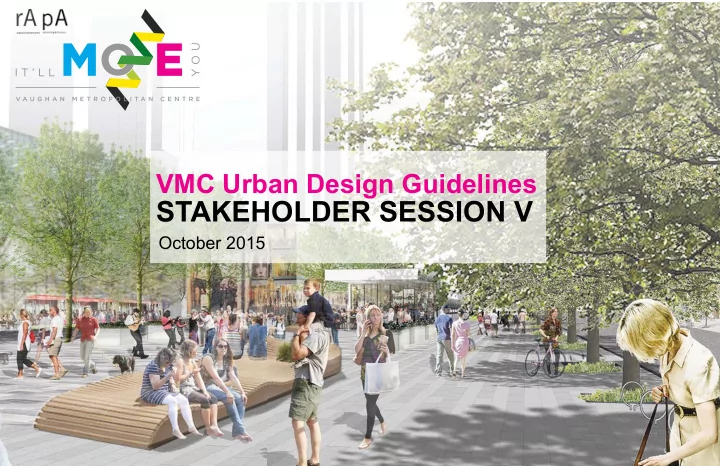
STAKEHOLDER SESSION V October 2015 Meeting Agenda October 26, 2015 - - PowerPoint PPT Presentation
VMC Urban Design Guidelines STAKEHOLDER SESSION V October 2015 Meeting Agenda October 26, 2015 - 9:00 am PART 1 - DRAFT GUIDELINES 9:00 PRESENTATION What we heard Whats new since July Finalizing the document Next steps
October 2015
October 26, 2015 - 9:00 am
PART 1 - DRAFT GUIDELINES 9:00 PRESENTATION
PART 2 - DISCUSSION 9:30 DISCUSSION 1: IMPLEMENTATION PLAN 10:00 DISCUSSION 2: DRAFT FEEDBACK 10:50 CLOSING COMMENTS 11:00 ADJOURN
URBAN DESIGN BEST PRACTICES OCT 2014 DEC 2014 DEVELOPMENT OF TYPOLOGIES Stakeholder Meeting Stakeholder Meeting Stakeholder Meeting Stakeholder Meeting Stakeholder Meeting DRP 1 DEVELOPMENT OF GUIDELINES
TODAY
DRP 2 MAR 2015 JAN 2015 MAY 2015 JUL 2015 SEP 2015 NOV 2015 REFINEMENT OF GUIDELINES FINAL PLAYBOOK VMC Sub- Committee
What is the schedule for completion and approval by Council and how will that process coordinate with the
Request receipt of hard copies of the full draft Urban Design Guidelines in order to complete a detailed review, prior to approval Desire to use the preliminary document as a guide for current development applications The fjnal document will be presented to Council for approval upon completion of the mediation A full draft was released October 5 DRP has reviewed the document and believe it will be a helpful tool to guide the discussion of development applications. Moving forward, this document will serve as a platform for design discussion related to development applications
The presented materials were welcomed and members of the stakeholder group appreciated the clarity of the presentation
A working session was requested to be scheduled a short time after the draft Guidelines were circulated, in order to facilitate detailed feedback Thank you! Here we are today
Putting together the Urban Design Guidelines has been a participatory process. The intent of the guidelines is place making and supporting economic development. The challenge was ensuring a balance between prescription and fmexibility
It was recognized that Urban Design Guidelines have limitations, preventing bad development but not necessarily ensuring excellence After early feedback from landowners and DRP, the document has been developed to support these objectives Excellency in design requires full commitment throughout the entire process of architectural development Section 6.0 Design Guidelines could be restructured into logical categories The subsections under 6.0 will be reorganized to follow a logical order
Insert a more detailed key map / matrix providing clarity on how to read the cross references and annotations between sections Insert an overall summary sheet graphically depicting the relationship to other VMC documents and guidelines and clarifying the jurisdiction each one have The landscape guidelines need to be further development
Provide a ‘Glossary of Defjnitions’ Will add as a pullout Will add to intro Will do Will add as an appendix
Insert text that clarifjes that this is a working document and will evolve and be reviewed as the VMC develops
Include guidelines for transition in the implementation section. Phasing needs to demonstrate transitions across blocks, heights, typologies, land uses and densities
Will add to Implementation section Cross-section between blocks will be included to demonstrate such transitions The document is well structured and has a logical progression, organized in an index-based logic. It is also graphically very attractive Thanks!
I N P R O G R E S S
December Landowner Meeting March Landowner Meeting July Landowner Meeting
+ + +
March DRP Meeting September DRP Meeting
+ +
UD Framework Revisions Launch
October Landowner Meeting November Presentation to Sub-committee
= = =
May Landowner Meeting
D R A F T
1 5 5 Vaughan Metropolitan Centre | Urban Design Guidelines “To reduce the impact on the pedestrian realm resulting from the scale of such uses, large scale retail uses shall be urban in form. To achieve this urban form, the ground fmoor street wall of large scale retail uses shall be animated through a high degree of articulation and fenestration including such features as large amount of clear glazing, multiple entrances (where practical), and smaller street oriented retail uses”. (VMC Secondary Plan 8.2.7) Figure 11. Block 24 ,Toronto (Image Credits: Tom Arban) SUPPORTING DOCUMENT HIGHLIGHT signage controlled by guidelines underground or internalized parking multi-story retail development glazing and additional height at-grade accessible on-street parking strategy integrated with developmentD R A F T
1 13 Vaughan Metropolitan Centre | Urban Design Guidelines Above-Grade Parking Above-grade parking is a common urban solution for residential, offjce and retail uses. Figure 47.Santa Monica Civic Center Parking Structure (Image Credits: Moore Ruble Yudell Architects) Figure 48.Retail hides truck docks and parking accessD R A F T
45 Vaughan Metropolitan Centre | Urban Design Guidelines Transitional Frontage A strong and consistent streetscape design with enhanced street furnishing shall alleviate interim conditions such as discordant alignment of frontages, lack of street animation or unsuitable uses like front parking. Figure 23.Lonsdale Street, Dandenong, Victoria (Image Credits: John Gollings and Peter Bennett) Setbacks to complete the pedestrian boulevard The available right-of-way varies along Avenue 7 and in some locations setbacks are essential to build a wide boulevard that shall accommodate all users and uses. Wide setbacks have been prescribed to address this issue. Figure 24.Dundas West Streetscape (Image Credits: City of Toronto’s POPS guidelines) Public Art features at Gateway In some segments of Avenue 7 the public right of way provides for a wider boulevard, which is a great opportunity for highly visible public art, particularly in proximity to gateways. Figure 25.Between the Eyes, Richard Deacon, 1990, Yonge Street and Queens Quay, Toronto (Image Credits: Michael Crisman) Access to public transportation can grant you LEED points (NC-SS Credit 4.1), as well as supporting alternative transportation, such as carpooling (NC-SS c4.4) SUSTAINABILITY KEYD R A F T
99 Vaughan Metropolitan Centre | Urban Design Guidelines Retail Type ‘A’ Small and Medium Retailers Primary retail streets such as Millway Promenade or New Park Place may be populated by cafes, restaurants and pedestrian-oriented stores. Types: Figure 33.The Stephen Avenue pedestrian mall, Calgary (Image Credits: Richard White) Figure 34.Gough street, permeable pavement, San Francisco (Image Credits: Bruce Damonte) Precedents: front view section TH-1 d f a b b i g e c hD R A F T
1 5 3 Vaughan Metropolitan Centre | Urban Design Guidelines Figure 4.North Toronto Collegiate Institute (Image Credits: Susan Spencer Lewin) “In order to provide convenient access for pedestrians and transit users, Public and Private Institutional Buildings should generally beD R A F T
38 Highway 400 Highway 7 Portage Parkway Peelar Road Highway 407 Jane Street Creditstone Road Millway Avenue3.2 Character Area Priorities
The delivery of vibrant, mixed-use neighbourhoods shall rely on establishing clear priorities that require specialD R A F T
1 2 4 5.2.2. Typical Block II Typical Block II is similar in size and displays conditions applicable to most of the southern blocks facing Avenue 7. These diagrams aim to demonstrate how the framework principles apply to govern the internal confjguration of similar blocks in the same character area. *Shadows at 21st September at 3pm Figure 4. Illustration of framework principles at the block level The signature streetscape along Avenue 7 shall extend into private property through setbacks. Entrances along Avenue 7 shall function as gateways, both through the design of iconic buildings and the provision of boulevard space to accommodate public art or signature streetscape features. Higher buildings shall be located in the northern portion within the block and shall be setback from the streetwall to minimize wind at the pedestrian boulevard. Vehicular access shall occur from local streets and be welcoming to pedestrians. Commercial uses are permitted in this block and highly encouraged to front onto Avenue 7. Due to the lack of adjacent public parkland, POPS shall accommodate green spaces for the block. local street local street Avenue 7 m i nD R A F T
1 2 4 5.2.2. Typical Block II Typical Block II is similar in size and displays conditions applicable to most of the southern blocks facing Avenue 7. These diagrams aim to demonstrate how the framework principles apply to govern the internal confjguration of similar blocks in the same character area. *Shadows at 21st September at 3pm Figure 4. Illustration of framework principles at the block level The signature streetscape along Avenue 7 shall extend into private property through setbacks. Entrances along Avenue 7 shall function as gateways, both through the design of iconic buildings and the provision of boulevard space to accommodate public art or signature streetscape features. Higher buildings shall be located in the northern portion within the block and shall be setback from the streetwall to minimize wind at the pedestrian boulevard. Vehicular access shall occur from local streets and be welcoming to pedestrians. Commercial uses are permitted in this block and highly encouraged to front onto Avenue 7. Due to the lack of adjacent public parkland, POPS shall accommodate green spaces for the block. local street local street Avenue 7 m i nD R A F T
69 Vaughan Metropolitan Centre | Urban Design Guidelines Master List of Urban Typologies Use Form This matrix is a summary of all urban typologies described in this chapter, structured according to their spatial form and associated use. The abbreviation system below shall be used in the next chapter to point to the illustration of each urban typology within the typical blocks. I N S T I T U T I O N A L C O M M E R C I A L R E S I D E N T I A L m u l t iD R A F T
1 56.1 Gateways
Gateways are established in order to symbolize the entrance into a distinct area, typically around major intersections where a signifjcant number of people enter and exit the area. They are places where character and sense of identity shall be recognized through enhanced site and building design. Gateways occur at a varietyD R A F T
1 2 5 Vaughan Metropolitan Centre | Urban Design Guidelines local street m i nD R A F T
1 2 5 Vaughan Metropolitan Centre | Urban Design Guidelines local street m i nD R A F T
1 2 4 5.2.2. Typical Block II Typical Block II is similar in size and displays conditions applicable to most of the southern blocks facing Avenue 7. These diagrams aim to demonstrate how the framework principles apply to govern the internal confjguration of similar blocks in the same character area. *Shadows at 21st September at 3pm Figure 4. Illustration of framework principles at the block level The signature streetscape along Avenue 7 shall extend into private property through setbacks. Entrances along Avenue 7 shall function as gateways, both through the design of iconic buildings and the provision of boulevard space to accommodate public art or signature streetscape features. Higher buildings shall be located in the northern portion within the block and shall be setback from the streetwall to minimize wind at the pedestrian boulevard. Vehicular access shall occur from local streets and be welcoming to pedestrians. Commercial uses are permitted in this block and highly encouraged to front onto Avenue 7. Due to the lack of adjacent public parkland, POPS shall accommodate green spaces for the block. local street local street Avenue 7 m i nD R A F T
1 2 4 5.2.2. Typical Block II Typical Block II is similar in size and displays conditions applicable to most of the southern blocks facing Avenue 7. These diagrams aim to demonstrate how the framework principles apply to govern the internal confjguration of similar blocks in the same character area. *Shadows at 21st September at 3pm Figure 4. Illustration of framework principles at the block level The signature streetscape along Avenue 7 shall extend into private property through setbacks. Entrances along Avenue 7 shall function as gateways, both through the design of iconic buildings and the provision of boulevard space to accommodate public art or signature streetscape features. Higher buildings shall be located in the northern portion within the block and shall be setback from the streetwall to minimize wind at the pedestrian boulevard. Vehicular access shall occur from local streets and be welcoming to pedestrians. Commercial uses are permitted in this block and highly encouraged to front onto Avenue 7. Due to the lack of adjacent public parkland, POPS shall accommodate green spaces for the block. local street local street Avenue 7 m i nD R A F T
1 2 5 Vaughan Metropolitan Centre | Urban Design Guidelines local street m i nD R A F T
1 2 5 Vaughan Metropolitan Centre | Urban Design Guidelines local street m i nD R A F T
site-specifjc conditions
Based on recent revisions to the Secondary Plan through the mediation process, revisions to the Guidelines will need to occur. It is critical that inconsistencies between the two documents are addressed accordingly Private Open Space: This section needs to be further explained and developed. The section implies that every block will have a central, on grade core of open space which may not be feasible given the density and built form policies of the offjcial plan
Use
I N S T I T U T I O N A L C O M M E R C I A L R E S I D E N T I A L m u l t iPS = Privately-owned Publicly Accessible Open Space (POPS) MB = Mid-Block TH = Thresholds PK = Parking
n/a n/a n/a n/a PS-4 PS-1 PS-3 PS-6 PS-7 PS-5 PS-2 86 4.3.1 Mews (Shared Streets)
According to the VMC SOS Plan, a mews or shared street is a “small scale, pedestrian-oriented neighbourhood street that is primarily for pedestrian and cycle traffjc but may also be designed as a vehicular laneway to accommodate vehicular traffjc with short-term parking at key destinations”. Spatial conditions: Thresholds: Landscape Design: D Located between two developable blocks or a developable block and a park (a). D The location of mews is identifjed in the VMC Secondary Plan. D The width shall vary depending on the character of each neighbourhood, but the Secondary Plan dictates a minimum of 15m in order to guarantee both access for emergency vehicles and landscape features (b). D Setbacks along the mews allow for usable public space such as cafés, seating areas, and greenery that makes the space more livable (c). D Mews shall be publicly-accessible at all times. D Access to the mews from the public street shall be highly visible and well articulated in the façade. A breezeway may act as an acceptable access to mews as long as it communicates the public character of the connection through the block (d). D Retractable bollards or similar fjxtures at the access point from the street shall make it possible to temporarily close segments of the mews from vehicular traffjc for outdoor events such as street festivals and farmer markets (e). D Treat the façades fronting the mews as a positive edge populated with active uses and fjne- grain detailed design. Building entrances and grade-related units are required (f). D No blank walls shall be permitted fronting the mews. D Shall be designed as an extension of the public sidewalk to prioritize pedestrian movementDesign for the Weather Employment areas are located along the perimeter of neighbourhoods, in most cases adjacent to the highway. As such, they are particularly exposed to the weather: wind, snow, sun, etc. Sustainable best practices may help to ameliorate micro-climatic effects and maximize its benefjts. Figure 1.The Children’s Development Centre, one of Calgary’s fjrst LEED buildings (Image Credits: Richard White)
We recommend that the Figures be renumbered in order, rather than being reset at each Section, in order to avoid confusion in the future Forbidding blank walls is too restrictive, not to mention ill-defjned. The document ought to better say that blank walls will be “discouraged”.
fjnal draft (landowners, DRP, Region, etc.)
AS PART OF AN INTEGRATED PLACEMAKING FRAMEWORK
[20th November]
7.1 Implementing these Guidelines
7.1 Implementing these Guidelines
‘go-to manual’ for urban design issues used by both applicants and their designers, as well as City staff responsible for review and approval.
be reviewed as the VMC develops over time - every 5 years, in coordination with SP review?
7.2 Existing Implementation Plans
Planning Act
Transit, Schools, Community Facilities
(every 2 years)
Report
SECONDARY PLAN SOS PLAN
Strategies to build the public realm
connectivity of the public realm/parks across blocks
Implementation Manual
(enhanced & premium level of service)
locations and quick win actions
conditions
Modelling
LWLP ASSESSMENT
i.e. public art, pedestrian connections, gateway features, incremental landscapes
permeability
7.3 Phasing within a Block
existing buildings active interface secure pedestrian connection accessible
1. 3. 2. 4.
Option C: maximize open space
Avenue 7 New Park Place cOption D: maximize structured parking
Avenue 7 New Park Place c 7.4 Interim Conditions
i.e. buffer zones, rooftop amenity areas
. Creative Fencing vs. streetwall [active interface with public realm] . Interim paths vs pedestrian connections [pedestrian permeability] . Movable furniture vs. full design [comfort in open spaces] . Green surface parking vs. multilevel parking [interim parking] . etc.
7.5 Transitions across blocks
Knowing that blocks will be developed over time, what Initial Priorities should be in the phasing of the design to ensure the long term vision for the VMC is achieved? What elements in the guidelines are more susceptible to change over time and should be fmagged as priority objectives for the 5-year revisions? What additional implementation tools could help advance development?