Staghorn An Automated Large-Scale Distributed System Analysis - - PowerPoint PPT Presentation

staghorn
SMART_READER_LITE
LIVE PREVIEW

Staghorn An Automated Large-Scale Distributed System Analysis - - PowerPoint PPT Presentation

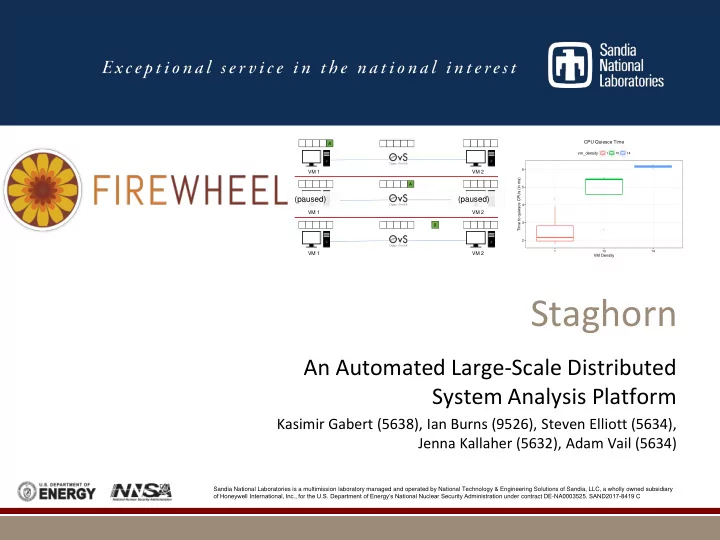
CPU Quiesce Time A vm_density 1 10 14 6 VM 1 VM 2 Time to quiesce CPUs (in ms) A 5 (paused) (paused) 4 VM 1 VM 2 3 X 2 1 10 14 VM 1 VM 2 VM Density Staghorn An Automated Large-Scale Distributed System Analysis


slide-1
SLIDE 1

Sandia National Laboratories is a multimission laboratory managed and operated by National Technology & Engineering Solutions of Sandia, LLC, a wholly owned subsidiary

  • f Honeywell International, Inc., for the U.S. Department of Energy’s National Nuclear Security Administration under contract DE-NA0003525. SAND2017-8419 C

Staghorn

An Automated Large-Scale Distributed System Analysis Platform

Kasimir Gabert (5638), Ian Burns (9526), Steven Elliott (5634), Jenna Kallaher (5632), Adam Vail (5634)

A VM 1 VM 2 A VM 1 VM 2 X VM 1 VM 2

(paused) (paused)

  • 2
3 4 5 6 1 10 14

VM Density Time to quiesce CPUs (in ms) vm_density

1 10 14

CPU Quiesce Time

slide-2
SLIDE 2

Problem

  • Large, distributed systems have become

ubiquitous

  • A common method for understanding their

behavior is to simply run them and observe / experiment (Emulytics)

  • This necessarily competes with the model for

CPU time, and the model and analysis must run at clock rate

  • We built a way to “stop time” within a model,
  • pening the door to the larger world of offline

model analysis

2

slide-3
SLIDE 3

A Few Use Cases

  • Vulnerability analysis
  • Debugging systems
  • Optimizing tests
  • Experimental repeatability
  • Training

3

slide-4
SLIDE 4

Key Contributions

  • A full-system snapshot and restore capability for Sandia’s

large-scale emulation-based model environments which preserves network and I/O state

  • A network modification system that allows for modification of

Ethernet frame contents and delivery, or the introduction and removal of frames, during a snapshot

  • The evaluation of this capability on real-world use-cases

4

slide-5
SLIDE 5

Design Requirements

  • The system must not perceive that a snapshot has occurred
  • Staghorn must preserve machine and network state
  • Staghorn must snapshot quickly so that each virtual machine

is snapshotted within a tight time window

5

slide-6
SLIDE 6

Firewheel

  • Staghorn is built on top of Firewheel, Sandia-developed tool

for automating the challenging parts in Emulytics

  • Two big technologies Firewheel brings:
  • Graphs to represent models
  • Plugin architecture to make automation extensible
  • Firewheel is scalable: to 75,000 VMs booting in 13 minutes

6

slide-7
SLIDE 7

Staging Architecture

7

slide-8
SLIDE 8

VM State Snapshots

  • Currently using QEMU migration-based snapshots
  • Straightforward to implement because they utilize existing QEMU

mechanisms.

  • Explored two other approaches:
  • Process-level snapshots
  • QEMU fork-based snapshots

11

slide-9
SLIDE 9

Network Snapshots

  • Design decisions:
  • Should we prioritize packet latency or packet ordering?
  • Choose packet ordering but minimize queuing delay as much as possible
  • How to pass information to/from the kernel?
  • Netlink, it is quick, asynchronous, and easy to implement
  • Where should we place our modifications?
  • Open vSwitch

12

slide-10
SLIDE 10

Why OVS

  • Can capture packets between cohosted VMs
  • Easy to install and actively developed
  • Compatible with virtualization platforms (KVM, Xen, etc.)
  • Already works with both Minimega and Firewheel

18

slide-11
SLIDE 11

rx_handler netdev_port_receive Staghorn

Network Snapshot Architecture

19

netif_rx execute_actions NIC Linux do_output

  • vs_vport_send

vport->ops->send(vport, skb) Open vSwitch Datapath ksoftirqd do_softirq net_rx_action netif_receive_skb

  • vs_dp_process_received_packet
  • vs_vport_recieve
slide-12
SLIDE 12

Evaluation – precisetimer.so

  • Tried to sleep 1 second into the future 60 times and

measured how close the sleep was to the desired time.

  • Results ranged from 1 – 55 ns with mean of 28.05 ns

20

20 40 20 40 60

Iteration Sleep error (in nanoseconds)

precisetimer.so Error Measurement

slide-13
SLIDE 13

Evaluation - RabbitMQ

21

1.0 1.5 10 20 30

Time (seconds) Delay error (in ms) type

remote−host same−host

RabbitMQ Delay Measurement

fi fi fl fl ignific

slide-14
SLIDE 14

Evaluation – Snapshot Timing

  • One of the most critical timing aspects of Staghorn is the

performance of quiescing the virtual CPUs on each VM

22

  • 2

3 4 5 6 1 10 14

VM Density Time to quiesce CPUs (in ms) vm_density

1 10 14

slide-15
SLIDE 15

Use Cases – Distributed Fuzzer

23 Fork execution by taking snapshot and returning to it Evaluate metric after different message modifications Greedily choose message modification with largest metric to take After many greedy message choices an issue is found

slide-16
SLIDE 16

Use Cases – Distributed Fuzzer

A VM 1 VM 2

24

slide-17
SLIDE 17

Use Cases – Distributed Fuzzer

A VM 1 VM 2

25

(Paused) (Paused)

slide-18
SLIDE 18

Use Cases – Distributed Fuzzer

X VM 1 VM 2

26

slide-19
SLIDE 19

Use Cases – Distributed Fuzzer

A VM 1 VM 2

27

(Paused) (Paused)

slide-20
SLIDE 20

Use Cases – Distributed Fuzzer

VM 2 VM 1 Y

28

slide-21
SLIDE 21

Use Cases – Distributed Debugger

29

  • 1. Set breakpoint
  • 2. Install Staghorn

Trigger

  • 3. Staghorn will wait

until the breakpoint is hit to snapshot the system.

slide-22
SLIDE 22

Use Cases – Debug Experiments

  • Firewheel user’s experiment failed after about 8 hours.
  • An 8 hour debug cycle is unacceptable.
  • Staghorn was used to snapshot before the crash enabling the

user to quickly test various fixes.

30

slide-23
SLIDE 23

Conclusion/Future Work

  • Conclusion
  • We have opened the door to offline analysis and modification for our

large-scale emulation based models

  • Follow-on work:
  • Improve our performance
  • Implement/productize more use cases
  • Better identify how long it takes for CPUs to quiese and improve this

time

  • Improve the stability of process-level snapshots and QEMU fork-based

snapshots

31

slide-24
SLIDE 24

Any Questions??

  • Paper: www.sandia.gov/emulytics/staghorn-report.pdf
  • Contact info: Steven Elliott (selliot@sandia.gov)

32