STAFF REPORT FOR CALENDAR ITEM NO.: 10 FOR THE MEETING OF: December - - PDF document

staff report for calendar item no 10 for the meeting of
SMART_READER_LITE
LIVE PREVIEW

STAFF REPORT FOR CALENDAR ITEM NO.: 10 FOR THE MEETING OF: December - - PDF document

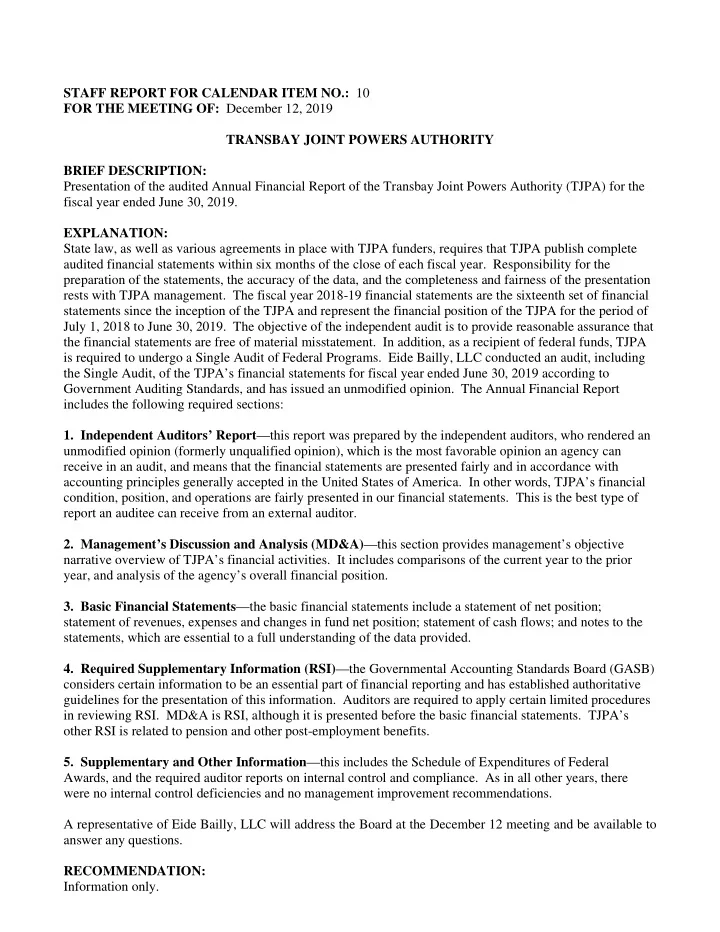
STAFF REPORT FOR CALENDAR ITEM NO.: 10 FOR THE MEETING OF: December 12, 2019 TRANSBAY JOINT POWERS AUTHORITY BRIEF DESCRIPTION: Presentation of the audited Annual Financial Report of the Transbay Joint Powers Authority (TJPA) for the fiscal year


slide-1
SLIDE 1

STAFF REPORT FOR CALENDAR ITEM NO.: 10 FOR THE MEETING OF: December 12, 2019 TRANSBAY JOINT POWERS AUTHORITY BRIEF DESCRIPTION: Presentation of the audited Annual Financial Report of the Transbay Joint Powers Authority (TJPA) for the fiscal year ended June 30, 2019. EXPLANATION: State law, as well as various agreements in place with TJPA funders, requires that TJPA publish complete audited financial statements within six months of the close of each fiscal year. Responsibility for the preparation of the statements, the accuracy of the data, and the completeness and fairness of the presentation rests with TJPA management. The fiscal year 2018-19 financial statements are the sixteenth set of financial statements since the inception of the TJPA and represent the financial position of the TJPA for the period of July 1, 2018 to June 30, 2019. The objective of the independent audit is to provide reasonable assurance that the financial statements are free of material misstatement. In addition, as a recipient of federal funds, TJPA is required to undergo a Single Audit of Federal Programs. Eide Bailly, LLC conducted an audit, including the Single Audit, of the TJPA’s financial statements for fiscal year ended June 30, 2019 according to Government Auditing Standards, and has issued an unmodified opinion. The Annual Financial Report includes the following required sections:

  • 1. Independent Auditors’ Report—this report was prepared by the independent auditors, who rendered an

unmodified opinion (formerly unqualified opinion), which is the most favorable opinion an agency can receive in an audit, and means that the financial statements are presented fairly and in accordance with accounting principles generally accepted in the United States of America. In other words, TJPA’s financial condition, position, and operations are fairly presented in our financial statements. This is the best type of report an auditee can receive from an external auditor.

  • 2. Management’s Discussion and Analysis (MD&A)—this section provides management’s objective

narrative overview of TJPA’s financial activities. It includes comparisons of the current year to the prior year, and analysis of the agency’s overall financial position.

  • 3. Basic Financial Statements—the basic financial statements include a statement of net position;

statement of revenues, expenses and changes in fund net position; statement of cash flows; and notes to the statements, which are essential to a full understanding of the data provided.

  • 4. Required Supplementary Information (RSI)—the Governmental Accounting Standards Board (GASB)

considers certain information to be an essential part of financial reporting and has established authoritative guidelines for the presentation of this information. Auditors are required to apply certain limited procedures in reviewing RSI. MD&A is RSI, although it is presented before the basic financial statements. TJPA’s

  • ther RSI is related to pension and other post-employment benefits.
  • 5. Supplementary and Other Information—this includes the Schedule of Expenditures of Federal

Awards, and the required auditor reports on internal control and compliance. As in all other years, there were no internal control deficiencies and no management improvement recommendations. A representative of Eide Bailly, LLC will address the Board at the December 12 meeting and be available to answer any questions. RECOMMENDATION: Information only.

slide-2
SLIDE 2

Transbay Joint Powers Authority Annual Financial Report

Fiscal Year Ended June 30, 2019

slide-3
SLIDE 3

This page left blank intentionally.

slide-4
SLIDE 4

TRANSBAY JOINT POWERS AUTHORITY SAN FRANCISCO, CALIFORNIA ANNUAL FINANCIAL REPORT FOR THE FISCAL YEAR ENDED JUNE 30, 2019 PREPARED BY THE FINANCE DEPARTMENT

slide-5
SLIDE 5

This page left blank intentionally.

slide-6
SLIDE 6

Table of Contents Page(s) INTRODUCTORY SECTION Letter of Transmittal ...................................................................................................................................... i Governing Board and Authority Staff .......................................................................................................... iii Organizational Chart .................................................................................................................................... iv FINANCIAL SECTION Independent Auditors’ Report ................................................................................................................ 1-2 Management’s Discussion and Analysis (Required Supplementary Information - Unaudited) ..... 4-10 Basic Financial Statements: Statement of Net Position ................................................................................................................. 12-13 Statement of Revenues, Expenses and Changes in Fund Net Position .................................................. 14 Statement of Cash Flows .................................................................................................................. 15-16 Notes to the Basic Financial Statements ........................................................................................... 17-41 Required Supplementary Information: Schedule of Proportionate Share of the Net Pension Liability ............................................................... 43 Schedule of Pension Contributions ........................................................................................................ 44 Schedule of Changes in the Net OPEB Liability and Related Ratios .................................................... 45 Schedule of OPEB Contributions .......................................................................................................... 46 Supplementary Information: Schedule of Expenditures of Federal Awards ........................................................................................ 48 Notes to Schedule of Expenditures of Federal Awards ......................................................................... 49 Other Reports: Independent Auditors’ Report on Internal Control Over Financial Reporting and on Compliance and Other Matters Based on an Audit of Financial Statements Performed in Accordance with Governmental Auditing Standards ................................................................... 51-52 Independent Auditors’ Report on Compliance for Each Major Federal Program; Report on Internal Control Over Compliance; and Report of Schedule of Expenditures of Federal Awards Required by the Uniform Guidance .... 53-54 Schedule of Findings and Questioned Costs ......................................................................................... 55

slide-7
SLIDE 7

i December 12, 2019 Board of Directors Transbay Joint Powers Authority San Francisco, California I am pleased to present the Annual Financial Report of the Transbay Joint Powers Authority (“TJPA”) for the year ended June 30, 2019, with the independent auditors’ report. The TJPA is responsible for the accuracy of the data and for the completeness and fairness of its

  • presentation. Our internal accounting controls provide reasonable assurance, rather than

absolute assurance, that the financial statements are free of material misstatements. I believe that the reported data is accurate in all material respects and that its presentation fairly depicts the TJPA’s financial position. I am confident that the included disclosures provide the reader with an understanding of the TJPA’s financial affairs. The records have been audited by Eide Bailly LLP and are presented in the Basic Financial

  • Statements. This letter of transmittal is designed to complement the Management’s

Discussion and Analysis (“MD&A”) section of the Annual Financial Report. The MD&A provides a narrative overview and analysis of the Basic Financial Statements and is presented after the independent auditors’ report. Governance The TJPA has primary jurisdiction with respect to all matters concerning the financing, design, development, construction, and operation of the Transbay Program. The TJPA is a joint exercise of powers authority created by the City and County of San Francisco, the Alameda-Contra Costa Transit District, the Peninsula Corridor Joint Powers Board, the California High Speed Rail Authority, and Caltrans (ex officio). The TJPA is managed by TJPA staff and is overseen by an eight-member Board of Directors. Overview The Transbay Program (Program) is a multi-billion dollar transportation infrastructure investment that replaces the former Transbay Terminal at First and Mission streets in San Francisco with a state-of-the-art regional transit station connecting eight Bay Area counties and the State of California through eleven bus and rail transit systems: AC Transit, BART, Caltrain, Golden Gate Transit, Greyhound, San Francisco Municipal Railway (Muni), SamTrans, WestCAT Lynx, Amtrak, Paratransit, and future high-speed rail from San Francisco to Los

  • Angeles. The Program consists of three interconnected elements:

 Replacing the former Transbay Terminal at First and Mission streets  Extending Caltrain and California High-Speed Rail underground from Caltrain’s current terminus at 4th and King streets into the new downtown Salesforce Transit Center

T JPA Boa rd of Dir e c tor s

Mohamme d Nuru, Chair Sa n F ra nc isc o Ma yor Re pre se ntative Je ff G e e , Vic e Chair Pe ninsula Corridor Joint Powe rs Board Re pre se ntative Che ryl Brinkman SF Munic ipa l T ra nsportation Age nc y Re pre se ntative Matt Hane y SF Boa rd of Supe rvisors Re pre se ntative Mic ha e l Hursh AC T ra nsit Re pre se ntative Boris L ipkin Ca lifornia Hig h Spe e d Ra il Authority Re pre se ntative Nadia Se say SF Boa rd of Supe rvisors Re pre se ntative T

  • ny T

a vare s, ex officio Sta te De partme nt of T ransportation (Caltrans) Re pre se ntative

slide-8
SLIDE 8

ii  Creating a new neighborhood with homes, offices, parks, and shops surrounding the new transit center The Program has two phases. Phase 1 includes the design and construction of the above- grade levels of the new transit center and its related components, including the core and shell of the below-grade train box, a bus ramp connecting the station to the San Francisco– Oakland Bay Bridge, a bus storage facility for off-peak bus layovers, a temporary terminal, and a utility relocation project to clear the area of utilities ahead of excavation. Phase 2 is the Downtown Rail Extension, which will extend Caltrain commuter rail from its current terminus at Fourth and King streets into the transit center and accommodate future high-speed rail service between San Francisco and Los Angeles. It also includes the build-out of the transit center’s below-grade train station, a new underground station at Fourth and Townsend streets, a pedestrian tunnel to the Embarcadero BART/Muni Metro station, and an intercity bus facility. Highlights In this Fiscal Year, we opened the Salesforce Transit Center on August 12, 2018. The $2.26 billion Transit Center replaces the seismically deficient Transbay Terminal with a modern regional transportation hub that connects transit systems throughout the Bay Area. It also includes pop-up retail, a public art program, shopping and dining; and a 5.4-acre rooftop public park that is programmed with year-round free activities. At one million square feet, the Transit Center stretches four blocks with four stories above ground, and two stories below ground to accommodate future regional and high-speed trains. The Transit Center eases traffic congestion, reduces pollution and makes transit more accessible and efficient for Bay Area commuters, especially in San Francisco’s rapidly growing South of Market neighborhood. However, on September 25, 2019, the building was closed for repairs to two structural steel girders and remained closed through June 30, 2019. Temporary shoring systems were installed until repairs were completed. Additional inspections and a building-wide review were completed, along with continued monitoring. The building-wide review revealed that there were no additional issues. On July 1, 2019, the transit center was reopened to the public and transit operations at the bus plaza resumed on July 13. AC Transit resumed operations on the bus deck in mid- August. Acknowledgements I would like to express my appreciation to the Finance staff for their professionalism, dedication, and efficiency in the day to day operations and in the preparation of this report. Respectfully submitted, Erin Roseman Chief Financial Officer

slide-9
SLIDE 9

iii TRANSBAY JOINT POWERS AUTHORITY GOVERNING BOARD GOVERNING BOARD Mohammed Nuru, Chair (Office of the San Francisco Mayor Representative) Jeff Gee, Vice Chair (Peninsula Corridor Joint Powers Board Representative) Cheryl Brinkman, Board Member (San Francisco Municipal Transportation Agency Representative) Matt Haney, Board Member (San Francisco Board of Supervisors Representative) Michael Hursh, Board Member (AC Transit Representative) Boris Lipkin, Board Member (California High Speed Rail Authority Representative) Nadia Sesay, Board Member (San Francisco Board of Supervisors Representative) Tony Tavares, Ex officio Board Member (Caltrans Representative) AUTHORITY STAFF Mark Zabaneh, Executive Director Erin Roseman, Chief Financial Officer Nila Gonzales, Secretary Deborah Miller (Shute Mihaly & Weinberger LLP), General Counsel

slide-10
SLIDE 10

iv ORGANIZATIONAL CHART

slide-11
SLIDE 11

1

What inspires you, inspires us. | eidebailly.com

260 Sheridan Ave., Ste. 440 | Palo Alto, CA 94306-2011 | T 650.462.0400 | F 650.462.0500 | EOE

INDEPENDENT AUDITORS’ REPORT

Board of Directors Transbay Joint Powers Authority San Francisco, California Report on the Financial Statements We have audited the accompanying financial statements of the Transbay Joint Powers Authority (TJPA), as of and for the fiscal year ended June 30, 2019, and the related notes to the financial statements, which collectively comprise the basic financial statements as listed in the table of contents. Management’s Responsibility for the Financial Statements Management is responsible for the preparation and fair presentation of these financial statements in accordance with accounting principles generally accepted in the United States of America; this includes the design, implementation, and maintenance of internal control relevant to the preparation and fair presentation

  • f financial statements that are free from material misstatement, whether due to fraud or error.

Auditor’s Responsibility Our responsibility is to express an opinion on these financial statements based on our audit. We conducted

  • ur audit in accordance with auditing standards generally accepted in the United States of America and the

standards applicable to financial audits contained in Government Auditing Standards, issued by the Comptroller General of the United States. Those standards require that we plan and perform the audit to

  • btain reasonable assurance about whether the financial statements are free from material misstatement.

An audit involves performing procedures to obtain audit evidence about the amounts and disclosures in the financial statements. The procedures selected depend on the auditor’s judgment, including the assessment

  • f the risks of material misstatement of the financial statements, whether due to fraud or error. In making

those risk assessments, the auditor considers internal control relevant to the entity’s preparation and fair presentation of the financial statements in order to design audit procedures that are appropriate in the circumstances, but not for the purpose of expressing an opinion on the effectiveness of the entity’s internal

  • control. Accordingly, we express no such opinion. An audit also includes evaluating the appropriateness of

accounting policies used and the reasonableness of significant accounting estimates made by management, as well as evaluating the overall presentation of the financial statements. We believe that the audit evidence we have obtained is sufficient and appropriate to provide a basis for our audit opinion. Opinion In our opinion, the financial statements referred to above present fairly, in all material respects, the financial position of the TJPA as of June 30, 2019 and the changes in financial position, and its cash flows thereof for the year then ended in accordance with accounting principles generally accepted in the United States of America.

slide-12
SLIDE 12

2 Other Matters Required Supplementary Information Accounting principles generally accepted in the United States of America require that the management’s discussion and analysis, schedule of the proportionate share of the net pension liability, schedule of pension contributions, schedule of changes in the net OPEB liability and related ratios and schedule of OPEB contributions, as listed in the table of contents, be presented to supplement the basic financial statements. Such information, although not a part of the basic financial statements, is required by the Governmental Accounting Standards Board, who considers it to be an essential part of financial reporting for placing the basic financial statements in an appropriate operational, economic, or historical context. We have applied certain limited procedures to the required supplementary information in accordance with auditing standards generally accepted in the United States of America, which consisted of inquiries of management about the methods of preparing the information and comparing the information for consistency with management’s responses to our inquiries, the basic financial statements, and other knowledge we obtained during our audit

  • f the basic financial statements. We do not express an opinion or provide any assurance on the information

because the limited procedures do not provide us with sufficient evidence to express an opinion or provide any assurance. Other Information Our audit was conducted for the purpose of forming opinions on the financial statements that collectively comprise the TJPA's basic financial statements. The transmittal letter and the schedule of expenditures of federal awards, as required by Title 2 U.S. Code of Federal Regulations (CFR) Part 200, Uniform Administrative Requirements, Cost Principles, and Audit Requirements for Federal Awards is presented for purposes of additional analysis and is not a required part of the basic financial statements. The schedule of expenditures of federal awards is the responsibility of management and was derived from and relates directly to the underlying accounting and other records used to prepare the financial statements. Such information has been subjected to the auditing procedures applied in the audit of the basic financial statements and certain additional procedures, including comparing and reconciling such information directly to the underlying accounting and other records used to prepare the financial statements or to the financial statements themselves, and other additional procedures in accordance with auditing standards generally accepted in the United States of America. In our opinion, the schedule of expenditures of federal awards is fairly stated in all material respect in relation to the financial statements taken as a whole. The transmittal letter has not been subjected to the auditing procedures applied in the audit of the basic financial statements and, accordingly, we do not express an opinion or provide any assurance on it. Other Reporting Required by Government Auditing Standards In accordance with Government Auditing Standards, we have also issued our report dated December 3, 2019 on our consideration of the TJPA’s internal control over financial reporting and on our tests of its compliance with certain provisions of laws, regulations, contracts and grant agreements, and other matters. The purpose of that report is solely to describe the scope of our testing of internal control over financial reporting and compliance and the results of that testing, and not to provide an opinion on the effectiveness

  • f the TJPA's internal control over financial reporting or on compliance. That report is an integral part of

an audit performed in accordance with Government Auditing Standards in considering the TJPA’s internal control over financial reporting and compliance. Palo Alto, California

December 3, 2019

slide-13
SLIDE 13

3 MANAGEMENT’S DISCUSSION AND ANALYSIS

slide-14
SLIDE 14

TRANSBAY JOINT POWERS AUTHORITY Management’s Discussion and Analysis (Required Supplementary Information-Unaudited) For the Year Ended June 30, 2019 4 The following management discussion and analysis (“MD&A”) provides a narrative overview of the Transbay Joint Powers Authority’s (“TJPA”) financial activities for the year ended June 30, 2019, with comparative information for the year ended June 30, 2018. The MD&A section is required by the provisions of the Governmental Accounting Standards Board (“GASB”) Statement No. 34 and should be read in conjunction with the TJPA’s basic financial statements, which follow this section. The TJPA’s financial activities are reported based on a twelve-month fiscal year, which starts on July 1 of

  • ne calendar year and ends on June 30 of the next calendar year; the fiscal year is named by the calendar

year in which the fiscal year ends. Therefore, the basic annual financial statements presented in this report are for Fiscal Year 2019. Purpose of the TJPA The TJPA is a local government agency formed in 2001 in accordance with California Government Code to design, build, develop, operate and maintain a new regional transit terminal (the “transit center”) and associated facilities in downtown San Francisco (collectively, the “Transbay Program”), replacing the former Transbay Terminal. An extension of rail lines for Caltrain and future California High Speed Rail from the current Caltrain San Francisco terminus at Fourth and King Streets to the transit center, referred to as the Downtown Rail Extension (“DTX”) is also part of the Transbay Program as a second phase (“Phase 2”). See Note 1 for additional information. Financial Highlights  We experienced an operating loss of $12,044,281 primarily due to the extended closure of the transit center related to the girder fissures discovered on September 25, 2018, which delayed planned revenues.  At the close of the fiscal year, assets and deferred outflows of the TJPA exceeded its liabilities and deferred inflows by $2,058,996,807.  The City and County of San Francisco (“City”) sold the second tranche of Community Facilities District (“CFD”) bonds during the fiscal year, a portion of which is remitted to the TJPA as CFD reimbursements to fund the transit center and other infrastructure in the Transit Center District. The issuance of more than $157 million resulted in $142.4 million in proceeds for the Transbay Program,

  • f which $25 million was used to pay down the interim City Financing. As of June 30, 2019, $180

million has been drawn by the TJPA since inception. Overview of the Financial Statements This discussion and analysis is intended to serve as an introduction to the TJPA’s basic financial statements. The annual financial report for the TJPA includes this management’s discussion and analysis (“MD&A”), the basic financial statements and notes to the basic financial statements. This report also contains other supplementary information in addition to the basic financial statements themselves. The TJPA is reported as an enterprise fund. Enterprise funds are a type of proprietary fund used to report information in a manner similar to a private-sector business. An enterprise fund is used to account for functions that are intended to recover all or a significant portion of their costs through user fees and charges. Under the Joint Powers Agreement creating the TJPA, dated April 4, 2001, the new transit center and related facilities are to be managed and operated as an enterprise operation.

slide-15
SLIDE 15

TRANSBAY JOINT POWERS AUTHORITY Management’s Discussion and Analysis (Required Supplementary Information-Unaudited) For the Year Ended June 30, 2019 5 The basic financial statements include the Statement of Net Position; Statement of Revenues, Expenses, and Changes in Fund Net Position; and Statement of Cash Flows. The Statement of Net Position presents information on all of the TJPA’s assets, deferred outflows of resources, deferred inflows of resources, and liabilities, with the difference between assets plus deferred

  • utflows of resources and liabilities plus deferred inflows of resources reported as net position. Over time,

increases or decreases in net position may serve as a useful indicator of whether the financial position of the TJPA is improving or deteriorating. The Statement of Revenues, Expenses and Changes in Fund Net Position presents information showing how the TJPA’s net position changed during the most recent fiscal year. All changes in net position are reported as soon as the underlying event giving rise to the change occurs, regardless of the timing of the related cash flows. Thus, revenues and expenses are reported in this statement for some items that will only result in cash flows in future fiscal periods. The Statement of Cash Flows presents the cash inflows and outflows from operating activities, capital and related financing activities, and investing activities, and the resulting cash position at fiscal year-end. The Notes to the Basic Financial Statements provide additional information that is essential to a full understanding of the data provided in the basic financial statements. In addition to the basic financial statements and accompanying notes, this report also presents certain required supplementary information (“RSI”) concerning the TJPA’s progress in funding its obligation to provide pension and other post-employment benefits to its employees. Financial Statement Analysis In accordance with GASB requirements, a comparative analysis of financial data is presented in the following condensed formats to compare amounts from the current fiscal year (2019) to amounts from the prior fiscal year (2018).

slide-16
SLIDE 16

TRANSBAY JOINT POWERS AUTHORITY Management’s Discussion and Analysis (Required Supplementary Information-Unaudited) For the Year Ended June 30, 2019 6

Dollar Percent 2019 2018 Change Change Assets: Current and other assets 39,806,853 $ 31,384,488 $ 8,422,365 $ 27% Restricted assets 40,497,075 38,522,343 1,974,732 5% Capital assets 2,324,072,355 2,232,131,779 91,940,576 4% Total assets 2,404,376,283 2,302,038,610 102,337,673 4% Deferred outflows of resources: OPEB related 47,768 30,028 17,740 59% Pension related 499,520 802,339 (302,819)

  • 38%

Total deferred outflows of resources 547,288 832,367 (285,079)

  • 34%

Liabilities: Current and other liabilities 63,307,787 76,169,986 (12,862,199)

  • 17%

TIFIA loan payable 186,128,592 156,606,090 29,522,502 19% Intergovernmental liability to the City for: Interim City financing 78,000,000 103,000,000 (25,000,000)

  • 24%

Re-conveyance of State transferred land 18,414,675 18,414,675

  • 0%

Total liabilities 345,851,054 354,190,751 (8,339,697)

  • 2%

Deferred inflows of resources: Pension related 75,710 74,247 1,463 2% Total deferred inflows of resources 75,710 74,247 1,463 2% Net position: Net investment in capital assets 2,006,396,770 1,893,787,267 112,609,503 6% Restricted O&M Reserve for transit center

  • 8,950,286

(8,950,286)

  • 100%

Construction of transit center 9,422,848 15,926,608 (6,503,760)

  • 41%

Debt service 16,779,491 14,012,765 2,766,726 20% Unrestricted 26,397,698 15,929,053 10,468,645 66% Total net position 2,058,996,807 $ 1,948,605,979 $ 110,390,828 $ 6% CONDENSED STATEMENTS OF NET POSITION

Total net position at June 30, 2019 includes net investment in capital assets, which is comprised of construction in progress of $2,119,438,106, land scheduled to be permanently and temporarily retained by the TJPA of $186,082,200, and permanent easements of $137,374. The construction in progress includes construction, construction management, program management, and administrative costs necessary to support the development of the transit center and DTX, as well as information technology costs for website development and labor compliance software. $16,779,491 of current year net position includes net tax increment funds restricted for debt service, being used to pay the ongoing interest costs of the interim City financing that closed in Fiscal Year 2017 and

  • therwise reserved for future debt service on a Federal Transportation Infrastructure Finance and Innovation

Act (“TIFIA”) loan.

slide-17
SLIDE 17

TRANSBAY JOINT POWERS AUTHORITY Management’s Discussion and Analysis (Required Supplementary Information-Unaudited) For the Year Ended June 30, 2019 7 In addition, $9,422,848 is land sales proceeds restricted for construction of the transit center under a cooperative agreement with the State of California (“State”). Total current year net position also includes $26,397,697 in unrestricted net position which is derived primarily from the TJPA’s non-operating

  • revenues. Of this amount, $11,330,374 is earmarked for the operations and maintenance of Program

facilities, including the transit center or the future DTX. The remaining $15,067,323 is to be used for acquisition of capital assets. The $8,422,365 net increase in current and other assets resulted primarily from a $12,614,795 increase in State of California pooled cash, partially offset by a $6,984,407 decrease in grantor receivables outstanding at fiscal year-end. The $1,974,732 increase in restricted assets resulted primarily from an increase in Tax Increment trust balances, partially offset by lower investment balances as land sales proceeds continue to be spent. The changes in deferred outflows of resources and deferred inflows of resources are due to accounting treatment of pension amounts, and the purchase of a derivative instrument to protect against rising interest rates under the interim City financing. The net decrease of $12,862,199 in current and other liabilities resulted primarily from a $7,398,639 decrease in retainage payable, a $10,902,956 decrease in accounts payable, and a $335,618 decrease in intergovernmental payables. In addition, liabilities increased $4,522,502 due to the final draws on the TIFIA loan, including capitalized interest, partially offset with the $25,000,000 paydown on the interim City financing.

slide-18
SLIDE 18

TRANSBAY JOINT POWERS AUTHORITY Management’s Discussion and Analysis (Required Supplementary Information-Unaudited) For the Year Ended June 30, 2019 8

Dollar Percent 2019 2018 Change Change Operating income Operating revenues 5,109,101 $ 3,349,162 $ 1,759,939 $ 53% Operating expenses (17,153,382) (8,206,581) (8,946,801) 109% Operating income (loss) (12,044,281) (4,857,419) (7,186,862) 148% Nonoperating revenues (expenses) Operating grant Revenue 8,026,046 7,838,235 187,811 2% Expenses

  • n/a

Net operating grant 8,026,046 7,838,235 187,811 2% Investment income 1,707,917 742,343 965,574 130% Miscellaneous revenues 29 881 (852)

  • 97%

Net tax increment revenue 12,457,838 13,331,888 (874,050)

  • 7%

CFD impact fee revenue

  • 866,000

(866,000)

  • 100%

Gain on conveyance of air rights 42,000 1,406,685 (1,364,685)

  • 97%

Total nonoperating revenues 22,233,830 24,186,032 (1,952,202)

  • 8%

Income before capital contributions 10,189,549 19,328,613 (9,139,064)

  • 47%

Capital contributions Federal government capital grants 1,885,660 4,952,293 (3,066,633)

  • 62%

State government capital grants

  • 6,445

(6,445)

  • 100%

Local government capital grants 2,723,205 13,603,080 (10,879,875)

  • 80%

CFD reimbursements 91,534,393 88,108,212 3,426,181 4% Other capital contributions 4,058,021 2,054,992 2,003,029 97% Total capital contributions 100,201,279 108,725,022 (8,523,743)

  • 8%

Change in net position 110,390,828 128,053,635 (17,662,807)

  • 14%

Net position- beginning 1,948,605,979 1,820,552,344 128,053,635 7% Net position- ending 2,058,996,807 $ 1,948,605,979 $ 110,390,828 $ 6% CONDENSED STATEMENTS OF CHANGES IN NET POSITION

Operating revenues The source of Fiscal Year 2019 operating revenues of $5,109,101 was comprised primarily of naming rights revenue, combined with cellular antennae licensing agreement revenue for the transit center, lease and rental revenues, reimbursements from others and Community Benefits District revenue. The increase in

  • perating revenues of $1,759,939 is due mainly to the naming rights revenue. $17,153,382 in operating

expenses were incurred in preparing the transit center for full operations and funded from operating revenues.

slide-19
SLIDE 19

TRANSBAY JOINT POWERS AUTHORITY Management’s Discussion and Analysis (Required Supplementary Information-Unaudited) For the Year Ended June 30, 2019 9 Nonoperating revenues The TJPA funds facility management and related operating expenses from a Metropolitan Transportation Commission (“MTC”) Regional Measure 2 (“RM-2”) operating grant. Total Fiscal Year 2019 operating grant revenues were $8,026,046. The Fiscal Year 2019 increase in investment income of $965,574 is attributable mainly to higher investment balances as Net Tax Increment funds are accumulated for debt service. The decrease in miscellaneous revenues is attributable to the inherent variability of revenues earned in this category. CFD reimbursements increased $3,426,181 as compared to the prior year following the City’s sale of the second tranche of CFD bonds in the current year. Gain on conveyance of air rights decreased $1,364,685 in the current year as a parcel was sold in the prior year, as compared to an easement sale in the current year. Capital contributions For the year ended June 30, 2019, the TJPA received $100,201,279 in capital contributions. The increase in capital contributions from the prior fiscal year is directly attributable to CFD reimbursements. Capital contributions were expended on the Transbay Program. Budgetary Highlights Quarterly budget-to-actual reports are presented to the TJPA Board of Directors (“TJPA Board”) by the TJPA Chief Financial Officer. During the fiscal year, four amendments each to the Capital Budget and Operating Budget were approved. The amendments transferred amounts amongst line items but did not increase total appropriations. Capital Asset and Debt Administration Capital assets The TJPA’s investment in capital assets as of June 30, 2019 amounts to $2,324,072,355. This investment in capital assets includes land, easements, and construction in progress. Major capital asset events during the fiscal year included the following:  The transit center opened on August 12, 2018, however on September 25, 2018, fissures were discovered in two steel beams over Fremont Street. Out of an abundance of caution, the transit center was temporarily closed for further evaluation and repair. The rooftop park re-opened on July 1, 2019, with bus service following in July and August 2019.  Transit center construction work continued throughout the year, with 5,663,429 craft hours completed through June 2019. The majority of work under all trade packages was completed or nearly complete.  Construction of the bus storage facility underneath Interstate 80 was completed. See Note 4 for additional information on the TJPA’s capital assets.

slide-20
SLIDE 20

TRANSBAY JOINT POWERS AUTHORITY Management’s Discussion and Analysis (Required Supplementary Information-Unaudited) For the Year Ended June 30, 2019 10 Long-term debt At the end of the current fiscal year, the TJPA had total debt outstanding of $264,128,592. Of this amount, $186,128,592 was TIFIA loan debt. The remainder of the TJPA’s debt represents amounts drawn on an interim financing provided by the City. Total debt increased by $4,522,502 during the fiscal year, the balance available under TIFIA was drawn, partially offset by a $25,000,000 payment on the interim City

  • financing. See Note 5 for more detailed information on the TJPA’s long-term debt.

Next Year’s Budgets The TJPA Board approved the Fiscal Year 2020 budgets on June 13, 2019. The Operating budget totals $37.3 million in revenues and expenses. Approximately a quarter of the revenues will be provided by RM-2 and RM-3 operating funds. The remainder will be covered through transit center revenues, and contributions from the Primary Tenants of the transit center, AC Transit and

  • SFMTA. Expenses include a facility management contract, operating support for Alameda-Contra Costa

Transit District (“AC Transit”), and other expenses directly related to the transit center such as security,

  • perations, and maintenance at the transit center totaling $24.7 million. Also included is $6.5 million in

debt service and $3.1 million in salaries, fringe benefits and administration. The TJPA’s Fiscal Year 2020 $100.1 million Capital budget anticipates that most of the revenues will be provided by the following sources: proceeds from CFD reimbursements, unspent proceeds from the TJPA debt (prior bank loan and TIFIA loan), land sales proceeds, the funding identified in the expenditure plan approved by the voters for the half cent sales tax for transportation in San Francisco (“Prop K”), Transit Center District Impact Fees, lease revenue, interest income and reimbursements, and to a lesser extent the bridge toll increases approved in Regional Measure 2 and AB1171 (“RM-2” and “AB1171”), and grants from the Federal Transit Administration (“FTA”). The approved Fiscal Year 2020 Capital budget shows revenues in two categories–committed and planned. Committed revenues are the planned drawdowns of grants that were already allocated or land sales and debt proceeds already received at the time the TJPA Board approved the 2020 fiscal year budget, and planned revenues include sources that have pending applications with funding partners or applications that are anticipated to be submitted and approved during the fiscal year. This is explained in detail in the Staff Reports which were submitted with the Fiscal Year 2020 budget presentations and can be found on the TJPA website for the May 9 and June 13, 2019 TJPA Board meetings. The main component of the Capital budget is the completion of construction of the new transit center. Approximately $76.9 million is budgeted for construction activities and $3.2 million for construction

  • management. The TJPA has also budgeted approximately $19.9 million for DTX preliminary engineering

in fiscal year 2020. Request for Information Questions concerning any of the information provided in this report or requests for additional financial information should be addressed to the Transbay Joint Powers Authority, 425 Mission Street, Suite 250, San Francisco, California 94105.

slide-21
SLIDE 21

11 BASIC FINANCIAL STATEMENTS

slide-22
SLIDE 22

TRANSBAY JOINT POWERS AUTHORITY Statement of Net Position June 30, 2019 See notes to the financial statements 12

Assets: Current assets: Cash and equivalent Cash in banks 2,848,500 $ Restricted for construction of the Transit Center 195,664 Cash in City and County of San Francisco pool 10,409,131 Cash in State of California pool 23,866,457 Total cash and cash equivalents 37,319,752 Receivables: Federal government 155,088 Metropolitan Transportation Commission 380,770 San Francisco County Transportation Authority 400,652 City and County of San Francisco 229,791 Accounts receivable 151,289 Total receivables 1,317,590 Other current assets: Prepaid items 120,467 Security deposits held by others 7,936 Total other current assets 128,403 Total current assets 38,765,745 Noncurrent assets: Restricted assets: Cash 4,000 Investments 40,055,931 Interest receivable 191,734 Interest rate cap 245,410 Total restricted assets 40,497,075 Other noncurrent assets Derivative instrument-interest rate cap 1,029,590 Net OPEB asset 11,518 Total other noncurrent assets 1,041,108 Capital assets, nondepreciable: Land 186,082,200 Permanent easements 137,374 State transferred land to be re-conveyed to the City and County of San Francisco 18,414,675 Construction in progress: Information technology 191,965 Transit Center 2,055,899,487 Caltrain Downtown Extension 63,346,654 Total nondepreciable capital assets 2,324,072,355 Total noncurrent assets 2,365,610,538 Total assets 2,404,376,283 Deferred outflows of resources: OPEB related 47,768 Pension related 499,520 Total deferred outflows of resources 547,288 (Continued on next page)

slide-23
SLIDE 23

TRANSBAY JOINT POWERS AUTHORITY Statement of Net Position (Continued) June 30, 2019 See notes to the financial statements 13

Liabilities: Current liabilities: Accounts, contracts and intergovernmental payables 22,807,020 Accrued payroll 91,192 Retainage payable 30,975,286 Intergovernmental payables-related parties City and County of San Francisco 1,849,210 AC Transit 143,089 Accrued interest payable 103,647 Unearned revenue 6,201,520 Deposits payable 192,766 Total current liabilities 62,363,730 Noncurrent liabilities: USDOT TIFIA loan payable 186,128,592 City and County of San Francisco interim financing 78,000,000 State transferred land to be reconveyed 18,414,675 Compensated absences 235,322 Net pension liability 708,735 Total noncurrent liabilities 283,487,324 Total liabilities 345,851,054 Deferred inflows of resources: Pension related 75,710 Total deferred inflows of resources 75,710 Net position: Net investment in capital assets 2,006,396,770 Restricted: Construction of Transit Center 9,422,848 Debt Service 16,779,491 Unrestricted 26,397,698 Total net position 2,058,996,807 $

slide-24
SLIDE 24

TRANSBAY JOINT POWERS AUTHORITY Statement of Revenues, Expenses and Changes in Fund Net Position For the Year Ended June 30, 2019 See notes to the financial statements 14

Operating revenues: Neutral host distributed antennae system revenue 864,583 $ Naming rights revenue 3,037,567 Community Benefits District revenue 246,255 Reimbursements from others 330,082 Temporary Terminal rental revenue 343,665 Other rental revenue 226,108 Miscellaneous revenue 60,841 Total operating revenues 5,109,101 Operating expenses: Personnel services 908,512 Materials and supplies 47,410 Transit Center temporary closure 164,235 Other expenses 427,799 Facility management 2,730,022 Security 5,743,193 Insurance 1,087,858 Maintenance 3,580,659 Marketing and wayfinding 1,594,292 Park expenses 869,402 Total operating expenses 17,153,382 Operating loss (12,044,281) Nonoperating revenues and expenses: Operating grant revenue 8,026,046 Investment income 1,707,917 Miscellaneous revenues 29 Net tax increment revenue 12,457,838 Gain on sale of easement 42,000 Total nonoperating revenues and expenses 22,233,830 Income before capital contributions 10,189,549 Capital contributions: Federal government capital grants 1,885,660 Local government capital grants: Regional Measures, bridge tolls 818,743 Proposition K, half cent sales tax 1,904,462 Community Facilities District reimbursements 91,534,393 Other capital contributions 4,058,021 Total capital contributions 100,201,279 Change in net position 110,390,828 Net position, beginning of year 1,948,605,979 Net position, end of year 2,058,996,807 $

slide-25
SLIDE 25

TRANSBAY JOINT POWERS AUTHORITY Statement of Cash Flows For the Year Ended June 30, 2019 See notes to the financial statements 15

Cash flows from operating activities: Cash receipts from Temporary Terminal lease revenue 6,461,337 $ Cash receipts from rental revenues 226,108 Cash receipts from Transit Center neutral host distributed antennae system revenues 864,583 Cash receipts from Transit Center naming rights revenue 3,037,567 Cash receipts from Community Benefits District revenue 246,255 Cash payments to employees for salaries and benefits (614,479) Cash payments to suppliers for goods and services (16,019,153) Other receipts 519,220 Net cash used for operating activities (5,278,562) Cash flows from noncapital financing activities: Net tax increment revenue received 12,457,838 Operating grant 10,693,675 Deposits received (paid) 143,944 Other receipts (payments) 29 Net cash provided by noncapital financing activities 23,295,486 Cash flows from capital and related financing activities: Proceeds from capital debt 4,522,502 Federal government capital grants received 2,496,548 Local government capital grants received 4,959,456 Other capital contributions received 4,058,021 Community Facilities District reimbursement revenue received 91,534,393 Proceeds from sale of air rights easement 42,000 Acquisition of capital assets (109,315,789) Net cash used for capital and related financing activities (1,702,869) Cash flows from investing activities: Purchases of investment securities (184,721,926) Proceeds from maturities of investment securities 180,731,078 Investment income received 1,485,321 Net cash used for investing activities (2,505,527) Net increase in cash and cash equivalents 13,808,527 Cash and cash equivalents, beginning of year 23,515,225 Cash and cash equivalents, end of year 37,323,752 $ Cash and cash equivalents, end of year: Cash and cash equivalents, unrestricted 37,319,752 $ Cash and cash equivalents, restricted 4,000 Cash and cash equivalents, end of year 37,323,752 $ (Continued on next page)

slide-26
SLIDE 26

TRANSBAY JOINT POWERS AUTHORITY Statement of Cash Flows (Continued) For the Year Ended June 30, 2019 See notes to the financial statements 16

Reconciliation of operating income to net cash provided by operating activities: Operating loss (12,044,281) $ Adjustments to reconcile operating income to net cash provided by operating activities (Increase) decrease in: Accounts receivables 296,086 Prepaid items (65,467) Increase (decrease) in: Pensions, OPEB and related deferrals 282,489 Accrued payroll (1,261) Unearned revenue 6,117,672 Accounts payable 123,395 Compensated absences 12,805 Net cash used for operating activities (5,278,562) $ Supplemental disclosures of cash flow information Noncash capital financing activities: Acquisition of capital assets on accounts 19,285,624 $

slide-27
SLIDE 27

TRANSBAY JOINT POWERS AUTHORITY Notes to the Basic Financial Statements For the Year Ended June 30, 2019 17 NOTE 1 - ORGANIZATION In April 2001, the City, AC Transit, and the Peninsula Corridor Joint Powers Board (“PCJPB”) entered into an agreement creating the TJPA to design, develop, finance, build, operate and maintain the transit center and DTX. In November 2017, the California High-Speed Rail Authority was added as a new member agency of the TJPA based on the unanimous concurrence of the original member agencies (the original member agencies and new member agency referred to collectively as “Member Agencies”). The 8-member TJPA Board is composed of a director appointed by each of the following: Alameda-Contra Costa Transit District California High-Speed Rail Authority City and County of San Francisco, Board of Supervisors (2 members) City and County of San Francisco, Mayor’s Office San Francisco Municipal Transportation Agency Peninsula Corridor Joint Powers Board State of California Department of Transportation (ex-officio) The Member Agencies of the TJPA have granted to the TJPA most of their jointly held powers, including the authority to buy and sell property, to enter into contracts, and to accept and expend grants of cash and

  • property. The TJPA’s management functions include contract oversight, policy direction, financing,

investment supervision, and coordinating and collaborating with, among others, the U.S. Department of Transportation, the State and local entities including but not limited to the Member Agencies. Based upon the TJPA Board’s adopted implementation plan, the Transbay Program is divided into two phases: the design and construction of the transit center, including the core-and-shell of the rail levels, as Phase 1, and the design and construction of the DTX as Phase 2. Phase 1 will be complete in Fiscal Year

  • 2020. Phase 2 is at approximately a 30 percent design level; final design and construction will commence

when the required revenues and financing have been secured. The TJPA is legally separate and financially independent and is not considered a component unit of the State, California High-Speed Rail Authority, the City, AC Transit, or the PCJPB. Therefore, these financial statements represent solely the activities, transactions and status of the TJPA. NOTE 2 - SUMMARY OF SIGNIFICANT ACCOUNTING POLICIES Basis of Accounting and Measurement Focus The TJPA is a single enterprise fund. The activities of the TJPA are reported using the economic resources measurement focus and its records are maintained on the accrual basis of accounting. Under this method, revenues are recorded when earned and Program capital outlay and operating expenses are recorded when the related liability is incurred. The TJPA distinguishes operating revenues and expenses from nonoperating revenues and expenses. Operating revenues and expenses generally result from providing services in connection with the principal

  • ngoing operations. In Fiscal Year 2019, the principal operating revenues of the TJPA are comprised of

revenues from neutral host distributed antennae system, naming rights, rentals and leases and the Community Benefits District reimbursements (“CBD”). Operating expenses for the TJPA include the cost

  • f operations and administrative expenses. Any revenues and expenses not meeting this definition are

reported as nonoperating revenues and expenses.

slide-28
SLIDE 28

TRANSBAY JOINT POWERS AUTHORITY Notes to the Basic Financial Statements For the Year Ended June 30, 2019 18 As noted above, nonoperating revenues result from an operating grant, CFD reimbursements and impact fees, net tax increment revenue, gain of the sale of an easement, as well as investment income and miscellaneous revenue. Capital grants are recognized as revenue as soon as all eligibility requirements imposed by the provider have been met and qualifying expenditures are incurred. Net Position Flow of Assumptions When Program costs are incurred, if there is both restricted and unrestricted net position available to finance the costs, it is the TJPA’s policy to first apply restricted grant and revenue sharing resources to such Program costs. Unearned Revenue Resource inflows that do not yet meet the criteria for revenue recognition are recorded as unearned revenue. Capital contribution revenue from the TJPA’s expenditure-driven grants and from other contributors such as adjacent property developers or tenants is recognized only when qualifying expenditures are incurred or the rental period begins. At June 30, 2019, the total amount of unearned revenue is $6,201,520, which is primarily from Naming Rights unearned revenue. Prepaid Items Resource outflows that do not yet meet the criteria for expenditure recognition, in that they benefit a future fiscal period, are recorded as prepaid items. At June 30, 2019, the total amount of prepaid items is $120,467. Security Deposits Payable The TJPA may require deposits from tenants of TJPA-owned rental property, the temporary terminal, and the transit center. Deposits may also be required from adjacent property developers for temporary leasing

  • f access easements. At June 30, 2019, the TJPA had deposits payable of $192,766, comprised of $8,900

for a rental property, $24,000 for a transit center operating lease, $12,132 from developers for two easements and $146,373 from new transit center retail lessees. Cash and Equivalents, and Investments The TJPA reports demand deposits, deposits in investment pools, money market funds, and all other highly liquid investments with a maturity of twelve months or less when purchased as cash equivalents or investments at cost. Investments that are not highly liquid, or had maturities longer than twelve months at purchase, would be reported at fair value derived from the investment account statements. All deposits are made in TJPA Board-designated official depositories. Investments are made per the TJPA Investment Policy, also approved by the TJPA Board. For more information on cash and investments, see Note 3. Restricted Assets Restricted assets consist of cash and investments that are held in trust as well as other assets that are restricted for specific purposes. Capital Assets The TJPA generally defines capital assets as assets with an initial, individual cost of more than $5,000 and an estimated useful life in excess of one year. Land, including land transferred by the State that may be re- conveyed to the City or the Office of Community Investment and Infrastructure (“OCII”) for future use or sale, and permanent easements are recorded as non-depreciable capital assets. Information technology, transit center, and DTX capital asset costs are classified as construction in progress until such assets are completed and placed in service, at which time the TJPA will commence recording depreciation expense

  • n depreciable capital assets.
slide-29
SLIDE 29

TRANSBAY JOINT POWERS AUTHORITY Notes to the Basic Financial Statements For the Year Ended June 30, 2019 19 All construction in progress costs associated with the planning and construction of the Program that are not directly associated with either the transit center or the DTX are accumulated as indirect program-wide costs. The annual increase in accumulated indirect program-wide costs is allocated to the transit center and DTX based on the respective percentage increase of annual direct costs of each project and capitalized. Non-depreciable land capital assets include the cost of the land and associated acquisition costs. Under the TJPA’s capital asset policy, land costs include the following in addition to the actual acquisition costs: title and closing costs; relocation services, consultation and assistance; appraisal services; environmental consulting; land surveys; and site preparation including demolition. Capital Contributions The TJPA receives expenditure-driven restricted capital grants from the federal, state and local

  • governments. Capital grants and contributions from external sources are recognized as capital contributions

earned when the related allowable expenditures are incurred. Details for the various active federal government direct and pass-through capital grants are presented in the Schedule of Expenditures of Federal Awards (“SEFA”). Contributions of donated noncash, nonland assets are recorded at estimated acquisition value in the period received as in-kind contributions. Federal and state grants, State-conveyed land scheduled to be retained by the TJPA, grants from local agency shared revenues, and in-kind contributions for the Transbay Program are reported in the Statement

  • f Revenues, Expenses, and Changes in Fund Net Position as capital contributions.

Net Position The difference between assets plus deferred outflows of resources and liabilities plus deferred inflows of resources in the Statement of Net Position is classified as Net Position and is subdivided into the following three categories: Net Position-Net Investment in Capital Assets This component of net position consists of capital assets, net of related debt and of accumulated depreciation (when applicable), reduced by obligations to re-convey State-transferred land. At June 30, 2019, the TJPA has $249,000,000 in debt related to acquisition of capital assets, and $18,414,675 recorded as an intergovernmental liability to the City for re-conveyance of State-transferred land. In addition, the TJPA had retention and accounts payable related to acquisition of capital assets in the amount of $50,260,909. Total invested in capital assets net of related debt is $2,006,396,770. Net Position-Restricted Restricted net position has external constraints imposed by creditors (such as through debt covenants), grantors, contributors, or laws or regulations of other governments or constraints imposed by law through constitutional provisions or enabling legislation, that restrict the use of net position.

slide-30
SLIDE 30

TRANSBAY JOINT POWERS AUTHORITY Notes to the Basic Financial Statements For the Year Ended June 30, 2019 20 Restricted net position at June 30, 2019 is as follows: Net position-restricted Restricted for construction 9,422,848 $ Restricted for debt service 16,779,491 Total restricted net position 26,202,339 $ Net Position-Unrestricted This component of net position consists of net position that does not meet the definition of “restricted” or “net investment in capital assets”. At June 30, 2019, unrestricted net position is $26,397,697. Pensions and OPEB For purposes of measuring the net pension liability or net OPEB liability, deferred outflows of resources and deferred inflows of resources related to pensions, and pension expense, information about the fiduciary net position of the California Public Employees’ Retirement System (“CalPERS”) plans and additions to/deductions from the plans’ fiduciary net position have been determined on the same basis as they are reported by CalPERS. For this purpose, benefit payments (including refunds of employee contributions) are recognized when due and payable in accordance with the benefit terms. Pension and OPEB plan investments are reported at fair value. Deferred inflows and outflows of resources are reported in accordance with generally accepted accounting

  • principles. Deferred outflows of resources represent a consumption of net position that applies to a future

period and thus will not be recognized as an expense until then. Deferred inflows of resources represent an acquisition of net position that applies to a future period and so will not be recognized as revenue until that

  • time. See Note 6 for detailed information on the TJPA’s pension benefits.

Derivative Instruments The TJPA’s interest rate cap is accounted for in accordance with generally accepted accounting principles, and the change in fair value of the hedging derivative instrument is reported as in the Statement of Revenues, Expenses and Changes in Fund Net Position. See Note 5 for further discussion of the TJPA’s interest rate cap. Use of Estimates The preparation of the basic financial statements in conformity with accounting principles generally accepted in the United States of America requires management to make estimates and assumptions that affect certain reported amounts and disclosures. Accordingly, actual results could differ from those estimates. NOTE 3 - CASH AND CASH EQUIVALENTS AND INVESTMENTS The TJPA’s investment policy allows the TJPA to invest cash balances in insured savings or money market accounts in a qualified public depository as established by California state law, the City Treasurer’s investment pool, the State’s Local Agency Investment Fund (“LAIF”), or through trust accounts required by agreements, including the 2003 Cooperative Agreement with the State and financing agreements such as the TIFIA loan agreement with the USDOT, for the deposit of various types of revenues and debt proceeds.

slide-31
SLIDE 31

TRANSBAY JOINT POWERS AUTHORITY Notes to the Basic Financial Statements For the Year Ended June 30, 2019 21 The TJPA’s cash held in the City and State investment pools is considered to be cash and cash equivalents because it has the same characteristics as a demand deposit. The TJPA’s investments in the pools may be deposited or withdrawn without notice or penalty. Because the TJPA’s short-term position in these pools is considered to be a demand deposit, the TJPA does not record any allocated share of unrealized gains or

  • losses. The TJPA cash held in the City and State pools on June 30, 2019, as follows:

Account Name City Pool State Pool Equity in pooled cash and investments 10,409,131 $ 23,866,457 $ LAIF and the City pool are not registered with the Securities and Exchange Commission. LAIF is a voluntary program created by statute as an investment alternative for California’s local governments and special districts. Oversight for LAIF is provided by the Local Investment Advisory Board (“LIAB”), consisting of five members appointed by the California State Treasurer. The City pool invests public funds in a manner which will preserve capital and provide a market rate of return while conforming to all state and local statutes governing the investment of public funds. Oversight for the City pool is provided by a Treasury Oversight Committee, established by the San Francisco Board of Supervisors. Additional information regarding the City pool is presented in the notes of the City’s basic financial

  • statements. Additional information regarding LAIF is available online at www.treasurer.ca.gov/pmia-

laif/laif.asp. As of June 30, 2019, the TJPA had investments of $40,055,932 in U.S. Treasury notes, U.S. Treasury bills, U.S. Agency notes, negotiable certificates of deposit and money market funds, all considered highly liquid with a term to maturity at purchase of less than one year. Accordingly, all investments below are reported at cost, rather than fair value because the difference between the cost and market value was insignificant: Type Value Credit Ratings Percent of Total Portfolio Cash equivalents Negotiable certificates of deposit 250,000 $ n/a 0% Money market mutual funds 7,038,436 AAAm 9% Investments U.S. Agency notes 7,042,347 AAA 9% U.S. Treasury notes 15,609,107 AAA 20% U.S. Treasury bills 10,116,042 AAA 13% Total investments 40,055,932 52% Cash and pooled investments 37,323,752 n/a 48% Total Portfolio 77,379,684 $ 100%

slide-32
SLIDE 32

TRANSBAY JOINT POWERS AUTHORITY Notes to the Basic Financial Statements For the Year Ended June 30, 2019 22 TJPA categorizes its fair value measurements within the fair value hierarchy established by generally accepted accounting principles. The hierarchy is based on the valuation inputs used to measure the fair value of the asset. Level 1 – inputs are quoted prices in active markets for identical assets. Level 1 assets may include debt and equity securities that are traded in an active exchange market, are highly liquid, and are actively traded in over-the-counter markets. Level 2 – inputs are significant other observable inputs such as quoted prices for similar assets in active markets, quoted prices for identical or similar assets in markets that are not active, or other inputs that are observable, such as interest rates and curves observable at commonly quoted intervals, implied volatilities, and credit spreads. Level 3 – inputs are unobservable and should be developed using the best information available under the circumstances; TJPA does not have any Level 3 investments at June 30, 2019. TJPA’s fair value measurements are categorized as follows at June 30, 2019:  U.S. Treasury securities are Level 1, valued using quoted market prices  U.S. Agency securities are Level 2, valued using IDSI institutional bond quotes  Certificates of deposit are Level 2, valued using market prices  Money market mutual funds are Level 2, valued at $1 per share TJPA’s investments in the City and State investment pools are uncategorized; they are not measured using the input levels described above because TJPA’s transactions are based on a stable net asset value of $1 per share. Credit Risk Credit risk is the risk that an issuer or other counterparty to an investment will not fulfill its obligation to the holder of the investment. Obligations of the U.S. Government are not considered to have credit risk and do not require disclosure of credit quality. Certificates of deposit are insured by the Federal Deposit Insurance Corporation up to $250,000; all TJPA certificates of deposit are $250,000 or less in value. The credit ratings of other TJPA investments are disclosed above. Concentration of Credit Risk Concentration of credit risk is the risk of loss attributed to the magnitude of investments in a single issuer. The only investments in any single issuer that exceeded 5% of the total investment portfolio were in U.S. Treasuries. Interest Rate Risk Interest rate risk is the risk that changes in interest rates will adversely affect the fair value of an investment. Generally, the longer the maturity of an investment, the greater the sensitivity of its fair value to changes in market interest rates. California Government Code limits investments in U.S. Treasury Obligations, commercial paper, and negotiable certificates of deposit to a maximum maturity of five years, 270 days, and five years, respectively, which helps to mitigate this risk since the prices of fixed- income securities with a longer time to maturity tend to be more sensitive to changes in interest rates. At June 30, 2019, TJPA had a series of investments in U.S. Treasury notes and bills that mature by March 15, 2020; U.S. Agency notes that matured by August 1, 2019; and negotiable certificates of deposit with the latest maturity at August 1, 2019.

slide-33
SLIDE 33

TRANSBAY JOINT POWERS AUTHORITY Notes to the Basic Financial Statements For the Year Ended June 30, 2019 23 Custodial Credit Risk Custodial credit risk for deposits is the risk that, in the event of the failure of a depository financial institution, a government will not be able to recover deposits or will not be able to recover collateral securities that are in the possession of an outside party. TJPA investment policy limits deposits to qualified public depositories as established by state law. The amounts placed on deposit with the bank were covered by federal depository insurance and were collateralized by the pledging financial institutions as required by Section 53652 of the California Government Code. Such collateral is held by the pledging financial institutions’ trust department or agent but not in the TJPA’s name. Custodial credit risk for investments is the risk that, in the failure of the counterparty to a transaction, a government will not be able to recover the value of its investment or collateral securities that are in the possession of another party. As of June 30, 2019, $32,767,496 of U.S. Treasuries and Agencies were held by the same broker-dealer (counterparty) that was used to purchase the securities. NOTE 4 - CAPITAL ASSETS The TJPA’s capital assets consist of land, including land transferred by the State and land acquired by the TJPA that may be re-conveyed to the City or OCII, permanent easements, and accumulated construction in progress related to the transit center and DTX. Construction in progress also includes intangible assets that are recorded as Information Technology in the statement of net position, which consists of costs to develop the TJPA’s website and labor compliance software licensing. Capital assets are recorded at historical cost if purchased or constructed. Capital assets not purchased or constructed are recorded at estimated fair value at the time of acquisition. Capital Asset Activity for the Fiscal Year Ended June 30, 2019:

Beginning Current Current End

  • f Fiscal

Year Year

  • f Fiscal

Year Acquisitions Dispositions Year

Capital assets not being depreciated: Land 186,082,200 $

  • $
  • $

186,082,200 $ Permanent easements 137,374

  • 137,374

State transferred land to be re-conveyed to the City 18,414,675

  • 18,414,675

Construction in progress: Information technology 177,965 14,000

  • 191,965

Transbay Transit Center 1,965,452,685 90,446,802

  • 2,055,899,487

Caltrain Downtown Extension 61,866,880 1,479,774

  • 63,346,654

Total capital assets not being depreciated 2,232,131,779 $ 91,940,576 $

  • $

2,324,072,355 $

slide-34
SLIDE 34

TRANSBAY JOINT POWERS AUTHORITY Notes to the Basic Financial Statements For the Year Ended June 30, 2019 24 Land Acquisition The total land value at June 30, 2019 of $186,082,200 is made up of 32 parcels of land acquired by purchase, eminent domain, or transfer from the State over the life of the Program. The additional costs included in the land value are primarily for demolition of the old terminal and bus ramps, relocation assistance and loss of goodwill for relocated businesses, appraisals, surveying, environmental remediation and monitoring, garage easement interests, and title and closing costs. No property was acquired during the year ended June 30, 2019. Land Acquisition Summary Land Additional Total Land Scheduled disposition: Parcels Value Costs Value Retained for: Transit Center 18 125,409,458 $ 21,607,336 $ 147,016,794 $ Downtown Extension 11 15,691,890 1,886,957 17,578,847 Total to be retained 29 141,101,348 23,494,293 164,595,641 Transfer to the City or OCII 3 20,628,720 857,839 21,486,559 Total value 32 161,730,068 $ 24,352,132 $ 186,082,200 $ TJPA is scheduled to permanently retain title to 29 parcels valued at $164,595,641. The TJPA will hold title to the remaining three parcels with a land value of $20,628,720 for a temporary period. These three parcels are needed only during the construction of the transit center and the operation of the Temporary Terminal and then will be conveyed to the City or OCII, along with an additional four parcels transferred by the State, with a value of $18,414,675, when no longer needed for Temporary Terminal operations. The fiscal year in which the TJPA transfers the parcels to the City or OCII, the TJPA will remove the liability related to the four former State-owned parcels and will report the remaining three parcels as either a sale or conveyance to the City or OCII at the time the transaction occurs. Land Transferred From the State by Fiscal Year and Land Scheduled to be Transferred to the City or OCII:

No. Value No. Value No. Value FY 2009 4 16,683,315 $

  • $

4 16,683,315 $ FY 2011 14 72,007,574 9 53,186,468 5 18,821,106 FY 2013 (6,985,999) (6,985,999)

  • FY 2014

1 7,476,962

  • 1

7,476,962 FY 2015

  • FY 2016
  • FY 2017
  • FY 2018
  • FY 2019
  • Total Transferred

19 89,181,852 $ 9 46,200,469 $ 10 42,981,383 Total State Parcels transferred to the City/OCII (6) (24,566,708) Remaining State Parcels to be transferred to the City/OCII 4 18,414,675 TJPA acquired land scheduled to be transferred to the City/OCII 3 20,628,720 Additional costs for all parcels scheduled to be transferred to the City/OCII 857,839 Total land scheduled to be transferred to the City/OCII 7 39,901,234 $ Scheduled To be Total Transferred Scheduled Transferred From the State To be Retained To City/OCII For Sale

slide-35
SLIDE 35

TRANSBAY JOINT POWERS AUTHORITY Notes to the Basic Financial Statements For the Year Ended June 30, 2019 25 The TJPA has applied one of two valuation methods for each land parcel transferred from the State to the

  • TJPA. Parcels that the State was leasing to third parties prior to transfer to the TJPA are valued by the

TJPA using the lease rate. For parcels that were not being leased by the State at or near the date of transfer, the TJPA has used the sale price of comparable parcel(s) sold in the vicinity of the transit center. This valuation is for purposes of compliance with GASB Statement No. 34 accounting and reporting requirements only and should not be construed as current market value for the parcels. Land parcels transferred from the State which are scheduled to be retained by the TJPA are recorded as a capital contribution and included as a component of the land capital asset account. At June 30, 2019, the value of the land transferred from the State which is scheduled to be retained by the TJPA is $46,200,469 according to the described valuation methodology. At June 30, 2019, the TJPA held title to seven land parcels valued at $39,901,234 which are temporarily needed by the TJPA only for the construction of the Transbay Program—three acquired by purchase and four via transfer from the State. Upon completion of the construction period, these parcels are scheduled to be transferred to the City or OCII for future sale. Land parcels transferred from the State which are scheduled to be re-conveyed to the City or OCII upon completion of the new transit center are recorded as an intergovernmental liability to the City and as State- transferred land to be re-conveyed to City capital asset account. At June 30, 2019, the total value of the land to be re-conveyed to the City recorded in these liability and capital asset accounts is $18,414,675. In the fiscal year the TJPA transfers the parcels to be re-conveyed to the City or OCII, the TJPA will record the liquidation of the intergovernmental liability to the City and accordingly reduce the State-transferred land capital asset account. Future Transfers of State Parcels Of the three State parcels to be transferred, one is scheduled to be transferred to the TJPA when required for construction purposes or development. Another parcel is scheduled to be transferred directly from the State to the City or OCII and will not be recorded in the TJPA’s accounting records. And the third parcel that had been planned for transfer is no longer required and will be retained by the State. Contract Commitments At year end, the TJPA had contract commitments of $72,194,368 for construction, design, engineering, planning and administrative costs. NOTE 5 - LONG TERM OBLIGATIONS AND DERIVATIVE INSTRUMENT The TJPA has outstanding debt from direct borrowings, at June 30, 2019, as follows: Obligation Final Maturity Date Interest Rate Balance at June 30 TIFIA loan 2051 4.57% 186,128,592 $ Interim City financing upon repayment 1-month LIBOR plus margin 78,000,000 264,128,592 $ Total long-term obligations

slide-36
SLIDE 36

TRANSBAY JOINT POWERS AUTHORITY Notes to the Basic Financial Statements For the Year Ended June 30, 2019 26 TIFIA Loan The federal TIFIA program provides loans, loan guarantees and standby lines of credit to transportation infrastructure projects throughout the country. TJPA reached financial close on a $171,000,000 TIFIA loan in January 2010 for Phase 1 transit center construction. TIFIA commenced disbursements of the loan in Fiscal Year 2017. The full loan amount of $171,000,000 was drawn as of June 30, 2019. Interest is added to the loan balance for the first two years; the TJPA accrued $15,128,592 through June 30, 2019. Interest payments will commence in 2020, two years after the substantial completion of the transit center. Principal repayment will commence when amortization begins in 2025. Pledged Revenues The TJPA receives net tax increment revenues generated by the former State-owned parcels sold for development and committed to the TJPA, pursuant to an agreement with the City and OCII. The net tax increment revenue that is received by TJPA, together with, to a much lesser extent, certain AC Transit contributions, and income derived from permitted investments from these two sources (together “Pledged Revenues”) is pledged as security under the TIFIA loan. This revenue is only available for limited other purposes until the TIFIA loan is repaid in full, currently forecast for August 1, 2050. Tax increment in California has a 20% mandated set-aside for affordable housing. The net tax increment revenue assumed to flow to TJPA is net of this set-aside as well as 21% statutory pass-through payments to other taxing entities including school districts. In accordance with the Transbay Development Project Tax Increment Allocation and Sales Proceeds Pledge Agreement, TJPA is to receive net tax increment revenue until March 31, 2050. An amendment to the TIFIA loan allows use of net tax increment revenues to pay the ongoing interest on, and, potentially, a take-out of, the interim City financing described below. TIFIA Annual Debt Service Principal Current Accreted Interest Future Accretion of Interest Total 2020

  • $
  • $

4,293,098 $ 4,293,098 $ 2021

  • 8,551,295

8,551,295 2022

  • 8,539,533

8,539,533 2023

  • 8,539,533

8,539,533 2024

  • 8,527,771

8,527,771 2025-2029 17,203,066 1,595,627 41,054,212 59,852,905 2030-2034 23,744,148 2,202,328 35,838,492 61,784,968 2035-2039 29,762,970 2,760,589 29,261,409 61,784,968 2040-2044 37,311,702 3,460,753 21,012,513 61,784,968 2045-2049 46,760,556 4,337,157 10,687,254 61,784,967 2050-2051 16,217,558 1,504,219 813,713 18,535,490 Total 171,000,000 $ 15,860,673 $ 177,118,823 $ 363,979,496 $ Year Ending June 30:

slide-37
SLIDE 37

TRANSBAY JOINT POWERS AUTHORITY Notes to the Basic Financial Statements For the Year Ended June 30, 2019 27 Interim City Financing In 2016, the TJPA Board approved a Phase 1 budget of $2.259 billion, at the recommendation of MTC following a risk and cost review of the project. To fully fund the new budget, additional funding was

  • required. The City, MTC and TJPA negotiated a financing that closed in Fiscal Year 2017. Under the

financing, TJPA leases the Train Box portion of the transit center to a bank acting as a trustee. The City is also leasing certain City-owned property to the trustee. The trustee subleases the properties back to the

  • City. Payments by the City under the subleases are set to be equivalent to and pay the debt service on

certificates of participation (“COPs”) sold by the City to Wells Fargo Bank, N.A. (“Wells Fargo”) and

  • MTC. Up to $160 million in COPs may be sold to Wells Fargo and up to $100 million to MTC. TJPA

submits draw requests to the City to fund construction costs and the City sells COPs as needed. TJPA is

  • bligated to reimburse the City for amounts paid by the City on the COPs pursuant to a leaseback by TJPA
  • f the asset it leased, which it pays from net tax increment revenues pursuant to an amendment to the TIFIA

loan negotiated concurrently with the City financing. TJPA intends to repay the outstanding principal of the COPs to the City with the City’s future bond proceeds allocated to the TJPA and backed by the Transbay Transit Center CFD special taxes. TJPA is expected to secure a long-term take-out of the financing in the next fiscal year if any City financing remains outstanding. Interim City Financing Annual Debt Service

Year Ending June 30: Principal Interest (Base Rental) Less Interest Rate Cap Payments Received Net Interest Additional Rental Total 2020 7,800,000 $ 2,787,599 $ (898,750) $ 1,888,849 $ 70,617 $ 9,759,466 $ 2021 15,600,000 2,322,870 (66,667) 2,256,203

  • 17,856,203

2022 15,600,000 1,759,797

  • 1,759,797
  • 17,359,797

2023 15,600,000 1,196,724

  • 1,196,724
  • 16,796,724

2024 15,600,000 635,193

  • 635,193
  • 16,235,193

2025 7,800,000 106,058

  • 106,058
  • 7,906,058

Total 78,000,000 $ 8,808,241 $ (965,417) $ 7,842,824 $ 70,617 $ 85,913,441 $

slide-38
SLIDE 38

TRANSBAY JOINT POWERS AUTHORITY Notes to the Basic Financial Statements For the Year Ended June 30, 2019 28 The COPs are sold based on a variable rate of one-month London Interbank Offer Rate (“LIBOR”) plus an applicable margin. The one-month LIBOR rate is the rate in effect each month and is set at the end of the prior month. TJPA was required by the TIFIA lender to enter into an interest rate cap that caps the 1-month LIBOR portion of the variable interest rate (excluding the margin) at 1.75%. The interest is paid as Base Rental on a quarterly basis, and a commitment fee for the unused amount of Wells Fargo capacity of 20 basis points (0.20%) is also paid quarterly as Additional Rental. The interest rate at June 30, 2019, was 3.0%. The Base and Additional Rental amounts paid or accrued for Fiscal Year 2019 are as follows: Quarter Ended Principal Balance Rate Interest (Base Rental) Less Interest Rate Cap Payments Received Net Base Rental Additional Rental Sep-18 103,000,000 $ 2.674% 691,148 $ (127,167) $ 563,981 $ 29,133 $ Dec-18 103,000,000 2.909% 761,266 (207,822) 553,445 29,133 Mar-19 78,000,000 3.049% 715,036 (272,812) 442,223 28,500 Jun-19 78,000,000 3.000% 598,778 (268,271) 330,507 28,817 Total 78,000,000 $ 2,766,228 $ (876,072) $ 1,890,156 $ 115,583 $ Base and Additional Rental were capitalized for the period because the financing proceeds were used exclusively to fund project construction. The changes in long-term obligations for the year ended June 30, 2019 are as follows: Beginning Current Current End

  • f Fiscal

Year Year

  • f Fiscal

Year Additions Decreases Year Loans payable TIFIA loan 156,606,090 $ 29,522,502 $

  • $

186,128,592 $ Interim City financing 103,000,000

  • (25,000,000)

78,000,000 Accrued compensated absences 222,517 12,805

  • 235,322

Total long-term obligations 259,828,607 $ 29,535,307 $ (25,000,000) $ 264,363,914 $ TJPA does not have any unused lines of credit. Derivative Instrument - Interest Rate Cap TJPA has two interest rate caps as a hedge against rising interest rates under the interim City financing, as required by the TIFIA lender. The first Interest Rate Cap Agreement limits TJPA’s variable interest rate exposure by providing that SMBC Capital Markets, Inc., as cap provider counterparty, will make monthly payments to TJPA to the extent that the one-month LIBOR rate exceeds 1.75%. The interest rate cap has a notional amount that started at $25,000,000 and stepped up incrementally to $162,000,000, and then back down to $64,000,000 as of June 30, 2019. The cap is in effect through July 1, 2020. TJPA paid $1,260,000 for the SMBC interest rate cap and the fair value was $239,326 at June 30, 2019; the cost exceeded fair value by $1,020,674.

slide-39
SLIDE 39

TRANSBAY JOINT POWERS AUTHORITY Notes to the Basic Financial Statements For the Year Ended June 30, 2019 29 The initial cap notional principal dropped to $64,000,000 on July 1, 2019, while the outstanding balance of the City Financing is expected to remain at $78,000,000 through some or all of calendar year 2020. In

  • rder to cover this gap, the TJPA purchased an incremental cap effective July 1, 2019 with a one-month

LIBOR strike price of 3% and a notional principal profile reflecting the expected repayment profile of the City Financing. The incremental cap notional profile is $14,000,000 through July 1, 2020, increasing to $78,000,000 through January 1, 2021. The TJPA paid $15,000 for the Goldman Sachs interest rate cap and the fair value was $6,084 at June 30, 2019; the cost exceeded fair value by $8,916. The fair value of both caps was derived from the Dodd Frank Regulatory Daily Mark value provided by Swap Financial Group, LLC. Both caps were recorded as other non-current assets on the Statement of Net Position. The interest rate cap was determined to be effective, meaning that the derivative significantly reduces an identified financial risk and hedge accounting is used. Credit Risk Credit risk is the risk that a counterparty will not fulfill its obligations. The maximum loss that would be recognized at the reporting date if both counterparties failed to perform as contracted is $245,410 which is the fair value of the interest rate caps at year-end. To minimize TJPA’s exposure to credit risk, the Interest Rate Cap agreements require that if the cap provider is downgraded below A/A2/A then the cap provider must transfer collateral to TJPA equal to 100% of the mark to market value of the cap or obtain a replacement counterparty that meets the rating requirements. If the cap provider is downgraded below A- /A3/A-, the cap provider must obtain a replacement counterparty that meets the rating requirements. At June 30, 2019, both counterparties were rated A/A1/A. Termination Risk Termination risk is the possibility that a derivative may end earlier than expected, depriving TJPA of the protection from interest rate risk. TJPA or its counterparty may terminate the interest rate cap in accordance with the terms of the Interest Rate Cap Agreement. The Interest Rate Cap Agreement was entered into under the International Swaps and Derivatives Association, Inc. Master Agreement (“ISDA Master Agreement”). The ISDA Master Agreement together with the Confirmation of the Interest Rate Cap Agreement provide the terms and conditions upon which each party may terminate the Interest Rate Cap

  • Agreement. Included in such terms and conditions is the right of TJPA to terminate the Interest Rate Cap

Agreement on any business day and the right of TJPA to terminate the Interest Rate Cap Agreement if the counterparty’s senior, unsecured, unenhanced debt rating is downgraded below the ratings noted above. No payment would be due from TJPA to the counterparty in any instance of termination. NOTE 6 - RETIREMENT AND OTHER POST-EMPLOYMENT BENEFITS

  • A. Pension Plan

Plan Description and Benefits Provided All full-time employees are eligible to participate in the Public Agency Cost-Sharing Multiple-Employer Defined-Benefit Pension Plan administered by CalPERS. CalPERS acts as a common investment and administrative agent for its participating member employers. CalPERS provides retirement, disability, and death benefits based upon the employee’s years of service, age, and final compensation. Benefit provisions under the Plan are established by State statute and TJPA resolution. Employees vest after five years of service.

slide-40
SLIDE 40

TRANSBAY JOINT POWERS AUTHORITY Notes to the Basic Financial Statements For the Year Ended June 30, 2019 30 TJPA contracted with CalPERS effective January 1, 2012. Prior to that date, full-time employees participated in the CalPERS pension plan via Local Government Services (“LGS”), previously TJPA’s employer of record under contract. CalPERS processed a merger, transferring TJPA employees from LGS’ plan to TJPA’s plan. Due to its small number of employees, TJPA participates in the CalPERS risk pool for Miscellaneous Employees. There are two retirement formulas for TJPA employees, depending upon date of hire: “2% at 55” risk pool for “Classic” CalPERS employees, and “2% at 62” for employees hired after January 1, 2013 who are not already CalPERS members, per the California Public Employees’ Pension Reform Act (“PEPRA”). Detailed information about the pension plan’s fiduciary net position is publicly available in separately issued CalPERS reports. The reports and other details referenced below may be obtained from CalPERS, www.calpers.ca.gov. Contributions The contribution requirements of plan members are established by State statute, and the employer contribution rate is actuarially established and may be amended by CalPERS. PEPRA members are required to contribute 6.25% of their annual covered salary, and Classic members are required to contribute 7% of their annual covered salary. TJPA pays this required contribution on behalf of Classic employees, amounting to $101,975 for the year ended June 30, 2019. For Fiscal Year 2019, the actuarially determined employer contribution rate was 9.409% of covered payroll costs for Classic employees, amounting to $137,069, and 6.842% for PEPRA employees, amounting to $43,450. The employer contribution, when combined with employee contributions, is expected to finance the costs of benefits earned by employees during the year, with an additional amount to finance any unfunded accrued liability. For the year ended June 30, 2019, TJPA employer contributions that are included in the calculation of net pension expense were $180,519. Pension Liabilities, Pension Expense, and Deferred Outflows of Resources and Deferred Inflows of Resources Related to Pensions Generally accepted accounting principles require employers that participate in a defined benefit pension plan administered as a trust or equivalent arrangement to record the net pension liability, pension expense, and deferred outflows/deferred inflows of resources related to pensions in their financial statements as part

  • f their financial position. Net pension liability is the plan’s total pension liability based on the entry age

normal actuarial cost method less the plan’s fiduciary net position. Pension expense is the change in net pension liability from the previous fiscal year to the current fiscal year less adjustments. Deferred outflows and deferred inflows of resources related to pensions are certain changes in total pension liabilities and fiduciary net position that are to be recognized in future pension

  • expense. Each participating cost-sharing employer, such as TJPA, is required to report its proportionate

share of the collective net pension liability, pension expense, and deferred outflows/deferred inflows of resources in their financial statements. The disclosures below are thus based on an actuarial valuation provided by CalPERS.

slide-41
SLIDE 41

TRANSBAY JOINT POWERS AUTHORITY Notes to the Basic Financial Statements For the Year Ended June 30, 2019 31 At June 30, 2019, TJPA reported a liability of $708,735 for its proportionate share of the net pension

  • liability. The net pension liability was measured by CalPERS as of June 30, 2018, and the total pension

liability used to calculate the net pension liability was determined by an actuarial valuation as of June 30, 2017 rolled forward to June 30, 2018 using standard update procedures. TJPA’s proportion of the net pension liability was based on a projection of TJPA’s long-term share of contributions to the pension plan relative to the projected contributions of all participating local governments, actuarially determined. TJPA’s proportionate share of the net pension liability for the plan as of June 30, 2018 and 2019 was as follows: Proportion - June 30, 2018 0.0186% Proportion - June 30, 2019 0.0188% Change - Increase (Decrease) 0.0002% The annual pension expense is equal to the change in the net pension liability from the beginning of the year to the end of the year, adjusted for the deferred recognition of actual contributions and items such as investment gains and losses, changes in actuarial assumptions, and changes in plan benefits. For the year ended June 30, 2020, TJPA recognized a net pension expense of $280,123. At June 30, 2019, TJPA also reported deferred outflows of resources and deferred inflows of resources related to pensions from the following sources:

Deferred Outflows

  • f Resources

Deferred Inflows

  • f Resources

Contributions subsequent to the measurement date 180,519 $

  • $

Differences between actual and expected experience 27,193 (9,254) Changes in assumptions 80,798 (19,802) Contributions in excess of employer share 30,433 (28,600) Changes in proportion 177,073 (18,054) Net differences between projected and actual earnings on pension plan investments 3,504

  • Total

499,520 $ (75,710) $ Of the $499,520 total deferred outflows of resources, $180,519 resulting from TJPA employer contributions subsequent to the measurement date will be recognized as a reduction of the net pension liability in the year ended June 30, 2020. Other amounts reported as deferred outflows of resources and deferred inflows of resources related to pensions will be recognized in pension expense as follows:

Year Ended June 30: Total Deferred Outflows (Inflows)

2020 136,221 $ 2021 105,773 2022 7,672 2023 (6,375) 2024

  • Total

243,291 $

slide-42
SLIDE 42

TRANSBAY JOINT POWERS AUTHORITY Notes to the Basic Financial Statements For the Year Ended June 30, 2019 32 Actuarial Assumptions The total pension liability in the June 30, 2017 actuarial valuation was determined using the following actuarial assumptions: Actuarial Assumptions Valuation Date June 30, 2017 Measurement Date June 30, 2018 Actuarial Cost Method Entry Age Normal Cost Actuarial Assumptions: Discount Rate 7.15% Inflation 2.50% Payroll Growth 2.75% Projected Salary Increase Varies by Entry Age and Service Investment Rate of Return 7.15%, Net of Expenses The underlying mortality assumptions and all other actuarial assumptions used in the June 30, 2017 valuation was based on the results of a 2014 actuarial experience study for the period 1997 to 2011. Further details of the Experience Study can be found on the CalPERS website. Discount Rate The discount rate used to measure the total pension liability remained at 7.15%. To determine whether the municipal bond rate should be used in the calculation of a discount rate for each plan, CalPERS stress- tested plans that would most likely result in a discount rate that would be different from the actuarially assumed discount rate. Based on the testing, none of the tested plans run out of assets. Therefore, the current 7.15% discount rate is adequate, and the use of the municipal bond rate calculation is not necessary. The long term expected discount rate of 7.15% will be applied to all plans in the Public Employees Retirement Fund (PERF). The stress test results are presented in a detailed report that can be obtained from the CalPERS website. CalPERS determined the long-term expected rate of return on pension plan investments using a building- block method in which best-estimate ranges of expected future real rates of return (expected returns, net of pension plan investment expense and inflation) are developed for each major asset class. Both short-term and long-term market return expectations were taken into account, as well as the expected pension fund cash flows. Using historical returns of all the funds’ asset classes, expected compound returns were calculated over the short-term (first 10 years) and the long-term (11-60 years). Using the expected nominal returns, the present value of benefits was calculated for each fund. The expected rate of return was set by calculating the single equivalent expected return that arrived at the same present value of benefits for cash flows as the one calculated using both short-term and long-term returns. The expected rate of return was then set equivalent to this calculated single equivalent rate and rounded down to the nearest one quarter of

  • ne percent.
slide-43
SLIDE 43

TRANSBAY JOINT POWERS AUTHORITY Notes to the Basic Financial Statements For the Year Ended June 30, 2019 33 Sensitivity of TJPA’s Proportionate Share of the Net Pension Liability to Changes in the Discount Rate The following presents TJPA’s proportionate share of the net pension liability for the plan, calculated using the discount rate of 7.15%, as well as what TJPA’s proportionate share of the net pension liability would be if it were calculated using a discount rate that is 1-percentage-point lower or 1-percentage-point higher than the current rate: Discount Rate -1 (6.15%) Discount Rate (7.15%) Discount Rate +1 (8.15%) Net pension liability 1,363,841 $ 708,735 $ 167,956 $ Payable to the Pension Plan At June 30, 2019, TJPA reported a payable of $14,630 for the outstanding amount of contributions to the pension plan required for the year ended June 30, 2019.

  • B. Defined Contribution Retirement Plan

TJPA participates in the California Public Agencies Self-Directed Tax-Advantaged Retirement System Plan (the “STARS Plan”), which provides retirement benefits for employees of the member public agencies. The STARS Plan includes a deferred compensation plan in accordance with Internal Revenue Code Section 457(b), whereby employees may elect to defer portions of their compensation in a self-directed investment plan for retirement, and a defined contribution plan in accordance with Internal Revenue Code Section 401(a), whereby TJPA matches employee contributions up to two percent of the employee’s base annual

  • salary. All employees are eligible for plan participation. Plan assets are invested in each individual’s name

with a deferred compensation plan provider. The STARS Plan deferred compensation and defined contribution assets are not reflected in these financial statements. Each of the STARS Plan’s participants directs the investments of their separate accounts. Employer contributions vest immediately. Distributions are made upon the participant’s termination, retirement, death or total disability. During the year ended June 30, 2019, the TJPA and participating employees made contributions to the STARS Plan totaling $32,154 and $125,387, respectively. At June 30, 2019, TJPA had a payable of $6,934 for the outstanding amount of contributions to the defined contribution plan required for the fiscal year.

  • C. Other Post-Employment Benefits

Plan Description and Benefits Provided TJPA contracts with CalPERS under the Public Employees’ Medical and Hospital Care Act (“PEMHCA”), which provides healthcare insurance programs for both active and retired employees

  • f public employer contracting agencies. TJPA has a program in place to partially pay CalPERS

medical insurance premiums for eligible retiring employees. Retiree benefit provisions are established and amended through agreements between TJPA and its employees; at a minimum TJPA will contribute the amount required by PEMHCA, which is $136 per month per employee in calendar year 2019 and $139 in

  • 2020. Participating retirees pay the difference between the benefit they receive and the monthly premium.

Medical insurance premiums for retiree’s spouses or dependents are not covered under these agreements, nor are dental or vision premiums. The plan does not issue a separate financial report.

slide-44
SLIDE 44

TRANSBAY JOINT POWERS AUTHORITY Notes to the Basic Financial Statements For the Year Ended June 30, 2019 34 Contribution TJPA joined the California Employers’ Retiree Benefit Trust (“CERBT”), an irrevocable trust established under Internal Revenue Code Section 115 to fund other post-employment benefits (“OPEB”), in Fiscal Year

  • 2016. CERBT, an agent multiple-employer plan, is administered and managed by CalPERS and issues a

financial report available on the CalPERS website. For Fiscal Year 2019, TJPA accrued a $25,252 payable to CERBT, which was paid on July 31, 2019. TJPA participates in the CERBT Strategy 3 portfolio, the most conservative of the three available investment strategies, and the ending trust balance at June 30, 2019 was $329,320. Employees Covered At the July 1, 2017 valuation date, the TJPA had nine active employees and one retiree receiving benefits. Discount Rate The discount rate used to measure the total OPEB liability was 5.6%. The projection of cash flows used to determine the discount rate assumed that the TJPA contributions will be made at rates equal to the actuarially determined contribution rates. Based on those assumptions, the OPEB plan’s fiduciary net position was projected to be available to make all projected OPEB payments for current active and inactive

  • employees. Therefore, the long-term expected rate of return on OPEB plan investments was applied to all

periods of projected benefit payments to determine the total OPEB liability. The long-term expected rate

  • f return on OPEB plan investments was determined using a building-block method in which best-estimate

ranges of expected future real rates of return (expected returns, net of OPEB plan investment expense and inflation) are developed for each major asset class. These ranges are combined to produce the long-term expected rate of return by weighting the expected future real rates of return by the target asset allocation percentage and by adding expected inflation. The target allocation and best estimates of arithmetic real rates

  • f return for each major asset class are summarized in the following table:

Asset Class Target Allocation Global Equity 22% Fixed Income 49% Treasury Inflation-Protected Securities 16% Real Estate Investment Trusts 8% Commodities 5% 100%

slide-45
SLIDE 45

TRANSBAY JOINT POWERS AUTHORITY Notes to the Basic Financial Statements For the Year Ended June 30, 2019 35 Net OPEB Asset TJPA’s net OPEB asset was measured as of June 30, 2018, determined by an actuarial valuation of total OPEB liability as of July 1, 2017: Total OPEB Liability Plan Fiduciary Net Position Net OPEB Asset Balance at June 30, 2018 238,490 $ 270,112 $ (31,622) $ Changes for the year: Service cost 26,314

  • 26,314

Interest 15,841

  • 15,841

Changes in benefit terms

  • Differences between actual and expected experience
  • 12,817

(12,817) Changes in assumptions 16,402

  • 16,402

Contribution - employer

  • 26,135

(26,135) Contribution - member

  • Net investment income
  • Benefit payments

(1,566) (1,566)

  • Other expenses
  • (358)

358 Administrative expense

  • (141)

141 Net changes 56,991 36,887 20,104 Balance at June 30, 2019 295,481 $ 306,999 $ (11,518) $ Increase (Decrease)

slide-46
SLIDE 46

TRANSBAY JOINT POWERS AUTHORITY Notes to the Basic Financial Statements For the Year Ended June 30, 2019 36 Actuarial Assumptions Projections of benefits are based on the substantive plan (the plan as understood by the employer and plan members) and include the types of benefits in force at the valuation date and the pattern of sharing benefit costs between TJPA and the plan members to that point. The methods and assumptions used include techniques that are designed to reduce short-term volatility in actuarial accrued liabilities and the actuarial value of assets, consistent with the long-term perspective of the calculations. The 2017 actuarial valuation used the following actuarial methods and assumptions: Discount rate 5.60% Inflation 2.75% Payroll growth 3.00% Projected salary increases 3.25%, used only to allocate cost of benefits between service years Investment rate of return 5.60% Mortality rates MacLeod Watts Scale 2017 applied generationally Healthcare cost trend rate 7.5% in 2019, trending down to 5% in 2024 and thereafter Sensitivity of the Net OPEB Liability to Change in Discount Rate The following presents the net OPEB liability/asset of the TJPA, as well as what the TJPA’s net OPEB liability would be if it were calculated using a discount rate that is one percentage point lower, or one percentage point higher, than the current discount rate (in thousands): Net OPEB Asset at 1% increase $ 50,294 Net OPEB Asset at Current Rate 11,518 Net OPEB Liability at 1% decrease (35,643) Sensitivity of the Net OPEB Liability to Change in Healthcare Costs The following presents the net OPEB liability/asset of the TJPA, as well as what the TJPA’s net OPEB liability would be if it were calculated using healthcare cost trend rates that are one percentage point lower,

  • r one percentage point higher, than the current healthcare cost trend rates (in thousands):

Net OPEB Liability at 1% increase $ (76,820) Net OPEB Asset at Current Rate 11,518 Net OPEB Asset at 1% decrease 68,435 Recognition of Deferred Outflows and Deferred Inflows of Resources Gains and losses related to changes in total OPEB liability and fiduciary net position are recognized in OPEB expense systematically over time. Amounts are first recognized in OPEB expense for the year the gain or loss occurs. The remaining amounts are categorized as deferred outflows and deferred inflows of resources related to OPEB and are to be recognized in future OPEB expense. The recognition period differs depending on the source of the gain or loss. The net difference between projected and actual earnings on OPEB plan investments is amortized over a five-year period. All other amounts are amortized over the expected average remaining service lifetime (EARSL) of 8.96 years.

slide-47
SLIDE 47

TRANSBAY JOINT POWERS AUTHORITY Notes to the Basic Financial Statements For the Year Ended June 30, 2019 37 OPEB Expense (Income) and Deferred Outflows/Inflows of Resources Related to OPEB For the fiscal year ended June 30, 2019, the TJPA recognized OPEB expense of $2,364. As of the fiscal year ended June 30, 2019, the TJPA reported deferred outflows/inflows of resources related to OPEB from the following sources: Deferred Outflows of Resources Deferred Inflows of Resources Pension contributions subsequent to measurement date $ 26,987

  • $

Assumption changes 14,571

  • Net differences between projected and

actual earnings on plan investments 6,210

  • Total

47,768 $

  • $

The reported deferred outflows of resources related to OPEB will be recognized as expense as follows: For the Fiscal Year Ending June 30 Deferred Outflows (Inflows) of Resources 2020 3,626 $ 2021 3,626 2022 3,627 2023 2,655 2024 1,831 Thereafter 5,416 Total deferred outflows (inflows) 20,781 $ NOTE 7 - LEASES Leases as Lessee The TJPA leases office space under an operating lease which expires in March 2021. Total costs for this lease were $767,819 for the year ended June 30, 2019. These costs represent direct Program management costs related to the transit center and DTX and as such are capitalized as part of accumulated Program costs. In May 2017 the TJPA entered into an airspace lease agreement with the State of California for the property under Interstate 80 between Third, Second, Perry and Stillman streets for the construction and operations

  • f the Bus Storage Facility. The term of the lease is 25 years. In August 2018, with the completion of

construction and commencement of operations of the Bus Storage Facility, AC Transit became responsible for the lease costs under a sublease with TJPA. Payments for this lease made for the fiscal year ending June 30, 2019 were $24,885. There are no future lease payments as a result of sublease with AC Transit.

slide-48
SLIDE 48

TRANSBAY JOINT POWERS AUTHORITY Notes to the Basic Financial Statements For the Year Ended June 30, 2019 38 The future minimum lease payments are as follows:

TJPA Office Lease 2020 753,761 $ 2021 579,899 1,333,659 $

Leases as Lessor The transit center is comprised of 91,640 square feet of retail space, currently divided into 36 retail spaces. As of June 30, 2019, 14 leases have been executed, which correlates to leasing rates of 39% of the retail spaces and 59% of the retail square footage. Total Total Executed % Executed Square Footage 91,640 53,082 58% Number of Retail Spaces 36 14 39% Average Annual Rent $5.5M $3.4M 62% NOTE 8 - RISK MANAGEMENT The TJPA is exposed to various risks of loss related to torts; theft of, damage to, and destruction of assets; errors and omissions; injuries to employees; and natural disasters. The TJPA participates in the Special District Risk Management Authority (“SDRMA”), a joint powers agency established in 1986 to provide pooled joint protection programs among the members of SDRMA. The purpose of SDRMA is to reduce the amount and frequency of losses and to decrease the cost incurred by its members in the handling and litigation of claims and to purchase excess or re-insurance as a group, thereby reducing costs. The TJPA’s deductibles and maximum coverages under the SDRMA pool are as follows: Coverage Description Deductibles Coverage General Liability $500 $10,000,000 Auto Liability $1,000 $10,000,000 Property Coverage $1,000 $1,000,000,000 Boiler and Machinery Coverage $1,000 $100,000,000 Employees and Public Officials: Errors and Omissions Liability $0 $10,000,000 Dishonesty $0 $1,000,000 Personal Liability for Board Members $500 $500,000 There were no reductions in insurance coverage from the previous year. The TJPA pays an annual contribution, determined by the Board of Directors of SDRMA, and any additional amounts which the SDRMA Board of Directors deems necessary in accordance with bylaws of SDRMA. The TJPA’s annual contribution for the fiscal year ended June 30, 2019 was $200,851. In addition, the TJPA purchased an excess liability policy to provide additional coverage of $10,000,000. The premium for the fiscal year ended June 30, 2019 for this policy was $105,264. There is no deductible under this policy. The TJPA does not maintain earthquake insurance coverage.

slide-49
SLIDE 49

TRANSBAY JOINT POWERS AUTHORITY Notes to the Basic Financial Statements For the Year Ended June 30, 2019 39 The TJPA maintains property insurance. The premium for the fiscal year ended June 30, 2019 was $985,983. The TJPA maintains workers’ compensation insurance in compliance with statutory limits. The premiums for the Fiscal Year ended June 30, 2019 for this coverage were $19,730. TJPA also holds a public officials bond renewed in May 2019, with a two-year term for $875. During the year ended June 30, 2010, the TJPA received a payment and performance bond from Webcor Builders/Obayashi Corporation, the joint venture awarded the Construction Manager/General Contractor (“CM/GC”) contract. The bond provides a $600 million guarantee that the CM/GC will complete the transit center and related structures in accordance with its contract and that it will pay its subcontractors, labor and

  • suppliers. The TJPA reimbursed the CM/GC $5.4 million for the original bond premium. In Fiscal Years

2014 and 2015, the bond amount was increased to $889 million, for premiums totaling $2,594,064. During the year ended June 30, 2016, the TJPA accrued an additional $4,017,442 for a bond rider that increased the bond amount to $1,336,575,975. The additional premium was fully paid by June 30, 2017. NOTE 9 - RELATED PARTY TRANSACTIONS Note 9 identifies agencies of State and local government that appoint members to the TJPA Board of

  • Directors. The TJPA also purchases goods and services from some of these TJPA Board Member Agencies

and these Agencies are therefore considered to be related parties to the TJPA. Below is a summary of goods and services purchased by the TJPA from these related parties during the fiscal year ended June 30, 2019.

  • A. City and County of San Francisco

During the year ended June 30, 2019, the City provided services including management, administration, permitting and inspection of construction; traffic engineering; transit center power connections; and legal assistance to the TJPA. Such services totaled $4,188,181, with $1,849,210 due to the City at June 30. Services were provided by the following organizations/departments: Office of the City Attorney 1,207 $ Department of Public Works 1,333,835 Department of Technology 16,272 Municipal Transportation Agency 285,327 Police Department 1,953,896 Fire Department 2,367 Public Utilities Commission 553,512 Department of Building Inspections 38,094 County Clerk 3,234 Tax Collector 437 Total 4,188,181 $

slide-50
SLIDE 50

TRANSBAY JOINT POWERS AUTHORITY Notes to the Basic Financial Statements For the Year Ended June 30, 2019 40 In addition, Community Benefit District special assessments of $221,597 were paid to the San Francisco Tax Collector during the fiscal year. $3,081,137 was paid to the Office of the Controller, of which $2,925,946 was for Base and Additional Rental (see Note 5) and $155,191 was property insurance under the lease-back agreement. Also, at June 30, 2019, the TJPA held title to land parcels which are temporarily needed by the TJPA only for the construction of the Transbay Program. Upon completion of the construction period, these parcels will be transferred to the City or OCII (see Note 4).

  • B. Alameda-Contra Costa Transit District (AC Transit)

AC Transit provides bus services between Alameda and Contra Costa counties and the City and County of San Francisco. Under the Program, the temporary terminal and the transit center are the point of destination/departure for AC Transit’s bus services in San Francisco. On September 29, 2008, the TJPA Board of Directors approved a comprehensive Lease and Use Agreement that controls AC Transit’s bus

  • perations at the temporary terminal and the transit center through at least the year 2050. The Agreement

sets forth all the rights and obligations of the parties with respect to the two facilities. It addresses payments AC Transit will make for its share of operating and maintenance costs at the transit center should operating expenses exceed revenues, as well as its contribution in the sum of $57,000,000 (discounted to 2011 dollars) to the capital cost of the new transit center. The Agreement also addressed incremental payments that TJPA would make to AC Transit to cover the increased costs to AC Transit of operating out of the temporary

  • terminal. The Agreement allows for subtenant agreements, where subtenants can be allocated a share of

the primary tenant’s operating and maintenance costs. Beginning in the fiscal year ended June 30, 2019, TJPA was no longer obligated to reimburse AC Transit for its incremental operating and maintenance costs at the temporary terminal.

  • C. State of California Department of Transportation (“Caltrans”)

Caltrans provides design review and construction support services to the TJPA and leases the site of the Bus Storage Facility to TJPA. Such services and lease payments totaled $30,154 during the year ended June 30, 2019, all of which had been paid to Caltrans at June 30. The agreements with Caltrans require the TJPA to provide, within the total agreement amounts, payment for revolving invoice reserves. The payment

  • f these deposits total $55,000, which the TJPA has recorded as prepaid items.

See also Note 4, Capital Assets, for information regarding State-conveyed land to be retained by the TJPA and re-conveyed to the City or OCII. As of June 30, 2019, the California High-Speed Rail Authority (“CHSRA”) does not provide services to the TJPA and TJPA has not reported any amounts due to or from CHSRA. NOTE 10 - CONTINGENT LIABILITIES

  • A. Due from Grantors

Amounts received or receivable from federal, state, and local funders are subject to audit and adjustment by these agencies. Any disallowed claims, including amounts already collected, may constitute a liability

  • f the applicable funds. The amount, if any, of expenditures which may be disallowed by these agencies

cannot be determined at this time although the TJPA expects such amounts, if any, to be immaterial.

slide-51
SLIDE 51

TRANSBAY JOINT POWERS AUTHORITY Notes to the Basic Financial Statements For the Year Ended June 30, 2019 41 B. Pollution Remediation TJPA has conducted pollution remediation activities as a matter of course in its demolition and construction. The expenditures associated with these activities are capitalized as costs to prepare property for use. As such, the TJPA capitalizes remediation outlays as incurred and does not record a pollution remediation

  • liability. Life-to-date remediation expenditures through June 30, 2019 total $17,584,342 and are associated

with the following project components: Temporary Terminal 948,283 $ Transit Center 15,071,322 Bus Storage Facility 1,563,729 Caltrain Downtown Extension 1,008 Total 17,584,342 $

  • C. Millennium Tower Litigation

Millennium Tower (the “Tower”) is a 58-story luxury residential building completed in 2009 and located at 301 Mission Street in downtown San Francisco. On August 17, 2016, several owners of condominiums in the Tower filed a lawsuit (the “Lehman Lawsuit”) against the Authority, among others. The Authority began excavation and construction of the Salesforce Transit Center in 2011, after the Tower was completed. In brief, the Lehman Lawsuit claims that the construction of the Salesforce Transit Center harmed the Tower by causing it to settle and tilt more than planned, and the owners claim unspecified monetary damages for inverse condemnation and nuisance. The Authority has asserted that due to a negligently designed foundation, the Tower had already sunk twice as much as planned and was tilting before the Authority began construction of the Salesforce Transit Center and that the Authority took precautionary efforts to avoid exacerbating the situation. In addition to the Lehman Lawsuit, the Authority is named as a defendant in lawsuits filed by the homeowners’ association, the Millennium Tower Association Lawsuit; the owners of a single unit, the Montana Lawsuit; and owners of multiple units, the Buttery, the Shadduck Lawsuit, the Ying Lawsuit, the Maui Peaks Lawsuit, and the Turgeon Lawsuit. All lawsuits contain similar claims as the Lehman Lawsuit. The plaintiff in the Maui Peaks Lawsuit has also filed a motion to certify the class of homeowners in the

  • Tower. In another suit, the Chang Lawsuit, the Authority is not named as a defendant but at least one of the

defendants has filed a petition for writ of mandate and cross complaint against the Authority. The parties have been participating in confidential mediation, and recently reached an agreement-in- principle as to a global resolution of the litigation.

slide-52
SLIDE 52

42

REQUIRED SUPPLEMENTARY INFORMATION

slide-53
SLIDE 53

TRANSBAY JOINT POWERS AUTHORITY Required Supplementary Information For the Year Ended June 30, 2019

43

SCHEDULE OF PROPORTIONATE SHARE OF THE NET PENSION LIABILITY CalPERS Public Agency Cost-Sharing Multiple-Employer Plan

Measurement date June 30, 20181 June 30, 2017 June 30, 2016 June 30, 2015 June 30, 2014 Proportion of the net pension liability 0.0188% 0.0186% 0.0164% 0.0144% 0.0171% Proportionate share of the net pension liability $708,735 $732,892 $569,938 $394,754 $423,397 Covered payroll $1,852,299 $1,932,209 $2,215,123 $2,125,171 $2,087,405 Proportionate share of the net pension liability as a percentage of its covered payroll 38.26% 37.93% 25.73% 18.58% 20.28% Plan fiduciary net position as a percentage of the total pension liability 75.26% 73.31% 74.06% 78.40% 79.82%

1 Historical information is required only for measurement periods for which GASB 68 is applicable. TJPA currently

has only five years of data to present in the schedule. As future years’ data is calculated, it will be added to the schedule until ten years of data is presented.

Changes of Benefit Terms and Assumptions The figures in the schedule of contributions above do not include any liability impact that may have resulted from plan changes which occurred after June 30, 2014. The discount rate was changed from 7.65% (net of administrative expense) to 7.15% beginning in Fiscal Year 2018.

slide-54
SLIDE 54

TRANSBAY JOINT POWERS AUTHORITY Required Supplementary Information For the Year Ended June 30, 2019 44 SCHEDULE OF PENSION CONTRIBUTIONS

FY 20191 FY 2018 FY 2017 FY 2016 FY 2015 FY 2014 FY 2013 Actuarially determined contribution 180,519 $ 182,740 $ 174,875 $ 174,033 $ 254,524 $ 228,308 $ 194,665 $ Contributions in relation to the actuarially determined contribution (180,519) (182,740) (174,875) (174,033) (254,524) (228,308) (194,665) Contribution deficiency (excess)

  • $
  • $
  • $
  • $
  • $
  • $
  • $

Covered payroll 2,163,436 $ 1,852,299 $ 1,932,209 $ 2,215,123 $ 2,125,171 $ 2,125,171 $ 1,976,776 $ Contributions as a percentage of covered payroll 8.34% 9.87% 9.05% 7.86% 11.98% 10.74% 9.85%

1 Historical information is required only for measurement periods for which GASB 68 is applicable. TJPA currently has seven years of data to present in the

  • schedule. As future years’ data is calculated, it will be added to the schedule until ten years of data is presented.
slide-55
SLIDE 55

TRANSBAY JOINT POWERS AUTHORITY Required Supplementary Information For the Year Ended June 30, 2019 45 SCHEDULE OF CHANGES IN THE NET OPEB LIABILITY AND RELATED RATIOS FY 20191 FY 2018 Total OPEB liability Service cost 26,314 $ 25,486 $ Interest 15,841 13,518 Changes in benefit terms

  • Differences between actual and expected experience
  • Changes in assumptions

16,402

  • Benefit payments

(1,566) (640) Net changes 56,991 38,364 Total OPEB liability - beginning 238,490 200,126 Total OPEB liability - ending 295,481 $ 238,490 $ Fiduciary net position Contribution - employer 26,135 $ 20,195 $ Contribution - member

  • Net investment income

12,817 10,149 Benefit payments (1,566) (640) Administrative expense (141) (127) Other expense (358)

  • Net changes

36,887 29,577 Total fiduciary net position - beginning 270,112 240,535 Total fiduciary net position - ending 306,999 $ 270,112 $ Plan net OPEB liability (asset) - ending (11,518) $ (31,622) $ Plan fiduciary net position as a percentage of the total OPEB liability 104% 113% Covered employee payroll 1,852,299 $ 1,932,209 $ Plan net OPEB liability as a percentage of covered-employee payroll

  • 0.62%
  • 1.64%

1 Historical information is required only for measurement periods for which GASB 75 is applicable. TJPA

currently has only two years of data to present in the schedule. As future years’ data is calculated, it will be added to the schedule until ten years of data is presented.

slide-56
SLIDE 56

TRANSBAY JOINT POWERS AUTHORITY Required Supplementary Information For the Year Ended June 30, 2019 46 SCHEDULE OF OPEB CONTRIBUTIONS FY 20191 FY 2018 Actuarially determined contribution 26,987 $ 26,135 $ Contributions in relation to the actuarially determined contribution (26,987) (26,135) Contribution deficiency (excess)

  • $
  • $

Covered employee payroll 2,163,436 $ 1,852,299 $ Contributions as a percentage of covered payroll 1.25% 1.41%

1 Historical information is required only for measurement periods for which GASB 75 is applicable. TJPA

currently has only two years of data to present in the schedule. As future years’ data is calculated, it will be added to the schedule until ten years of data is presented.

slide-57
SLIDE 57

47 SUPPLEMENTARY INFORMATION

slide-58
SLIDE 58

TRANSBAY JOINT POWERS AUTHORITY Schedule of Expenditures of Federal Awards For the Year Ended June 30, 2019

See note to Schedule of Expenditures of Federal Awards

48

Program Description Federal CFDA Number Grant Number Program Award Cumulative through June 30, 2018 July 1, 2018 through June 30, 2019 Cumulative through June 30, 2019 Cumulative through June 30, 2018 July 1, 2018 through June 30, 2019 Cumulative through June 30, 2019 U.S. DEPARTMENT OF TRANSPORTATION Direct Grant Federal Transit Formula Grants 20.500 CA-04-0140 7,885,080 $ 7,498,579 $ 367,880 $ 7,866,459 $ 7,498,579 $ 367,880 $ 7,866,459 $ Total Federal Transit Cluster 7,885,080 7,498,579 367,880 7,866,459 7,498,579 367,880 7,866,459 Direct Grant Alternatives Analysis 20.522 1,240,000 1,210,690 29,310 1,240,000 1,210,690 29,310 1,240,000 Direct Grant Highway Planning and Construction Grant: General Capital Assistance 20.205 CA-70-X011 24,459,002 24,382,465 76,537 24,459,002 24,382,465 76,537 24,459,002 General Capital Assistance 20.205 CA-95-X321 6,000,000 4,588,067 1,411,933 6,000,000 4,588,067 1,411,933 6,000,000 Total Highway Planning and Construction Cluster 30,459,002 28,970,532 1,488,470 30,459,002 28,970,532 1,488,470 30,459,002 Direct Grant Transportation Infrastructure Finance and Innovation Act Program 20.223 20081007A 171,000,000 149,377,959 21,622,041 171,000,000 149,377,959 21,622,041 171,000,000 Total Transportation Infrastructure Finance and Innovation Act Program 171,000,000 149,377,959 21,622,041 171,000,000 149,377,959 21,622,041 171,000,000 TOTAL U.S. DEPARTMENT OF TRANSPORTATION 210,584,082 187,057,760 23,507,701 210,565,461 187,057,760 23,507,701 210,565,461 TOTAL SCHEDULE OF EXPENDITURES OF FEDERAL AWARDS 210,584,082 $ 187,057,760 $ 23,507,701 $ 210,565,461 $ 187,057,760 $ 23,507,701 $ 210,565,461 $ CA-39-0009 EXPENDITURES - FEDERAL SHARE REVENUES - FEDERAL SHARE

slide-59
SLIDE 59

TRANSBAY JOINT POWERS AUTHORITY Notes to Schedule of Expenditures of Federal Awards For the Year Ended June 30, 2019 49 NOTE 1 – GENERAL The Schedule of Expenditures of Federal Awards (the “Schedule”) presents the current fiscal year and life- to-date activity of all direct and pass-through federal award programs of the Transbay Joint Powers Authority (the “TJPA”) that were active or closed out during Fiscal Year 2019. The TJPA has not elected to use the 10-percent de minimis indirect cost rate as allowed under the Uniform Guidance. NOTE 2 – BASIS OF ACCOUNTING The Schedule is presented using the accrual basis of accounting. NOTE 3 – RELATIONSHIP TO FEDERAL FINANCIAL REPORTS Amounts reported in the Schedule agree to or can be reconciled with the amounts reported in the related federal financial reports. NOTE 4 – RELATIONSHIP TO BASIC FINANCIAL STATEMENTS Federal award and expenditures agree to or can be reconciled with the amounts reported in the TJPA’s basic financial statements. NOTE 5 – TRANSPORTATION INFRASTRUCTURE FINANCE AND INNOVATION ACT (TIFIA) PROGRAM LOAN The TJPA executed a TIFIA loan agreement with the United States Department of Transportation in an amount not to exceed $171,000,000 to finance a portion of permanent terminal center. Total TIFIA loan proceeds expended during the fiscal year ended June 30, 2019 totaled $21,622,041, and the outstanding loan payable at June 30, 2019 is $171,000,000 with additional accrued interest for $15,128,592.

slide-60
SLIDE 60

50 OTHER REPORTS

slide-61
SLIDE 61

INDEPENDENT AUDITORS’ REPORT ON INTERNAL CONTROL OVER FINANCIAL REPORTING AND ON COMPLIANCE AND OTHER MATTERS BASED ON AN AUDIT OF FINANCIAL STATEMENTS PERFORMED IN ACCORDANCE WITH GOVERNMENTAL AUDITING STANDARDS Board of Directors Transbay Joint Powers Authority San Francisco, California We have audited, in accordance with the auditing standards generally accepted in the United States of America and the standards applicable to financial audits contained in Government Auditing Standards, issued by the Comptroller General of the United States, the financial statements of the Transbay Joint Powers Authority (TJPA), as of and for the year ended June 30, 2019, and the related notes to the financial statements, which collectively comprise the TJPA’s basic financial statements, and have issued our report thereon dated December 3, 2019. Internal Control over Financial Reporting In planning and performing our audit of the financial statements, we considered the TJPA’s internal control over financial reporting (internal control) to determine the audit procedures that are appropriate in the circumstances for the purpose of expressing our opinion on the financial statements, but not for the purpose of expressing an opinion

  • n the effectiveness of the TJPA’s internal control. Accordingly, we do not express an opinion on the effectiveness
  • f the TJPA’s internal control.

A deficiency in internal control exists when the design or operation of a control does not allow management or employees, in the normal course of performing their assigned functions, to prevent, or detect and correct, misstatements on a timely basis. A material weakness is a deficiency, or a combination of deficiencies, in internal control, such that there is a reasonable possibility that a material misstatement of the entity’s financial statements will not be prevented, or detected and corrected, on a timely basis. A significant deficiency is a deficiency, or a combination of deficiencies, in internal control that is less severe than a material weakness, yet important enough to merit attention by those charged with governance. Our consideration of internal control was for the limited purpose described in the first paragraph of this section and was not designed to identify all deficiencies in internal control that might be material weaknesses or significant deficiencies. Given these limitations, during our audit we did not identify any deficiencies in internal control that we consider to be material weaknesses. However, material weaknesses may exist that have not been identified. 51

What inspires you, inspires us. | eidebailly.com

260 Sheridan Ave., Ste. 440 | Palo Alto, CA 94306-2011 | T 650.462.0400 | F 650.462.0500 | EOE

slide-62
SLIDE 62

52 Compliance and Other Matters As part of obtaining reasonable assurance about whether the TJPA’s financial statements are free from material misstatement, we performed tests of its compliance with certain provisions of laws, regulations, contracts, and grant agreements, noncompliance with which could have a direct and material effect on the determination of financial statement amounts. However, providing an opinion on compliance with those provisions was not an

  • bjective of our audit, and accordingly, we do not express such an opinion. The results of our tests disclosed no

instances of noncompliance or other matters that are required to be reported under Government Auditing Standards. Purpose of this Report The purpose of this report is solely to describe the scope of our testing of internal control and compliance and the results of that testing, and not to provide an opinion on the effectiveness of TJPA’s internal control or on

  • compliance. This report is an integral part of an audit performed in accordance with Government Auditing Standards

in considering TJPA’s internal control and compliance. Accordingly, this communication is not suitable for any

  • ther purpose.

Palo Alto, California December 3, 2019

slide-63
SLIDE 63

INDEPENDENT AUDITORS’ REPORT ON COMPLIANCE FOR EACH MAJOR FEDERAL PROGRAM; REPORT ON INTERNAL CONTROL OVER COMPLIANCE; AND REPORT OF SCHEDULE OF EXPENDITURES OF FEDERAL AWARDS REQUIRED BY THE UNIFORM GUIDANCE Board of Directors Transbay Joint Powers Authority San Francisco, California Report on Compliance for Each Major Federal Program We have audited Transbay Joint Powers Authority’s (TJPA's) compliance with the types of compliance requirements described in the OMB Compliance Supplement that could have a direct and material effect on each of TJPA's major federal programs for the year ended June 30, 2019. The TJPA's major federal programs are identified in the summary of auditor's results section of the accompanying schedule of findings and questioned costs. Management’s Responsibility Management is responsible for compliance with federal statutes, regulations, and the terms and conditions of its federal awards applicable to its federal programs. Auditor’s Responsibility Our responsibility is to express an opinion on compliance of TJPA’s major federal programs based on our audit of the types of compliance requirements referred to above. We conducted our audit of compliance in accordance with auditing standards generally accepted in the United States of America; the standards applicable to financial audits contained in Government Auditing Standards, issued by the Comptroller General of the United States; and the audit requirements of Title 2 U.S. Code of Federal Regulations Part 200, Uniform Administrative Requirements, Cost Principles, and Audit Requirements for Federal Awards (Uniform Guidance). Those standards and the Uniform Guidance require that we plan and perform the audit to obtain reasonable assurance about whether noncompliance with the types of compliance requirements referred to above that could have a direct and material effect on a major federal program occurred. An audit includes examining, on a test basis, evidence about TJPA’s compliance with those requirements and performing such other procedures as we considered necessary in the circumstances. We believe that our audit provides a reasonable basis for our opinion on compliance for each major federal program. However, our audit does not provide a legal determination of the TJPA’s compliance. Opinion on Each Major Federal Program In our opinion, the TJPA complied, in all material respects, with the types of compliance requirements referred to above that could have a direct and material effect on each of its major federal programs for the year ended June 30, 2019. 53

What inspires you, inspires us. | eidebailly.com

260 Sheridan Ave., Ste. 440 | Palo Alto, CA 94306-2011 | T 650.462.0400 | F 650.462.0500 | EOE

slide-64
SLIDE 64

54 Report on Internal Control Over Compliance Management of TJPA is responsible for establishing and maintaining effective internal control over compliance with the types of compliance requirements referred to above. In planning and performing our audit of compliance, we considered TJPA's internal control over compliance with the types of requirements that could have a direct and material effect on each major federal program to determine the auditing procedures that are appropriate in the circumstances for the purpose of expressing an opinion on compliance for each major federal program and to test and report on internal control over compliance in accordance with the Uniform Guidance, but not for the purpose of expressing an opinion on the effectiveness of internal control over compliance. Accordingly, we do not express an opinion on the effectiveness of TJPA's internal control over compliance. A deficiency in internal control over compliance exists when the design or operation of a control over compliance does not allow management or employees, in the normal course of performing their assigned functions, to prevent, or detect and correct, noncompliance with a type of compliance requirement of a federal program on a timely basis. A material weakness in internal control over compliance is a deficiency, or combination of deficiencies, in internal control over compliance, such that there is a reasonable possibility that material noncompliance with a type of compliance requirement of a federal program will not be prevented, or detected and corrected, on a timely basis. A significant deficiency in internal control over compliance is a deficiency, or a combination of deficiencies, in internal control over compliance with a type of compliance requirement of a federal program that is less severe than a material weakness in internal control over compliance, yet important enough to merit attention by those charged with governance. Our consideration of internal control over compliance was for the limited purpose described in the first paragraph of this section and was not designed to identify all deficiencies in internal control over compliance that might be material weaknesses or significant deficiencies. We did not identify any deficiencies in internal control over compliance that we consider to be material weaknesses. However, material weaknesses may exist that have not been identified. The purpose of this report on internal control over compliance is solely to describe the scope of our testing of internal control over compliance and the results of that testing based on the requirements of the Uniform

  • Guidance. Accordingly, this report is not suitable for any other purpose.

Palo Alto, California December 3, 2019

slide-65
SLIDE 65

TRANSBAY JOINT POWERS AUTHORITY Schedule of Findings and Questioned Costs For the Year Ended June 30, 2019 55 Section I Summary of Auditor’s Results Financial Statements: Type of auditor’s report issued on whether the financial statements audited were prepared in accordance with GAAP: Unmodified Internal control over financial reporting:  Material weaknesses identified? No  Significant deficiencies identified that are not considered to be material weaknesses? None reported Noncompliance material to financial statements noted? No Federal Awards: Internal control over major programs:  Material weaknesses identified? No  Significant deficiencies identified that are not considered to be material weaknesses? None reported Type of auditor’s report issued on compliance for major programs: Unmodified Any audit findings disclosed that are required to be reported in accordance with 2 CFR 200.516(a)? No Identification of major programs: CFDA No. 20.223 Transportation Infrastructure Finance and Innovation Act Program Dollar threshold used to distinguish between Type A and Type B programs $750,000 Auditee qualified as low-risk auditee? Yes Section II Financial Statement Findings No matters were reported. Section III Federal Award Findings and Questioned Costs No matters were reported.