SLIDE 1
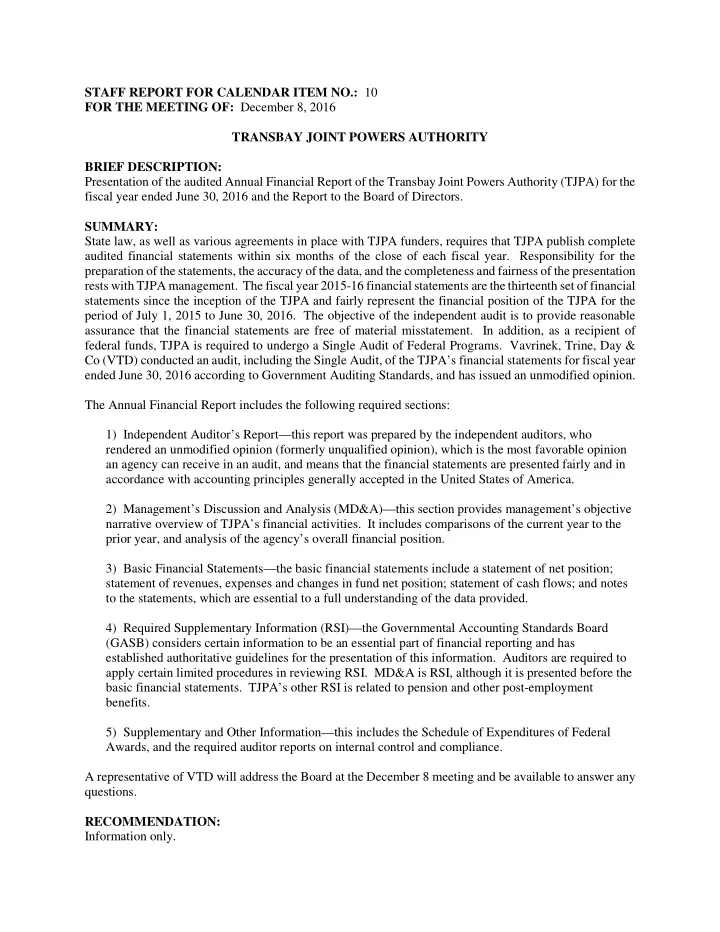
STAFF REPORT FOR CALENDAR ITEM NO.: 10 FOR THE MEETING OF: December 8, 2016 TRANSBAY JOINT POWERS AUTHORITY BRIEF DESCRIPTION: Presentation of the audited Annual Financial Report of the Transbay Joint Powers Authority (TJPA) for the fiscal year ended June 30, 2016 and the Report to the Board of Directors. SUMMARY: State law, as well as various agreements in place with TJPA funders, requires that TJPA publish complete audited financial statements within six months of the close of each fiscal year. Responsibility for the preparation of the statements, the accuracy of the data, and the completeness and fairness of the presentation rests with TJPA management. The fiscal year 2015-16 financial statements are the thirteenth set of financial statements since the inception of the TJPA and fairly represent the financial position of the TJPA for the period of July 1, 2015 to June 30, 2016. The objective of the independent audit is to provide reasonable assurance that the financial statements are free of material misstatement. In addition, as a recipient of federal funds, TJPA is required to undergo a Single Audit of Federal Programs. Vavrinek, Trine, Day & Co (VTD) conducted an audit, including the Single Audit, of the TJPA’s financial statements for fiscal year ended June 30, 2016 according to Government Auditing Standards, and has issued an unmodified opinion. The Annual Financial Report includes the following required sections: 1) Independent Auditor’s Report—this report was prepared by the independent auditors, who rendered an unmodified opinion (formerly unqualified opinion), which is the most favorable opinion an agency can receive in an audit, and means that the financial statements are presented fairly and in accordance with accounting principles generally accepted in the United States of America. 2) Management’s Discussion and Analysis (MD&A)—this section provides management’s objective narrative overview of TJPA’s financial activities. It includes comparisons of the current year to the prior year, and analysis of the agency’s overall financial position. 3) Basic Financial Statements—the basic financial statements include a statement of net position; statement of revenues, expenses and changes in fund net position; statement of cash flows; and notes to the statements, which are essential to a full understanding of the data provided. 4) Required Supplementary Information (RSI)—the Governmental Accounting Standards Board (GASB) considers certain information to be an essential part of financial reporting and has established authoritative guidelines for the presentation of this information. Auditors are required to apply certain limited procedures in reviewing RSI. MD&A is RSI, although it is presented before the basic financial statements. TJPA’s other RSI is related to pension and other post-employment benefits. 5) Supplementary and Other Information—this includes the Schedule of Expenditures of Federal Awards, and the required auditor reports on internal control and compliance. A representative of VTD will address the Board at the December 8 meeting and be available to answer any questions. RECOMMENDATION: Information only.
SLIDE 2
TRANSBAY JOINT POWERS AUTHORITY Annual Financial Report For the Year Ended June 30, 2016
SLIDE 3
TRANSBAY JOINT POWERS AUTHORITY For the Year Ended June 30, 2016 Table of Contents Page(s) Independent Auditor's Report ................................................................................................................ 1-2 Management’s Discussion and Analysis (Required Supplementary Information - Unaudited) ..... 5-10 Basic Financial Statements: Statement of Net Position ................................................................................................................. 12-13 Statement of Revenues, Expenses and Changes in Fund Net Position .................................................. 14 Statement of Cash Flows .................................................................................................................. 15-16 Notes to the Basic Financial Statements ........................................................................................... 17-42 Required Supplementary Information: Schedule of TJPA’s Share of the Net Pension Liability ........................................................................... 44 Schedule of TJPA Pension Contributions ................................................................................................ 44 Schedule of Funding Progress for Other Post-Employment Benefits ...................................................... 45 Supplementary Information: Schedule of Expenditures of Federal Awards ........................................................................................ 48 Notes to Schedule of Expenditures of Federal Awards ......................................................................... 49 Other Reports: Independent Auditor’s Report on Internal Control Over Financial Reporting and on Compliance and Other Matters Based on an Audit of Financial Statements Performed in Accordance with Government Auditing Standards........................................................................ 53-54 Independent Auditor’s Report on Compliance for Each Major Federal Program and on Internal Control Over Compliance Required by the Uniform Guidance ....................................... 55-56 Schedule of Findings and Questioned Costs ......................................................................................... 57
SLIDE 4
This page left blank intentionally.
SLIDE 5 1
INDEPENDENT AUDITOR’S REPORT
Board of Directors Transbay Joint Powers Authority San Francisco, California Report on the Financial Statements We have audited the accompanying basic financial statements of the Transbay Joint Powers Authority (TJPA), as of and for the fiscal year ended June 30, 2016, and the related notes to the financial statements, which collectively comprise the basic financial statements as listed in the table of contents. Management’s Responsibility for the Financial Statements Management is responsible for the preparation and fair presentation of these financial statements in accordance with accounting principles generally accepted in the United States of America; this includes the design, implementation, and maintenance of internal control relevant to the preparation and fair presentation of financial statements that are free from material misstatement, whether due to fraud or error. Auditors’ Responsibility Our responsibility is to express an opinion on these financial statements based on our audit. We conducted our audit in accordance with auditing standards generally accepted in the United States of America and the standards applicable to financial audits contained in Government Auditing Standards, issued by the Comptroller General of the United States. Those standards require that we plan and perform the audit to obtain reasonable assurance about whether the financial statements are free from material misstatement. An audit involves performing procedures to obtain audit evidence about the amounts and disclosures in the financial statements. The procedures selected depend on the auditor’s judgment, including the assessment of the risks of material misstatement of the financial statements, whether due to fraud or error. In making those risk assessments, the auditor considers internal control relevant to the entity’s preparation and fair presentation of the financial statements in order to design audit procedures that are appropriate in the circumstances, but not for the purpose of expressing an opinion on the effectiveness of the entity’s internal control. Accordingly, we express no such opinion. An audit also includes evaluating the appropriateness of accounting policies used and the reasonableness of significant accounting estimates made by management, as well as evaluating the overall presentation of the financial statements. We believe that the audit evidence we have obtained is sufficient and appropriate to provide a basis for
Opinion In our opinion, the financial statements referred to above present fairly, in all material respects, the financial position of the TJPA as of June 30, 2016 and the changes in financial position, and cash flows thereof for the year then ended in accordance with accounting principles generally accepted in the United States of America.
SLIDE 6 2
Other Matters Required Supplementary Information Accounting principles generally accepted in the United States of America require that the management’s discussion and analysis, schedule of TJPA’s share of the net pension liability, schedule of TJPA pension contributions and schedule of funding progress for other post-employment benefits, as listed in the table of contents, be presented to supplement the basic financial statements. Such information, although not a part
- f the basic financial statements, is required by the Governmental Accounting Standards Board, who
considers it to be an essential part of financial reporting for placing the basic financial statements in an appropriate operational, economic, or historical context. We have applied certain limited procedures to the required supplementary information in accordance with auditing standards generally accepted in the United States of America, which consisted of inquiries of management about the methods of preparing the information and comparing the information for consistency with management’s responses to our inquiries, the basic financial statements, and other knowledge we obtained during our audit of the basic financial
- statements. We do not express an opinion or provide any assurance on the information because the limited
procedures do not provide us with sufficient evidence to express an opinion or provide any assurance. Other Information Our audit was conducted for the purpose of forming opinions on the financial statements that collectively comprise the TJPA's basic financial statements. The schedule of expenditures of federal awards, as required by Title 2 U.S. Code of Federal Regulations (CFR) Part 200, Uniform Administrative Requirements, Cost Principles, and Audit Requirements for Federal Awards is presented for purposes of additional analysis and is not a required part of the basic financial statements. The schedule of expenditures of federal awards is the responsibility of management and was derived from and relates directly to the underlying accounting and other records used to prepare the financial
- statements. Such information has been subjected to the auditing procedures applied in the audit of the
basic financial statements and certain additional procedures, including comparing and reconciling such information directly to the underlying accounting and other records used to prepare the financial statements or to the financial statements themselves, and other additional procedures in accordance with auditing standards generally accepted in the United States of America. In our opinion, the schedule of expenditures of federal awards is fairly stated in all material respect in relation to the financial statements taken as a whole. Other Reporting Required by Government Auditing Standards In accordance with Government Auditing Standards, we have also issued our report dated December 1, 2016 on our consideration of the TJPA’s internal control over financial reporting and on our tests of its compliance with certain provisions of laws, regulations, contracts and grant agreements, and other
- matters. The purpose of that report is to describe the scope of our testing of internal control over financial
reporting and compliance and the results of that testing, and not to provide an opinion on internal control
- ver financial reporting or on compliance. That report is an integral part of an audit performed in
accordance with Government Auditing Standards in considering the TJPA’s internal control over financial reporting and compliance. Palo Alto, California December 1, 2016
SLIDE 7
MANAGEMENT’S DISCUSSION AND ANALYSIS
SLIDE 8 TRANSBAY JOINT POWERS AUTHORITY Management’s Discussion and Analysis (Required Supplementary Information-Unaudited) For the Year Ended June 30, 2016
4
The following discussion and analysis provides an overview of the Transbay Joint Powers Authority’s (“TJPA”) financial activities for the year ended June 30, 2016 with comparative information for the year ended June 30, 2015. Please read it in conjunction with the TJPA’s basic financial statements, which follow this section. Financial Highlights During the year ended June 30, 2016:
- The TJPA received $68,141,517 in capital contributions. All contributions were used for the
Transbay Transit Center Program (the “Program”), which consists of both the Transbay Transit Center (“TTC”) and the Caltrain Downtown Extension (“DTX”) projects.
- The direct senior secured term loan (“bridge loan”) in the amount of $171,000,000 from Goldman
Sachs Bank USA and Wells Fargo Securities LLC that closed in fiscal year 2015 was redeemed.
- Land sales proceeds totaled $403,076,028 for the fiscal year, from the sales of Block 5, Block 8, and
Parcel F. These proceeds will be used for Phase 1 construction of the TTC, and the future property tax increment from the developments is a source of repayment of TJPA’s federal TIFIA loan.
- At the close of the fiscal year, assets and deferred outflows of the TJPA exceeded its liabilities and
deferred inflows by $1,788,424,367. Construction Highlights
- The TTC construction work continued, with 2,395,878 craft hours completed through June 2016. The
final train box lid concrete pour occurred on June 30. Structural steel installation and welding was completed; the TTC superstructure consists of nearly 25,000 tons of steel and its assembly involved approximately 225,000 craft hours with no lost time injuries. Installation of glass curtain walls and the aluminum ‘Penrose pattern’ exterior awning commenced.
- Construction of the bus ramp continued. Design work for the bus storage facility was nearly
completed during the fiscal year.
- Five of six utility relocation packages are complete. The remaining trade package had scope added at
the request of the City and County of San Francisco (“City”); it is not on the critical path, and is scheduled to be completed in fiscal year 2017. Overview of the Financial Statements This discussion and analysis is intended to serve as an introduction to the TJPA’s basic financial
- statements. The annual financial report for the TJPA includes this management’s discussion and analysis
(“MD&A”), the basic financial statements and notes to the basic financial statements. The TJPA is reported as an enterprise fund. Enterprise funds are a type of proprietary fund that is used to report information in a manner similar to a private-sector business. An enterprise fund is used to account for functions that are intended to recover all or a significant portion of their costs through user fees and
- charges. Under the Joint Powers Agreement creating the TJPA, dated April 4, 2001, the new transit
terminal and related facilities will be managed and operated upon their completion as an enterprise
SLIDE 9 TRANSBAY JOINT POWERS AUTHORITY Management’s Discussion and Analysis (Required Supplementary Information-Unaudited) For the Year Ended June 30, 2016
5
The basic financial statements include the Statement of Net Position; Statement of Revenues, Expenses, and Changes in Fund Net Position; and Statement of Cash Flows. Following is a brief explanation of the use of each of the statements. The Statement of Net Position presents information on all of the TJPA’s assets, deferred outflows
- f resources, deferred inflows of resources, and liabilities, with the difference between assets plus
deferred outflows of resources and liabilities plus deferred inflows of resources reported as net
- position. Over time, increases or decreases in net position may serve as a useful indicator of
whether the financial position of the TJPA is improving or deteriorating. The Statement of Revenues, Expenses and Changes in Fund Net Position presents information showing how the TJPA’s net position changed during the most recent fiscal year. All changes in net position are reported as soon as the underlying event giving rise to the change occurs, regardless of the timing of the related cash flows. The Statement of Cash Flows presents the cash inflows and outflows and the resulting cash position at fiscal year-end. Notes to the Basic Financial Statements. The notes to the basic financial statements provide additional information that is essential to a full understanding of the data provided in the basic financial statements. Financial Statement Analysis The TJPA has applied Governmental Accounting Standards Board (“GASB”) Statement No. 34. In accordance with GASB, a comparative analysis of financial data is presented.
SLIDE 10 TRANSBAY JOINT POWERS AUTHORITY Management’s Discussion and Analysis (Required Supplementary Information-Unaudited) For the Year Ended June 30, 2016
6 Dollar Percent 2016 2015 Change Change Assets: Current and other assets 28,748,537 $ 51,998,029 $ (23,249,492) $
Restricted assets 228,457,418 236,628,426 (8,171,008)
Capital assets 1,617,941,436 1,310,456,841 307,484,595 23% Total assets 1,875,147,391 1,599,083,296 276,064,095 17% Deferred outflows of resources: Pension related 692,675 381,477 311,198 82% Derivative instrument-interest rate cap
(585,962)
Total deferred outflows of resources 692,675 967,439 (274,764)
Liabilities: Current and other liabilities 68,700,395 82,623,520 (13,923,125)
Notes payable
(171,000,000)
Intergovernmental liability to the City for re-conveyance of State transferred land 18,414,675 27,584,421 (9,169,746)
Total liabilities 87,115,070 281,207,941 (194,092,871)
Deferred inflows of resources: Pension related 300,628 249,489 51,139 20% Net Position: Net investment in capital assets 1,525,036,717 1,208,382,376 316,654,341 26% Restricted O&M Reserve for Transbay Transit Center 4,763,312 4,281,615 481,697 11% Construction of Transbay Transit Center 252,359,978 76,952,748 175,407,230 228% Debt service 2,509,708 22,863,847 (20,354,139)
Unrestricted 3,754,653 6,112,720 (2,358,067)
Total net position 1,788,424,368 $ 1,318,593,306 $ 469,831,062 $ 36% TJPA'S CONDENSED STATEMENTS OF NET POSITION
Total net position at June 30, 2016 includes invested in capital assets, net of related debt, which is comprised of construction in progress of $1,413,313,697, land scheduled to be permanently and temporarily retained by the TJPA of $186,075,690, and permanent easements of $137,374. The construction in progress includes construction, construction management, program management, and administrative costs necessary to support the development of the TTC and DTX, as well as information technology costs for website development and labor compliance software. $2,509,708 of current year net position is net tax increment funds restricted for debt service, although with the redemption of the bridge loan at the end of the fiscal year these funds were transferred out of the debt service account in fiscal year 2017. A $4,763,312 restriction of total current year net position results from the restriction of the net position of Temporary Terminal operations for an Operating and Maintenance Reserve. The Operating and Maintenance Reserve can only be used for the operations and maintenance of Program facilities, including the Temporary Terminal, the future TTC, or the future DTX. The $481,697 increase in restricted assets for the operating and maintenance reserve resulted from
SLIDE 11 TRANSBAY JOINT POWERS AUTHORITY Management’s Discussion and Analysis (Required Supplementary Information-Unaudited) For the Year Ended June 30, 2016
7
In addition, $252,359,978 is restricted for construction of the TTC as a result of land sales proceeds (see Note 4 for additional information). Total current year net position also includes $3,754,653 in unrestricted net position which is derived from TJPA’s non-operating revenues and is to be used for acquisition of capital assets. The $23,249,492 net decrease in current and other assets resulted primarily from a $23,559,089 decrease in grantor receivables outstanding at fiscal year-end. The $8,171,009 decrease in restricted assets resulted primarily from a lower balance in the City Treasurer’s investment pool and the write-down of the fair market value of the interest rate cap, given that it no longer qualifies for hedge accounting with the redemption of the associated bridge loan. The changes in deferred outflows of resources and deferred inflows of resources are due to accounting treatment of pension amounts, and the removal of the prior year deferral associated with the interest rate cap. The net decrease of $13,923,125 in current and other liabilities resulted primarily from a $13,422,244 decrease in accounts payable and an $815,898 decrease in accrued interest payable, offset primarily by a $1,092,883 increase in intergovernmental payables to the City. In addition, liabilities decreased by $171,000,000 with the redemption of the bridge loan during the fiscal year.
Dollar Percent 2016 2015 Change Change Temporary Terminal operating income Operating revenues 481,697 $ 406,662 $ 75,035 $ 18% Operating expenses
Operating income 481,697 406,662 75,035 18% Nonoperating revenues (expenses) Operating grant for Temporary Terminal Revenue 3,817,607 3,644,073 173,534 5% Expenses (3,817,607) (3,644,073) (173,534) 5% Net operating grant
Investment income 876,211 292,357 583,854 200% Loss on interest rate cap (4,660,288) Rental revenues 114,110 96,906 17,204 18% Miscellaneous revenues 39 27,912 (27,873)
Net tax increment revenue 1,631,749 2,419,979 (788,230)
Gain on conveyance of land 403,076,028 43,651,000 359,425,028 823% Gain on conveyance of air rights 170,000
n/a Total nonoperating revenues 401,207,849 46,488,154 359,379,983 773% Income before capital contributions 401,689,546 46,894,816 359,455,018 767% Capital contributions Federal government capital grants 7,324,826 38,393,123 (31,068,297)
State government capital grants 21,882,281 5,585,732 16,296,549 292% Local government capital grants 38,286,442 55,218,072 (16,931,630)
Other capital contributions 647,968 4,467,981 (3,820,013)
Total capital contributions 68,141,517 103,664,908 (35,523,391)
Change in net position 469,831,063 150,559,724 323,931,627 215% Net position- beginning 1,318,593,304 1,168,033,580 150,559,724 13% Net position- ending 1,788,424,367 $ 1,318,593,304 $ 469,831,063 $ 36% TJPA'S CONDENSED STATEMENTS OF CHANGES IN NET POSITION
SLIDE 12 TRANSBAY JOINT POWERS AUTHORITY Management’s Discussion and Analysis (Required Supplementary Information-Unaudited) For the Year Ended June 30, 2016
8
Operating revenues Operation of the Temporary Terminal commenced on August 7, 2010. The source of fiscal year 2016
- perating revenues of $481,697 was lease and advertising revenues. The increase in operating revenues
- f $75,034 is due to CPI increases in Temporary Terminal rental and advertising contracts. No operating
expenses were funded from operating revenues. Nonoperating revenues The TJPA funds Temporary Terminal facility management and related operating expenses from a Metropolitan Transportation Commission (“MTC”) Regional Measure 2 (“RM-2”) operating grant. Total fiscal year 2016 operating grant revenues and expenses were $3,817,607. The fiscal year 2016 increase in investment income of $876,211 is attributable to higher investment balances of land sales proceeds. The decrease in miscellaneous revenues is attributable to the inherent variability of revenues earned in this category. The decrease in net tax increment revenue is due to an
- verpayment by the City in the prior year and subsequent clawback in this fiscal year. The increase in the
gain on the conveyance of land of $359,425,028 is due to the sale of three parcels in fiscal year 2016, versus one parcel in the prior fiscal year.
SLIDE 13 TRANSBAY JOINT POWERS AUTHORITY Management’s Discussion and Analysis (Required Supplementary Information-Unaudited) For the Year Ended June 30, 2016
9
Capital contributions (See Note 2 for additional information) For the year ended June 30, 2016, the TJPA received $68,141,517 in capital contributions. The decrease in capital contributions from the prior fiscal year reflects the shifting nature of TJPA’s funding sources from capital grants to land sales proceeds and debt. Capital contributions were expended on the Transbay Transit Center Program, which includes a new Transit Center building, new bus storage facility, bus ramps, and a 1.95 mile extension of rail lines for Caltrain and future California High Speed Rail to the Transit Center. At June 30, 2016, the TJPA had capital project contract commitments of $521,403,186 for construction, design, engineering, planning and administrative costs. Additional information on the TJPA’s capital assets can be found in Note 4 to the financial statements. Economic Factors and Next Year’s Budget The TJPA Board approved the fiscal year 2017 Capital Budget on June 9, 2016. The main component of the TJPA’s fiscal year 2017 $484,920,300 Capital Budget is the continuation of construction of the new
- TTC. Approximately $428 million is budgeted for construction activities and $12.3 million for
construction management. The TJPA has budgeted approximately $7 million for the TTC building architect to continue construction administration activities in fiscal year 2017. The TJPA’s fiscal year 2017 budget anticipates that most of the revenues to pay for these expenditures will be provided by the following sources: land sales proceeds, unspent proceeds from the bridge loan, additional financing provided by the TIFIA loan and the City, the funding identified in the expenditure plan approved by the voters for the half cent sales tax for transportation in San Francisco (“Prop K”), and to a lesser extent the bridge toll increases approved in Regional Measure 1 and 2 and AB1171 (“RM-1”, “RM-2” and “AB1171”), federal and state grants passed through from AC Transit, grants from the Federal Transit Administration (“FTA”), and an American Recovery and Reinvestment Act (“ARRA”) grant from the Federal Railroad Administration (“FRA”). The approved fiscal year 2017 Capital Budget shows revenues in two categories–committed and planned. Committed revenues are those planned expenditures of grants that were allocated, or land sales and debt proceeds already received, at the time the TJPA Board approved the 2017 fiscal year budget, and planned revenues include sources that have pending applications with funding partners or applications that are anticipated to be submitted and approved during the fiscal year. Throughout the 2017 fiscal year, TJPA will work with the funding agencies to secure grants and financing as any additional funding needs are
- identified. This is explained in detail in the staff reports which were submitted with the fiscal year 2017
budget presentations and can be found on the TJPA website for the May 12 and June 9, 2016 TJPA Board meetings. The fiscal year 2017 Operating Budget was approved June 9, 2016, and consists of $5,187,168 in revenues and expenditures. Expenditures include a facility management contract, security, operating support for AC Transit, and parking control officers. The majority of the revenues will be provided by the RM-2 operating grant. Request for Information Questions concerning any of the information provided in this report or requests for additional financial information should be addressed to the Transbay Joint Powers Authority, 201 Mission Street, Suite 2100, San Francisco, California 94105.
SLIDE 14
This page left blank intentionally.
SLIDE 15
BASIC FINANCIAL STATEMENTS
SLIDE 16
See accompanying notes to the basic financial statements. 12 Assets: Current assets: Cash and cash equivalents: Cash in bank 950,201 $ Restricted cash for operations and maintenance of the Transbay Transit Center 265,311 Restricted cash for construction of the Transbay Transit Center 669,265 Equity in pooled cash and investments with the City and County of San Francisco 5,669,886 Equity in pooled cash and investments with the City and County of San Francisco - restricted for operations and maintenance of the Transbay Transit Center 4,549,265 Equity in pooled cash and investments with the State of California 500,748 Total cash and cash equivalents 12,604,675 Receivables: Federal government 1,551,146 Metropolitan Transportation Commission 4,676,731 San Francisco County Transportation Authority 7,811,049 Alameda-Contra Costa Transit District 1,764,422 Accounts receivable 277,762 Total receivables 16,081,111 Other current assets: Prepaid items 55,000 Security deposits held by others 7,751 Total other current assets: 62,751 Total current assets 28,748,537 Noncurrent assets: Restricted assets: Cash 751 Equity in pooled cash and investments with the City and County of San Francisco 3,177,226 Investments 223,465,805 Interest receivable 233,923 Interest rate cap 1,579,712 Total restricted assets 228,457,418 Capital assets, nondepreciable: Land 186,075,690 Permanent easements 137,374 State transferred land to be re-conveyed to the City and County of San Francisco 18,414,675 Construction in progress: Information technology 158,965 Transbay Transit Center 1,357,765,184 Caltrain Downtown Extension 55,389,548 Total nondepreciable capital assets 1,617,941,436 Total noncurrent assets 1,846,398,853 Total Assets 1,875,147,390 (Continued) TRANSBAY JOINT POWERS AUTHORITY Statement of Net Position June 30, 2016
SLIDE 17 See accompanying notes to the basic financial statements. 13 Deferred Outflows of Resources: Pension related 692,675 Total Deferred Outflows of Resources 692,675 Liabilities: Current liabilities: Accounts, contracts and intergovernmental payables 38,332,675 Accrued payroll 76,703 Retainage payable 27,623,648 Intergovernmental payables-related parties Caltrans 92,274 City and County of San Francisco 1,360,812 AC Transit 543,074 Accrued interest payable
82,264 Deposits payable 32,900 Total current liabilities 68,144,350 Noncurrent liabilities: Intergovernmental liability to the City and County of San Francisco for re-conveyance of State transferred land 18,414,675 Compensated absences, accrued vacation 161,290 Net pension liability 394,755 Net other postemployment benefit obligation
- Total noncurrent liabilities
18,970,720 Total Liabilities 87,115,070 Deferred Inflows of Resources: Pension related 300,628 Total Deferred Inflows of Resources 300,628 Net Position: Net investment in capital assets 1,525,036,717 Restricted Operations and maintenance of Transbay Transit Center 4,763,312 Construction of Transbay Transit Center 252,359,978 Debt Service 2,509,708 Unrestricted 3,754,653 Total Net Position 1,788,424,367 $ Statement of Net Position (Continued) June 30, 2016 TRANSBAY JOINT POWERS AUTHORITY
SLIDE 18 See accompanying notes to the basic financial statements. 14 Operating Revenues - Temporary Terminal: Lease revenue 427,422 $ Advertising revenue 54,275 Total operating revenues 481,697 Operating Expenses - Temporary Terminal: Total operating expenses
- Operating Income - Temporary Terminal
481,697 Nonoperating Revenues and Expenses: Operating grant (MTC) for Temporary Terminal Operating grant revenue 3,817,607 Operating grant expenses: AC Transit incremental operating and maintenance costs 2,600,000 Facility Management 1,041,315 Utilities
124,992 Insurance 51,300 Total operating grant expenses 3,817,607 Net operating grant revenues (expenses)
- Contribution from AC Transit for O&M reserve
- Unrealized loss on interest rate cap
(4,660,288) Investment income 876,211 Rental revenues 114,110 Miscellaneous revenues 39 Net tax increment revenue 1,631,749 Gain (Loss) on sale of land 403,076,028 Gain (Loss) on sale of easement 170,000 Total nonoperating revenues 401,207,848 Income Before Capital Contributions 401,689,545 Capital Contributions: Federal government capital grants 7,324,826 State government capital grants 21,882,281 Local government capital grants: Regional Measures, bridge tolls 6,598,351 Proposition K, half cent sales tax 31,688,091 Other capital contributions 647,968 Total Capital Contributions 68,141,517 Change in Net Position 469,831,062 Net Position, Beginning of Year 1,318,593,305 Net Position, End of Year 1,788,424,367 $ TRANSBAY JOINT POWERS AUTHORITY Statement of Revenues, Expenses and Changes in Fund Net Position For the Year Ended June 30, 2016
SLIDE 19
See accompanying notes to the basic financial statements. 15 Cash Flows from Operating Activities: Temporary Terminal: Cash receipts from lease revenue 427,902 $ Cash receipts from advertising revenue 54,275 Net cash provided by operating activities 482,177 Cash Flows from Noncapital Financing Activities: Operating grant, net 3,433 Cash receipts from rental revenues 103,224 Other noncapital increases (decreases) 266 Net cash provided by noncapital financing activities 106,923 Cash Flows from Capital and Related Financing Activities: Principal paid on capital debt (171,000,000) Federal government capital grants received 22,377,446 State government capital grants received 22,663,612 Local government capital grants received 45,154,605 Other capital contributions received 591,090 Net tax increment revenue received 1,631,749 Proceeds from sale of land 403,094,170 Proceeds from sale of air rights easement 170,000 Acquisition of capital assets (329,970,095) Net cash used for capital and related financing activities (5,287,423) Cash Flows from Investing Activities: Purchases of investment securities (1,077,608,813) Proceeds from maturities of investment securities 1,076,995,700 Investment income received 921,381 Net cash provided by investing activities 308,267 Net Decrease in Cash and Cash Equivalents (4,390,055) Cash and Cash Equivalents, Beginning of Year 20,172,707 Cash and Cash Equivalents, End of Year 15,782,651 $ Cash and Cash Equivalents, End of Year: Cash and cash equivalents, unrestricted 12,604,675 $ Cash and cash equivalents, restricted 3,177,977 Cash and cash equivalents, end of year 15,782,651 $ (Continued) TRANSBAY JOINT POWERS AUTHORITY Statement of Cash Flows For the Year Ended June 30, 2016
SLIDE 20 See accompanying notes to the basic financial statements. 16 Reconciliation of Operating Income to Net Cash Provided by Operating Activities: Operating income-Temporary Terminal 481,697 $ Adjustments to reconcile operating income to net cash provided by operating activities Increase in unearned revenue 480 Net cash provided by operating activities 482,177 $ Supplemental disclosures of cash flow information Noncash capital financing activities: Acquisition of capital assets on accounts payable, contracts payable, intergovernmental payables, retainage payable and accrued liabilities 67,408,157 $ Acquisition of capital assets from capital debt
For the Year Ended June 30, 2016 TRANSBAY JOINT POWERS AUTHORITY Statement of Cash Flows (Continued)
SLIDE 21 TRANSBAY JOINT POWERS AUTHORITY Notes to the Basic Financial Statements For the Year Ended June 30, 2016
17
NOTE 1 - ORGANIZATION In April 2001, the City, Alameda-Contra Costa Transit District (“AC Transit”), and the Peninsula Corridor Joint Powers Board (“PCJPB”) (collectively, “Member Agencies”) entered into an agreement creating the Transbay Joint Powers Authority (“TJPA”) to design, build, develop, operate and maintain a new transportation terminal known as the Transbay Transit Center (“TTC” or “Transit Center”) and associated facilities in San Francisco (collectively, the “Program”). The TJPA Board of Directors (“TJPA Board”) is composed of one director appointed by each of the following agencies: Alameda-Contra Costa Transit District City and County of San Francisco, Board of Supervisors City and County of San Francisco, Mayor’s Office San Francisco Municipal Transportation Agency Peninsula Corridor Joint Powers Board State of California Department of Transportation (ex-officio) The State of California (“State”) has granted the TJPA primary jurisdiction with respect to all matters pertaining to the financing, design, development, construction, and operation of the new Transit Center. The Member Agencies of the TJPA have granted to the TJPA most of their jointly held powers, including the authority to buy and sell property, to enter into contracts, and to accept and expend grants of cash and
- property. The TJPA’s management functions include contract oversight, policy direction, financing,
investment supervision, and coordinating and collaborating with, among others, the U.S. Department of Transportation, the State, and local entities including the Member Agencies. The Program will provide expanded bus and rail service in a new Transit Center building on the site of the former Transbay Terminal in downtown San Francisco at First and Mission Streets. Also included in the Program is a ramp linking the new Transit Center to the Bay Bridge and to off-site bus storage facilities; a below-grade extension of Caltrain to the new Transit Center building, including the construction of a new subsurface station in the vicinity of Fourth and Townsend Streets; modifications to the existing Fourth and Townsend surface station; a temporary terminal for use by buses during construction of the new Transit Center; and a new permanent off-site bus storage facility. The new Transit Center will eventually accommodate not only buses and commuter trains but also California High- Speed Rail. Based upon the TJPA Board’s adopted implementation plan, the Project is divided into two phases: the design and construction of the Transit Center Building and Train Box as Phase 1, and the design and construction of the DTX as Phase 2. Phase 1 has completed major milestones including commencement
- f construction. Phase 2 is at approximately a 30 percent design level; final design and construction will
commence when the required revenues and financing have been secured. The TJPA is legally separate and financially independent and is not a component unit of the State, City, AC Transit, or the PCJPB. Therefore, these financial statements represent solely the activities, transactions and status of the TJPA.
SLIDE 22 TRANSBAY JOINT POWERS AUTHORITY Notes to the Basic Financial Statements For the Year Ended June 30, 2016
18
NOTE 1 - ORGANIZATION (Continued) The TJPA’s major funding sources include grants from the federal government; grants of local revenue sharing (“Capital and Operating Grants”) from AC Transit, MTC, and the San Francisco County Transportation Authority (“SFCTA”); and proceeds from sale of land parcels formerly owned by the
- State. In addition, financing was provided in fiscal year 2015 through a direct loan from Goldman Sachs
Bank USA and Wells Fargo Securities LLC, and additional debt proceeds from a TIFIA loan and the City are anticipated to be available and utilized in fiscal year 2017. The federal TIFIA program provides loans and loan guarantees to transportation infrastructure projects throughout the country. TJPA closed on a TIFIA loan in January 2010 for Phase 1 Transbay Transit Center construction which is to be repaid primarily with net tax increment revenues allocated to the project. The net tax increment revenues allocated to the project are committed to the TJPA pursuant to an agreement with the City. NOTE 2 - SUMMARY OF SIGNIFICANT ACCOUNTING POLICIES Basis of Accounting The TJPA is a single enterprise fund. The activities of the TJPA are reported using the economic resources measurement focus and its records are maintained on the accrual basis of accounting. Under this method, revenues are recorded when earned and Program capital outlay and Temporary Terminal expenses are recorded when the related liability is incurred. The TJPA distinguishes operating revenues and expenses from nonoperating revenues and expenses. Operating revenues and operating expenses result from the operation of the Temporary Terminal. Any excess of actual Temporary Terminal revenues over expenses is restricted for the Operating and Maintenance Reserve. Expenses funded by an operating grant are also incurred in the operation of the Temporary Terminal but are considered nonoperating expenses as they are grant funded. The TJPA will generate Transit Center operating revenues and operating expenses once the Transit Center is complete and placed into service. Nonoperating revenues result from a Temporary Terminal operating grant, investment income, rent from property tenants other than Temporary Terminal operators, and miscellaneous revenue. All active TJPA capital grants are expenditure-driven restricted grants. Restricted grant revenue is recognized only when qualifying expenditures are incurred. That is, restricted grant revenue recognition is driven by restricted grant-related expenditures being incurred. When Program costs are incurred, if there is both restricted and unrestricted net position available to finance the costs, it is the TJPA’s policy to first apply restricted grant and revenue sharing resources to such Program costs. Cash Equivalents and Investments The TJPA reports all highly liquid investments with a maturity of twelve months or less when purchased as cash equivalents or investments at cost. The deposits in the City and State investment pools are considered to be cash equivalents as the pools function as demand deposit accounts. Investments that are not highly liquid, or had maturities longer than twelve months at purchase, would be reported at fair value derived from the investment account statements. TJPA did not hold any such investments at June 30, 2016 (see Note 3).
SLIDE 23 TRANSBAY JOINT POWERS AUTHORITY Notes to the Basic Financial Statements For the Year Ended June 30, 2016
19
NOTE 2 - SUMMARY OF SIGNIFICANT ACCOUNTING POLICIES (Continued) Prepaid Items Resource outflows that do not yet meet the criteria for expenditure recognition, in that they benefit a future fiscal period, are recorded as prepaid items. At June 30, 2016, the total amount of prepaid items is $55,000. Deposits Payable The TJPA may require deposits from tenants of TJPA-owned rental property and the Temporary Terminal, as well as from developers during negotiations. At June 30, 2016, the TJPA had a deposit payable for a rental property totaling $8,900, and a deposit payable of $24,000 for a Temporary Terminal
Unearned Revenue Resource inflows that do not yet meet the criteria for revenue recognition are recorded as unearned
- revenue. Capital contribution revenue from the TJPA’s expenditure-driven grants and from other
contributors such as adjacent property developers or tenants is recognized only when qualifying expenditures are incurred or the rental period begins. At June 30, 2016, the total amount of unearned revenue is $82,264. Compensated Absences It is the policy of TJPA to permit employees to accumulate earned but unused vacation and sick pay
- benefits. Each employee is assigned an accrual rate and allowed to accrue up to two years’ worth of
vacation benefits. Vacation pay is accrued when earned. At June 30, 2016 the amount of accrued vacation payable is $161,290. There is no limit on accrual of sick leave, but also no liability for unpaid accumulated sick leave since TJPA does not have a policy to pay any amounts for sick leave when employees separate from service. Capital Assets The TJPA defines capital assets as assets with an initial, individual cost of more than $5,000 and an estimated useful life in excess of one year. Land, including land transferred by the State that may be re- conveyed to the City or the Office of Community Investment and Infrastructure (“OCII”) for future use or sale, and permanent easements are recorded as non-depreciable capital assets. Information technology, TTC, and DTX capital asset costs are classified as construction in progress until such assets are completed and placed in service, at which time the TJPA will commence recording depreciation expense
- n depreciable capital assets.
All construction in progress costs associated with the planning and construction of the Program that are not directly associated with either the TTC or the DTX are accumulated as indirect program-wide costs. The annual increase in accumulated indirect program-wide costs is allocated to the TTC and DTX based
- n the respective percentage increase of annual direct costs of the TTC and DTX.
Non-depreciable land capital assets include the cost of the land and associated acquisition costs. Under the TJPA’s capital asset policy, land costs include the following in addition to the actual acquisition costs: title and closing costs; relocation services, consultation and assistance; appraisal services; environmental consulting; land surveys; and site preparation including demolition.
SLIDE 24 TRANSBAY JOINT POWERS AUTHORITY Notes to the Basic Financial Statements For the Year Ended June 30, 2016
20
NOTE 2 - SUMMARY OF SIGNIFICANT ACCOUNTING POLICIES (Continued) Capital Contributions The TJPA receives expenditure-driven restricted capital grants from the federal government. Details for the various active federal government direct and pass-through capital grants are presented in the “Schedule of Expenditures of Federal Awards” (“SEFA”). In addition to the grants listed in the SEFA, during the fiscal years ended June 30, 2002 through 2008, $8,795,355 in Federal Transit Formula Grants were passed through from the San Francisco Municipal Transportation Agency to the TJPA and
- disbursed. Other FTA, FRA and Federal Emergency Management Agency (“FEMA”) grants now closed
and not included in the SEFA total $27,399,823, which was spent on Program capital expenditures in prior fiscal years. The State provides direct and pass-through expenditure-driven restricted capital grants, the details for which are presented in Note 8, Local and State Revenue Funding Agreements. Land transferred (conveyed) from the State and scheduled to be permanently retained by the TJPA is recorded as a capital
- contribution. Land transferred (conveyed) from the State which is scheduled to be re-conveyed to the
City or OCII during or at the end of the interim construction period is recorded as an intergovernmental
- liability. See Note 4, Capital Assets, for details regarding State-conveyed land.
Grants from local agency expenditure-driven restricted shared revenues and pass-through grants for the TJPA Capital Program are provided from: AC Transit Federal and State pass through grants MTC State-owned bridge tolls SFCTA Sales and use tax SMCTA Sales tax See Note 8, Local and State Revenue Funding Agreements, for details regarding the local government capital grants from AC Transit, MTC, SFCTA, and San Mateo County Transportation Authority (“SMCTA”). Contributions of donated noncash, nonland assets are recorded at fair value in the period received as in- kind contributions. The TJPA recorded donated materials and survey and planning services during the two-year period ended June 30, 2004 from the former San Francisco Redevelopment Agency (now OCII) in the amount of $798,689. Capital grants and contributions from external sources are recognized as capital contributions earned when the related allowable expenditures are incurred. Federal and State grants, State-conveyed land scheduled to be retained by the TJPA, grants from local agency shared revenues, and in-kind contributions for the TJPA Capital Program are reported in the Statement of Revenues, Expenses, and Changes in Fund Net Position as capital contributions.
SLIDE 25 TRANSBAY JOINT POWERS AUTHORITY Notes to the Basic Financial Statements For the Year Ended June 30, 2016
21
NOTE 2 - SUMMARY OF SIGNIFICANT ACCOUNTING POLICIES (Continued) Capital Contributions (Continued) The table below summarizes the current year and life-to-date capital contributions for each of TJPA’s funding partners.
Current Fiscal Year Approved Unexpended Funding Partner Actual Award Actual Award Federal government Capital grants 7,324,826 $ 475,779,260 $ 465,431,799 $ 10,347,461 $ Total Federal government 7,324,826 475,779,260 465,431,799 10,347,461 State government Capital grants 21,882,281 44,213,279 44,069,852 143,427 Total State government 21,882,281 44,213,279 44,069,852 143,427 Local agencies MTC 6,598,351 353,200,327 348,200,189 5,000,138 SFCTA 31,688,091 184,885,416 172,019,148 12,866,268 SMCTA Completed 23,359,514 23,359,514
- SFRA in-kind contribution
Completed 798,689 798,689
38,286,442 562,243,946 544,377,539 17,866,407 Total grantor contributions 67,493,549 1,082,236,485 $ 1,053,879,191 28,357,294 $ Other capital contributions 647,968 6,554,702 Total capital contributions 68,141,517 $ 1,060,433,893 $ Percent of the total life-to-date actual grantor contributions made by funding partners: Federal State Local Total Amount 465,431,799 $ 44,069,852 $ 544,377,539 $ 1,053,879,191 $ Percent 44% 4% 52% 100% Life-To-Date Actual
Net Position The difference between assets plus deferred outflows of resources and liabilities plus deferred inflows of resources in the Statement of Net Position is classified as Net Position and is subdivided into the following three categories: Net Position-Net investment in capital assets This component of net position consists of capital assets, net of related debt and of accumulated depreciation (when applicable), reduced by obligations to re-convey State-transferred land. At June 30, 2016, the TJPA has no debt related to acquisition of capital assets, and $18,414,675 recorded as an intergovernmental liability to the City for re-conveyance of State-transferred land. Total invested in capital assets net of related debt is $1,525,036,717. Net Position-Restricted Restricted net position has external constraints imposed by creditors (such as through debt covenants), grantors, contributors, or laws or regulations of other governments or constraints imposed by law through constitutional provisions or enabling legislation, that restrict the use of net position.
SLIDE 26 TRANSBAY JOINT POWERS AUTHORITY Notes to the Basic Financial Statements For the Year Ended June 30, 2016
22
NOTE 2 - SUMMARY OF SIGNIFICANT ACCOUNTING POLICIES (Continued) Restricted net position at June 30, 2016 is as follows: Restricted for operations and maintenance of TTC 4,763,312 $ Restricted for construction 252,359,978 Restricted for debt service 2,509,708 Total restricted net position 259,632,998 $ Net Position-Unrestricted This component of net position consists of net position that does not meet the definition of “restricted” or “net investment in capital assets”. At June 30, 2016, unrestricted net position is $3,754,653. Temporary Terminal Operating and Nonoperating Revenues and Operating and Maintenance Reserve The Transbay Temporary Terminal provides temporary bus terminal facilities while construction of the new multi-modal TTC takes place. Located minutes from the former Terminal on the block bounded by Main, Folsom, Beale and Howard Streets, the Temporary Terminal serves AC Transit, WestCAT Lynx, SF Muni, Golden Gate Transit, SamTrans and Greyhound passengers. Temporary Terminal construction began in 2008 and was completed in 2010, with operations commencing in August 2010. The Temporary Terminal will serve commuters until the new TTC opens in 2017. Temporary Terminal Operating Revenue Temporary Terminal operating revenues consist of lease and advertising revenue. For the fiscal year ended June 30, 2016, total operating revenue was $481,697 and no operating and maintenance expenses were funded from operating revenues. Temporary Terminal Nonoperating Revenue Restricted operating assistance from local shared revenues (operating grants) is classified as nonoperating revenue and recorded as earned revenue when the related expenses are incurred. The TJPA receives an
- perating grant from MTC RM-2 state-owned bridge tolls to fund Temporary Terminal facility
management expenses, including utilities, security, and primary tenant AC Transit’s increased costs to
- perate from the Temporary Terminal.
For the year ended June 30, 2016, the MTC-approved RM-2 operating grant allocation total is $4,533,205
- f which $3,817,607 was expended leaving an unexpended balance of $715,598. The unexpended
- perating grants do not carry over to the following fiscal year. MTC approves a new operating grant for
each fiscal year. Temporary Terminal Operating and Maintenance Reserve The net position of the Temporary Terminal is restricted pursuant to the September 29, 2008 TJPA Board
- f Directors-approved comprehensive Lease and Use Agreement that controls AC Transit’s bus
- perations in the Temporary Terminal and future operations in the Transit Center. The net position of the
Temporary Terminal is restricted for the Operating and Maintenance Reserve for Program facilities and is not available for construction of the TTC or the DTX. At June 30, 2016, net position of $4,763,312 is restricted for the Operating and Maintenance Reserve.
SLIDE 27 TRANSBAY JOINT POWERS AUTHORITY Notes to the Basic Financial Statements For the Year Ended June 30, 2016
23
NOTE 2 - SUMMARY OF SIGNIFICANT ACCOUNTING POLICIES (Continued) The purpose of the Operating and Maintenance Reserve is to ensure that sufficient operating and maintenance funds are available in the event of unanticipated revenue shortfalls and unavoidable costs. Disbursements from restricted Operating and Maintenance Reserve funds must meet at least one of the following criteria:
- Necessary for the safety or security of the public or the facility;
- Required by the Lease and Use Agreements with operators or other agreements or contracts
entered into by the TJPA;
- Authorized under the annual Operating and Maintenance budget approved by the Board; or
- Other unforeseen circumstances wherein the use of the reserve funds is deemed necessary by the
Executive Director, designee, or by the Board of Directors. In addition to the criteria described above, the TJPA may use funds in the TTC Operating and Maintenance Reserve as working capital to fulfill contractual or other obligations, for payment to vendors
- r contractors prior to the receipt of funds from funding partners. A commitment from the funding
partners must be in place prior to the temporary “borrowing” of cash from this reserve. To the extent possible, the use of these funds as working capital should not result in the Operating and Maintenance Reserve balance dropping below two months of current fiscal year Temporary Terminal or TTC (as applicable) direct operating and maintenance costs. The use of the Operating and Maintenance Reserve funds as working capital must be authorized by the Executive Director or designee. Pensions For purposes of measuring the net pension liability, deferred outflows of resources and deferred inflows
- f resources related to pensions, and pension expense, information about the fiduciary net position of the
California Public Employees Retirement System (“CalPERS”) plans and additions to/deductions from the plans’ fiduciary net position have been determined on the same basis as they are reported by CalPERS. For this purpose, benefit payments (including refunds of employee contributions) are recognized when due and payable in accordance with the benefit terms. Investments are reported at fair value. Derivative Instruments In fiscal year 2015, TJPA’s interest rate cap was accounted for in accordance with Governmental Accounting Standards Board (“GASB”) Statement No. 53, Accounting and Financial Reporting for Derivative Instruments (“GASB 53”), and the change in fair value of the hedging derivative instrument was reported as a deferral in the Statement of Net Position. At the end of fiscal year 2016, the interest rate cap was no longer considered a derivative instrument as the associated debt was no longer
- utstanding, and the change in fair value is reported as a loss on the Statement of Revenues, Expenses and
Changes in Fund Net Position. Rounding One-dollar differences within and between statements and schedules are due to rounding. Use of Estimates The preparation of the basic financial statements in conformity with accounting principles generally accepted in the United States of America requires management to make estimates and assumptions that affect certain reported amounts and disclosures. Accordingly, actual results could differ from those estimates.
SLIDE 28 TRANSBAY JOINT POWERS AUTHORITY Notes to the Basic Financial Statements For the Year Ended June 30, 2016
24
NOTE 3 - CASH AND CASH EQUIVALENTS AND INVESTMENTS The TJPA’s investment policy allows the TJPA to invest cash balances in insured savings or money market accounts in a qualified public depository as established by California state law, the City Treasurer’s investment pool, the State’s Local Agency Investment Fund (“LAIF”), or through trust accounts required by agreements, including the 2003 Cooperative Agreement with the State and financing agreements such as the TIFIA loan agreement with the USDOT, for the deposit of various types of revenues and debt proceeds. TJPA’s cash held in the City and State investment pools is considered to be cash and cash equivalents because it has the same characteristics as a demand deposit. The TJPA’s investments in the pools may be deposited or withdrawn without notice or penalty. Because the TJPA’s short-term position in these pools is considered to be a demand deposit, the TJPA does not record any allocated share of unrealized gains or
- losses. TJPA cash held in the City and State pools on June 30, 2016 is $13,897,124 and is classified in
the statement of net position as follows: Account Name City Pool State LAIF Pool Restricted cash for O&M 4,549,265 $
Restricted cash for construction 3,177,226
- Equity in pooled cash and investments
5,669,886 500,748 Total 13,396,377 $ 500,748 $ TJPA participation in the City and State pools is voluntary. Additional information regarding the City pool is presented in the notes of the City’s basic financial statements. Additional information regarding LAIF is available online at www.treasurer.ca.gov/pmia-laif/laif.asp. As of June 30, 2016, the TJPA had investments of $223,465,805 in U.S. Treasury notes, U.S. Treasury bills, commercial paper, negotiable certificates of deposit and money market funds, all considered highly liquid with a term to maturity at purchase of less than one year. Accordingly, all investments below are reported at cost, rather than fair market value:
Credit Percent of Ratings Total Type Value S&P Portfolio Cash Equivalents Commercial paper 61,390,631 $ A-1 26% Negotiable certificates of deposit 9,500,000 N/A 4% Money market mutual funds 12,455,904 AAAm 5% Investments U.S. Treasury notes 31,019,433 N/A 13% U.S. Treasury bills 109,099,837 N/A 46% Total investments 223,465,805 93% Cash and pooled investments 15,781,901 N/A 7% Total Portfolio 239,247,706 $ 100%
SLIDE 29 TRANSBAY JOINT POWERS AUTHORITY Notes to the Basic Financial Statements For the Year Ended June 30, 2016
25
NOTE 3 - CASH AND CASH EQUIVALENTS AND INVESTMENTS (Continued) If any of the investments were reported at fair value rather than at cost, TJPA would categorize its fair value measurements within the fair value hierarchy established by generally accepted accounting
- principles. The hierarchy is based on the valuation inputs used to measure the fair value of the asset.
Level 1 inputs are quoted prices in active markets for identical assets. Level 1 assets may include debt and equity securities that are traded in an active exchange market, are highly liquid, and are actively traded in over-the-counter markets. Level 2 inputs are significant other observable inputs such as quoted prices for similar assets in active markets, quoted prices for identical or similar assets in markets that are not active, or other inputs that are observable, such as interest rates and curves observable at commonly quoted intervals, implied volatilities, and credit spreads. Level 3 inputs are unobservable and should be developed using the best information available under the circumstatnces; TJPA does not have any Level 3 investments at June 30, 2016. TJPA’s fair value measurements would be categorized as follows at June 30, 2016:
- U.S. Treasury securities are Level 1, valued using quoted market prices
- Commercial paper is Level 2, valued using a matrix pricing model
- Certificates of deposit are Level 2, valued using market prices
- Money market mutual funds are Level 2, valued at $1 per share
TJPA’s investments in the City and State investment pools are uncategorized; they are not measured using the input levels described above because TJPA’s transactions are based on a stable net asset value
Credit Risk Credit risk is the risk that an issuer or other counterparty to an investment will not fulfill its obligation to the holder of the investment. Obligations of the U.S. Government are not considered to have credit risk and do not require disclosure of credit quality. Certificates of deposit are insured by the Federal Deposit Insurance Corporation up to $250,000; all TJPA certificates of deposit are $250,000 or less in value. The credit ratings of other TJPA investments are disclosed above. Concentration of Credit Risk Concentration of credit risk is the risk of loss attributed to the magnitude of investments in a single issuer. The issuer and amount of investments representing 5 percent or more of total investments are disclosed in the table below: Issuer Type Amount Percent
Portfolio Abbey Natl Treasury commercial paper 17,439,961 $ 7% Credit Agricole commercial paper 13,990,114 6% Natixis NY commercial paper 19,969,511 8% U.S. Treasury notes and bills 140,117,270 59%
SLIDE 30 TRANSBAY JOINT POWERS AUTHORITY Notes to the Basic Financial Statements For the Year Ended June 30, 2016
26
NOTE 3 - CASH AND CASH EQUIVALENTS AND INVESTMENTS (Continued) Interest Rate Risk Interest rate risk is the risk that changes in interest rates will adversely affect the fair value of an
- investment. Generally, the longer the maturity of an investment, the greater the sensitivity of its fair value
to changes in market interest rates. California Government Code limits investments in U.S. Treasury Obligations, commercial paper, and negotiable certificates of deposit to a maximum maturity of five years, 270 days, and five years, respectively, which helps to mitigate this risk since the prices of fixed- income securities with a longer time to maturity tend to be more sensitive to changes in interest rates. At June 30, 2016, TJPA had a series of investments in U.S. Treasury Notes and Bills that matured by October 31, 2016; commercial paper that matured by November 21, 2016; and negotiable certificates of deposit with the latest maturity by February 6, 2017. Custodial Credit Risk Custodial credit risk for deposits is the risk that, in the event of the failure of a depository financial institution, a government will not be able to recover deposits or will not be able to recover collateral securities that are in the possession of an outside party. TJPA investment policy limits deposits to qualified public depositories as established by state law. The amounts placed on deposit with the bank were covered by federal depository insurance and were collateralized by the pledging financial institutions as required by Section 53652 of the California Government Code. Such collateral is held by the pledging financial institutions’ trust department or agent but not in the TJPA’s name. Custodial credit risk for investments is the risk that, in the failure of the counterparty to a transaction, a government will not be able to recover the value of its investment or collateral securities that are in the possession of another party. As of June 30, 2016, $140,117,270 of U.S. Treasuries and $61,390,631 in commercial paper were held by the same broker-dealer (counterparty) that was used to purchase the securities. NOTE 4 - CAPITAL ASSETS The TJPA’s capital assets consist of land, including land transferred by the State that may be re-conveyed to the City, permanent easements, and accumulated construction in progress related to the Transbay Transit Center and Caltrain Downtown Extension. Construction in progress also includes intangible assets that are recorded as Information Technology in the statement of net position, which consists of costs to develop the TJPA’s website and labor compliance software licensing. Capital assets are recorded at historical cost if purchased or constructed. Capital assets not purchased or constructed are recorded at estimated fair value at the time of acquisition.
SLIDE 31 TRANSBAY JOINT POWERS AUTHORITY Notes to the Basic Financial Statements For the Year Ended June 30, 2016
27
NOTE 4 - CAPITAL ASSETS (Continued) Capital Asset Activity for the Fiscal Year Ended June 30, 2016
Beginning Current Current End
Year Year
Year Acquisitions Dispositions Year Capital assets not being depreciated: Land 186,129,510 $ 22,213 $ (76,033) $ 186,075,690 $ Permanent easements 137,374
State transferred land to be re-conveyed to the City 27,584,421
18,414,675 Construction in progress: Information technology 155,965 3,000
Transbay Transit Center 1,041,360,754 316,404,430
Caltrain Downtown Extension 55,088,817 300,731
Total capital assets not being depreciated Less outstanding capital related obligation: Intergovernmental liability to the City for re-conveyance of State transferred land (27,584,421)
(18,414,675) Invested in capital assets, net of related obligations 1,282,872,420 316,730,374 (76,033) 1,599,526,761 Capital assets acquired with debt proceeds (74,490,044)
Invested in capital assets, net of related debt 1,208,382,376 $ 316,730,374 $ (76,033) $ 1,525,036,717 $
Land Acquisition The total land value at June 30, 2016 of $186,075,690 is made up of thirty-two parcels of land acquired by purchase, eminent domain, or transfer from the State over the life of the Program. The additional costs included in the land value are primarily for demolition of the old terminal and bus ramps, relocation assistance and loss of goodwill for relocated businesses, appraisals, surveying, environmental remediation and monitoring, garage easement interests, and title and closing costs. No property was acquired during the year ended June 30, 2016. Additional net land costs total ($53,820) incurred during the fiscal year. Land Acquisition Summary Land Additional Total Land Scheduled Disposition: Parcels Value Costs Value Retained for: Transbay Transit Center 18 125,409,458 $ 21,600,826 $ 147,010,284 $ Downtown Extension 11 15,691,890 1,886,957 17,578,847 Total to be retained 29 141,101,348 23,487,783 164,589,131 Transfer to the City or OCII 3 20,628,720 857,839 21,486,559 Total Value 32 161,730,068 $ 24,345,622 $ 186,075,690 $
SLIDE 32 TRANSBAY JOINT POWERS AUTHORITY Notes to the Basic Financial Statements For the Year Ended June 30, 2016
28
NOTE 4 – CAPITAL ASSETS (Continued) TJPA is scheduled to permanently retain title to twenty-nine parcels valued at $164,589,131. The TJPA will hold title to the remaining three parcels with a land value of $20,628,720 for a temporary period. These three parcels are needed only during the construction of the TTC and the operation of the Temporary Terminal and then will be conveyed to the City or OCII, along with an additional four parcels transferred by the State, with a total value of $18,414,675, when no longer needed for Temporary Terminal operations. In the fiscal year the TJPA transfers parcels to the City or OCII, the TJPA will record a loss on conveyance of land for the total land value of the three parcels, plus the additional costs
- f $857,839 associated with the three parcels and the seven former State-owned parcels to be conveyed.
Land transferred from the State by fiscal year and Land scheduled to be transferred to the City The TJPA is applying one of two valuation methods for each land parcel transferred from the State to the
- TJPA. Parcels that the State was leasing to third parties prior to transfer to the TJPA are valued by the
TJPA using the lease rate. For parcels that were not being leased by the State at or near the date of transfer, the TJPA has used the sale price of comparable parcel(s) sold in the vicinity of the Transbay Transit Center. This valuation is for purposes of compliance with GASB Statement No. 34 accounting and reporting requirements only, and should not be construed as current market value for the parcels. On September 23, 2015 the sale of portions of formerly State-owned Parcels N and N’, comprising Redevelopment Block 5, closed. TJPA received $172,590,000 in proceeds. On December 15, 2015, Redevelopment Block 8, made up of former State Parcel C, was sold for $71,000,000. The proceeds from the sales will be used for Phase 1 construction of the TTC. On June 22, 2016, the sale of Redevelopment/State Parcel F closed, for total proceeds of $159,504,052, the majority of which was used to redeem the bridge loan. The future net property tax increment from each of the properties is a source
- f repayment of TJPA’s federal TIFIA loan.
The TJPA disposed of former State-owned Parcel F and portions of N and N’, removing a net book value
- f $9,187,888 from its accounting records. The sale of Block 8 did not change the number of State
parcels held by TJPA, as Parcel C did not transfer to TJPA prior to sale to the developer.
No. Value No. Value No. Value FY 2009 4 16,683,315 $
4 16,683,315 $ FY 2011 14 72,007,574 9 53,186,468 5 18,821,106 FY 2013 (6,985,999) (6,985,999)
1 7,476,962
7,476,962 Total Transferred 19 89,181,852 $ 9 46,200,469 $ 10 42,981,383 Total State Parcels transferred to the City/OCII (6) (24,566,708) Remaining State Parcels to be transferred to the City/OCII 4 18,414,675 TJPA acquired land scheduled to be transferred to the City/OCII 3 20,628,720 Additional costs for all parcels scheduled to be transferred to the City/OCII 857,839 Total land scheduled to be transferred to the City/OCII 7 39,901,234 $ Scheduled To be To City/OCII For Sale Transferred From the State Total Transferred Scheduled To be Retained
SLIDE 33 TRANSBAY JOINT POWERS AUTHORITY Notes to the Basic Financial Statements For the Year Ended June 30, 2016
29
NOTE 4 - CAPITAL ASSETS (Continued) Land parcels transferred from the State which are scheduled to be retained by the TJPA are recorded as a capital contribution and included as a component of the land capital asset account. At June 30, 2016, the value of the land transferred from the State which is scheduled to be retained by the TJPA is $46,200,469 according to the described valuation methodology. At June 30, 2016, the TJPA held title to seven land parcels valued at $39,901,234 which are temporarily needed by the TJPA only for the construction of the Transbay Program—three acquired by purchase and four via transfer from the State. Upon completion of the construction period, these parcels are scheduled to be transferred to the City or OCII for future sale. Land parcels transferred from the State which are scheduled to be re-conveyed to the City or OCII upon completion of the new TTC are recorded as an intergovernmental liability to the City and as State- transferred land to be re-conveyed to City capital asset account. At June 30, 2016, the total value of the land to be re-conveyed to the City recorded in these liability and capital asset accounts is $18,414,675. In the fiscal year the TJPA transfers the parcels to be re-conveyed to the City or OCII, the TJPA will record the liquidation of the intergovernmental liability to the City and accordingly reduce the State- transferred land capital asset account. Future Transfers of State Parcels One remaining State parcel is scheduled to be transferred to the TJPA when required for construction purposes or development. Three parcels are scheduled to be transferred directly from the State to the City
- r OCII and will not be recorded in the TJPA’s accounting records. However, one or more of these four
parcels could potentially come to the TJPA first on an interim basis and then be re-conveyed from TJPA to the City or OCII. Contract Commitments At year end, the TJPA had contract commitments of $521,403,186 for construction, design, engineering, planning and administrative costs. NOTE 5 - RETIREMENT AND OTHER POST-EMPLOYMENT BENEFITS
Plan Description and Benefits Provided All full-time employees are eligible to participate in the Public Agency Cost-Sharing Multiple- Employer Defined-Benefit Pension Plan administered by CalPERS. CalPERS acts as a common investment and administrative agent for its participating member employers. CalPERS provides retirement, disability, and death benefits based upon the employee’s years of service, age, and final
- compensation. Benefit provisions under the Plan are established by State statute and TJPA
- resolution. Employees vest after five years of service.
TJPA contracted with CalPERS effective January 1, 2012. Until that date, full-time employees participated in the CalPERS pension plan via Local Government Services (“LGS”), previously TJPA’s employer of record under contract. CalPERS processed a merger, transferring TJPA employees from LGS’ plan to TJPA’s plan. TJPA participates in two CalPERS risk pools—the Miscellaneous Employee “2% at 55” risk pool for “Classic” CalPERS employees, and the
SLIDE 34 TRANSBAY JOINT POWERS AUTHORITY Notes to the Basic Financial Statements For the Year Ended June 30, 2016
30
NOTE 5 - RETIREMENT AND OTHER POST-EMPLOYMENT BENEFITS (Continued)
- A. Pension Plan (Continued)
Miscellaneous Employee “2% at 62” risk pool for employees hired after January 1, 2013 who are not already CalPERS members, per the California Public Employees’ Pension Reform Act (“PEPRA”). Detailed information about the pension plan’s fiduciary net position is publicly available in separately issued CalPERS reports. The reports and other details referenced below may be obtained from CalPERS, www.calpers.ca.gov. Contributions The contribution requirements of plan members are established by State statute, and the employer contribution rate is actuarially established and may be amended by CalPERS. PEPRA members are required to contribute 6.25% of their annual covered salary, and Classic members are required to contribute 7% of their annual covered salary. TJPA pays this required contribution on behalf of Classic employees, amounting to $134,675 for the year ended June 30, 2016. The actuarially determined employer contribution rate is currently 8.88% of covered payroll costs for Classic employees, amounting to $163,765 for fiscal year 2016, and 6.555% for PEPRA employees, amounting to $8,267 for fiscal year 2016. The employer contribution, when combined with employee contributions, is expected to finance the costs of benefits earned by employees during the year, with an additional amount to finance any unfunded accrued liability. For the year ended June 30, 2016, TJPA employer contributions that are included in the calculation of net pension expense were $174,033. Pension Liabilities, Pension Expense, and Deferred Outflows of Resources and Deferred Inflows
- f Resources Related to Pensions
TJPA implemented GASB Statement No. 68, Accounting and Financial Reporting for Pensions, (“GASB 68”) in fiscal year 2015. GASB 68 requires employers that participate in a defined benefit pension plan administered as a trust or equivalent arrangement to record the net pension liability, pension expense, and deferred outflows/deferred inflows of resources related to pensions in their financial statements as part of their financial position. Net pension liability is the plan’s total pension liability based on entry age normal actuarial cost method less the plan’s fiduciary net position. Pension expense is the change in net pension liability from the previous fiscal year to the current fiscal year less adjustments. Deferred outflows and deferred inflows of resources related to pensions are certain changes in total pension liabilities and fiduciary net position that are to be recognized in future pension expense. Under GASB 68, each participating cost-sharing employer, such as TJPA, is required to report its proportionate share of the collective net pension liability, pension expense, and deferred outflows/deferred inflows of resources in their financial statements. The disclosures below are thus based on an actuarial valuation provided by CalPERS. At June 30, 2016, TJPA reported a liability of $394,755 for its proportionate share of the net pension
- liability. The net pension liability was measured as of June 30, 2015, and the total pension liability
used to calculate the net pension liability was determined by an actuarial valuation as of June 30, 2014 rolled forward to June 30, 2015 using standard update procedures. TJPA’s proportion of the net pension liability was based on a projection of TJPA’s long-term share of contributions to the pension plan relative to the projected contributions of all participating local governments, actuarially
- determined. TJPA’s proportionate share of the net pension liability for the plan as of June 30, 2014
and 2015 was as follows:
SLIDE 35 TRANSBAY JOINT POWERS AUTHORITY Notes to the Basic Financial Statements For the Year Ended June 30, 2016
31
NOTE 5 - RETIREMENT AND OTHER POST-EMPLOYMENT BENEFITS (Continued)
- A. Pension Plan (Continued)
Proportion - June 30, 2014 0.0171% Proportion - June 30, 2015 0.0217% Change - Increase (Decrease) 0.0046% The annual pension expense under GASB 68 is now equal to the change in the net pension liability from the beginning of the year to the end of the year, adjusted for the deferred recognition of actual contributions and items such as investment gains and losses, changes in actuarial assumptions, and changes in plan benefits. For the year ended June 30, 2016, TJPA recognized net pension credit of ($114,668). At June 30, 2016, TJPA also reported deferred outflows of resources and deferred inflows of resources related to pensions from the following sources: Deferred Outflows
Deferred Inflows
TJPA contributions subsequent to the measurement date 174,033 $
Differences between actual and expected experience 16,313
- Changes in assumptions
- (154,337)
Contributions in excess of employer share 203,664
- Changes in TJPA proportion
298,666 (68,920) Net differences between projected and actual earnings on pension plan investments
Total 692,676 $ (300,628) $ Of the $692,676 total deferred outflows of resources, $174,033 resulting from TJPA employer contributions subsequent to the measurement date will be recognized as a reduction of the net pension liability in the year ended June 30, 2017. Other amounts reported as deferred outflows of resources and deferred inflows of resources related to pensions will be recognized in pension expense as follows: Total Year Ended June 30: Deferred Outflows (Inflows) 2017 49,257 $ 2018 56,915 2019 12,945 2020 98,899 Total 218,015 $
SLIDE 36 TRANSBAY JOINT POWERS AUTHORITY Notes to the Basic Financial Statements For the Year Ended June 30, 2016
32
NOTE 5 - RETIREMENT AND OTHER POST-EMPLOYMENT BENEFITS (Continued)
- A. Pension Plan (Continued)
Actuarial Assumptions The total pension liability in the June 30, 2014 actuarial valuation was determined using the following actuarial assumptions: Valuation Date June 30, 2014 Measurement Date June 30, 2015 Actuarial Cost Method Entry Age Normal Cost Actuarial Assumptions: Discount Rate 7.65% Inflation 2.75% Payroll Growth 3.00% Projected Salary Increase Varies by Entry Age and Service Investment Rate of Return 7.50% Net of Expenses Mortality Rate Table Based on 2010 CalPERS Experience Study and Society of Actuaries Scale AA Discount Rate The discount rate used to measure the total pension liability was 7.65%. To determine whether the municipal bond rate should be used in the calculation of a discount rate for each plan, CalPERS stress-tested plans that would most likely result in a discount rate that would be different from the actuarially assumed discount rate. Based on the testing, none of the tested plans run out of assets. Therefore, CalPERS has determined that using the 7.65% long-term expected rate of return gross of administrative expenses for all plans in the Public Employees Retirement Fund is appropriate and compliant with GASB 68. The stress test results are presented in the “GASB Crossover Testing Report” available on the CalPERS website. The long-term expected rate of return on pension plan investments was determined using a building- block method in which best-estimate ranges of expected future real rates of return (expected returns, net of pension plan investment expense and inflation) are developed for each major asset class. In determining the long-term expected rate of return, CalPERS took into account both short-term and long-term market return expectations as well as the expected pension fund cash flows. Using historical returns of all the funds’ asset classes, expected compound returns were calculated over the short-term (first 10 years) and the long-term (11-60 years) using a building-block approach. Using the expected nominal returns for both short-term and long-term, the present value of benefits was calculated for each fund. The expected rate of return was set by calculating the single equivalent expected return that arrived at the same present value of benefits for cash flows as the one calculated using both short-term and long-term returns. The expected rate of return was then set equivalent to this calculated single equivalent rate and rounded down to the nearest one quarter of one percent. Sensitivity of TJPA’s Proportionate Share of the Net Pension Liability to Changes in the Discount Rate The following presents TJPA’s proportionate share of the net pension liability for the plan, calculated using the discount rate of 7.65%, as well as what TJPA’s proportionate share of the net pension liability would be if it were calculated using a discount rate that is 1-percentage-point lower or 1- percentage-point higher than the current rate:
SLIDE 37 TRANSBAY JOINT POWERS AUTHORITY Notes to the Basic Financial Statements For the Year Ended June 30, 2016
33
NOTE 5 - RETIREMENT AND OTHER POST-EMPLOYMENT BENEFITS (Continued)
- A. Pension Plan (Continued)
Discount Rate
Discount Rate (7.65%) Discount Rate +1 (8.65%) TJPA's net pension liability 644,559 $ 394,754 $ 189,317 $ Payable to the Pension Plan At June 30, 2016, TJPA reported a payable of $11,923 for the outstanding amount of contributions to the pension plan required for the year ended June 30, 2016.
- B. Defined Contribution Retirement Plan
TJPA participates in the California Public Agencies Self-Directed Tax-Advantaged Retirement System Plan (the “STARS Plan”), which provides retirement benefits for employees of the member public agencies. The STARS Plan includes a deferred compensation plan in accordance with Internal Revenue Code Section 457(b), whereby employees may elect to defer portions of their compensation in a self-directed investment plan for retirement, and a defined contribution plan in accordance with Internal Revenue Code Section 401(a), whereby TJPA matches employee contributions up to two percent of the employee’s base annual salary. All employees are eligible for plan participation. Plan assets are invested in each individual’s name with a deferred compensation plan provider. The STARS Plan deferred compensation and defined contribution assets are not reflected in these financial statements. Each of the STARS Plan’s participants directs the investments of their separate
- accounts. Employer contributions vest immediately. Distributions are made upon the participant’s
termination, retirement, death or total disability. During the year ended June 30, 2016, the TJPA and participating employees made contributions to the STARS Plan totaling $34,575 and $125,993,
- respectively. At June 30, 2016, TJPA had a payable of $5,648 for the outstanding amount of
contributions to the defined contribution plan required for the fiscal year.
- C. Other Post-Employment Benefits
Plan Description and Funding Policy TJPA contracts with CalPERS under the Public Employees’ Medical and Hospital Care Act (“PEMHCA”), which provides healthcare insurance programs for both active and retired employees
- f public employer contracting agencies. TJPA has a program in place to partially pay CalPERS
medical insurance premiums for eligible retiring employees. Retiree benefit provisions are established and amended through agreements between TJPA and its employees; at a minimum TJPA will contribute the amount required by PEMHCA, which is $125 per month per employee in calendar year 2016 and $128 in 2017. Medical insurance premiums for retiree’s spouses or dependents are not covered under these agreements, nor are dental or vision premiums. The plan does not issue a separate financial report. Annual OPEB Cost and Net OPEB Obligation TJPA’s annual other postemployment benefit (“OPEB”) cost is calculated based on the annual required contribution of the employer (“ARC”). The ARC represents the level of funding that, if paid
- n an ongoing basis, is projected to cover the normal cost each year and to amortize any unfunded
actuarial liabilities over a period not to exceed thirty years. An actuarial valuation has been performed as of January 1, 2015 to calculate the ARC and related information.
SLIDE 38 TRANSBAY JOINT POWERS AUTHORITY Notes to the Basic Financial Statements For the Year Ended June 30, 2016
34
NOTE 5 – RETIREMENT AND OTHER POST-EMPLOYMENT BENEFITS (Continued)
- C. Other Post-Employment Benefits (Continued)
The following table shows the components of TJPA’s annual OPEB cost, the amount actually contributed to the plan, and changes in TJPA’s net OPEB obligation to the plan: Annual required contribution 30,494 $ Interest on net OPEB obligation 12,348 Adjustment to annual required contribution (10,926) Annual OPEB cost 31,916 Contributions made 237,711 Change in net OPEB obligation (205,795) Net OPEB obligation - beginning of year 205,795 Net OPEB obligation - end of year
TJPA’s annual OPEB cost, the percentage of annual OPEB cost contributed to the plan, and the net OPEB obligation as of June 30 for the past four fiscal years were as follows: Fiscal Year Ended Annual OPEB Cost Percentage of OPEB Cost Contributed Net OPEB Obligation 6/30/2013 54,724 $ 0% 109,559 $ 6/30/2014 54,612 0% 164,171 6/30/2015 41,624 0% 205,795 6/30/2016 31,916 100%
- Funded Status and Funding Progress
The funded status of the plan as of January 1, 2015, the most recent actuarial valuation, was as follows:
Actuarial Value of Assets (a) Actuarial Accrued Liability (AAL) (b) Unfunded AAL (UAAL) (b-a) Funded Ratio (a/b) Covered Payroll (c) UAAL as a Percentage
Payroll ((b-a)/c)
209,284 $ 209,284 $ 0% 2,101,029 $ 10.0%
Subsequent to the valuation, TJPA joined the California Employers’ Retiree Benefit Trust (“CERBT”), an irrevocable trust established to fund OPEB. CERBT is administered and managed by CalPERS, and issues a financial report available on the CalPERS website. For fiscal year 2016, TJPA contributed $237,711 to CERBT, pre-funding 100% of its net OPEB obligation. TJPA participates on the CERBT Strategy 3 portfolio, the most conservative of the three available investment strategies, and the ending trust balance at June 30, 2016 was $240,534 following TJPA’s June 10 deposit. The projection of future benefit payments for an ongoing plan involves estimates of the value of reported amounts and assumptions about the probability of occurrence of events far into the future.
SLIDE 39 TRANSBAY JOINT POWERS AUTHORITY Notes to the Basic Financial Statements For the Year Ended June 30, 2016
35
NOTE 5 – RETIREMENT AND OTHER POST-EMPLOYMENT BENEFITS (Continued)
- C. Other Post-Employment Benefits (Continued)
Examples include assumptions about future employment, mortality, and the healthcare cost trend. Amounts determined regarding the funded status of the plan and the annual required contributions of the employer are subject to continual revision as actual results are compared to past expectations and new estimates are made about the future. The required schedule of funding progress presented as required supplementary information following the notes to the financial statements is designed to present trend information that shows whether the actuarial value of plan assets is increasing or decreasing over time relative to the actuarial accrued liability for benefits. Actuarial Methods and Assumptions Projections of benefits are based on the substantive plan (the plan as understood by the employer and plan members) and include the types of benefits in force at the valuation date and the pattern of sharing benefit costs between TJPA and the plan members to that point. The methods and assumptions used include techniques that are designed to reduce short-term volatility in actuarial accrued liabilities and the actuarial value of assets, consistent with the long-term perspective of the
- calculations. The 2015 actuarial valuation used the following actuarial methods and assumptions:
Valuation Date January 1, 2015 Actuarial Cost Method Entry Age Normal Cost Actuarial Assumptions: Discount Rate 6.00% Inflation 2.75% Payroll Growth 3.00% Projected Salary Increase 3.25%, used only to allocate cost of benefits between service years
The underlying mortality assumptions and all other demographic actuarial assumptions used in the valuation were based on the results of the January 2014 CalPERS actuarial experience study for the period 1997 to 2011, except for a different basis used to project future mortality improvements. Healthcare cost trend rate – Medical plan premiums are assumed to increase once each year, at levels varying from 4.5% to 8.0%. The PEMHCA minimum required contribution is assumed to increase annually by 4.5%.
SLIDE 40 TRANSBAY JOINT POWERS AUTHORITY Notes to the Basic Financial Statements For the Year Ended June 30, 2016
36
NOTE 6 - LEASES The TJPA leases office space under an operating lease which expires during fiscal year 2021. Total costs for this lease were $466,943 for the year ended June 30, 2016. These costs represent direct Program management costs related to the TTC and DTX and as such are capitalized as part of accumulated Program costs. In the event that the TJPA terminates a contract held with the Program Management & Program Control consultant, the TJPA will assume the AECOM lease of office trailers, or cover any termination costs associated with early termination of the lease. That lease expires during fiscal year
- 2018. The future minimum lease payments for both leases are as follows:
TJPA Lease AECOM Lease 2017 689,814 $ 71,191 $ 2018 710,509 35,596 2019 731,824
753,779
579,909
$ 106,787 $
NOTE 7 - RISK MANAGEMENT The TJPA is exposed to various risks of loss related to torts; theft of, damage to, and destruction of assets; errors and omissions; injuries to employees; and natural disasters. The TJPA participates in the Special District Risk Management Authority (“SDRMA”), a joint powers agency (risk-sharing pool) established in 1986 to provide pooled joint protection programs among the members of SDRMA. The purpose of SDRMA is to reduce the amount and frequency of losses and to decrease the cost incurred by its members in the handling and litigation of claims and to purchase excess or re-insurance as a group, thereby reducing costs. The TJPA’s deductibles and maximum coverages under the SDRMA pool are as follows: Coverage Description Deductibles Commercial Insurance Coverage General Liability $500 $10,000,000 Auto Liability $1,000 $10,000,000 Property Coverage $1,000 $1,000,000,000 Boiler and Machinery Coverage $1,000 $100,000,000 Errors and Omissions Liability $0 $10,000,000 Employee Dishonesty $0 $400,000 Personal Liability for Board $500 $500,000 There were no reductions in insurance coverage from the previous year. The TJPA pays an annual contribution, determined by the Board of Directors of SDRMA, and any additional amounts which the SDRMA Board of Directors deems necessary in accordance with bylaws of SDRMA. The TJPA’s annual contribution for the fiscal year ended June 30, 2016 was $75,848 and no insurance claims were filed for the fourteen years ended June 30, 2016. In addition, the TJPA purchased an excess liability policy to provide additional coverage of $10,000,000. The premium for the fiscal year ended June 30, 2016 for this policy was $46,079. There is no deductible under this policy. The TJPA does not maintain earthquake insurance coverage.
SLIDE 41 TRANSBAY JOINT POWERS AUTHORITY Notes to the Basic Financial Statements For the Year Ended June 30, 2016
37
NOTE 7 - RISK MANAGEMENT (Continued) The TJPA maintains workers’ compensation insurance in compliance with statutory limits. The premium for the fiscal year ended June 30, 2016 for this coverage was $20,216. TJPA also holds a public officials bond purchased for $613 for a two year term ending December 28, 2016. During the year ended June 30, 2010, the TJPA received a payment and performance bond from Webcor Builders/Obayashi Corporation, the joint venture awarded the Construction Manager/General Contractor (“CM/GC”) contract. The bond provides a $600 million guarantee that the CM/GC will complete the Transit Center and Related Structures in accordance with its contract and that it will pay its subcontractors, labor and suppliers. The TJPA reimbursed the CM/GC $5.4 million for the original bond
- premium. In fiscal years 2014 and 2015, the bond amount was increased to $889 million, for premiums
totaling $2,594,064. During the year ended June 30, 2016, the TJPA accrued an additional $4,017,442 for a bond rider that increased the bond amount to $1,336,575,975. NOTE 8 - LOCAL AND STATE CAPITAL REVENUE FUNDING AGREEMENTS
RM-1 The RM-1 funds from MTC are derived from Regional Measure 1, approved by California voters in 1989, which authorized toll increases on all state-owned bridges in the northern and southern bay area bridge groups. In June 2001, the San Francisco Municipal Transportation Agency received two RM- 1 funding allocations totaling $1,400,000 on the TJPA’s behalf to provide preliminary planning and preliminary design services for the Transbay Terminal and Caltrain Downtown Extension project. The SFMTA passed through the $1,400,000 to TJPA and the funds were disbursed during the fiscal years ended June 30, 2002 through 2005. The MTC-approved RM-1 allocations direct to TJPA total $53,000,000 which has been fully expended as of the end of the fiscal year. RM-2 On March 2, 2004, voters approved RM-2, which increased the state-owned bridge toll in the San Francisco Bay Area by $1.00 for each vehicle. RM-2 assigns the administrative duties and responsibilities associated with this additional toll revenue to the MTC. The additional toll revenues are earmarked for transportation projects within the region that have been determined to reduce congestion or to make improvements to travel in the toll bridge corridors and are incorporated into the Regional Traffic Relief Plan, which is also administered by the MTC. The MTC-approved RM-2 allocations total $150,000,000 of which $147,705,264 has been expended leaving an unexpended balance of $2,294,736 which was appropriated for the fiscal year ending June 30, 2017. AB 1171 MTC’s Resolution 3434 includes AB 1171 funds for the Transit Center Program. This source results from the adoption of AB 1171 Bridge Toll Funds by the California legislature for a plan to fund the cost of seismic retrofit of Bay Area toll bridges. The Transbay program is eligible for these funds under a provision that makes the money available to projects consistent with the purposes of the voter-approved RM-1 program.
SLIDE 42 TRANSBAY JOINT POWERS AUTHORITY Notes to the Basic Financial Statements For the Year Ended June 30, 2016
38
NOTE 8 - LOCAL AND STATE CAPITAL REVENUE FUNDING AGREEMENTS (Continued) The MTC-approved AB 1171 allocations total $148,800,327 of which $146,094,924 has been expended leaving an unexpended balance of $2,705,403 which was appropriated for the fiscal year ending June 30, 2017.
Allocations Expended Unexpended RM-1 Direct 53,000,000 $ 53,000,000 $
RM-1 Pass Through 1,400,000 1,400,000
150,000,000 147,705,264 2,294,736 AB 1171 148,800,327 146,094,924 2,705,403 Life-To-Date Total 353,200,327 $ 348,200,188 $ 5,000,139 $ Summary of MTC Allocations Life-To-Date
On November 4, 2003, the voters approved Prop K, which imposes one-half of one percent of additional sales and use tax to be used for the planning, maintenance and rehabilitation of, and improvement to, the City’s multi-modal transportation system. The SFCTA is responsible for allocating, administering and overseeing the expenditures of Prop K. The SFCTA-approved allocations total $184,885,416 of which $172,019,148 has been expended leaving an unexpended balance of $12,866,268. The unexpended balance was appropriated for the fiscal year ending June 30, 2017.
- C. SMCTA Measure A Revenues
In June of 1988, San Mateo County voters approved Measure A, which established a program to fund transportation projects by an increase in sales tax of 0.5%. The SMCTA is an independent agency formed to administer the proceeds of the sales tax increase. The SMCTA-approved sales tax allocations total $23,359,514 and the funds were disbursed during the fiscal years ending June 30, 2006 through June 30, 2013.
In September 2011, AC Transit passed through two security grants from the Federal Emergency Management Agency and two security grants from the California Emergency Management Agency (“Cal-EMA”) totaling $7,697,323. In January 2013, AC Transit passed through an additional security grant from Cal-EMA totaling $2,149,588. In February 2014, AC Transit passed through another security grant from Cal-EMA totaling $2,149,596. In February 2015, a Proposition 1B, or Public Transportation Modernization, Improvement, and Service Enhancement Account (PTMISEA) Program grant from Caltrans in the amount of $21,164,990 was passed through, and in fiscal year 2016 AC Transit notified TJPA of two additional Cal-EMA grants to be passed through totaling $4,296,855 as well. These pass-throughs are being credited towards AC Transit’s required capital contribution under the Lease and Use Agreement (see Note 10) and are for construction. Of the $37,458,352 allocated thus far, $37,314,924 has been expended leaving an unexpended balance of $143,427 which was appropriated for the fiscal year ending June 30, 2017. Because these
SLIDE 43 TRANSBAY JOINT POWERS AUTHORITY Notes to the Basic Financial Statements For the Year Ended June 30, 2016
39
NOTE 8 - LOCAL AND STATE CAPITAL REVENUE FUNDING AGREEMENTS (Continued) grants are pass-throughs from the federal and state governments, they are not included as local agency contributions in Note 2, Capital Contributions (see also below).
- E. State of California Revenues
RTIP In January 2007, the State and the TJPA entered into a Program Master Agreement for future planned State financial allocations of Regional Transportation Improvement Program (“RTIP”) funds for locally administered rail and transit projects. Pursuant to the Master Agreement, program supplements are entered into subject to all of the terms and conditions of the Master Agreement. The State-approved program supplements total $10,153,000, and the funds were disbursed during the fiscal years ending June 30, 2008 through June 30, 2013.
- E. State of California Revenues (Continued)
Cal-EMA A portion of the AC Transit revenue discussed above is six grants totaling $12,895,290 being passed through from Cal-EMA. $12,894,957 has been expended, leaving an unexpended balance of $332 which was appropriated for the fiscal year ending June 30, 2017. PTMISEA A portion of the AC Transit revenue discussed above is for a Public Transportation Modernization, Improvement, and Service Enhancement Account (“PTIMSEA”) grant totaling $21,164,990 being passed through from Caltrans. $21,021,895 has been expended, leaving an unexpended balance of $143,095 which was appropriated for the fiscal year ending June 30, 2017. NOTE 9 - RELOCATION ASSISTANCE AND LOSS OF GOODWILL COMPENSATION The TJPA has acquired real property for the implementation of the Transbay Transit Center Program, affecting various business and residential occupants of those properties. Recipients of federal and state financial assistance such as TJPA are required to provide relocation assistance to eligible occupants in accordance with the Federal Uniform Relocation Assistance and Real Property Acquisition Policies Act (“Uniform Act”), 42 U.S.C. Sections 4601 et seq., and its implementing regulations, 49 CFR Part 24; and the California Relocation Act, Govt. Code Sections 7260 et seq., and its implementing regulations, 25
- Cal. Code Regs. Sections 6000 et seq. Relocation assistance costs were estimated for eligible businesses
and residents, and the estimates periodically revised, by Associated Right of Way Services, Inc. (“ARWS”), under contract with the TJPA. The final deadline for relocation claims passed during fiscal year 2016 and the total relocation liability reduced to $0. The TJPA is also required under the State Code of Civil Procedure (Title 7, Chapter 9, Article 6, Sections 1263.510 et seq.) to provide compensation for the loss of business goodwill if the business owner proves that the loss is caused by the TJPA’s acquisition of the property. The business owner has the burden of proof for loss of goodwill, and TJPA engaged appraisers to complete its own loss of goodwill valuations for affected businesses. As of June 30, 2014, TJPA had capitalized $1,248,383 of loss of business goodwill payments to five business owners, and no additional claims were received in fiscal years 2015 or 2016.
SLIDE 44 TRANSBAY JOINT POWERS AUTHORITY Notes to the Basic Financial Statements For the Year Ended June 30, 2016
40
NOTE 10 - NOTES PAYABLE AND DERIVATIVE INSTRUMENT Notes Payable In fiscal year 2015, TJPA executed two Notes Payable under a Credit Agreement for a direct bridge loan from Goldman Sachs Bank USA and Wells Fargo Securities LLC totaling $171,000,000. The bridge loan has provided cash in the interim until TJPA draws down on its TIFIA loan. TJPA capitalized interest expense of $4,897,151 for the fiscal year ended June 30, 2016. Capitalized interest equaled interest expense for the period because the bridge loan proceeds were used exclusively to fund the construction of the TTC. The bridge loan was redeemed from the proceeds of Parcel F on June 22, 2016. Derivative Instrument - Interest Rate Cap TJPA purchased an interest rate cap as a hedge against rising interest rates for the bridge loan. The Interest Rate Cap Agreement limits TJPA’s variable interest rate exposure by providing that Goldman Sachs Bank USA, as cap provider counterparty, will make quarterly payments to TJPA to the extent that the three-month LIBOR rate exceeds 50 basis points. The interest rate cap has a notional amount of $171 million and it is in effect through December 31, 2018. TJPA paid $6,240,000 for the interest rate cap and the fair value was $1,579,712 at June 30, 2016. The fair value of the cap is derived from the Dodd Frank Regulatory Daily Mark value provided by Goldman Sachs Bank; the change in the fair value was $4,660,288. Because the associated debt is no longer
- utstanding, the interest rate cap no longer qualifies for hedge accounting and the reduction in fair value
was recorded as an unrealized loss on the Statement of Revenues, Expenses and Changes in Fund Net Position. Credit Risk Credit risk is the risk that a counterparty will not fulfill its obligations. The maximum loss that would be recognized at the reporting date if the counterparty failed to perform as contracted is $1,579,712, which is the fair value of the interest rate cap at year-end. To minimize TJPA’s exposure to credit risk, the Interest Rate Cap Agreement requires the difference between the termination value of the interest rate cap and certain negotiated threshold levels for certain counterparty rating levels set forth in a credit support annex be collateralized by the counterparty with cash or U.S. Treasury Securities should the counterparty’s credit rating decrease to negotiated trigger points. Collateral would be posted with a third-party
- custodian. At June 30, 2016, there is no requirement for collateral posting for the interest rate cap as the
counterparty is rated A/A1/A+. Termination Risk Termination risk is the possibility that a derivative may end earlier than expected, depriving TJPA of the protection from interest rate risk. TJPA or its counterparty may terminate the interest rate cap in accordance with the terms of the Interest Rate Cap Agreement. The Interest Rate Cap Agreement was entered into under the International Swaps and Derivatives Association, Inc. Master Agreement (“ISDA Master Agreement”). The ISDA Master Agreement together with the Confirmation of the Interest Rate Cap Agreement provide the terms and conditions upon which each party may terminate the Interest Rate Cap Agreement. Included in such terms and conditions is the right of TJPA to terminate the Interest Rate Cap Agreement on any business day and the right of TJPA to terminate the Interest Rate Cap Agreement if the counterparty’s senior, unsecured, unenhanced debt rating is withdrawn, suspended or reduced below BBB in the case of Standard & Poor’s or Baa2 in the case of Moody’s, and the right of the counterparty to terminate the Interest Rate Cap Agreement upon the failure of TJPA to comply with the terms of the Credit Support Annex or upon the bankruptcy of TJPA. No payment would be due from TJPA to the counterparty in any instance of termination.
SLIDE 45 TRANSBAY JOINT POWERS AUTHORITY Notes to the Basic Financial Statements For the Year Ended June 30, 2016
41
NOTE 11 - RELATED PARTY TRANSACTIONS Note 11 identifies agencies of State and local government that appoint members to the TJPA Board of
- Directors. The TJPA also purchases goods and services from these TJPA Board Member Agencies and
these Agencies are therefore considered to be related parties to the TJPA. Below is a summary of goods and services purchased by the TJPA from these related parties during the fiscal year ended June 30, 2016.
- A. City and County of San Francisco
During the year ended June 30, 2016, the City provided legal, project planning and review services including construction management, administration and inspection to the TJPA. Such services totaled $1,782,917 and were provided by the following organizations/departments:
Office of the City Attorney 14,946 $ Office of Community Investment and Infrastructure 20,000 Department of Building Inspection 760,326 Department of Public Works 289,065 Department of Technology 11,417 Municipal Transportation Agency 485,078 Planning Department 25,819 Public Utilities Commission 81,880 San Francisco Arts Commission 94,386 Total 1,782,917 $
In addition, tax related payments of $60,427 were paid to the San Francisco Tax Collector during the fiscal year. At June 30, 2016, the TJPA reported $1,360,812 due to the City. Also at June 30, 2016, the TJPA held title to land parcels which are temporarily needed by the TJPA only for the construction
- f the Transbay Program. Upon completion of the construction period, these parcels will be
transferred to the City or OCII (see Note 4).
- B. Alameda-Contra Costa Transit District (AC Transit)
AC Transit provides bus services between Alameda and Contra Costa counties and the City and County of San Francisco. Under the Program, the Temporary Terminal and the future TTC are the point of destination/departure for AC Transit’s bus services in San Francisco. AC Transit is the TJPA’s only Primary Tenant in the Temporary Terminal, for the life of the Temporary Terminal, and will be a Primary Tenant in the Transit Center. On September 29, 2008, the TJPA Board of Directors approved a comprehensive Lease and Use Agreement that controls AC Transit’s bus operations in the Temporary Terminal and the Transit Center through at least the year 2050. The Agreement sets forth all the rights and obligations of the parties with respect to the two facilities. It addresses payments AC Transit will make for its share of operating and maintenance costs in the Temporary Terminal and in the TTC should operating expenses exceed revenues, as well as its contribution in the sum of $57,000,000 (discounted to 2011 dollars) to the capital cost of the new Transit Center (see Note 8). The Agreement allows for subtenant agreements, where subtenants can be allocated a share of the primary tenant’s operating and maintenance costs. For the fiscal year ended June 30, 2016, expenses incurred by the TJPA to reimburse AC Transit for its incremental operating and maintenance costs in the Temporary Terminal totaled $2,600,000 and the TJPA reported $543,074 due to AC Transit at June 30, 2016.
SLIDE 46 TRANSBAY JOINT POWERS AUTHORITY Notes to the Basic Financial Statements For the Year Ended June 30, 2016
42
NOTE 11 - RELATED PARTY TRANSACTIONS (Continued)
- C. State of California (State) Department of Transportation (Caltrans)
Caltrans provides design review and construction support services to the TJPA. Such services totaled $137,765 during the year ended June 30, 2016, and the TJPA reported $92,274 due to Caltrans at June 30, 2016. The agreements with Caltrans require the TJPA to provide, within the total agreement amounts, payment for revolving invoice reserves. The payment of these deposits totals $55,000, which the TJPA has recorded as prepaid items. See also Note 4, Capital Assets, for State-conveyed land to be retained by the TJPA and re-conveyed to the City. NOTE 12 - CONTINGENT LIABILITIES
Amounts received or receivable from federal, state, and local funders are subject to audit and adjustment by these agencies. Any disallowed claims, including amounts already collected, may constitute a liability of the applicable funds. The amount, if any, of expenditures which may be disallowed by these agencies cannot be determined at this time although the TJPA expects such amounts, if any, to be immaterial. B. Pollution Remediation TJPA has conducted pollution remediation activities as a matter of course in its demolition and
- construction. The expenditures associated with these activities are capitalized as costs to prepare
property for use. As such, the TJPA capitalizes remediation outlays as incurred and does not record a pollution remediation liability. Life-to-date remediation expenditures through June 30, 2016 total $15,998,507 and are associated with the following project components: Temporary Terminal 948,283 $ Transbay Transit Center 15,049,216 Caltrain Downtown Extension 1,008 Total 15,998,507 $
SLIDE 47
REQUIRED SUPPLEMENTARY INFORMATION
SLIDE 48 TRANSBAY JOINT POWERS AUTHORITY Notes to Required Supplementary Information For the Year Ended June 30, 2016
44
SCHEDULE OF TJPA’S PROPORTIONATE SHARE OF THE NET PENSION LIABILITY CalPERS Public Agency Cost-Sharing Multiple-Employer Plan June 30, 20151 June 30, 20142 TJPA's proportion of the net pension liability 0.0022% 0.0068% TJPA's proportionate share of the net pension liability $394,755 $423,396 TJPA's covered-employee payroll $2,215,123 $2,087,405 TJPA's proportionate share of the net pension liability as a percentage of its covered-employee payroll 17.82% 20.28% Plan fiduciary net position as a percentage of the total pension liability 88.95% 83.03%
1 Historical information is required only for measurement periods for which GASB 68 is applicable. TJPA currently
has only two years of data to present in the schedule. As future years’ data is calculated, it will be added to the schedule until ten years of data is presented.
2 TJPA covered payroll figure for fiscal year 2014 is the figure used by CalPERS in its GASB 68 valuation report
for that fiscal year, versus the actual pensionable earnings reported by TJPA, as displayed in the next schedule.
SCHEDULE OF TJPA PENSION CONTRIBUTIONS FY 20161,2 FY 2015 FY 2014 FY 2013 Actuarially determined contribution 174,033 $ 254,524 $ 228,308 $ 194,665 $ Contributions in relation to the actuarially determined contribution (174,033) (254,524) (228,308) (194,665) Contribution deficiency (excess)
TJPA's covered-employee payroll 1,932,209 $ 2,215,123 $ 2,125,171 $ 1,976,776 $ Contributions as a percentage of covered-employee payroll 9.01% 11.49% 10.74% 9.85%
1 Historical information is required only for measurement periods for which GASB 68 is applicable. TJPA currently has
four years of data to present in the schedule. As future years’ data is calculated, it will be added to the schedule until ten years of data is presented.
2 TJPA covered payroll figure for fiscal year 2016 is the amount for Classic employees only, as the PEPRA employees will
not be included in the GASB 68 valuation report provided by CalPERS until the next fiscal year.
Changes of Benefit Terms and Assumptions The figures in the schedule of contributions above do not include any liability impact that may have resulted from plan changes which occurred after June 30, 2014. The discount rate was changed from 7.5% (net of administrative expense) to 7.65% to correct for an adjustment to exclude administrative expenses.
SLIDE 49 TRANSBAY JOINT POWERS AUTHORITY Notes to Required Supplementary Information For the Year Ended June 30, 2016
45
SCHEDULE OF FUNDING PROGRESS FOR OPEB
Actuarial Valuation Date Actuarial Value of Assets (a) Actuarial Accrued Liability (AAL) (b) Unfunded AAL (UAAL) (b-a) Funded Ratio (a/b) Covered Payroll (c) UAAL as a Percentage
Payroll ((b-a)/c) 6/30/2012
253,655 $ 253,655 $ 0% 1,760,761 $ 14.4% 1/1/2015
209,284 0% 2,101,029 10.0%
SLIDE 50
This page left blank intentionally.
SLIDE 51
SUPPLEMENTARY INFORMATION
SLIDE 52 48 Program Description Federal CFDA Number Grant Number Program Award Cumulative through June 30, 2015 July 1, 2015 through June 30, 2016 Cumulative through June 30, 2016 Cumulative through June 30, 2015 July 1, 2015 through June 30, 2016 Cumulative through June 30, 2016 U.S. DEPARTMENT OF TRANSPORTATION Federal Trans it - Capital Inves tment Grants : Federal Transit Formula Grants: General Capital Assistance 20.522 1,240,000 $ 792,141 $ 128,180 $ 920,321 $ 792,141 $ 128,180 $ 920,321 $ General Capital Assistance 20.500 CA-04-0140 7,885,080 5,502,680 906,721 6,409,401 5,502,680 906,721 6,409,401 Total Federal Transit - Capital Investment Grants 9,125,080 6,294,821 1,034,901 7,329,722 6,294,821 1,034,901 7,329,722 Federal Railroad Adminis tration (FRA) Capital Grants : American Recovery and Reinvestment Act (ARRA) 20.319 FR-HSR-0007-10-01-00 400,000,000 393,581,134 3,961,792 397,542,926 393,581,134 3,961,792 397,542,926 Highway Planning and Cons truction Grant: General Capital Assistance 20.205 CA-70-X011 24,459,002 22,035,840 2,328,133 24,363,973 22,035,840 2,328,133 24,363,973 General Capital Assistance 20.205 CA-95-X321 6,000,000
- Total Highway Planning and Construction Grants
30,459,002 22,035,840 2,328,133 24,363,973 22,035,840 2,328,133 24,363,973 TOTAL U.S. DEPARTMENT OF TRANSPORTATION 439,584,082 421,911,795 7,324,826 429,236,621 421,911,795 7,324,826 429,236,621 TOTAL SCHEDULE OF EXPENDITURES OF FEDERAL AWARDS 439,584,082 $ 421,911,795 $ 7,324,826 $ 429,236,621 $ 421,911,795 $ 7,324,826 $ 429,236,621 $ CA-39-0009 TRANSBAY JOINT POWERS AUTHORITY Schedule of Expenditures of Federal Awards For the Year Ended June 30, 2016 EXPENDITURES - FEDERAL SHARE REVENUES - FEDERAL SHARE
SLIDE 53
TRANSBAY JOINT POWERS AUTHORITY Notes to Schedule of Expenditures of Federal Awards For the Year Ended June 30, 2016
49
NOTE 1 - GENERAL The Schedule of Expenditures of Federal Awards (the “Schedule”) presents the current fiscal year and life-to-date activity of all direct and pass-through federal award programs of the Transbay Joint Powers Authority (the “TJPA”) that were active or closed out during fiscal year 2016. NOTE 2 - BASIS OF ACCOUNTING The Schedule is presented using the accrual basis of accounting. NOTE 3 - RELATIONSHIP TO FEDERAL FINANCIAL REPORTS Amounts reported in the Schedule agree to or can be reconciled with the amounts reported in the related federal financial reports. NOTE 4 - RELATIONSHIP TO BASIC FINANCIAL STATEMENTS Federal award and expenditures agree to or can be reconciled with the amounts reported in the TJPA’s basic financial statements.
SLIDE 54
This page left blank intentionally.
SLIDE 55
OTHER REPORTS
SLIDE 56
This page left blank intentionally.
SLIDE 57 53
INDEPENDENT AUDITORS’ REPORT ON INTERNAL CONTROL OVER FINANCIAL REPORTING AND ON COMPLIANCE AND OTHER MATTERS BASED ON AN AUDIT OF FINANCIAL STATEMENTS PERFORMED IN ACCORDANCE WITH GOVERNMENTAL AUDITING STANDARDS Board of Directors Transbay Joint Powers Authority San Francisco, California We have audited, in accordance with the auditing standards generally accepted in the United States of America and the standards applicable to financial audits contained in Government Auditing Standards issued by the Comptroller General of the United States, the financial statements of the Transbay Joint Powers Authority (TJPA), as of and for the year ended June 30, 2016, and the related notes to the financial statements, which collectively comprise the TJPA’s basic financial statements, and have issued our report thereon dated December 1, 2016. Internal Control over Financial Reporting In planning and performing our audit of the financial statements, we considered the TJPA’s internal control over financial reporting (internal control) to determine the audit procedures that are appropriate in the circumstances for the purpose of expressing our opinion on the financial statements, but not for the purpose of expressing an
- pinion on the effectiveness of the TJPA’s internal control. Accordingly, we do not express an opinion on the
effectiveness of the TJPA’s internal control. A deficiency in internal control exists when the design or operation of a control does not allow management or employees, in the normal course of performing their assigned functions, to prevent, or detect and correct, misstatements on a timely basis. A material weakness is a deficiency, or a combination of deficiencies, in internal control, such that there is a reasonable possibility that a material misstatement of the entity’s financial statements will not be prevented, or detected and corrected on a timely basis. A significant deficiency is a deficiency, or a combination of deficiencies, in internal control that is less severe than a material weakness, yet important enough to merit attention by those charged with governance. Our consideration of internal control was for the limited purpose described in the first paragraph of this section and was not designed to identify all deficiencies in internal control that might be material weaknesses or significant deficiencies. Given these limitations, during our audit we did not identify any deficiencies in internal control that we consider to be material weaknesses. However, material weaknesses may exist that have not been identified.
SLIDE 58 54
Compliance and Other Matters As part of obtaining reasonable assurance about whether the TJPA’s financial statements are free from material misstatement, we performed tests of its compliance with certain provisions of laws, regulations, contracts, and grant agreements, noncompliance with which could have a direct and material effect on the determination of financial statement amounts. However, providing an opinion on compliance with those provisions was not an
- bjective of our audit, and accordingly, we do not express such an opinion. The results of our tests disclosed no
instances of noncompliance or other matters that are required to be reported under Government Auditing Standards. Purpose of this Report The purpose of this report is solely to describe the scope of our testing of internal control and compliance and the results of that testing, and not to provide an opinion on the effectiveness of the entity’s internal control or on
- compliance. This report is an integral part of an audit performed in accordance with Government Auditing
Standards in considering the entity’s internal control and compliance. Accordingly, this communication is not suitable for any other purpose. Palo Alto, California December 1, 2016
SLIDE 59 55
INDEPENDENT AUDITORS’ REPORT ON COMPLIANCE FOR EACH MAJOR FEDERAL PROGRAM AND ON INTERNAL CONTROL OVER COMPLIANCE REQUIRED BY UNIFORM GUIDANCE Board of Directors Transbay Joint Powers Authority San Francisco, California Report on Compliance for Each Major Federal Program We have audited Transbay Joint Powers Authority (TJPA)'s compliance with the types of compliance requirements described in the OMB Compliance Supplement that could have a direct and material effect on each
- f TJPA's major Federal programs for the year ended June 30, 2016. TJPA's major Federal programs are
identified in the summary of auditor's results section of the accompanying schedule of findings and questioned costs. Management’s Responsibility Management is responsible for compliance with the requirements of laws, regulations, contracts, and grants applicable to its federal programs. Auditor’s Responsibility Our responsibility is to express an opinion on compliance of TJPA’s major federal program based on our audit of the types of compliance requirements referred to above. We conducted our audit of compliance in accordance with auditing standards generally accepted in the United States of America; the standards applicable to financial audits contained in Government Auditing Standards, issued by the Comptroller General of the United States; and the audit requirements of Title 2 U.S. Code of Federal Regulations Part 200, Uniform Administrative Requirements, Cost Principles, and Audit Requirements for Federal Awards (Uniform Guidance). Those standards and the Uniform Guidance require that we plan and perform the audit to obtain reasonable assurance about whether noncompliance with the types of compliance requirements referred to above that could have a direct and material effect on a major federal program occurred. An audit includes examining, on a test basis, evidence about TJPA’s compliance with those requirements and performing such other procedures as we considered necessary in the circumstances. We believe that our audit provides a reasonable basis for our opinion on compliance for each major federal
- program. However, our audit does not provide a legal determination of the TJPA’s compliance.
Opinion on Each Major Federal Program In our opinion, the TJPA complied, in all material respects, with the types of compliance requirements referred to above that could have a direct and material effect on each of its major federal programs for the year ended June 30, 2016.
SLIDE 60 56
Report on Internal Control Over Compliance Management of TJPA is responsible for establishing and maintaining effective internal control over compliance with the types of compliance requirements referred to above. In planning and performing our audit of compliance, we considered TJPA's internal control over compliance with the types of requirements that could have a direct and material effect on each major Federal program to determine the auditing procedures that are appropriate in the circumstances for the purpose of expressing an opinion on compliance for each major Federal program and to test and report on internal control over compliance in accordance with the Uniform Guidance, but not for the purpose of expressing an opinion on the effectiveness of internal control over compliance. Accordingly, we do not express an opinion on the effectiveness of TJPA's internal control over compliance. A deficiency in internal control over compliance exists when the design or operation of a control over compliance does not allow management or employees, in the normal course of performing their assigned functions, to prevent, or detect and correct, noncompliance with a type of compliance requirement of a Federal program on a timely basis. A material weakness in internal control over compliance is a deficiency,
- r combination of deficiencies, in internal control over compliance, such that there is a reasonable possibility
that material noncompliance with a type of compliance requirement of a Federal program will not be prevented, or detected and corrected, on a timely basis. A significant deficiency in internal control over compliance is a deficiency, or a combination of deficiencies, in internal control over compliance with a type
- f compliance requirement of a Federal program that is less severe than a material weakness in internal
control over compliance, yet important enough to merit attention by those charged with governance. Our consideration of internal control over compliance was for the limited purpose described in the first paragraph of this section and was not designed to identify all deficiencies in internal control over compliance that might be material weaknesses or significant deficiencies. We did not identify any deficiencies in internal control over compliance that we consider to be material weaknesses. However, material weaknesses may exist that have not been identified. The purpose of this report on internal control over compliance is solely to describe the scope of our testing of internal control over compliance and the results of that testing based on the requirements of the Uniform
- Guidance. Accordingly, this report is not suitable for any other purpose.
Palo Alto, California December 1, 2016
SLIDE 61 TRANSBAY JOINT POWERS AUTHORITY Schedule of Findings and Questioned Costs For the Year Ended June 30, 2016
57
Section I Summary of Auditor’s Results Financial Statements: Type of auditor’s report issued: Unmodified Internal control over financial reporting:
- Material weaknesses identified?
No
- Significant deficiencies identified that are not considered to be
material weaknesses? None reported Noncompliance material to financial statements noted? No Federal Awards: Internal control over major programs:
- Material weaknesses identified?
No
- Significant deficiencies identified that are not considered to be
material weaknesses? None reported Type of auditor’s report issued on compliance for major programs: Unmodified Any audit findings disclosed that are required to be reported in accordance with 2 CFR 200.516(a) of the Uniform Guidance? No Identification of major programs: CFDA No. 20.319 - ARRA High-Speed Rail Corridors and Intercity Passenger Rail Service Dollar threshold used to distinguish between Type A and Type B programs $750,000 Auditee qualified as low-risk auditee? Yes Section II Financial Statement Findings No matters were reported. Section III Federal Award Findings and Questioned Costs No matters were reported.
SLIDE 62 December 1, 2016 Board of Directors Transbay Joint Powers Authority San Francisco, California We have audited the financial statements of the Transbay Joint Powers Authority (the TJPA) for the year ended June 30, 2016. Professional standards require that we provide you with information about our responsibilities under generally accepted auditing standards, Government Auditing Standards, and the Uniform Guidance, as well as certain information related to the planned scope and timing of our audit. We have communicated such information in our letter to you dated June 10, 2016. Professional standards also require that we communicate to you the following information related to our audit. Significant Audit Findings Qualitative Aspects of Accounting Practices Management is responsible for the selection and use of appropriate accounting policies. The significant accounting policies used by the TJPA are described in Note 2 to the financial statements. We noted no transactions entered into by the TJPA during the year for which there is a lack of authoritative guidance or
- consensus. All significant transactions have been recognized in the financial statements in the proper period.
Accounting estimates are an integral part of the financial statements prepared by management and are based on management’s knowledge and experience about past and current events and assumptions about future events. Certain accounting estimates are particularly sensitive because of their significance to the financial statements and because of the possibility that future events affecting them may differ significantly from those expected. The most sensitive estimates affecting TJPA’s financial statements were: Management’s estimates used in: fair values of investments and the valuation of pension and
- ther postemployment benefit liabilities and disclosures. We evaluated the key factors and
assumptions used to develop these estimates in determining that they appeared reasonable in relation to the financial statements taken as a whole. The financial statement disclosures are neutral, consistent, and clear. Difficulties Encountered in Performing the Audit We encountered no difficulties in dealing with management in performing and completing our audit. Disagreements with Management For purposes of this letter, a disagreement with management is a financial accounting, reporting, or auditing matter, whether or not resolved to our satisfaction, that could be significant to the financial statements or the auditor’s report. We are pleased to report that no such disagreements arose during the course of our audit.
SLIDE 63 Management Representations We have requested certain representations from management that are included in the management representation letter dated December 1, 2016. Management Consultations with Other Independent Accountants In some cases, management may decide to consult with other accountants about auditing and accounting matters, similar to obtaining a “second opinion” on certain situations. If a consultation involves application of an accounting principle to the governmental unit’s financial statements or a determination of the type of auditor’s
- pinion that may be expressed on those statements, our professional standards require the consulting accountant
to check with us to determine that the consultant has all the relevant facts. To our knowledge, there were no such consultations with other accountants. Other Audit Findings or Issues We generally discuss a variety of matters, including the application of accounting principles and auditing standards, with management each year prior to retention as the governmental unit’s auditors. However, these discussions occurred in the normal course of our professional relationship and our responses were not a condition to our retention. Other Matters We applied certain limited procedures to management’s discussion and analysis, the schedule of TJPA’s share of the net pension liability, schedule of pension contributions and the schedule of funding progress for other postemployment benefits, which are required supplementary information (RSI) that supplement the basic financial
- statements. Our procedures consisted of inquiries of management regarding the methods of preparing the
information and comparing the information for consistency with management’s responses to our inquiries, the basic financial statements, and other knowledge we obtained during our audit of the basic financial statements. We did not audit the RSI and do not express an opinion or provide any assurance on the RSI. We were engaged to report on the Schedule of Expenditures of Federal Awards, which accompany the financial statements but are not RSI. With respect to this supplementary information, we made certain inquiries of management and evaluated the form, content, and methods of preparing the information to determine that the information complies with accounting principles generally accepted in the United States of America, the method
- f preparing it has not changed from the prior period, and the information is appropriate and complete in relation
to our audit of the financial statements. We compared and reconciled the supplementary information to the underlying accounting records used to prepare the financial statements or to the financial statements themselves. This information is intended solely for the use of governing board and management of the TJPA and is not intended to be, and should not be, used by anyone other than these specified parties. Palo Alto, California December 1, 2016